Call for Papers | Graphic Landscape: The Landscape Print Series

J. T. Smith, The Entrance of Stroud, a Village near Egham, Surry, from Twenty Rural Landscapes from Nature, 1795, etching
(London: British Museum 1860,1208.72)
◊ ◊ ◊ ◊ ◊
From the Mellon Centre and the British Library:
Graphic Landscape: The Landscape Print Series in Britain, c. 1775–1850
Online, Paul Mellon Centre and the British Library, 2–11 November 2021
Proposals due by 1 July 2021
Organized by Mark Hallett and Felicity Myrone
Landscape and topographical print series proliferated in the late eighteenth century and in the first decades of the nineteenth century. Indeed, the format seems to have enjoyed an artistic and commercial boom in this period. The British Museum, the British Library and the Yale Center for British Art hold rich collections of such series, in various formats. Some, like Turner’s Liber Studiorum (1807–19) and Constable’s English Landscape Scenery (1830–33) are extremely well known. Many others, however, have still to receive sustained and critical attention. This programme of four online seminars, to take place in the first two weeks of November 2021, is designed to look afresh at the late Georgian and early Victorian landscape print series and to stimulate new research on this important strand of graphic art.
Across the programme, we will seek to question the assumptions that are typically brought to bear on such material. Why were print series produced? Who produced them, and what was their appeal? Why did they so regularly focus on landscape and topographical subjects? What were the commercial stakes in producing prints in series? How did they work as pictorial sequences, and how did they shape contemporary artistic practice? Is it possible to interrogate the full compass of such works—how many series were initiated, how many completed, and which survive? Were particular formats and subjects specific to printmaking in Britain, and how does this compare to the production of print series in the rest of the world? Finally, what do these series tell us about the categories of artist and of landscape art in the Romantic period?
This programme of seminars, which is being convened by Mark Hallett and Felicity Myrone, will seek to be broad and interdisciplinary in approach. We hope to showcase new research on print culture and publishing and to present new ways of thinking about how and why the ‘big names’ of the period such as Turner, Constable, Girtin and Cotman stand out (or not) in this context. We would hope that the subject will appeal to scholars of publishing, literature, and book history, as well as to landscape art historians.
We welcome proposals for 15-minute papers that take a variety of approaches. These might offer close readings of individual sets of such prints, whether familiar or obscure. We are just as interested in approaches that look at these kinds of graphic series from a broader perspective, and that address their production, consumption and appeal within the wider realms of print publishing, print culture, publishing, antiquarianism and artistic practice. Similarly, we encourage proposals that place such series in the context of eighteenth/nineteenth-century debates about rural, regional, metropolitan and imperial identity, and in relation to recent discussions on the environment and the Anthropocene.

William Crotch, THE BRILL HILLS, from WOODPERRY, near OXFORD. Pubd. Septr. 1. 1810, by J. Girtin, Engraver, Printer & Publisher, 11, Charles Street, Soho Square (London: British Library, K.Top.35.39)
◊ ◊ ◊ ◊ ◊
Most of all, we encourage original, scholarly and creative approaches that allow us to see the landscape print series in new ways, and to place such work in productive dialogue with the other kinds of contemporary landscape imagery—painted, water-coloured, or drawn—with which we may now be more familiar. The British Library’s recently uploaded gallery of images from the King’s Topographical Collection may provide inspiration.
This series has been organised as part of the Paul Mellon Centre’s ‘Generation Landscape’ research project, and in collaboration with the British Library. It is convened by Mark Hallett and Felicity Myrone. Presentations are planned to take place online on the afternoons of Tuesday, 2 November; Thursday, 4 November; Tuesday, 9 November; and Thursday, 11 November 2021.
To propose a paper, please email an abstract of 300 words or fewer and a 50-word biography in a single Word document to Shauna Blanchfield at sblanchfield@paul-mellon-centre.ac.uk by midnight on Thursday, 1 July 2021.
New Book | Gainsborough in London
Distributed for Modern Art Press by Yale UP:
Susan Sloman, Gainsborough in London (London: Modern Art Press, 2021), 412 pages, ISBN: 978-0956800787, £35 / $45.
 Thomas Gainsborough’s (1727–1788) London years, from 1774 to 1788, were the pinnacle and conclusion of his career. They coincided with the establishment of the Royal Academy, of which Gainsborough was a founding member, and the city’s ascendance as a center for the arts. This is a meticulously researched and readable account of how Gainsborough designed his home and studio and maintained a growing schedule of influential patrons, making a place for himself in the art world of late-18th-century London. New material about Gainsborough’s technique is based on examinations of his pictures and firsthand accounts by studio visitors. His fractious relationship with the Royal Academy and its exhibition culture is reexamined through the works he sent to its annual shows. The full range of Gainsborough’s art, from fashionable portraits to landscapes and fancy pictures, is addressed in this major contribution, not just to the study of a great artist, but to 18th-century studies in general.
Susan Sloman is an independent scholar and curator specialising in eighteenth-century studies. Gainsborough in London is the follow-up to her previous book, Gainsborough in Bath.
For more information, see Dr. Sloman’s posting at the Yale Books Blog.
Online Conference | Friedrich Christian von Sachsen (1722–1763)
From the Sächsischen Akademie der Wissenschaften zu Leipzig:
Friedrich Christian von Sachsen (1722–1763): Thronfolger und Förderer der Künste
Online, Saxon Academy of Sciences in Leipzig, 3-5 June 2021
Organized by Susanne Müller-Bechtel

Pierre Subleyras, Portrait of Friedrich Christian von Sachsen (Gemäldegalerie Alte Meister, Staatliche Kunstsammlungen Dresden, Foto: Elke Estel/ Hans-Peter Klut).
Vom 3. bis 5. Juni 2021 findet an der Sächsischen Akademie der Wissenschaften zu Leipzig die internationale Tagung Friedrich Christian von Sachsen (1722–1763): Thronfolger und Förderer der Künste statt. Sie wird ausgerichtet von Dr. phil. habil. Susanne Müller-Bechtel, Mitglied des Jungen Forums der Akademie, in Kooperation mit der Strukturbezogenen Kommission „Kunstgeschichte Mitteldeutschlands“ und dem Institut für Kunst- und Musikwissenschaft der TU Dresden. Die Tagung findet als virtuelle Veranstaltung statt.
Intention der Tagung ist die Erarbeitung eines aktuellen und methodisch avancierten Kenntnisstands zum kulturellen Wirken Friedrich Christians und seines Umfelds, nicht nur am Hof in Dresden. Damit sollen zudem in mikrohistorischer Perspektive konkrete Ergebnisse zur Rolle der Künste für Thronfolger zusammengetragen werden — eine wichtige Grundlage für weitere Forschungen zum dynastischen Nachwuchs und seiner Bedeutung für Geschichte und Kultur. Außerdem bietet die Tagung methodisch zahlreiche Ansatzpunkte für die Bewältigung künftiger kunsthistorischer Forschungsfragen an den Schnittstellen zwischen Biographie, Netzwerk und kulturellen Objekten.
D O N N E R S T A G , 3 J U N I 2 0 2 1
ab 13.30 Konferenzsaal geöffnet | Virtuelles Eintreffen
14.00 Eröffnung & Grußworte, Susanne Müller-Bechtel, Prof. Bruno Klein, Prof. Dr. Wolfgang Huschner
14.20 Susanne Müller-Bechtel (Leipzig), Einführung ins Tagungsthema
14.40 Sektion 1: Historischer Rahmen
Moderation: Susanne Müller-Bechtel
• Werner Telesko (Wien), Herrscherrepräsentation und bildende Kunst im europäischen 18. Jahrhundert – Möglichkeiten und Grenzen der Visualisierung von Macht
• Joachim Schneider (Dresden), Friedrich Christian und die sächsisch-polnische Union
• Matthias Müller (Mainz), Kranke Herrscher – mächtige Körper: zum Problem der Darstellung physisch kranker Regenten und ihrer bildlichen Sublimierung am Beispiel Karls II. von Spanien und Friedrich Christians von Sachsen
17.10 Pause | Aperitif
18.00 Keynote / Abendvortrag
Moderation: Susanne Müller-Bechtel
• Maureen Cassidy-Geiger (New York), A Princely Muse: Friedrich Christian of Saxony/Poland and our Adventures in the Archives and on the Road
19.00 Online Reception
F R E I T A G , 4 J U N I 2 0 2 1
9.00 Sektion 2: Grand Tour
Moderation: Peter Heinrich Jahn (Dresden)
• Peter Björn Kerber (London)‚ The Adriatic Sea Receiving into Her Arms the Hope of Saxony: Friedrich Christian in Venice
• Tobias Weissmann (Mainz), Die Nation auf dem Wasser. Inszenierung venezianischer Identität bei Fürstenbesuchen von Heinrich III. (1574) bis Friedrich Christian von Sachsen (1740)
• Pilar Diez Del Corral Corredoira (Madrid), Don Carlos in Parma: A Sort of ‚Prinzenreise‘ for the King In-being
11.40 Kurzpräsentationen: Kunst und Geschichte in Dresden im 18. Jahrhundert
• Alexander Röstel (Dresden), Bernardo Bellotto und Friedrich Christian von Sachsen zwischen Venedig und Dresden
• Sabine Peinelt-Schmidt (Dresden), Im Wettstreit mit dem Kaiser von China – Digitalisierung und Erschließung der Porzellansammlung Augusts des Starken und Augusts III.
• Stefanie Wenzel (Dresden) & ANDREAS RUTZ (Dresden), Weibliche Herrschaftspartizipation in der Frühen Neuzeit. Regentschaften im Heiligen Römischen Reich in westeuropäischer Perspektive – ein DFG-Projekt des Lehrstuhls für Sächsische Landesgeschichte, TU Dresden
• Tobias Knobelsdorf (Dresden), Architektur für das Kurprinzenpaar 1747–1764
12.30 Mittagspause
14.00 Sektion 3: Kindheit
Moderation: Marina Beck (Erlangen)
• Ulrike Marlow (München), Das Taufzeremoniell anlässlich der Geburt von Friedrich Christian und seiner Kinder
• Annette C. Cremer (Giessen), Zur Materialität hochadeliger Kindheit
• Anselm Hartinger (Leipzig), Mein hoffnungsvoller Held‘ – Eine Huldigungskantate als tönender Regentenspiegel
16.00 Kaffeepause
16.30 Sektion 4: Friedrich Christian von Sachsen & Maria Antonia Walpurgis von Bayern
Moderation: Marina Beck
• Christine Fischer (Luzern), Oronte als Grenzgänger: Maria Antonia Walpurgis’ Talestri neu gedacht
• Carolin Köhler (Leipzig), Die Beziehungen zwischen dem Gelehrtenpaar Gottsched und dem sächsischen Thronfolgerpaar Friedrich Christian und Maria Antonia Walpurgis
• Sabrina Leps (Münster), Reliquien und Reliquienkult bei Friedrich Christian von Sachsen
18.45 Online Reception
S A M S T A G , 5 J U N I 2 0 2 1
9.00 Sektion 5: Beziehungen und Netzwerke
Moderation: Annette C. Cremer
• Pablo Vázquez Gestal (Paris), Maria Amalia of Saxony, Queen of the Two-Sicilies and Spain, and the Politics of Art, 1738–1760
• Jakub Sito (Warschau), Maria Josepha und ihre Kinder als Architektur- und Kunstförderer in Warschau. Ein unbekanntes Kapitel in der Geschichte des Sächsischen Mäzenatentums in Polen
• Ute Christina Koch (Münster), Heinrich Graf Brühl und Friedrich Christian
• Wiebke Fastenrath Vinattieri (Florenz), Joseph Anton Gabaleon Graf Wackerbarth-Salmour (1685–1761): Oberhofmeister und Kunstberater des Kurprinzen Friedrich Christian von Sachsen in der Zeit von 1731 bis 1761
12.20 Abschlussdiskussion mit Kurzstatements
• Helen Watanabe O’Kelly (Oxford) und Matthias Müller (Mainz)
13.00 Susanne Müller-Bechtel, Schlusswort
New Book | Dangerous to Show: Byron and His Portraits
Distributed in the US and Canada by The University of Chicago Press:
Geoffrey Bond and Christine Kenyon Jones, Dangerous to Show: Byron and His Portraits (London: Unicorn Publishing Group, 2020), 160 pages, ISBN: 978-1912690718, £25 / $38.
 “Don’t look at him. He is dangerous to look at,” said Lady Liddell to her daughter in 1817. Handsome, charismatic, aristocratic, and allegedly “mad, bad and dangerous to know,” Lord Byron (1788–1824) is one of the most captivating and recognizable figures of the Romantic Age. His face, figure, and appearance added to the appeal of his poetry, and the close association of the man with his poetic creations encouraged a wide range of artists to create portraits during his lifetime and to memorialize him after his heroic death in Greece.
The first work on the subjects of the portraits of the poet, and written by two authorities on the subject, Dangerous to Show explores Byron’s life through the intriguing stories behind one hundred of these images. Reproduced in color for the first time, we can explore the key paintings, miniatures, sculptures, drawings, and sketches, along with a selection of prints, cartoons, engravings, and other representations of the artist. The book uses Byron’s own wit with words to recount his attempts to manage his own image through the way he was presented in his portraits, as well as through fashion, weight control, and the disguise of his lameness.
Christine Kenyon Jones is a writer and lecturer, and an expert on Lord Byron and the Romantic period. She has been published widely on Byron’s image and his portraiture; on his politics and his pronunciation; on his disability and his dieting; on his relationship with his publisher John Murray, his religious background and his afterlife as a science-fiction character. Her book Kindred Brutes is a study of animals in the Romantic period, in which Byron figures largely. She has also written, lectured and broadcast widely about the Regency period and Jane Austen. She is a Research Fellow in the Department of English at King’s College London.
Geoffrey Bond is a polymath, having had careers as a solicitor, businessman, and broadcaster. His special interests now are the creation and promotion of education initiatives for young people in the heritage, law and engineering sectors. He has written and lectured on heritage matters and chaired a variety of heritage organisations at regional and national level. A collector and antiquarian, living in an historic house, he is a Fellow and former member of the council of the Antiquaries Society of London. He has one of the best collections of Byron first editions and Byron memorabilia in the country.
Call for Papers | Discovering Dalmatia VII, Travel Stories
From the Call for Papers for this conference, envisioned to include both in-person and online components:
Discovering Dalmatia VII — Travel Stories: The Grand Tour, Travellers, Itineraries, Travelogues
The Institute of Art History – The Cvito Fisković Centre in Split, 9–11 December 2021
Abstracts due by 15 July 2021
 A call for papers for an international conference organized as part of a week of events in scholarship and research
Over the course of time, the aims of the journeys discussed in travel writing underwent numerous changes. This, in turn, had an impact on the creation of travel itineraries. At times, the factors driving these changes were the dominant layers of a history that travellers wished to read in a particular space, such as that of antiquity or the Middle Ages. At others, itineraries were shaped by the limits of the journeys undertaken, which over the course of the 18th and 19th centuries gradually extended ever further towards the East. Between the eastern and the western portions of the Grand Tour itinerary lies Dalmatia, a historical region through which—due to centuries of Venetian-Ottoman wars—the border between the eastern and western worlds ran. The spatial features that had a strong pull on travellers to Dalmatia, drawing them to this region to capture it in words and images, frequently remained the same; nevertheless, travellers recognised and uncovered new layers of interest within them.
The Grand Tour in Dalmatia is the central theme of this conference, but it is not the only one. In addition to inviting researchers working on travel writing, travel itineraries, and travelogues that shed light on the role that Dalmatia played as a destination for study trips, we also invite all those working on the topics of travellers-researchers and study trip itineraries. We also invite researchers undertaking comparative studies that consider various records of a particular space through a range of different media. Finally, this call for papers is also open to those working on the development of digital research tools and resources for travelogues, as well as the visualization of study trip itineraries.
We therefore invite professionals of various backgrounds, whose research addresses the topics this conference covers, to send a 250-word abstract (for a 20-minute paper) and a short CV, both in English, to discoveringdalmatia@gmail.com. The closing date is 15 July 2021.
In the light of current uncertainties, we plan to host the conference both live in Split and via online platforms to facilitate international participation. Registration will take place on the evening of the 8th of December, the closing address will take place on the 11th of December, and the hosts will organise coffee and refreshments for the conference participants during breaks. No participation fee will be charged for this conference. The organisers do not cover travel and accommodation costs. The organisers can help participants to find reasonably-priced accommodation in the historical city centre. The duration of a spoken contribution should not exceed 20 minutes. Contributions will be divided into sections according to topics. Each section will be followed by a discussion. We propose to publish a collection of papers from the conference.
Scientific Committee
• Joško Belamarić (Institute of Art History – Cvito Fisković Centre Split)
• Katrina O’Loughlin (Brunel University London)
• Ana Šverko (Institute of Art History – Cvito Fisković Centre Split)
• Colin Thom (The Bartlett School of Architecture, University College London)
• Elke Katharina Wittich (Leibniz Universität Hannover)
Organizing Committee
• Joško Belamarić (Institute of Art History – Cvito Fisković Centre Split)
• Ana Ćurić (Institute of Art History)
• Matko Matija Marušić (Independent Researcher)
• Sarah Rengel (Independent Researcher)
• Ana Šverko (Institute of Art History – Cvito Fisković Centre Split)
Journée d’étude | Figures of Widows in the 17th and 18th Centuries

This GRHAM study day takes place next month online:
Widows in the 17th and 18th Centuries: Images of Social Status—Accepted, Hidden, Claimed?
Figures de veuves à l’époque moderne (XVIIe et XVIIIe siècles): Images d’un statut social accepté, caché, revendiqué?
Online, 15 June 2021
How did the image of the widowed woman develop during the 17th and 18th centuries? This study day aims to question the identity of widows during the period—famous or unknown—in order to better understand their intellectual, political, and social influence. To register for a Zoom link for the event, please email asso.grham@gmail.com.
P R O G R A M M E
9.00 Accueil des participants
9.15 Introduction — Scarlett BEAUVALET-BOUTOUYRIE (professeure à l’Université de Picardie)
9.45 Pouvoir et rôle politique dans « l’Europe » de l’Ancien Régime
Modération : Maël Tauziède-Espariat (chercheur associé à l’Université de Bourgogne)
• Veuves royales : représentations politiques du veuvage en France et en Angleterre à l’époque moderne (XVIIe–XVIIIe) — Julie ÖZCAN (doctorante en Histoire et Civilisation, l’École des Hautes Études en Sciences Sociales)
• Christine de France, duchesse et régente de Piémont-Savoie (1619–1663). Entre l’être et le paraître, le statut politique et social d’une veuve Femme d’État — Florine VITAL-DURAND (chercheuse associée à l’Université Grenoble Alpes)
• L’obscur et l’éclat : concilier gouvernement et viduité sous la régence d’Anne d’Autriche — Damien BRIL (chercheur à l’École du Louvre)
11.30 Identité, codes et normes vestimentaires
Modération : Marine Roberton (doctorante à l’Université Paris 1 Panthéon-Sorbonne)
• Apparences et images des veuves à la cour de France au cœur du XVIIIe siècle. L’exemple des dames de la reine Marie Leszczynska (1725–1768) — Aurélie CHATENET-CALYSTE (maître de conférences en histoire moderne, l’Université Rennes 2)
• Refashioning and Identity in the Mourning Portraits of Katherine Villiers, Duchess of Buckingham — Megan SHAW (PhD Candidate in Art History, The University of Auckland)
12.30 Pause
14.00 Représentations de veuves dans la peinture
Modération : Florence Fesneau, doctorante à l’Université Paris 1 Panthéon-Sorbonne
• La Vierge-Veuve, un modèle accompli de la viduité ? — Alysée LE DRUILLENEC (doctorante à l’Université Paris 1 Panthéon-Sorbonne)
• The Virtuous Widow in Late 18th-Century Art — Emma BARKER (Senior Lecturer, The Open University)
15.00 Se distinguer ou perpétuer l’œuvre de l’époux
Modération : Maxime-Georges Métraux (Université Gustave Eiffel / Galerie Hubert Duchemin)
• Derrière la veuve, la maîtresse peintresse ? Être veuve de peintre à Paris aux XVIIe et XVIIIe siècles — Bruno GUILOIS (chercheur associé au Centre André Chastel, Sorbonne Université)
• Business ‘as Usual’: What We Know of Jane Hogarth, the Printseller — Cristina S. MARTINEZ (Adjunct Professor, University of Ottawa)
16.15 Conclusion, Pierre-Antoine FABRE (Directeur d’études à l’École des Hautes Études en Sciences Sociales)
New Book | Minerva’s French Sisters
Professor Gelbart will be discussing her book this Thursday, 27 May, at 6pm (ET), in an online session hosted by The Athenaeum of Philadelphia. From Yale UP:
Nina Rattner Gelbart, Minerva’s French Sisters: Women of Science in Enlightenment France (New Haven: Yale University Press, 2021), 360 pages, ISBN: 978-0300252569, $40.
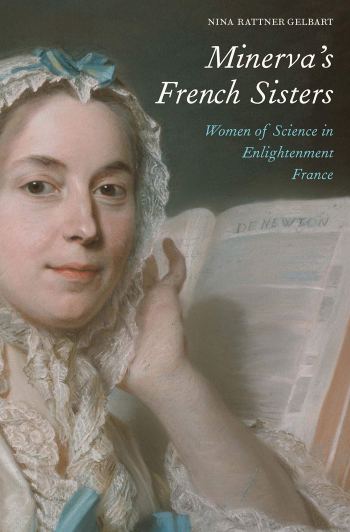 A fascinating collective biography of six female scientists in eighteenth-century France, whose stories were largely written out of history
This book presents the stories of six intrepid Frenchwomen of science in the Enlightenment whose accomplishments—though celebrated in their lifetimes—have been generally omitted from subsequent studies of their period: mathematician and philosopher Elisabeth Ferrand, astronomer Nicole Reine Lepaute, field naturalist Jeanne Barret, garden botanist and illustrator Madeleine Françoise Basseporte, anatomist and inventor Marie-Marguerite Biheron, and chemist Geneviève d’Arconville. By adjusting our lens, we can find them.
In a society where science was not yet an established profession for men, much less women, these six audacious and inspiring figures made their mark on their respective fields of science and on Enlightenment society, as they defied gender expectations and conventional norms. Their boldness and contributions to science were appreciated by such luminaries as Franklin, the philosophes, and many European monarchs. The book is written in an unorthodox style to match the women’s breaking of boundaries.
Nina Rattner Gelbart is professor of history and Anita Johnson Wand Professor of Women’s Studies at Occidental College. Her previous books include Feminine and Opposition Journalism in Old Regime France and The King’s Midwife: A History and Mystery of Madame du Coudray.
C O N T E N T S
Acknowledgments
Chronology
Actors in a Supporting Role
Introduction: A Sextet of Firsts, Variations on a Theme
Interlude: Letter to Elisabeth, Reine, Jeanne, Madeleine Françoise, Marie-Marguerite, and Geneviève
1 Mathematician and Philosopher: The ‘Celebrated Mlle Ferrand’ (1700–1752)
Interlude: Letter to Elisabeth
2 Astronomer and ‘Learned Calculator’: Nicole Reine Lepaute (1723–1788)
Interlude: Letter to Reine
3 Botany in the Field and in the Garden: Jeanne Baret (1740–1807) and Madeleine Françoise Basseporte (1701–1780)
Interlude: Letters to Jeanne and Madeleine Françoise
4 Anatomist and Inventor: Marie-Marguerite Biheron and Her Medical Museum (1719–1795)
Interlude: Letter to Marie-Marguerite
5 Chemist and Experimentalist: Marie Geneviève Charlotte Thiroux d’Arconville and Her Choice of Anonymity (1720–1805)
Interlude: Letter to Geneviève
Epilogue
Notes
Index
New Book | Copley and West in England, 1775–1815
Distributed by Paul Holberton Publishing and The University of Chicago Press:
Allen Staley, Copley and West in England, 1775–1815 (London: Burlington Press, 2021), 176 pages, ISBN: 978-1916237803, £35 / $45.
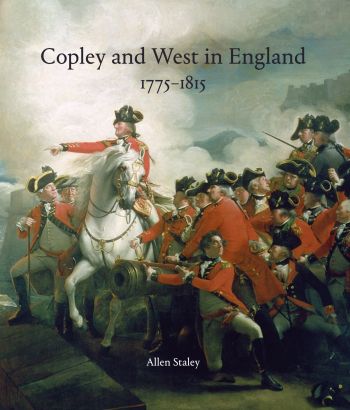 This beautifully and thoroughly illustrated book, which constitutes the first serious investigation of the relationship between Benjamin West and John Singleton Copley, will be of considerable interest to both British and American art historians, and appeal to art lovers from both countries.
West and Copley have always and properly been viewed as the two pre-eminent eighteenth-century American artists, despite the fact that, at the age of twenty-one, West left his native shores in 1760, never to return. He went on to become immensely successful in England, becoming, among other things, the second president of the Royal Academy of Arts. Copley spent half his working life also in England. However, before making the move across the Atlantic, he made his mark as an exceptionally talented artist, who, without any real training, painted likenesses of fellow Bostonians, including ones of figures such as John Hancock and Paul Revere, that have become icons of American history. While those portraits remain his most widely admired works, after 1775 and his resettling in England, he started painting distinctly different types of pictures, initially showing modern historical subjects in emulation of the model provided him by West, following, for example, West’s celebrated Death of General Wolfe, exhibited in 1771, with his own Death of the Earl of Chatham, begun in 1779. For a brief span of time, the two expatriate Americans had a close working relationship, that we can see substantially reflected in both the formal language and the subject matter of many of their best works, but it eventually and inevitably turned into rivalry.
The book begins with a brief prologue discussing the earliest of West’s depictions of recent historical events and of subjects set in America, painted prior to Copley’s arrival in England. It then follows the year-by-year evolution of Copley’s painting from 1775 to his death in 1815, with an underlying focus upon his ongoing give-and-take with West. It ends with examination of hitherto little-known and unstudied major late paintings, from after 1800, by both artists.
Allen Staley is Professor Emeritus of Art History at Columbia University, where he taught for more than thirty years. Prior to Columbia he worked at the Frick Collection in New York and as an assistant curator at the Philadelphia Museum of Art. His engagement with Benjamin West began in Philadelphia with an article about an oil sketch by West, published in the museum’s bulletin in 1965. In 1975 he took on the task of completing the monumental catalogue of West’s paintings begun by the late Helmut von Erff, which led him to think about the artist’s influence upon the work of his compatriot and exact contemporary Copley. The book, after a decade’s labor, saw publication in 1986. His other significant books are The Pre-Raphaelite Landscape, published in 1973 with a second edition in 2001, and The New Painting of the 1860s: Between the Pre-Raphaelites and the Aesthetic Movement, published in 2011, both products of long-standing love and study of English Victorian painting. In addition to writing countless reviews and articles—the first in The Burlington Magazine in 1963—he has organized or shared in organizing and writing the catalogues of numerous exhibitions.
Online Conversation | Future of Publishing, Art and Architectural History
The Future of Art and Architectural History in Publishing: A Conversation
Online, University of Buckingham, 27 May 2021, 5pm (UK)
 The last of this academic year’s Research Days organised by the Department of History and History of Art at the University of Buckingham is structured as a conversation with some of the most prominent editors in history of art and architecture. To register, please send an email to Seminars-HRI@buckingham.ac.uk. Questions may be addressed to Adriano Aymonino, who will be moderating the event, adriano.aymonino@buckingham.ac.uk.
• Mark Eastment, Editorial Director, Art and Architecture Editor, Yale University Press, London
• Michelle Komie, Publisher, Art & Architecture, Princeton University Press
• Alodie Larson, Art and Art History Editor, Oxford University Press
• Thomas Weaver, Senior Acquisitions Editor, Art and Architecture, MIT Press
NMWA’s Comprehensive Renovation To Begin in August
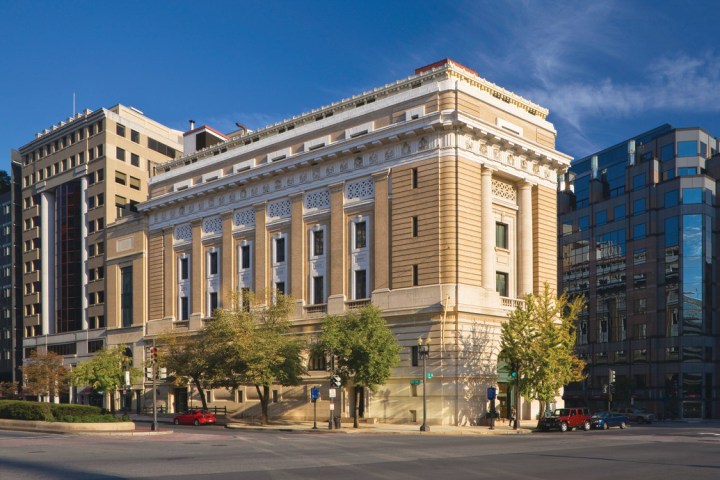
National Museum of Women in the Arts, Exterior, 13th Street and New York Avenue sides, Washington, D.C.
(Photo by Thomas H. Field, September 2008)
◊ ◊ ◊ ◊ ◊
From the museum’s press release (17 May 2021) . . .
Upgrades to historic building will enhance exhibition galleries, programming, scholarship, and accessibility and improve visitor experience.
The National Museum of Women in Arts (NMWA), the world’s only major museum solely dedicated to championing women artists, announces a plan for the comprehensive renovation of the museum’s historic building at 1250 New York Avenue, NW, in Washington, D.C. State-of-the-art upgrades to the museum’s home, a 1908 Classical Revival structure listed on the National Register of Historic Places, will expand NMWA’s exhibition space and enhance its programming, strengthening its work for years to come. The plan requires the building to close to the public beginning 9 August 2021. Construction will commence on 1 September 2021 and will be completed in approximately two years.
The building’s first full renovation since 1987, the $66 million project will honor the structure’s history while improving its interior spaces, mechanical systems, and exterior envelope. The long-planned updates include enlarged gallery space to showcase historic and contemporary artworks and installations; a new destination for researchers and education programs; and enhanced amenities and accessibility for visitors. Infrastructure and storage upgrades will bolster the long-term conservation and security of the museum’s collection of more than 5,500 works.
“From its home in the nation’s capital, NMWA has given deserved prominence to groundbreaking women artists of the past and present for nearly 35 years, but the goal of equity for women through excellence in the arts has yet to be achieved,” said NMWA Director Susan Fisher Sterling. “This renovation will ensure that the museum continues to promote the contributions of women artists in ways that engage audiences and advocates of tomorrow. Thanks to our founder Wilhelmina Cole Holladay and her husband Wallace—whose bold and ambitious vision led them to collect art by women and create a museum for its permanent display—our building is the center of a worldwide movement that champions women in, and through, the arts.”
Beginning in 2015, NMWA undertook a rigorous assessment of the historic building and created an extensive plan for renovations that apply recent advances in engineering, building codes, and sustainability. The Baltimore-based architectural firm Sandra Vicchio & Associates was chosen to lead the project.
“It is a majestic structure—timeless and beautiful,” said Vicchio. “To protect the collection and enable NMWA to educate and engage the world more effectively, we must upgrade the building’s envelope, improve the performance of its systems, and make better use of its interior space. Revitalizing the building is all about positioning the museum for a triumphant future.”
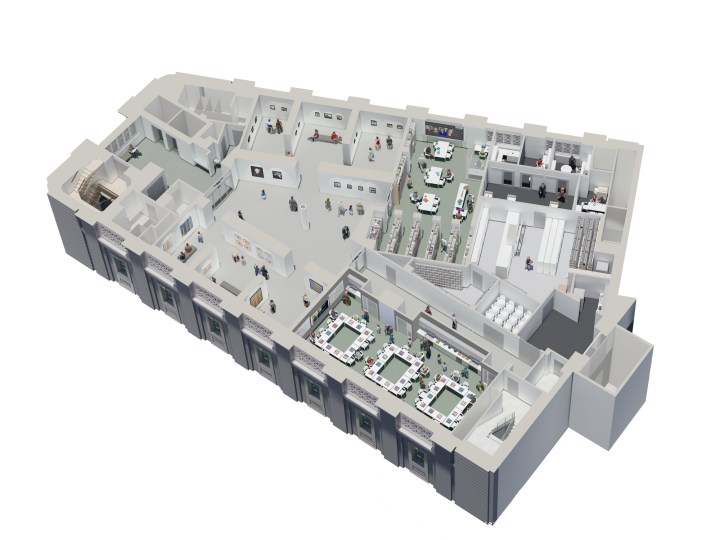
Learning Commons, National Museum of Women in the Arts Renovation Project
(Rendering by Sandra Vicchio & Associates, LLC, with Marshall Craft Associates, Inc.)
The renovation project at NMWA will include
• Transforming the building to provide easier access for all visitors, with upgraded technologies and amenities as well as improved ADA accessibility
• Dedicating a new orientation gallery in the Great Hall that welcomes visitors, introduces the museum’s mission, and tells stories of women artists
• Renovating and enlarging galleries to accommodate historic and contemporary artworks and multifaceted installations
• Creating a new Learning Commons that features a major exhibition gallery, a state-of-the-art Library and Research Center, Reading Room, and an Education Studio for hands-on workshops, curated conversations, and classes, as well as flexible space for rehearsals and other museum events
• Improving wireless and touch-screen technology in galleries, which will enhance visitors’ experiences and learning opportunities with additional connectivity
• Updating the Great Hall and Mezzanine to preserve these iconic spaces while improving their functionality for museum events and facility rentals
• Installing new lighting, climate control, and security technology to support long-term conservation of the art and the overall comfort of visitors
• Enhancing collection storage space to store art more efficiently and care for works of art more effectively
• Improving signage to provide better wayfinding and easy-to-follow pathways throughout the museum
• Restoring the roof, historic cornice, and the building exterior in accordance with the D.C. Historic Preservation Office
During the closure, NMWA will continue to offer a robust slate of online programs and events, virtual exhibitions and digital content. Plans are also underway to present off-site exhibitions and special events.
In less than two years, NMWA has raised over $50 million towards a capital campaign goal of $66 million. With the advent of the COVID-19 pandemic and rising costs in the construction industry, the renovation project costs have grown. Building on the campaign’s robust beginnings, NMWA will continue to solicit gifts throughout the life of the campaign.
“This renovation was the dream of our founder Wilhelmina Cole Holladay, who died on March 6th at age 98,” said Winton S. Holladay, Vice-Chair of the NMWA Board. “In the campaign’s quiet phase, donors and friends have stepped up in wonderful ways, putting us within sight of our campaign goal. With Billie’s passing, we are honored to carry her vision forward by completing this campaign and restoring our building for future generations.”
The museum’s capital campaign is directed by a steering committee of NMWA trustees, advisors, and senior museum staff and is currently supported by gifts from individuals, foundations, and corporations. In addition, the museum has received federal and city funding through competitive grants from the Institute of Museum and Library Services (Museums for America Grant) as well as a first-ever 2020 Cultural Institutions grant from Events DC, a semi-public company supported by D.C. taxpayer funds.
For more information, the capital campaign website displays renderings, tracks project progress, and offers ways to get involved.
About the Historic Building
Designed by the architecture firm Wood, Donn & Deming, the museum’s Classical Revival-style building was completed in 1908 as a temple for the Masons, an organization that did not allow women members. The 78,810-square-foot main building is listed on the DC Inventory of Historic Sites and the National Register of Historic Places. The exterior façade incorporates Tuscan and Mediterranean design elements in addition to Masonic symbolism.
In 1983, Wilhelmina and Wallace Holladay purchased the property to establish a museum dedicated to women artists. The building was refurbished in accordance with the highest design, museum and security standards. After the extensive renovations, which won numerous architectural awards, the National Museum of Women in the Arts opened to the public on 7 April 1987. In 1993, the museum purchased 5,300 square feet of adjacent property, and, following further renovation, the Elisabeth A. Kasser Wing opened in 1997, making the entire facility 84,110 square feet.










 Enfilade
leave a comment