Williamsburg Receives Hennage Bequest of Decorative Arts
Press release (12 January 2021) from the Colonial Williamsburg Foundation:
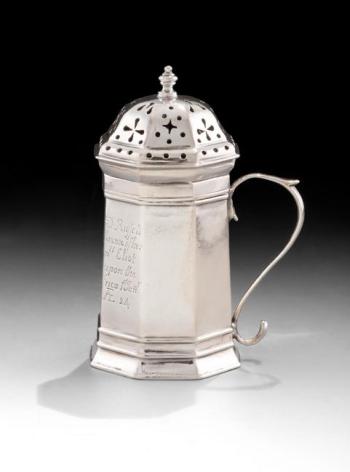
Pepper Box, John Blowers, Boston, ca. 1741, silver (Colonial Williamsburg Foundation, bequest of Joseph and June Hennage).
Theirs was a love story of many dimensions: a love for one another, a love of America and its decorative arts, and a love of Colonial Williamsburg. The culmination of Joseph and June Hennage’s passion and evidence of their extraordinary philanthropic generosity is the bequest of their entire American decorative arts collection, which they amassed over 60 years, to the Colonial Williamsburg Foundation. The Hennage Collection is a singular gift that will transform the already renowned American furniture and furniture miniatures, silver, and ceramics collections at Colonial Williamsburg. Totaling more than 400 objects of various media, the Hennage Collection also includes paintings, prints, and antique toy animals, vehicles, and figures. To honor this significant bequest, an exhibition of highlighted objects from the bequest, A Gift to the Nation: The Joseph and June Hennage Collection, will open at the DeWitt Wallace Decorative Arts Museum, one of the recently expanded Art Museums of Colonial Williamsburg, in the spring.
“Joe and June Hennage always sought objects of excellent quality and condition. Their gift consequently comes as an outstanding addition to Colonial Williamsburg’s collections. It includes superior examples of furniture from Massachusetts, Rhode Island, Connecticut, New York, Pennsylvania, and Maryland, as well as silver by the major East Coast artisans of that day and a variety of other materials,” said Ronald L. Hurst, the Foundation’s Carlisle H. Humelsine chief curator and vice president for museums, preservation, and historic resources. “The Hennages’ decision to place the entire collection in a museum setting is a clear example of their public-spirited generosity.”
A Love Affair Begins
In 1945 after being discharged from the United States Navy, Joe Hennage (1921–2010) returned to Washington, D.C. and soon thereafter founded Hennage Creative Printers. When he found himself in need of secretarial help in 1946, he hired June Stedman (1927–2020) who had come to Washington to begin her career after finishing school in Virginia. They were married in 1947 and their partnership blossomed. In the late 1940s they made their first visit to Colonial Williamsburg, and their life-long love for the historic city began. Their first collecting passion was not antiques, but memorabilia relating to Joe’s hero, Benjamin Franklin, and books on printing, the profession the two men shared. June’s love of small objects extended to what she and Joe referred to as ‘penny toys’, or miniature animals, vehicles and figures, as well as miniature furniture, including tables, chests, chairs, and beds. By the early 1950s, they were also collecting antique Chinese bronzes, porcelain, snuff bottles, and netsuke. Although they did not begin attending the annual Antiques Forum, which began at Colonial Williamsburg in 1949, until later in the 1950s and more regularly in the 1960s, Joe often named this event as a great influence on them both. In 1965, Joe was asked to serve on the Fine Arts Committee of the State Department, a group formed to assist White House and State Department Curator Clement Conger in raising funds for the architectural renovation and furnishing of the diplomatic reception rooms and remained a member and sometime chairman of the Committee until 1996. By the early 1970s, the Hennages were collecting American antiques with increased fervor and attending Antiques Forum regularly.
“Joe and June were born-again patriots and their excitement in being American was demonstrated by their passion for American furniture in the 18th century,” said John A. Hays, deputy chairman, Christie’s, Inc. “They loved furniture that made a big statement, and their collection includes many pieces that boldly say ‘I am American.’”
The Love Affair Blossoms
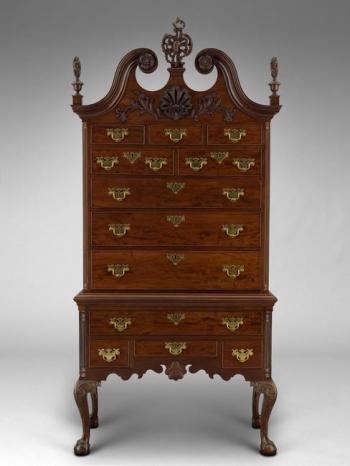
High Chest, Philadelphia, ca. 1770, mahogany, sabicu, yellow pine, and tulip poplar (Colonial Williamsburg Foundation, bequest of Joseph and June Hennage, 1989-450).
Over the years Joe and June gave the State Department several exquisite pieces of American furniture and helped to transform the State Department diplomatic reception rooms significantly. Joe’s involvement with this effort led to his being asked to head similar Americana drives for the National Archives and for the Supreme Court. During the Bicentennial year, the Hennage’s philanthropic spirit provided numerous extraordinary gifts of important objects to various American institutions including Mount Vernon, Monticello, the White House, the National Portrait Gallery, and Colonial Williamsburg among others. The Hennages shared these gifts with such institutions, which are among the finest examples of American craftsmanship at its highest levels, not simply because they are masterpieces but in hopes of enhancing the public’s education about its material culture. Although gardening was among June’s greatest pleasures, her interest in and deep knowledge of art and antiques led to her also serving as a member of the Department of State Fine Arts Committee.
Colonial Williamsburg, however remained a special place to both Joe and June where they could learn about and relive American historical events, and this unique interest caused them to use their resources to help the Foundation flourish. They became charter and life members of the Foundation’s highest-level annual giving group, the Raleigh Tavern Society, as well as members of the President’s Council, a group dedicated to nurturing greater awareness of Colonial Williamsburg through philanthropic support. In 1985, the Hennage Auditorium at the DeWitt Wallace Decorative Arts Museum, one of the Art Museums of Colonial Williamsburg, was named in their honor, and in 2019, the Foundation named a new gallery in the same museum the June Stedman Hennage Gallery in honor of June’s 90th birthday. By 1988, the Hennages completed a Georgian-style home in Williamsburg, which they named Hennage House, and they made this their home after relocating from Chevy Chase, Maryland. This home was where they lived with their extensive collections and viewed themselves as the custodians of the objects rather than their owners. Over time, they gave them to Colonial Williamsburg for safekeeping.
“Colonial Williamsburg inspires us all over time, but some take the message to new heights. That is true for Joe and June Hennage whose Georgian-style house on South England Street reflects the Governor’s Palace in Williamsburg and whose stunning collection of masterpieces inside—the furniture in particular—carries the analogy to conclusion,” said Philip Zea, president and CEO, Historic Deerfield in Massachusetts, and former curator of furniture at Colonial Williamsburg from 1999 to 2001. “The Hennages’ significant legacy and generosity secure their presence in Williamsburg and make it possible to use the present tense when we think about them for some time to come.”
The Love Endures
Joe and June Hennage’s passion for their American decorative arts and for Colonial Williamsburg led to the decision to bequeath their entire collection to the Foundation upon their deaths because they believed in Colonial Williamsburg’s unique ability to understand the objects’ significance to American history and make that story accessible to all. Their extraordinary assemblage of material culture is transformative. Already renowned for having the best in British and American fine and decorative arts from 1670–1840, the Wallace Museum will now make its furniture collection complete in its ability to show the full geographic spectrum from Maine to Louisiana through superlative pieces from major East Coast centers. Knowing of this promised gift has also helped to shape the American silver collection over the past decade as acquisitions were made with the Hennage collection in mind; these objects will now serve as the backbone of Colonial Williamsburg’s American silver holdings. The Hennage Chinese export porcelain objects will provide the Foundation with the first pieces from two different services bearing the insignia of the Society of the Cincinnati, a fraternal organization of American and French officers who served in the Revolutionary War. The miniature furniture from the bequest will nearly double the number of pieces currently in Colonial Williamsburg’s collection (separate from its doll house furniture and child’s chairs) and these objects, too, will be transformative in the variation of forms include in the Hennage collection, which includes blanket chests, chest of drawers, a high chest, a desk, chairs, tables, looking glasses, beds, and tall case clocks, as well as the exceptional quality of many of the pieces. These are but a few examples of how this bequest will significantly enhance the way in which the Art Museums can interpret America’s enduring story for its visitors each year.
According to Erik K. Gronning, Senior Vice President, Senior Specialist and Head of Americana Department at Sotheby’s, the Hennages formed “a collection for the ages assembled during the zenith of the 1970s and 1980s collecting period. With great advisors, such as the Israel Sack firm, they acquired many American masterpieces. Their passion for their collection never ceased; it wasn’t just a passing fancy for them…. They were among the very first people to build a new home in period style to display their collection to its fullest. They did it all and didn’t leave a stone unturned. They were ardent supporters of scholarship, and they believed it was their responsibility to further the knowledge about Americana and American history.”
As many have said, Joe and June Hennage were rare people and it was a privilege to know and learn from them. Their dedication to American decorative arts was immense, and their love of America even more so. Through this extraordinary bequest, this collection will live on for generations to come, and visitors to Colonial Williamsburg will have the opportunity to deepen their appreciation through these superlative objects of material culture.
Additional information on particular pieces, including the objects pictured here, is available from this press release addressing highlights of the collection.

Five-piece Garniture, Jingdezhen, China, ca. 1785, hard-paste porcelain
(Colonial Williamsburg Foundation, bequest of Joseph and June Hennage)
◊ ◊ ◊ ◊ ◊
Note (added 12 January 2021) — The original posting did not include the image of the five-piece garniture.
New Book | The Science of Abolition
From Yale UP:
Eric Herschthal, The Science of Abolition: How Slaveholders Became the Enemies of Progress (New Haven: Yale University Press, 2021), 352 pages, ISBN: 9780300236804, $33.
 A revealing look at how antislavery scientists and black and white abolitionists used scientific ideas to discredit slaveholders
In the context of slavery, science is usually associated with slaveholders’ scientific justifications of racism. But this book demonstrates that abolitionists were equally adept at using scientific ideas to discredit slaveholders. Focusing on antislavery scientists and black and white abolitionists in Britain and America between the 1770s and 1860s, historian Eric Herschthal shows how these activists drew upon chemistry, botany, medicine, and mechanics to portray slavery as a premodern institution bound for obsolescence. These activists contended that slavery stood in the way of scientific progress, blinded slaveholders to scientific evidence, and prevented enslavers from adopting labor-saving technologies that might eradicate enslaved labor. Historians have recently begun to challenge the myth that slavery was premodern—backward—demonstrating slavery’s centrality to the rise of modern capitalism, science, and technology. This book demonstrates where the myth comes from in the first place.
Eric Herschthal is an assistant professor of history at the University of Utah. His writing has appeared in The New York Times, The New Republic, The New York Review of Books, and other publications. He lives in Salt Lake City.
New Book | The Cabinet
From Harvard UP:
Lindsay Chervinsky, The Cabinet: George Washington and the Creation of an American Institution (Cambridge: Belknap Press, 2020), 432 pages, ISBN 978-0674986480, $30 / £24 / €27.
 The U.S. Constitution never established a presidential cabinet—the delegates to the Constitutional Convention explicitly rejected the idea. So how did George Washington create one of the most powerful bodies in the federal government?
On November 26, 1791, George Washington convened his department secretaries—Alexander Hamilton, Thomas Jefferson, Henry Knox, and Edmund Randolph—for the first cabinet meeting. Why did he wait two and a half years into his presidency to call his cabinet? Because the U.S. Constitution did not create or provide for such a body. Washington was on his own. Faced with diplomatic crises, domestic insurrections, and constitutional challenges—and finding congressional help lacking—Washington decided he needed a group of advisors he could turn to. He modeled his new cabinet on the councils of war he had led as commander of the Continental Army. In the early days, the cabinet served at the president’s pleasure. Washington tinkered with its structure throughout his administration, at times calling regular meetings, at other times preferring written advice and individual discussions.
Lindsay Chervinsky reveals the far-reaching consequences of Washington’s choice. The tensions in the cabinet between Hamilton and Jefferson heightened partisanship and contributed to the development of the first party system. And as Washington faced an increasingly recalcitrant Congress, he came to treat the cabinet as a private advisory body to summon as needed, greatly expanding the role of the president and the executive branch.
Lindsay M. Chervinsky is Scholar in Residence at the Institute for Thomas Paine Studies at Iona College, Senior Fellow at the Robert H. Smith International Center for Jefferson Studies, and Professorial Lecturer at the School of Media and Public Affairs, George Washington University.
C O N T E N T S
Introduction
1 Forged in War
2 The Original Team of Rivals
3 Setting the Stage
4 The Early Years
5 The Cabinet Emerges
6 A Foreign Challenge
7 A Domestic Threat
8 A Cabinet in Crisis
Epilogue
Citation and Abbreviation Guide
Notes
Acknowledgments
Index
Research Lunch | Rebecca Tropp on the Picturesque and Country Houses
This talk was slated for last March; it’s been rescheduled as an online event, sponsored by the Mellon Centre:
Rebecca Tropp, Accommodating the Picturesque: The Country Houses of James Wyatt, John Nash, and Sir John Soane, 1793–1815
(Zoom) Paul Mellon Centre for Studies in British Art, London, 29 January 2021

James Wyatt, Ashridge House, commissioned by the 7th Earl of Bridgewater.
Whilst much has been written about the development of Picturesque theory at the end of the eighteenth century, regarding both the landscape itself and prescriptions for the sitting of buildings within it, these discussions have generally been limited to two-dimensional snapshots, such as those represented in Humphry Repton’s Red Books. This paper, based upon ongoing research for a doctoral dissertation, seeks to push beyond the visual to investigate some of the physical implications and repercussions of the Picturesque ideal – the intersection between the visual two-dimensional picture-plane and the practical three-dimensional architectural response – on the design and construction of country houses at the turn of the nineteenth century.
Focusing on the work of James Wyatt (1746–1813), John Nash (1752–1835), and Sir John Soane (1753–1837), and limiting investigation to those country houses designed during the pivotal period from 1793 to 1815, the paper investigates two specific implications related to the lowering of the principal floor from piano nobile to ground level, as part of a general repositioning of the house within the landscape. First is the use of level changes within the ground floor—the inclusion of a few steps up or down in entrance halls or between rooms, as distinct from staircases between floors—considering some possible reasons for their incorporation and the purposes they served. Second, and sometimes connected to these level changes, is an increase in permeability between interior and exterior, through the use of full-length windows, loggias and attached conservatories—social/botanical spaces that were first incorporated into the design of the house during this period. Taken together, these developments furthered the evolving relationship between house and landscape and, as a result, the experience of moving through and between those spaces.
Rebecca Tropp is currently finishing her PhD in History of Art at St John’s College, University of Cambridge, working under the supervision of Dr Frank Salmon. She completed her MPhil in History of Art and Architecture at Cambridge in 2015, investigating recurring spatial arrangements and patterns of movement in the country houses of John Nash. Prior to commencing postgraduate studies in the UK, she received her bachelor’s degree from Columbia University in New York, where she majored in the History and Theory of Architecture.
Call for Papers | Reproductive Prints in the 18th and 19th Centuries
From the Call for Papers:
La Storie dell’Arte Illustrata e la Stampa di Traduzione, 18 e 19 Secolo
(Online, via MS Teams) Università di Chieti Gabriele d’Annunzio, Chieti, 10–11 June 2021
Proposals due by 25 January 2021 (for papers in Italian or English)
“E per le Arti poi l’incisione è quel che la stampa è per le scienze”
–Francesco Milizia, Dizionario di Belle Arti del Disegno (Bassano: Giuseppe Remondini, 1797)
La Cattedra di Storia della Critica d’arte del Dipartimento di Lettere Arti e Scienze Sociali, Università degli Studi “G. d’Annunzio” di Chieti – Pescara terrà una giornata di studi dedicata alla stampa di traduzione e storia dell’arte. Se gli studi sugli artisti incisori e lo sviluppo di un mercato di stampe europeo vivace e ben delineato hanno visto un crescente interesse negli ultimi anni per i secoli XVII– XVIII e XIX, l’indagine rimane ancora aperta per la stampa di traduzione utilizzata a corredo della storiografia artistica di quei secoli.
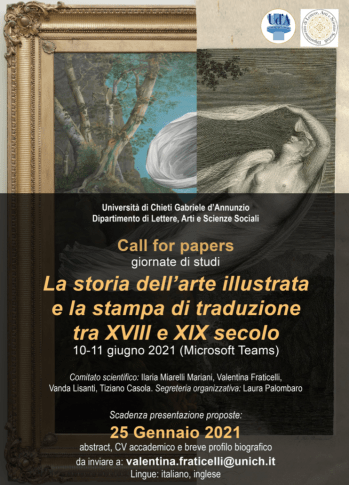 Partendo dall’affermazione dell’incisione di traduzione a contorno semplice nel Dizionario di Belle Arti del Disegno di Francesco Milizia (1797), la giornata di studi si propone di presentare nuove ricerche sull’utilizzo delle incisioni e delle stampe per lo studio della storia dell’arte, esplorando le tematiche seguenti pur non limitandosi solo ad esse, anzi auspicandone un ampliamento sia in termini geografici che cronologici:
• singoli contributi su artisti, disegnatori e incisori
• singoli contributi su album o raccolte di stampe ed incisioni
• il mercato delle stampe di traduzione e dei libri d’arte illustrati: stamperie, librai, mercanti e collezionisti
• stampa di traduzione e studio dell’arte: trattati, cataloghi, recueils, quotidiani a stampa, riviste d’arte, descrizioni, letteratura periegetica illustrata
• illustrare per promuovere: i cataloghi di vendita delle collezioni
• nascita e sviluppo delle monografie d’artista illustrate
• stampa di traduzione per la storia della letteratura
Le proposte di partecipazione alla giornata di studi dovranno pervenire all’indirizzo valentina.fraticelli@unich.it in forma di abstract (350–500 parole, con titolo e parole chiave), ed essere accompagnate da CV e affiliazione accademica o breve profilo biografico (300 parole) entro il 25/01/2021. Le giornate di studio si svolgeranno sulla piattaforma Microsoft Teams; gli interventi selezionati, di cui è prevista la pubblicazione, avranno una durata di circa 20-30 minuti e verranno presentati online. Lingue: italiano, inglese. Per ulteriori informazioni contattare la dott.ssa Valentina Fraticelli all’indirizzo email valentina.fraticelli@unich.it.
Comitato scientifico: Ilaria Miarelli Mariani, Valentina Fraticelli, Tiziano Casola, Vanda Lisanti
Segreteria organizzativa: Laura Palombaro
Metropolitan Museum Journal 2020
The 2020 issue of the Metropolitan Museum Journal is now available at The University of Chicago Press website and The Met Store. PDF’s are available for free on MetPublications. Of particular note for dix-huitièmistes:
Metropolitan Museum Journal 55 (2020)
R E S E A R C H N O T E S
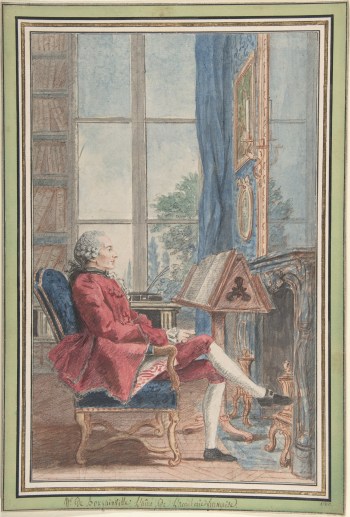
Carmontelle, Portrait of Jean-Pierre de Bougainville, ca. 1760, watercolor over graphite and black and red chalk, 30 × 19 cm (New York: The Metropolitan Museum of Art, Gift of Mrs. Charles Wrightsman, 2004.475.6).
Margot Bernstein, “Carmontelle’s Telltale Marks and Materials,” pp. 135–44.
Bernstein addresses three portraits heretofore described as autograph works by the French amateur draftsman Louis Carrogis, called Carmontelle (1717–1806). She confirms the attribution of the Portrait of Jean-Pierre de Bougainville but cast doubts on the other two. As she notes in the conclusion, “The discoveries outlined here have enabled the present author to identify additional inauthentic Carmontelle portraits in public and private collections, including the Art Institute of Chicago and the National Gallery of Art, Washington, D.C.24 In fact, the majority of purported autograph replicas of Carmontelle portraits in international collections are not authentic. Most of these problematic works display technical issues that are consistent with those found in the Robert Lehman Collection drawings. . .” (142).
Daniel Wheeldon, “The Met’s German Keyed Guitar,” pp. 145–56.
In providing context, Wheeldon addresses the eighteenth century, too. As he writes in the introduction, “The keyed guitar at The Metropolitan Museum of Art, made in Germany in the mid-nineteenth century [89.4.3145], was part of the collection of musical instruments originally established by Mary Elizabeth Adams Brown in 1889. This guitar has long been worthy of greater attention, despite its being neither the most ornate example of nineteenth-century guitar making nor an object that fits into a clear tradition of guitar playing. The ingenuity of its design has been overshadowed by the instrument’s peculiarity, current state of deterioration, and plainness, and consequently it has entirely avoided academic coverage. As the only such instrument in a public collection, and one that bears two labels inside—’Matteo Sprenger / fece à Carlsruhe1 1843′, and ‘F. Fiala’—the Museum’s keyed guitar is essential to identifying and contextualizing (145) the sparse body of nineteenth-century literature on the topic. This article examines the history of the nineteenth-century keyed guitar using the Metropolitan Museum’s instrument as the basis for understanding the provenance of other instruments and establishing them within an historical narrative” (147).
◊ ◊ ◊ ◊ ◊
Note (added 6 January 2020) — Submissions for next year’s volume are due by 15 September 2021; more information is available from the 2020 issue, immediately after the table of contents.
Exhibition | Women Painters, 1780–1830

Elisabeth Louise Vigée Lebrun, Peace Bringing Back Abundance, detail, 1780
(Paris: Musée du Louvre)
◊ ◊ ◊ ◊ ◊
From the Musée du Luxembourg:
Peintres femmes, 1780–1830: Naissance d’un combat
Musée du Luxembourg, Paris, 3 March — 4 July 2021
Curated by Martine Lacas
Le Musée du Luxembourg met les femmes à l’honneur à l’occasion d’une exposition ambitieuse consacrée à celles qui ont ouvert la voie aux artistes féminines au XIXe siècle. L’exposition se concentre sur une période unique d’effervescence historique et culturelle, de 1780 à 1830, où les salons de peinture se multiplient et où les femmes gagnent progressivement en visibilité sur la scène artistique.
De grands noms d’artistes de l’époque viennent à l’esprit, à l’instar d’Elisabeth Vigée Le Brun. Grande portraitiste de l’Ancien Régime, elle fut peintre de la cour de France, de Marie-Antoinette et de Louis XVI. Mais l’exposition met aussi en avant des artistes moins connues, qui profitèrent des basculements politiques pour se faire une place dans le milieu artistique. En outre, cette mise en lumière est l’occasion d’en apprendre davantage sur les conditions sociales de l’époque et de voir comment ces femmes se sont aussi battues pour le droit de se former aux arts ou d’exposer leurs toiles. Les artistes présentées font ainsi figure d’actrices des mutations de l’art mais aussi des évolutions de la société du XIXe siècle.
Martine Lacas, ed., Peintres femmes, 1780–1830: Naissance d’un combat (Paris: Gallimard, 2021), ISBN: 978-2072906640. Details forthcoming
◊ ◊ ◊ ◊ ◊
An interview from December 2020 with curator Martine Lacas is available at Femmes d’Art Magazine.
AWA’s Conservation of Ferroni’s Pair of Hospital Paintings
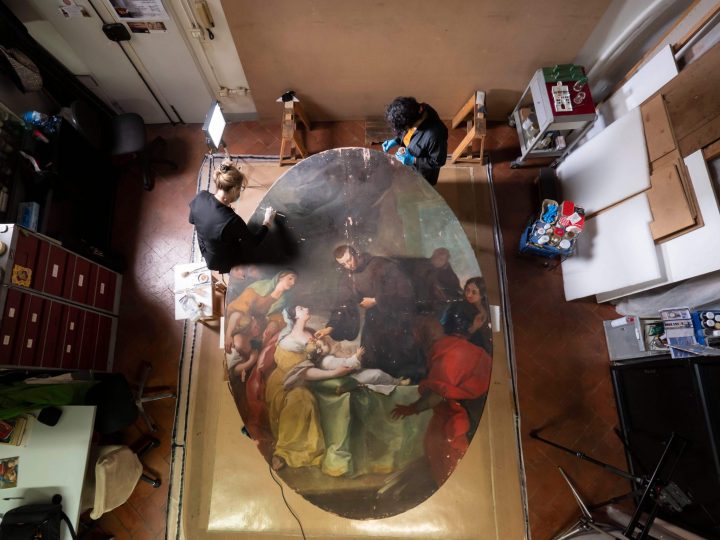
An aerial view of conservators in their studio with Saint John of God Heals Plague Victims (1756) by Violante Ferroni; its pendant Saint John of God Feeds the Poor is also being conserved. Photo by Francesco Cacchiani / Advancing Women Artists.
◊ ◊ ◊ ◊ ◊
On Saturday, Sylvia Poggioli reported for NPR on the work of AWA (Advancing Women Artists), including the conservation now in progress of Violante Ferroni’s two large oval canvases, painted for Florence’s San Giovanni di Dio, a former hospital founded in the fourteenth century: “‘Where Are The Women?’: Uncovering The Lost Works of Female Renaissance Artists,” NPR Weekend Edition (2 January 2021). Last month, Alexandra Kiely wrote on Ferroni’s pictures for Daily Art Magazine: “Healing Violante Ferroni’s Paintings at San Giovanni di Dio Hospital.” And the latest issue of the AWA newsletter includes an interview with conservator Elizabeth Wicks, who in the May issue shared these thoughts:
Elizabeth Wicks, “‘The Art of Healing’ Becomes Literal” Inside AWA (May 2020): 54–59.
In October 2019, we began conservation work on the first painting of our project ‘The Art of Healing’, Violante Ferroni’s large oval canvas painted in 1756 and entitled St. John of God Heals Victims of the Plague. . . When we learned that the monumental atrium of the former hospital where the painting is situated had been used as a place of triage for plague victims, it seemed like a calamity from a faraway era, disconnected from our more fortunate present-day lives. Now that we are fighting a global war against a virus, defined as a ‘modern-day plague’, my connection to the figures in the painting has become a deeply emotional one. I have never been surer about the power of art to connect and heal us all (54).
A conversation with AWA director Linda Falcone and Elisabeth Wicks is available on YouTube: “Restoration Conversations: Art Rescue in Progress” The Florentine (13 November 2020).
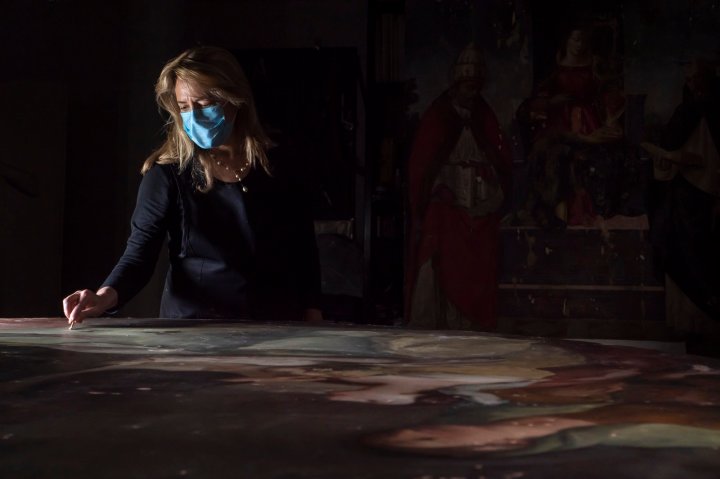
Conservator Elisabeth Wicks at work in her studio in Florence. Photo by Francesco Cacchiani / AWA
Xavier Salomon on Clodion’s Dance of Time
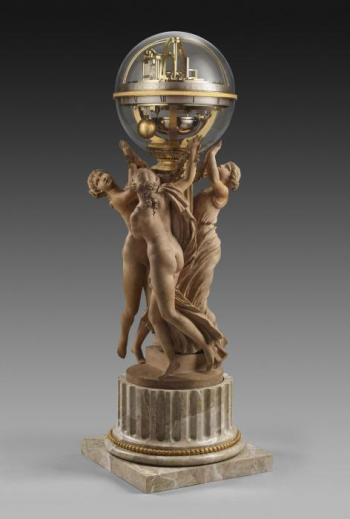
The Dance of Time, Three Nymphs Supporting a Clock, movement by Jean-Baptiste Lepaute, sculpture by Claude Michel Clodion, 1788, terracotta, gilt brass, and glass, H.: 41 inches (New York: The Frick Collection, bequest of Winthrop Kellogg Edey) Photo: Michael Bodycomb.
A very Happy New Year to all of you! I should have posted news of this brief talk earlier, but it will be available on YouTube whenever you might have the time and inclination to watch. I also point out the series more generally for those of you always looking for teaching resources. Past installments (typically 20 minutes) address paintings by Gainsborough, Stubbs, Romney, Tiepolo, Boucher, and Chardin, along with extraordinary decorative arts objects (and plenty of works beyond the eighteenth century). –CH
Xavier Salomon on Clodion’s Dance of Time
YouTube, 1 January 2021, 5pm (EST)
This week’s episode of Cocktails with a Curator toasts the new year with Deputy Director and Peter Jay Sharp Chief Curator Xavier F. Salomon as he examines a masterpiece of both sculpture and clockmaking: The Dance of Time, by Clodion (Claude Michel) and Jean-Baptiste Lepaute. In this 18th-century timepiece, three terracotta nymphs or Hours dance in a circle around an exquisite mechanism enclosed in a glass globe. The Frick has one of the country’s most important collections of clocks, many of which came to the museum through a gift from Winthrop Kellogg Edey. Welcome 2021 by raising a Metropolitan cocktail—Happy New Year!










 Enfilade
leave a comment