IDEAL Internship Grants from Decorative Arts Trust

Hermann-Grima House parlor and dining room, 1831
New Orleans
◊ ◊ ◊ ◊ ◊
From the press release (22 December 2021) . . .
The Decorative Arts Trust announces that four organizations will receive IDEAL Internship Grants for 2022: Drexel’s Lenfest Center for Cultural Partnerships/Atwater Kent Collection and the Museum of the American Revolution in Philadelphia, the Hermann-Grima + Gallier Historic Houses in New Orleans, and the High Museum of Art in Atlanta.
The primary objective of the IDEAL Internship program is to improve access to curatorial careers and mentorship for students of color as a path toward achieving comprehensive change in the museum field. The partners were selected based on the likely impact of the internships, which offer students consequential experience and stipends while providing the host organizations valuable contributions to curatorial projects and to meaningful discussions about inclusion, diversity, and equity.
• Drexel’s Lenfest Center for Cultural Partnerships will receive a second year of internship funding to hire an undergraduate student to assist with the development of two exhibitions highlighting objects from the Atwater Kent Collection.
• The Hermann-Grima + Gallier Historic Houses is creating a year-long internship for a local college student that will focus on the collection at the 1831 Hermann-Grima House, seeking narratives of invisible labor in fine and decorative arts as well as architectural elements to enhance the organization’s successful Urban Enslavement Tours.
• The High Museum will hire a summer intern to develop a gallery rotation after researching objects, rethinking narratives, and drafting labels while also generating a public outreach initiative through a gallery tour, social media campaign, or hosted event.
• The Museum of the American Revolution aims to hire a summer intern to increase awareness of the diverse communities that contributed to the Revolution through research into the permanent collection.
Visit each institution’s website and follow them on social media for updates about internship opportunities. The Trust is committed to offering IDEAL Internship funding in the coming years; visit the Trust’s website for more information.
Exhibition | Golden Age of Kabuki Prints
Opening this week at the AIC:
The Golden Age of Kabuki Prints
Art Institute of Chicago, 15 January — 10 April 2022 / 16 April — 26 June 2022

Katsukawa Shunshō 勝川 春章, The Actor Nakamura Nakazo I as Osada no Taro in the Play ‘Ima o Sakari Suehiro Genji’ (‘The Genji Clan Now at Its Zenith’), 1763–73, color woodblock print (hosoban), 31 × 14 (Chicago: AIC, Clarence Buckingham Collection, 1938.479).
The Kabuki theater district of 18th-century Edo (modern-day Tokyo) was one of the centers of urban life.
At the theater, people could escape the rigid confines of a society controlled by the shogunal government and watch their favorite actors perform in dramas that were often based on ancient historical events and myths. These were tales of murder, revenge, infamy, jealousy, and, sometimes even, redemption.
Along with the dramatic subject matter, Kabuki theater is characterized by its highly stylized postures, movements, hand gestures, facial expressions, even makeup. All these elements are exaggerated to heighten narrative impact. Perhaps the most renowned aspect of Kabuki is the mie, an emphatic pose struck by an actor at a crucial point in the action. Mie often comprise amplified scowls or dramatic twists of the face with crossed eyes and are accompanied by specific body posturing and particular hand and limb positions. Such intense expressions and poses made striking and popular subjects for prints.
The drama of Kabuki theater was most successfully conveyed in the prints of the Katsukawa School of artists because they captured the individual characteristics of each actor. Kabuki actors were the celebrities of their time, and prints depicting them found an eager audience in their fans. Founded by Katsukawa Shunshō (1726–1792), the Katsukawa school included several prominent artists, all of whom created portraits of actors performing in popular Kabuki plays in Edo, though almost all of these prints show the actors in a realistic setting—on the street or under a flowering tree—rather than on a stage. The best-known artists of the school, in addition to Shunsho, were Katsukawa Shunkō (1743–1812) and Shun’ei (1762–1819). This exhibition includes examples by all three of these artists and is drawn from the more than 700 Katsukawa School prints in the Art Institute’s collection.
This exhibition will consist of two rotations, the first running 15 January – 10 April 2022, and the second covering 16 April – 26 June 2022; the gallery will be closed April 11–15.
New Book | Rhapsodic Objects
From De Gruyter:
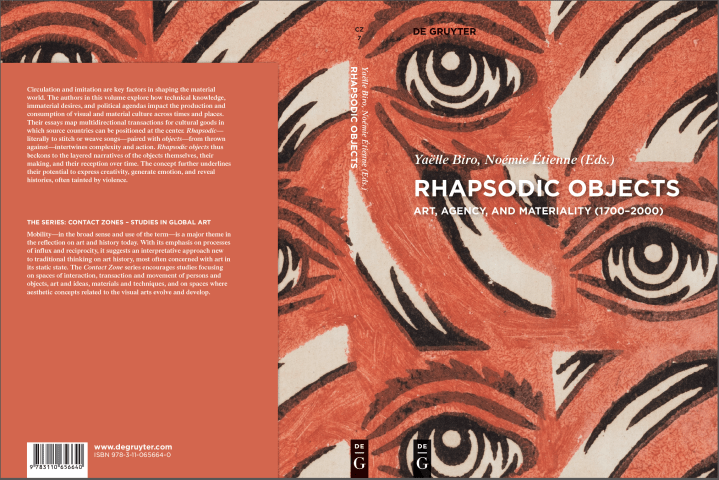
Yaëlle Biro and Noémie Étienne, eds., Rhapsodic Objects: Art, Agency, and Materiality, 1700–2000 (Berlin: De Gruyter, 2022) 236 pages, ISBN: 97-83110656640, $80. Also available as a free PDF file from the publisher.
Circulation and imitation are key factors in shaping the material world. The authors in this volume explore how technical knowledge, immaterial desires, and political agendas impact the production and consumption of visual and material culture across times and places. Their essays map multidirectional transactions for cultural goods in which source countries can be positioned at the center. Rhapsodic—literally to stitch or weave songs—paired with objects—from thrown against—intertwines complexity and action. Rhapsodic objects thus beckons to the layered narratives of the objects themselves, their making, and their reception over time. The concept further underlines their potential to express creativity, generate emotion, and reveal histories—often tainted with violence.
Edited by Yaëlle Biro (Metropolitan Museum of Art) and Noémie Étienne (Universität Bern).
C O N T E N T S
Yaelle Biro and Noemie Etienne, Introduction
Part 1 | Interlaced Patterns
• Dorothy Armstrong, Wandering Designs: The Repossession of the ‘Oriental’ Carpet and Its Imaginary
• Aziza Gril-Mariotte, The Art of Printed Textiles: Selecting Motifs in the Eighteenth Century
• Chonja Lee, Chintzes as Printed Matter and Their Entanglement within the Transatlantic Slave Trade around 1800
Part 2 | Embedded Relationships
• James Green, Interpretations of Central African Taste in European Trade Cloth of the 1890s
• Helen Glaister, The Picturesque in Peking: European Decoration at the Qing Court
• Rémi Labrusse and Bernadette Nadia Saou-Dufrêne, Cultural Intersections and Identity in Algeria on the Eve of the French Invasion: The Case of the Bey Palace in Constantine
Part 3 | Crafted Identities
• Ashley V. Miller, ‘What Is Colonial Art? And How Can It Be Modern?’: Design and Modernity in France and Morocco, 1925
• Victoria L. Rovine, Crafting Colonial Power: Weaving and Empire in France and French West Africa
• Thomas Grillot, A World of Knowledge: Recreating Lakota Horse Effigies
• Gail Levin, Frida Kahlo’s Circulating Crafts: Her Painting and Her Identities
Authors
Picture Credits
New Book | Luisa Roldán
On this day (10 January) in 1706, Luisa Roldán died, as both a celebrated and impoverished artist. From the Getty Store:
Catherine Hall-van den Elsen, Luisa Roldán (Los Angeles: Getty Publications, 2021), 144 pages, ISBN 978-1606067321, $40.
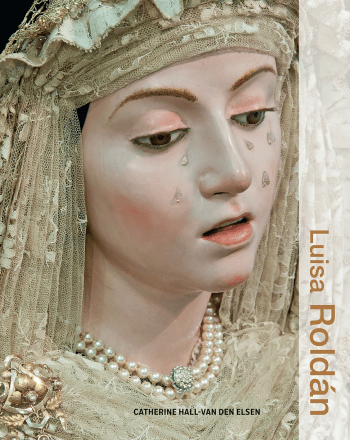 This initial book in the groundbreaking new series Illuminating Women Artists is the first English-language monograph on the extraordinary Spanish Baroque sculptor Luisa Roldán.
Luisa Roldán (1652–1706), also known as La Roldana, was an accomplished Spanish Baroque artist, much admired during her lifetime for her exquisitely crafted and painted wood and terracotta sculptures. Roldán trained under her father and worked in Seville, Cádiz, and Madrid. She even served as sculptor to the royal chambers of two kings of Spain. Yet despite her great artistry and achievements, she has been largely forgotten by modern art history. Written for art lovers of all backgrounds, this beautifully illustrated book offers an important perspective that has been missing—a deeper understanding of the opportunities, and the challenges, facing a woman artist in Roldán’s time. With attention to the historical and social dynamics of her milieu, this volume places Roldán’s work in context alongside that of other artists of the period, including Velázquez, Murillo, and Zurbarán, and provides much-needed insight into what life was like for this trailblazing artist of seventeenth-century Spain.
Catherine Hall-van den Elsen studied Spanish art at La Trobe University in Melbourne, Australia. She completed her MA and PhD on the life and work of Luisa Roldán.
C O N T E N T S
Series Foreword
Preface
Introduction
1 Women in Early Modern Spain
2 Sculpture in Early Modern Seville
3 Andalucía: Building a Career
4 Madrid: Challenge and Opportunity
5 Luisa Roldán through the Lenses of History
Chronology
Notes
List of Extant Works in Public and Church Collections
A Selection of Further Reading
Image Credits
Index
Call for Papers | Close Encounters: The Low Countries and Britain

Jacob Jordaens, A Maidservant with a Basket of Fruit, and Two Lovers, detail, 1629–35
(Glasgow: Kelvingrove Art Gallery and Museum)
◊ ◊ ◊ ◊ ◊
From the RKD:
Close Encounters: Cross-Cultural Exchange between the Low Countries and Britain, 1500–1800
RKD – Netherlands Institute for Art History, The Hague, 22 September 2022
Proposals due by 1 March 2022
The risks and challenges of migration are of compelling interest today. Over the last thirty years, research on early modern artists’ migration and on cultural exchange between the Low Countries and Britain has advanced rapidly, and has addressed many themes. The Dutch and Flemish artists’ communities in London, and the careers of individual artists at the English/British and Scottish courts, in particular, have received attention, as has the history of the collecting of Netherlandish art in the UK.

Gerrit van Honthorst, King Charles I, 1628 (London: NPG).
On 22 September 2022, a symposium at the RKD – Netherlands Institute for Art History will mark the launch of the heavily annotated and illustrated digital English language version of Horst Gerson’s chapter on ‘England’ from his Ausbreitung und Nachwirkung der holländischen Malerei des 17. Jahrhunderts of 1942 (The Dispersal and Legacies of Dutch 17th-Century Painting). For historians of Dutch 17th-century painting, in 1942, Gerson’s study of the integration of Dutch art in Britain was largely uncharted territory, although earlier British art historians, including Horace Walpole and C.H. Collins Baker, had been well aware of the involvement of Netherlandish migrants and visitors in art in the British Isles. The launch of the translated and annotated version of Gerson’s text marks the perfect occasion to discuss, contextualize, and rethink his original ideas in the light of present and developing knowledge.
The organizers welcome unpublished contributions on a broad range of areas relating to Dutch and Flemish artists, artisans and art production in Britain. These include: painting, drawing, graphic arts, tapestry, sculpture and architecture, collecting and the art market, as well as the contribution of Dutch and Flemish migrants to many forms of material culture.
Papers will be 20 minutes long, and might address the following themes and questions:
• Fresh approaches to the careers of practitioners from the Low Countries at the English/British and Scottish courts, and in UK urban centres (including monographic studies).
• How did those courts and urban centres function as hubs of cross-cultural exchange between individuals, and of production?
• Less-studied works by Dutch and Flemish artists and artisans who were active in Britain between 1500 and 1800.
• What were the workshop practices and techniques employed by Dutch and Flemish artists and artisans in Britain, and how did these inter-act with local artistic traditions and impact on technical and art literature?
• What were the social networks and professional relationships that linked and supported Netherlandish and British makers, art dealers and collectors?
• What was the market for Dutch and Flemish artistic goods in Britain, and how did it develop over time?
Please submit a preliminary title, abstract (max. 300 words) and a short CV to Angela Jager (jager@rkd.nl) and Rieke van Leeuwen (leeuwen@rkd.nl) before 1 March 2022. Speakers will be notified by 1 April 2022. Selected presentations will be considered for publication.
Close Encounters will be a hybrid symposium to allow for national and international COVID-19 restrictions. Speakers and attendees may choose whether to participate in person or online. For those presenters who decide to come to The Hague, travel and accommodation expenses will be covered (in consultation with the organization).
Academic Committee
Karen Hearn (University College London), Angela Jager (RKD), Sander Karst (University of Amsterdam), Rieke van Leeuwen (RKD), David A.H.B.Taylor (Independent; previously National Trust and National Galleries Scotland) and Joanna Woodall (Courtauld Institute of Art, London)
Online Publication | Gerson Digital
Published online and freely accessible by the Netherlands Institute for Art History, the RKD (Rijksbureau voor Kunsthistorische Documentatie) . . .
Gerson Digital — Dispersal and After-Effect of Dutch Painting of the 17th Century
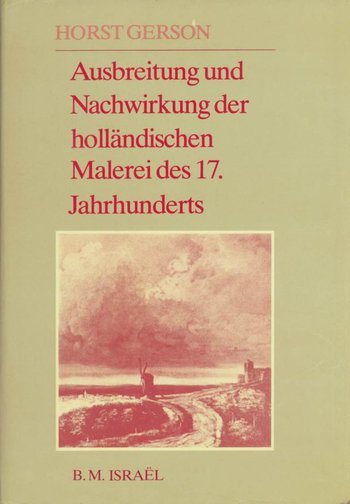 The series of Gerson Digital is a translated, critically annotated, and illustrated edition of Horst Gerson’s Ausbreitung und Nachwirkung der holländischen Malerei des 17. Jahrhunderts (Dispersal and After-Effect of Dutch Painting of the 17th Century, 1942/1983), supplemented with new articles on artistic exchange and transnational mobility of artists from the Low Countries in the early modern period. So far, the following volumes have been published:
1 Gerson Digital: Poland (2013/2014)
2 Gerson Digital: Denmark (2015)
3 Gerson Digital: Germany I (2017/2018)
4 Gerson Digital: Germany II (2018)
5 Gerson Digital: Italy (2019)
6 Masters of Mobility (2020)
ECCO for BSECS Members
Gale is delighted to announce a partnership with the British Society of Eighteenth-Century Studies (BSECS). This partnership provides free access to Gale’s Eighteenth Century Collections Online (ECCO) for all non-affiliated members of the society. From 1 February 2022, any member of BSECS without an existing affiliation to a UK or Ireland higher education institution will be able to apply for access to this seminal resource at no cost.
Visit the Gale Blog for more details on the partnership with BSECS.
Information for ASECS members in North America accessing ECCO is available here»
Online Study Day | Joshua Johnson: Conversations and New Discoveries
This online study day is held in conjunction with the the exhibition, which closes January 23:
Joshua Johnson: Conversations and New Discoveries
Online, Washington County Museum of Fine Arts, Hagerstown, Maryland, 14 January 2022.

Joshua Johnson, Portrait of Benjamin Franklin Yoe and Son Benjamin Franklin You Jr., 1809, oil on canvas mounted onto hardboard, 37 × 26 inches (Hagerstown: WCMFA, Gift of F. Sydney Cushwa).
The exhibition Joshua Johnson: Portraitist of Early American Baltimore presents a rare opportunity for Johnson scholars and art historians to study a significant group of Johnson’s works in one place.
Join WCMFA staff and colleagues Friday, January 14, for a day of intriguing, in-depth conversations about portraitist Joshua Johnson (ca. 1763–1824/25), one of the first professional African American artists. Joshua Johnson: Conversations and New Discoveries will be held from 9am to 4pm (EST) via Zoom. Organized in conjunction with the final days of the exhibition, this study day will address a variety of topics, including Johnson’s life and historical context in antebellum Maryland, his patrons, artistic style and technique, and connoisseurship. A broad range of speakers and special guests will offer unique perspectives and expertise about this fascinating artist in an informal, conversational format.
The first monographic presentation of the artist’s work since 1988, Joshua Johnson: Portraitist of Early American Baltimore contextualizes Johnson both historically and culturally and explores the key forms of natural symbolism represented in his paintings. Johnson was a freed slave who achieved a remarkable degree of success as a portraitist in his lifetime by painting affluent patrons in his native Baltimore such as politicians, doctors, clergymen, merchants, and sea captains. The exhibition is accompanied by a scholarly catalogue available for purchase from the museum.
To register for the study day, please email Donna Rastelli at drastelli@wcmfa.org or call 301.739.5727.
S C H E D U L E
9.00 Introduction by Sarah Hall (Director Washington County Museum of Fine Arts) with Opening Remarks by Kellie Mele (Director of Education for WCMFA)
9.30 Who Was Joshua Johnson? — David Terry (Associate Professor of History and Geography at Morgan State University) and Daniel Fulco (Agnita M. Stine Schreiber Curator at Washington County Museum of Fine Arts)
10.30 The Artist’s Patrons — Mark Letzer (President & CEO, Maryland Center for History and Culture), Stiles Colwill (Stiles T. Colwill Interiors), and Linda Crocker Simmons (Curator Emerita, Corcoran Gallery of Art)
11.15 Roundtable Discussion — This hour-long conversation features our panelists discussing Johnson’s influence and style, addressing his predecessors and contemporaries, some of whom are on view in a companion exhibition at the WCMFA.
12.15 Lunch Break
1.15 Johnson’s Cultural and Historical Context and Relationship to Baltimore Society — David Terry, Daniel Fulco, and Philippe Halbert (PhD candidate, Department of the History of Art, Yale University)
2.15 Connoisseurship: Technique, Materials, and Conservation. See the Yoe family portraits up close with Heather Smith (Conservator, Maryland Art Conservation), Sian Jones (Art Conservator), and Stiles Colwill.
3.15 Future Directions — In this concluding segment, panelists will discuss Johnson in public and private collections. Other topics include the art market as well as new research and directions in the field.
P A N E L I S T S
David Terry is Associate Professor of History and Geography at Morgan State University in Baltimore. He previously was the executive director of the Reginald F. Lewis Museum and was a research specialist in African American history for the Maryland State Archives. He holds a doctorate in history from Howard University, a Master of Arts in African American history from Morgan State University and a Bachelor of Arts in American studies from the University of Maryland-College Park.
Mark Letzer is the President and CEO of Maryland Center for History and Culture in Baltimore. Letzer is an expert in Maryland silver and decorative and fine arts. He became connected with MCHC when he was researching for his book, The Diary of William Faris: The Daily Life of an Annapolis Silversmith, which was published in 2003. In addition, he has written numerous articles on Maryland silver and decorative arts and lectured on the topic. Previously, he served as the Chief Development Officer for the Maryland Historical Society.
Anne Verplanck is Associated Professor of American Studies for Penn State-Harrisburg. She teaches courses in American art and visual culture, social and cultural history, American decorative arts and material culture, museum studies and heritage studies. Prior to becoming part of the Penn State-Harrisburg faculty she worked in the museum field for 30 years. She is the former Curator of Prints and Paintings at Winterthur Museum where she also served as Interim Director of Museum Collections and Interim Director of the Research Fellowship Program.
Linda Crocker Simmons has spent over 40 years in the museum field. Since 1998 she has held the title of Curator Emerita for the Corcoran Gallery of the Art. She has also worked with private and institutional clients including the Alice Ferguson Foundation at Hard Bargain Farm in Accokeek, Maryland. She holds a Bachelor of Arts in studio art and art history from American University; a Master of Arts in art history from the University of Delaware; a certificate in arts administration from Harvard University and remains a.b.d. for her PhD from the University of Virginia. She is an expert in the field of American painting from the end of the 18th century into the early 20th century.
Stiles Colwill has been the President and Chief Designer of Stiles Tuttle Colwill Interiors in Lutherville, Maryland, for nearly 30 years. Colwill also operates Halcyon House Antiques with New York City antiques firm John Rosselli & Associates. He previously served as a Board of Trustees for Baltimore Museum of Art where he served as chairman for five years. He also spent 16 years with the Maryland Historical Society.
Heather Smith is the Owner and Chief Conservator of Maryland Art Conservation LLC (formerly Art Conservation Services) in Baltimore. In 2005, she began her career with ACS after receiving her Master of Art Conservation at Queen’s University in Ontario, Canada, the previous year. She is a professional associate of the American Institute for Conservation.
Sian Jones is the previous owner of Art Conservation Services before retiring in 2018 after more than 30 years. She studied art conservation at the State University of New York at Oneonta, and studied art at Goucher College in Baltimore.
Phillipe Halbert is a doctoral candidate with the Department of History of Art at Yale University. He studies the intersection of art and identity in Colonial America and early modern Europe. For more than a decade he has been an independent museum consultant and has served as a guest curator at a variety of historic sites and museums. He has a Master of Philosophy in art history, criticism and conservation from Yale University and a Master of Arts in American material culture from the University of Delaware. He was a dual major in French and Francophone studies and history at The College of William and Mary where he received his undergraduate degree.
This exhibition is generously supported by grants from the following: National Endowment for the Arts (NEA), the Art Dealers Association of America (ADAA) Foundation, an anonymous donor, Mr. & Mrs. James N. Holzapfel, Dr. & Mrs. George E. Manger, the Heart of the Civil War Heritage Area (part of the Maryland Heritage Areas Authority), Maryland Marketing Partnership, Community Foundation of Washington County MD, Inc., Dr. & Mrs. Robert S. Strauch, and Mr. & Mrs. Thomas B. Riford.
Call for Papers | Reception of Art in 18th- and 19th-C Mantua
From ArtHist.net:
Opere in Viaggio: Reimpieghi, collezionismo, e nuove committenze a Mantova tra XVIII e XIX secolo
Istituti Santa Paola, Mantua 18-19 May 2022
Organized by Gabriele Barucca, Gigliola Gorio, and Debora Trevisan
Proposals due by 15 January 2022
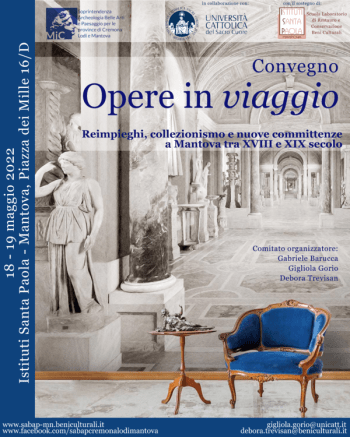 Through the analysis of significant and unpublished case studies, this conference will explore issues and dynamics related to the collecting and reuse of art objects in and around Mantua in the 18th and 19th centuries, during the crucial period between the fall of the Gonzaga and the beginning of Austrian domination. Proposals can be sent by art historians, numismatists, palethnologists, archaeologists, naturalists, and archivists—at any stage of their careers. Submissions should be sent to Gigliola Gorio (gigliola.gorio@unicatt.it) and Debora Trevisan (debora.trevisan@beniculturali.it) by the 15th of January 2022.
Organized by Gabriele Barucca, Gigliola Gorio, and Debora Trevisan, the conference is supported by the Soprintendenza Archeologia Belle Arti e Paesaggio per le province di Cremona, Lodi and Mantova in collaboration with the Catholic University of Milan and with the support of Istituti Santa Paola (Mantua).
More information, in Italian, is available here»
Call for Papers | Art and Friendship

Eustache Le Sueur, Réunion d’amis, ca. 1640, oil on canvas, 136 × 195 cm
(Paris: Musée du Louvre)
◊ ◊ ◊ ◊ ◊
From the Groupe de Recherche en Histoire de l’Art Moderne (GRHAM), where readers will find the French version of the Appel à communication:
Art et amitié aux XVIIe et XVIIIe siècles en Europe
Art and Friendship in 17th- and 18th-Century Europe
Salle Vasari, Institut national d’histoire de l’art (INHA), Paris, 14 June 2022
Organized by GRHAM and Charlotte Rousset
Proposals due by 31 March 2022
Following the pandemic which isolated all of us, magazines such as Courrier international and Philosophie magazine have dedicated their publications to friendship. This workshop intends on discussing this topical notion through the prism of cultural and social history in art. How did 17th– and 18th-century artists live and conceive friendship?
In her recent publication L’Amitié en France aux XVIe et XVIIe siècles: Histoire d’un sentiment[1], Aurélie Prévost reminds us that the term friendship for Modernists entails a large polysemy. It can refer to a feeling of benevolence, erotic love, harmony, or even a filial, marital, charitable, or religious affection. Furetière in his Dictionnaire even applies it to meat, stating “q’u’une viande n’a point d’amitié, pour dire, qu’elle est dure, infipide, ou degouftante”[2] [“A piece of meat is said to lack friendship when it is hard, flavourless or disgusting”].
Friendship is at the origin of many texts and maxims that constitute our cultural heritage today. Descartes, Kant, the Marquise de Sablé, Spinoza, Jean de La Fontaine, and the philosophers of the Enlightenment have all treated the notion of friendship in literature and philosophy. It can be passionate, like the one maintained by La Boétie and Montaigne, immortalized by the quote “Parce que c’était lui, parce que c’était moi” [“Because it was him, because it was me”], or experienced as a betrayal like the one that tore Diderot, Rousseau, Voltaire and D’Alembert when they were writing the Encyclopédie.
What about the art sector? What sort of relationship, whether friendships or rivalries, did 17th– and 18th-century painters, sculptors, architects, engravers, goldsmiths, miniaturists, medalists, and weavers have? What consequences did these have on their contemporary productions? Is it possible to map out united networks of artists through the link of friendship and joint creations?
Many artists made friendship the main subject of their work. Rembrandt van Rijn[3] depicted the story of David and Jonathan from the Book of Samuel in the 17th century. Arnold Houbraken, a Dutch engraver, depicted a personification of friendship[4] at the start of the 18th century. In France, in 1753, Jean-Baptiste Pigalle produced an allegory of friendship to mark the evolution of the relationship between Louis XV and the Marquise de Pompadour and to emphasize that she remained a beloved friend of the king after having been his mistress[5]. The painter François Boucher produced l’École de l’amitié[6] in 1760. One must also question the importance of portraits of friends and the character of these friendships. These can be between a painter and his patrons such as Antoine Watteau and Jean de Julienne[7] or between artists such as Jean-Honoré Fragonard and Marguerite Gérard[8].
How to make visible the feeling of friendship in a visual art piece? Is it possible to ‘read’ the emotions uniting loved ones through the medium of painting, engraving, or sculpting? How do gazes, gestures, and attitudes express this feeling? What visual devices does the artist use to convey this feeling of sincerity, trust, and commitment?
With this in mind, this workshop intends on exploring a wide variety of themes, such as:
• The cultural history of friendship/friendships
• Sociability (on the individual scale)
• Networks (on the collective scale)
• Quarrels and rivalries, even lawsuits created by a deteriorating friendship
• Friendships leading to artistic collaborations
• The representation of friendship in religious iconography
• Portraits of friends or patrons, conversation pieces, genre scenes, and allegories
• Patterns, symbols, gestures, and positions associated with the representation of friendship
• Objects representing friendship
• Letters of artists
• The fringes of friendship: hidden or forbidden love experienced through a friendship displayed in the eyes of all
Abstracts (up to 500 words, either in French or English), presenting a case study or a general discussion, together with a CV, should be sent to asso.grham@gmail.com and charlotte_rousset@hotmail.com by the 31st of March 2022. The workshop is organized by GRHAM and Charlotte Rousset (doctoral candidate at Lille University, laboratory IRHiS).
Notes
[1] Prévost, Aurélie, L’Amitié en France aux XVIe et XVIIe siècles : Histoire d’un sentiment, Louvain-La-Neuve, UCL, Presses Universitaires de Louvain, 2017, p. 17.
[2] Furetière, Antoine, « Amitié », Dictionnaire universel, La Haye et Rotterdam, Arnout & Reinier Leers, 1690.
[3] La Réconciliation de David et d’Absalon ou Les dieux de David et Jonathan, 1642, Huile sur bois, 73 × 62 cm, Saint-Pétersbourg, musée de l’Ermitage.
[4] Arnold Houbraken, Personnification de l’amitié, v. 1710–1715, gravure sur bois, 18 × 9 cm, Amsterdam, Rijksmuseum.
[5] Jean-Baptiste Pigalle, L’Amitié sous les traits de Madame de Pompadour, 1753, marbre, Paris, musée du Louvre.
[6] François Boucher, L’École de l’Amitié, 1760, huile sur toile, 113 × 146 cm, collection particulière.
[7] As illustrated by the work of François de Troy representing a portrait of Jean de Julienne holding a pencil holder and a portrait of his friend Watteau (1722, huile sur toile, 93 × 73 cm, Valenciennes, musée des Beaux-arts).
[8] Marguerite Gérard is portrayed several times by her brother-in-law Jean-Honoré Fragonard. He represents her at least twice (Jean-Honoré Fragonard, Portrait de Marguerite Gérard, v. 1778, dessin, plume, encre et lavis, 18 × 13 cm, Besançon, musée des Beaux-arts et d’Archéologie et Jean-Honoré Fragonard, Portrait de la belle-sœur du peintre, 2ème moitié du XVIIIe siècle, pierre noire, 13 cm de diamètre, Paris, département des Arts graphiques du musée du Louvre).
Selective Bibliography
• Alberti, Alessia, Rovetta, Alessandro, Salsi, Claudio, D’après Michelangelo, Venise, Marsilio, 2015.
• Cazes, Hélène (dir.), Topiques, Études Satoriennes – Topique de l’amitié dans les littératures françaises d’Ancien régime, Victoria, SATOR, 2015, vol. 1.
• Chapman, H. Perry, Jorink, Eric, Lehmann, Ann-Sophie, Ars Amicitiae: The Art of Friendship in the Early Modern Netherlands, Boston, Brill, 2020.
• Chittister, Joan, The Friendship of Women: The Hidden Tradition of the Bible, Saint-Laurent, Bellarmin, 2007.
• Florensky, Pavel, L’Amitié, Paris, Éditions Mimésis, 2018.
• Fripp, Jessica L., Portraiture and Friendship in Enlightenment France, Newark, University of Delaware Press, 2020.
• Goedt, Michel de, L’Amitié divine à l’école de Thérèse d’Avila, Toulouse, Éditions du Carmel, 2012.
• Heacock, Anthony, Jonathan Loved David: Manly Love in the Bible and the Hermeneutic of Sex, Sheffield, Sheffield Phoenix Press, 2011.
• Hoare, Alexandra, Salvator Rosa, Friendship and the Free Artist in Seventeenth-Century Italy, London, Turnhout, Harvey Miller, Brepols, 2018.
• Nardelli, Jean-Fabrice, Classical and Byzantine Monographs – Le motif de la paire d’amis héroïque à prolongements homophiles. Perspectives odysséennes et proche orientales, Amsterdam, Hakkert, 2004, n° 56.
• Olyan, Saul, Friendship in the Hebrew Bible, New Haven, Yale University Press, 2017.
• Petit, Jean-François, Saint Augustin et l’amitié, Paris, Desclée de Brouwer, 2007.
• Prévost, Aurélie, L’Amitié en France aux XVIe et XVIIe siècles : Histoire d’un sentiment, Louvain-La-Neuve, UCL, Presses Universitaires de Louvain, 2017.
• Rievaulx, Aelred de, Briey, Gaëtane de, L’Amitié spirituelle, Paris, Les Éditions du Cerf, 2019.
• Schnackenburg, Bernhard, Jan Lievens: Friend and Rival of the Young Rembrandt, with a Catalogue raisonné of his Early Leiden Work, 1623–1632, Petersberg, Michael Imhof Verlag, 2016.
• Vesely, Patricia, Friendship and Virtue Ethics in the Book of Job, New York, Cambridge University Press, 2019.
• Williams, Hannah, Académie Royale: A History in Portraits, Farnham, Ashgate, 2015.










 Enfilade
leave a comment