NGS Acquires Rare Watercolour of a Black Milkmaid by David Allan
From the press release (18 November 2021), via Art Daily:
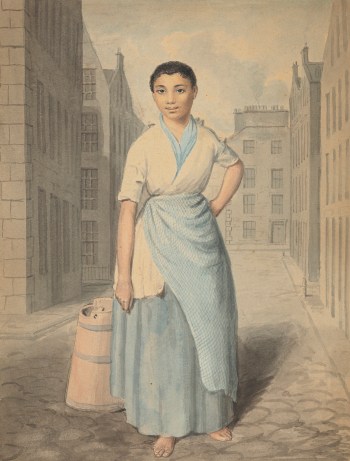
David Allan, Edinburgh Milkmaid with Butter Churn, ca. 1785–95, watercolour on paper, image size: 21 × 16 cm (Edinburgh: National Galleries of Scotland, D 5721, purchased 2019).
One of the earliest known images of a Black person by a Scottish artist has been acquired by the National Galleries of Scotland. Edinburgh Milkmaid with Butter Churn by David Allan (1744–1796) is a beautifully painted watercolour, which is both exceptionally rare and striking. It depicts a Black woman alone and centre stage at a time when Black sitters more often appeared as marginal or subservient figures in group portraits.
Looking directly at the viewer, the woman is shown in working dress, going about her daily duties and set against the backdrop of an elegant Edinburgh street. Her name and life story is unknown, but it is likely that she was a servant, a milkmaid, as suggested by the large vessel or butter churn shown beside her.
Modest in scale, the image is dated to the mid-1780s to early 1790s, a period when Allan created evocative drawings of ordinary people going about their daily lives in Edinburgh, such as soldiers, coalmen, fishwives, sedan chair porters, firemen, and officers of the city guard. These works, known as Allan’s ‘Edinburgh Characters’, suggest a background context for Edinburgh Milkmaid with Butter Churn, but they are generally sketched in a summary way, intended to capture character types, rather than specific personalities, and were often copied and duplicated. The Edinburgh Milkmaid, however, is highly detailed, precisely painted, and clearly a portrait of a specific person. It is hoped that further research may reveal more about the connection between the artist and the young woman and shed some light on her identity.
Director of European and Scottish Art at the National Galleries of Scotland, Christopher Baker, commented: “We are so pleased to bring this remarkable, rare, and extraordinary watercolour into Scotland’s national collection. It is an incredibly striking and special work, one which we believe will be enjoyed by many and, we hope, lead to new research on its background and most importantly the story of the woman depicted.”
Born in Alloa, David Allan was arguably the first Scottish artist to take contemporary life and customs from across the social hierarchy as a subject worthy of art. With the support of his patrons, Lord and Lady Cathcart of Shaw Park, near Alloa, he travelled to Italy around 1767 and remained there for a decade, painting historical pictures and portraits. He became interested in drawing scenes of street life, inspired by the popular print tradition of depicting street criers who called out to advertise their produce or trades. He sketched street vendors, aristocrats on the Grand Tour, coffee house scenes, dances, carnivals, and local costume in Rome and Naples and on a visit to the islands of Procida, Ischia, and Minorca.
These experiences led Allan to take a similar approach after his return to Scotland in 1779. He drew his subject matter from contemporary life, ranging from specific events such as The Ceremony of Laying the Foundation Stone of the New College of Edinburgh (1789) to timeless traditions and customs, such as A Highland Dance and The Penny Wedding. In 1786 Allan was appointed to a teaching post as Master of the Trustees’ Academy and he settled permanently in Edinburgh. The city and its inhabitants became a particular focus for this work. From about 1788 he developed the series of over twenty drawings of workers and traders; often referred to as his ‘Edinburgh Characters’, they typically show an individual or pair of figures with the tools of their trade, set against a simple architectural or rural background.
Allan’s subjects range from higher status figures, such as a Highland officer in uniform and officers of the Town Guard, to those who did the city’s heavy labour, such as the coalmen, chimney sweeps, porters, and water carriers. Female workers are represented by a fishwife, a salt vendor, and a lacemaker. The figures are drawn with strong outlines in ink to enable them to be traced easily, as Allan made multiple versions of his character drawings, several of which are held in the National Galleries of Scotland collection. He also reproduced his Edinburgh characters on a smaller scale as the cast that populate his landscape views of the Royal Mile, such as High Street from the Netherbow, made in 1793. Seen as a group, Allan’s street characters give a broad and fascinating insight into late 1780s Edinburgh as a living, working city.
Edinburgh Milkmaid with Butter Churn is one of several notable acquisitions highlighted in the recently published NGS Annual Review, covering the years 2019–2021. The painting will go on display at a later date following some conservation work, which is currently being prepared. With much still unknown about the painting, the Galleries would welcome information, comments, or feedback about it.
Exhibition | Turner in January
From the National Galleries of Scotland:
Turner in January
Scottish National Gallery, Edinburgh, 2–31 January 2022
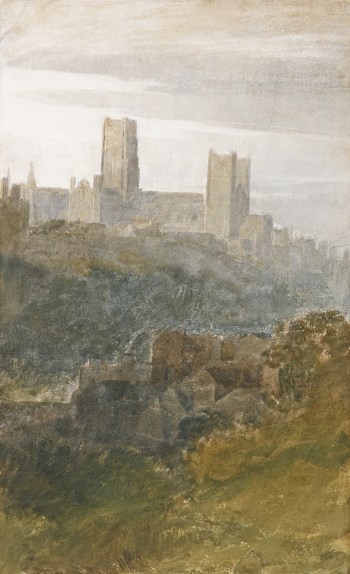
Joseph Mallord William Turner, Durham, 1801, watercolour over pencil on paper, 41 × 25 cm (Edinburgh: Scottish National Gallery).
The National Galleries of Scotland has presented an exhibition of the work of J.M.W. Turner every January for more than a century. This year’s exhibition will showcase all of the 38 watercolours by Turner that were given to the National Galleries of Scotland in 1900 by the art collector Henry Vaughan.
The exquisite works in the Vaughan bequest range from early wash drawings of the 1790s, to the colourful, atmospheric, and wonderfully expressive late works executed on visits to the Swiss Alps during the 1830s and 1840s.
Highlights of the bequest include a series of spectacular views of Venice such as The Piazzetta, Venice and Venice from the Laguna, which capture the drama and explosive skies of late summer Adriatic storms and demonstrate the artist’s consummate mastery of atmospheric lighting effects.
A booking for the Scottish National Gallery must be made in order to enjoy this exhibition.
More information on Henry Vaughan and the bequest is available here»
Exhibition | Alison Watt: A Portrait without Likeness

Alison Watt, Centifolia, detail, 2019, oil on canvas, 76 × 62cm
(Collection of the Artist, © Alison Watt)
◊ ◊ ◊ ◊ ◊
Closing this month at the Scottish National Portrait Gallery:
Alison Watt: A Portrait without Likeness
Scottish National Portrait Gallery, Edinburgh, 17 July 2021 — 9 January 2022
Curated by Julie Lawson
Alison Watt (born 1965) is widely regarded as one of the leading painters working in the UK today. This significant body of new work consists of sixteen paintings made in response to the practice of the celebrated eighteenth-century portrait artist Allan Ramsay (1713–1784) and are on show for the first time.
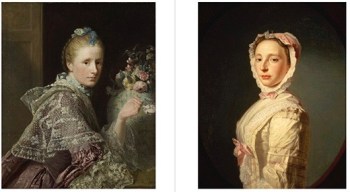
Left: Allan Ramsay, Portrait of the Artist’s Wife, Margaret Lindsay of Evelick, 1758–60, 74 × 62 cm (National Galleries of Scotland). Right: Allan Ramsay, Portrait of the Artist’s Wife, Anne Bayne, ca.1739, 68 × 55 cm (National Galleries of Scotland).
Alison Watt | A Portrait Without Likeness explores the artist’s continuing fascination with Ramsay’s portraits. Watt, most known for her beautiful and intricate large-scale paintings of drapery and folds, has long been an admirer of Ramsay’s portraits of women, in particular the intensely personal images of his first and second wives, Anne Bayne (died 1743) and Margaret Lindsay of Evelick (1726–1782). Both portraits reside in the Gallery’s collection and will be shown alongside Watt’s new work.
The exhibition is the fruit of a long period of study of Ramsay paintings, in addition to the drawings and sketchbooks from his extensive archive held by National Galleries of Scotland. Watt has said, “Looking into an artist’s archive is to view the struggle that takes place to make a work of art. A painting is a visual record of the inside of the artist’s mind. A painting is something that takes place over time; it is not static. To look at a work of art is to engage with an idea, and that is not a one sided activity. It’s more of a conversation.”
Alison Watt, Fortrose, 2019, oil on canvas, 61 × 46 cm (Collection of the Artist © Alison Watt).
A Portrait Without Likeness is accompanied by a publication featuring conversations between the artist and Julie Lawson, the Chief Curator of European, Scottish Art, and Portraiture at National Galleries of Scotland, who has curated the exhibition, as well as an essay from art historian Dr Tom Normand and a new work of short fiction by Booker Prize-nominated novelist Andrew O’Hagan.
Normand writes: “The fascination with flowers is uncommon within Watt’s oeuvre, but she has recently been engaged with the works of Allan Ramsay held in the Scottish National Portrait Gallery. Most particularly she has reflected upon his painting The Artist’s Wife, Margaret Lindsay of Evelick, painted between 1758 and 1760. This is an exquisite and mysterious portrait. At one level a tender study of his second wife, some thirteen years younger than the artist, at another a poignant essay on the enigma of human passion.”
Alison Watt, Julie Lawson, Tom Normand, and Andrew O’Hagan, Alison Watt: A Portrait without Likeness (Edinburgh: National Galleries of Scotland, 2021), 96 pages, ISBN: 978-1911054450, £20.
New Book | Scottish Portraiture, 1644–1714: David and John Scougall

From Brepols:
Carla van de Puttelaar, Scottish Portraiture, 1644–1714: David and John Scougall and Their Contemporaries, 2 vols. (Turnhout: Brepols, 2021), 756 pages, ISBN: 978-2503597270, €195.
This book is the first comprehensive publication on Scottish portraiture from the period 1644 to 1714, with an emphasis on the painters David Scougall (1625–1685) and his son John Scougall (1657–1737). It is based on in-depth art historical and archival research. As such, it is an important academic contribution to this thus far little-researched field. Virtually nothing was known about the Scougall portraitists, who also include the somewhat obscure George Scougall (active c. 1690–1737). Thorough archival research has provided substantial biographical information. It has yielded life dates and data on family relations and also has shown that David Scougall had two parallel careers: as a portrait painter and as a writer (solicitor). The legal community in which the Scougalls were embedded has been defined, as well as an extended group of sitters and their social, economic, and family networks. The book includes a catalogue raisonné of the oeuvre of David Scougall.
The most important contemporaries of the Scougalls were the portraitist L. Schüneman (active c. 1655/60–1667 or slightly later); his successor James Carrudus (active c. 1668–1683 or later), whose work is identified for the first time in this book; David Paton (c. 1650–in or after 1708); Jacob Jacobsz. de Wet (1641/42–1697); and Sir John Baptist Medina (1659–1710). Their lives and work are discussed. An extensive survey of Scottish portraits, with an emphasis on the work of the Scougall painters, is presented for the period 1644 to 1714. Numerous attributions to various artists and sitter identifications have been established or revised. An overview of the next generation is provided, in which the oeuvres and biographical details are highlighted of the principal portrait painters, such as William Aikman (1682–1731), Richard Waitt (1684–1733), and John Alexander (1686–1767). Numerous paintings have been photographed anew or for the first time and have been compared in detail, which had hardly been done before, while information is also included on technical aspects and original frames. The resulting data have been complemented by analysing the social and (art-) historical context in which the portraits were made. The works of the portrait painters in Scotland from this period, as this book shows, now form a solid bridge between the portraits painted prior to George Jamesone’s death in 1644 and those by the renowned Scottish painters of the eighteenth century.
Carla van de Puttelaar (b. 1967, Zaandam, The Netherlands) is an artist and art historian. She holds a PhD in art history from Utrecht University (2017). In 1996, she graduated from the Gerrit Rietveld Academy in Amsterdam. Since then, her photographic work has gained worldwide recognition, and has been exhibited and published extensively. Her skills as a photographer were an important asset in producing the illustrations with which this publication is so lavishly furnished.
C O N T E N T S
Volume 1 — The Scougalls and Their Circle
Abbreviations
Foreword
Acknowledgements
Introduction
Current State of Published Research on the Scougalls and Their Circle and the Appreciation of Their Work Through the Centuries
The Elder Scougall/Old Scougall and the Younger Scougall
Dates and Scarcity of Known Archival Material
Artistic Context: Painting in Scotland, the Start of a Portrait Tradition, c. 1575–1660
David Scougall (Edinburgh, 1625–1685), His Life and Career
Emerging from the Shadows
Father and Son, John (d. after 13 October 1627) and David (1625–1685)
Writer and Painter
Family Patrons
The Outset of a Career
Father and Son, David (1625–1685) and John (1657–1737)
The Advocate’s Close
The Profession of a Writer or Clerk in the Time of David Scougall
The Profession of a Painter in the Time of David Scougall
Possible Teachers and Family Creativity
Decline and Death
Skougall or Scougall
Personal Network, Legal Community, and Further Family Relations
John Scougall (Edinburgh, 1657–1737), His Life and Career
A Long and Prosperous Life
Becoming a Limner
Family Patrons
Increased Prosperity
Lack of Competition
1694: A Year of Important Changes
Decline in Skill and Death
David Scougall: The Oeuvre, Characteristics, Development, and Sources of Inspiration
The Outset of a Career
Core Works, the Basis for a Compilation of the Oeuvre
Associated Works
Miniatures or Pocket Pictures
Stylistic Features and Motifs
Consistency in Style
Late Works, 1675–1685
Technical Aspects of David Scougall’s Paintings
Technical Research and Painting Technique
Painting Materials
David Scougall as a Copyist
Costumes and Jewellery
Use of Motifs from Portraits by Other Painters
No Inventor, but Painting Real People
Production
Studio Practice and Legal Community
John Scougall: The Oeuvre, Characteristics, Development, and Sources of Inspiration
The Early Years
Indisputable Works
Associated Works
Use of Motifs from Portraits by Other Painters
Stylistic Features and Motifs
Technical Aspects of John Scougall’s Paintings
Technical Research and Painting Technique
John Scougall as a Copyist
Production
Mending and Washing
Studio Practice and Apprentices
George Scougall (b. 1670?, active c. 1690– c. 1737)
Lack of Biographical Data
In the Studio of John Scougall
Inadequate Traces of Work
Clients/Sitters
Nobility and Clergy
Clients and Religious Beliefs
Loyal Patrons
Bonding Portraits
Competition from Abroad
Ladies and Gentlemen
Portraying Children
Problems in Sitter Identification
Known Sitter, but Problem in Period and Handling
Portraits Telling the Truth?
Scougall’s Clients, Where Were They Based, and the Painter’s Studio
Backs and Frames
The Back of the Painting
Period Frames
Prices for Portraits and Frames
Prices for Portraits by David Scougall, 1664–1683
Prices for Portraits by John Scougall, 1674–1728
Prices for Frames
The Contemporaries of the Scougalls
John Michael Wright (1617–1694)
L. Schüneman (active c. 1655/60–1667 or shorty after)
James Carrudus (active 1671 or earlier–1683 or later)
David Paton (c. 1650–in or after 1708)
Thomas Murray (1663–1735)
Jacob Jacobsz. de Wet (1641/42–1697)
Portraits, Painters Unknown
Painters, Portraits Unknown
Sir John Baptist Medina (1659–1710)
The Next Generation
William Aikman (1682–1731)
Richard Waitt (1684–1733)
John Alexander (1686–1767)
John Smibert (1688–1751)
And Beyond
Summary and Conclusion
Appendices
Appendix I: The Scougall Family, Reconstruction of the Family Tree
Appendix II: Transcriptions of Various Archival Documents Concerning the Scougall Painters
Appendix III: The Mysterious Portrait of ‘John Scougall’
Appendix IV: Transcription of the Memoir by Sir John Clerk of Penicuik, 1st Baronet (1649–1722) of His Wife Elizabeth Henderson, Lady Clerk (1658–1683)
Volume 2 — Catalogue Raisonné of the Paintings by David Scougall (1625–1685)
Introduction
Glossary
Catalogue A: Authentic Works
Catalogue AW: Works Known Only from Written Sources
Catalogue B: Copies by David Scougall after Works by Others
Catalogue C: Doubtful Works
Catalogue D: Works Known Only through Copies and Prints
Catalogue E: Rejected Works
Concordance
Notes
Bibliography
Websites
Guides to Houses and Other Venues
Exhibitions
Inserted Details
Index
New Book | Uncommon Sense: Jeremy Bentham
From the University of Virginia Press:
Carrie Shanafelt, Uncommon Sense: Jeremy Bentham, Queer Aesthetics, and the Politics of Taste (Charlottesville: University of Virginia Press, 2022), 194 pages, ISBN: 978-0813946863 (hardcover), $95 / ISBN: 978-0813946870 (paperback), $32. Also available as an ebook.
 Infamous for authoring two concepts since favored by government powers seeking license for ruthlessness—the utilitarian notion of privileging the greatest happiness for the most people and the panopticon—Jeremy Bentham is not commonly associated with political emancipation. But perhaps he should be. In his private manuscripts, Bentham agonized over the injustice of laws prohibiting sexual nonconformity, questioning state policy that would put someone to death merely for enjoying an uncommon pleasure. He identified sources of hatred for sexual nonconformists in philosophy, law, religion, and literature, arguing that his goal of ‘the greatest happiness’ would be impossible as long as authorities dictate whose pleasures can be tolerated and whose must be forbidden. Ultimately, Bentham came to believe that authorities worked to maximize the suffering of women, colonized and enslaved persons, and sexual nonconformists in order to demoralize disenfranchised people and prevent any challenge to power.
In Uncommon Sense, Carrie Shanafelt reads Bentham’s sexual nonconformity papers as an argument for the toleration of aesthetic difference as the foundation for egalitarian liberty, shedding new light on eighteenth-century aesthetics and politics. At odds with the common image of Bentham as a dehumanizing calculator or an eccentric projector, this innovative study shows Bentham at his most intimate, outraged by injustice and desperate for the end of sanctioned, discriminatory violence.
Carrie D. Shanafelt is Associate Professor of Literature and Philosophy at Fairleigh Dickinson University.










 Enfilade
leave a comment