Exhibition | Moses Mendelssohn in His Time
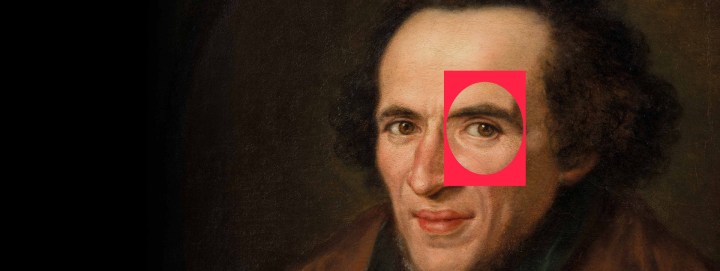
Johann Christoph Frisch, Portrait of Moses Mendelssohn, detail, 1783
(Jewish Museum Berlin, 2013.355.0; photo by Roman März)
◊ ◊ ◊ ◊ ◊
Opening this week at the Jewish Museum in Berlin:
‘We Dreamed of Nothing but Enlightenment’: Moses Mendelssohn in His Time
‘Wir träumten von nichts als Aufklärung’: Moses Mendelssohn in seiner Zeit
Jüdisches Museum Berlin, 14 April — 11 September 2022
Immigrant, Enlightenment philosopher, and self-made intellectual: in his time, Moses Mendelssohn (1729–1786) was already a European celebrity, and he remains a central figure in German Judaism to this day. This exhibition tells of Mendelssohn’s life in Berlin and shows him as a figure who integrated polarizing forces in the midst of historical upheaval and awakening.
With his Christian and Jewish friends, Moses Mendelssohn discussed philosophical and political questions. As an author he challenged his audience to think critically. As an observant Jew, he linked tradition with Enlightenment ideas, and championed secular education and civil equality for his ‘Jewish nation’. His translation of the Torah made religious knowledge accessible to all. The exhibition presents the era of the Enlightenment as a laboratory for radical change, in which human rights, freedom of opinion, and the diversity of individual ways of life were articulated and demanded. With his arguments for the emancipation of Jews, rights for minorities, and the separation of religion and the state, Mendelssohn opened paths into modernity—and provoked questions about Jewish identity that persist to this day.
Inka Bertz and Thomas Lackmann, eds., ‘Wir träumten von nichts als Aufklärung’: Moses Mendelssohn (Cologne: Wienand Verlag, 2022), 248 pages, ISBN 978-3868326901, €30.
Online Talk | Christopher Webster on Late Georgian Churches

St Mary, Paddington Green, London, 1788–91, designed by John Plaw. It is a one of the finest surviving interiors from the late Georgian period, one carefully designed for the auditory worship of the age. (Photograph by Geoff Brandwood).
◊ ◊ ◊ ◊ ◊
Presented by the Ecclesiological Society:
Christopher Webster, Late-Georgian Churches: A Reassessment
Online and In-person, Art Workers’ Guild, London, Thursday, 21 April 2022, 7pm
In the summer of 2022, Christopher Webster’s book Late-Georgian Churches: Anglican Architecture, Patronage, and Church-Going in England, 1790–1840 will be published by John Hudson Publishing. It will be the first comprehensive study of church-building in the late Georgian period. After centuries of post-Reformation inactivity, the Church of England began to address the desperate shortage of accommodation and build on a huge scale. Almost all the leading architects were involved and, amongst approximately 1500 new churches, there are some outstanding designs—buildings of the very highest order architecturally. The lecture will examine these churches, free from the Ecclesiological zeal that condemned them and has, for so long, prevented their serious study. It will consider them in the context of Georgian auditory worship and the period’s attitudes to the architecture of the past. Revealing some remarkable buildings, the talk will also explore what church-going involved at the time.
The Ecclesiological Society’s annual general meeting (for ES members) will begin at 6.30pm followed at 7.00 by Dr. Webster’s lecture (for the general public).
We are excited to provide the option of attending the annual meeting and this lecture either in-person at the Art Workers’ Guild or by Zoom for those who would like to join from home. Current government regulations suggest the in-person option will be entirely feasible, and it is the organisers’ intention that it be available: only new government restrictions will remove that option. After so long, we would love to see you in person and to enjoy a glass of wine! In the event, however, of new regulations, the lecture will still take place, though solely as a Zoom event–in which case it is assumed that all those who have booked for ‘live’ attendance will be content to move online. For those who opt to join us via Zoom, the link to the meeting will be sent a couple of days in advance.
New Book | Late-Georgian Churches, 1790–1840
Forthcoming from John Hudson Publishing:
Christopher Webster, Late-Georgian Churches: Anglican Architecture, Patronage, and Church-Going in England, 1790–1840 (London: John Hudson Publishing, 2022), 360 pages, ISBN: 978-1739822903, £80 / $115. Also available as an ebook for £20.
 This book is the first comprehensive study of late-Georgian church-building. After centuries of post-Reformation inactivity, the Church of England began to address the desperate shortage of accommodation and build on a huge scale. Almost all the leading architects were involved and, amongst approximately 1500 new churches, there are some outstanding designs—buildings of the very highest order architecturally. In this pioneering study, the churches are considered free from the Ecclesiological zeal that condemned them and has, for so long, prevented their serious study. It celebrates the best of them and provide valuable insights into the design and planning of the whole corpus. Included is a thorough examination of the stylistic alternatives and contemporary liturgical imperatives, along with their architectural implications. The book also explores a lost world of late-Georgian churchgoing: what people expected and experienced in a church service. Also considered are some of the period’s remarkable material and constructional innovations, ones often exploited in church-building, along with the provision of architectural services in the era that preceded full professionalisation.
Christopher Webster is an independent architectural historian whose work focuses on Georgian England. His books include R.D. Chantrell (1793–1872) and the Architecture of a Lost Generation (2009) and edited volumes of essays: Episodes in the Gothic Revival (2011); Building a Great Victorian City: Leeds Architects and Architecture, 1790–1914 (2011); and The Practice of Architecture (2012). Dr Webster has also published articles in Architectural History, The Georgian Group Journal, and Ecclesiology Today.
C O N T E N T S
1 Introduction
2 The Church in Danger
3 Ecclesiastical Architecture and the Question of Style
4 Church Designers and Their World
5 Constructional and Decorative Innovation in Church-building
6 Designing for Worship: The Practical Issues
7 Planning Liturgical Spaces
8 Late-Georgian Worship
9 Seating the Congregation
10 Late Eighteenth Century Church-building: The Final Triumph of Classicism
11 Church-building, 1800–1820
12 The Gothic Revival in West Yorkshire and Liverpool, 1800–1820
13 Design Debates and Solutions, 1820: The Commissioners, the ICBS and Publications
14 Church-building in the 1820s
15 Church-building in London, c1790–1830: From Classical to Gothic
16 Church-building in South-East Lancashire, 1790–1830: The Role of the Clergy
17 Church-building in the 1830s
18 A Brave New World?
19 Conclusions
Select Bibliography
Select Gazetteer
Index
Exhibitions | Contemporary Art at the Wellington Arch

Decimus Burton, Wellington Arch, Hyde Park Corner, 1826–30 (Photo by Beata May, June 2012, Wikimedia Commons). Together with Marble Arch, Wellington Arch was conceived by George IV in 1825 to celebrate Britain’s victories in the Napoleonic Wars. From 1846, the arch supported a massive equestrian sculpture by Matthew Cotes Wyatt depicting the Waterloo hero, a statue many people saw as painfully out of proportion for the arch. In the early 1880s, Wellington Arch was moved from its original nearby site to its current location, and the statue was relocated to Aldershot. Adrian Jones’s bronze quadriga was installed in 1912. For a fine essay grappling with the site as a war memorial, see Sharifa Rhodes-Pitts, “Peace Descending on the Chariot of War, Hyde Park Corner, London,” Bidoun (Winter 2008).
◊ ◊ ◊ ◊ ◊
From the press release (via Art Daily):
Contemporary Art at the Wellington Arch: Jordy Kerwick, Ibrahim El-Salahi, Matthew Burrows, and Marcus Harvey
Quadriga Gallery, Wellington Arch, London, April 2022 — January 2023
This year a programme of exhibitions curated by Vigo Gallery will be on display in London at Wellington Arch. The historic site, under the care of English Heritage, is hosting the exhibitions in its Quadriga Gallery from April 2022 to January 2023. Th installations include a series of epic paintings by Australian artist Jordy Kerwick, a group of never-before-exhibited works by Ibrahim El-Salahi created in the run up to his solo retrospective at Tate Modern, the much-anticipated exhibition of new paintings by #ArtistSupportPledge founder Matthew Burrows, and an exciting exhibition of specially commissioned work by YBA favourite Marcus Harvey. The partnership offers a new way for contemporary art to reach a larger audience and to encourage engagement with this important landmark in a new way.
Toby Clarke, Director of Vigo Gallery says: “It is a privilege to be able to bring contemporary exhibitions inspired by history to one of London’s most iconic landmarks and to work in partnership with English Heritage to create interesting opportunities for both the artists and public to experience this setting within a new context.”
Josephine Oxley, Keeper of the Wellington Collection for Apsley House and Wellington Arch added: “We welcome the opportunity to work in partnership with Vigo Gallery and are excited about the varied and diverse programme that they have put together. The exhibitions will give our visitors to the Wellington Arch a wholly new and exciting experience.”
Jordy Kerwick, Vertical Planes
6 April — 29 May 2022
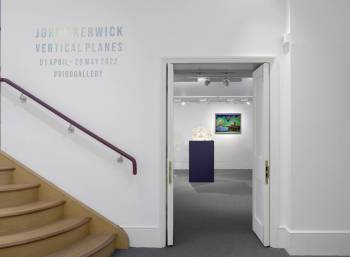 Jordy Kerwick’s brazen, colour saturated paintings transport you to a dream world of mythology, folk law, and misadventure. The artist explores his own domestic family frivolity through the lens of alternative bodies or forms. Snakes, bears, wolves, and tigers are juxtaposed with his favourite books, still life flowers, trees, and domestic arrangements within almost fairy-tale narratives. His two sons Sony and Milo, for example, are often represented as double-headed beasts.
The current exhibition is a playful reaction to the history—or alternate histories—of Wellington Arch and some of the characters it immortalises. Tigers, bears, snakes, and unicorns all take sides in the artist’s own version of the Battle of Waterloo, replacing key characters such as Napoleon and Wellington but leaving these characters ambiguous and interchangeable. The work was by Ken Webster’s book Vertical Planes (1989), which documents the author’s experience of receiving contact from people of the 16th-century and the future who had all inhabited the same cottage in Dodleston, Cheshire. Webster believed in parallel planes of existence all running simultaneously, an idea that also fascinates Kerwick.
Ibrahim El-Salahi, Black and White
1 June — 30 October 2022
This group of Black and White works on paper by Ibrahim El-Salahi from 2012 have never before been exhibited. They were completed in the lead up to his 2013 solo show at Tate Modern, when he became the first artist of African birth to be featured there in a retrospective exhibition. The works show the ‘godfather of African art’ at his best with a confidence of line reflecting over seventy years of creating his surreal multilayered visions.
Born in Sudan in 1930, Ibrahim El-Salahi is one of the most important living African artists and a key figure in the development of African Modernism. El-Salahi grew up in Omdurman, Sudan and studied at the Slade School in London. On his return to Sudan in 1957, he established a new visual vocabulary, integrating various Sudanese, Islamic, African, Arab, and Western artistic traditions.
2022 is an exciting year for the now Oxford-based El-Salahi. The artist has been selected to participate with 99 drawings in the 2022 59th Venice Biennale, The Milk of Dreams curated by Cecilia Alemani. Alongside the exhibition at Wellington Arch, Vigo will also show El-Salahi at their gallery in Masons Yard, London (June 2021), and his Pain Relief drawings will be the subject of a solo exhibition at the Norwegian Drawing Association (Tegnerforbundet), a show which will travel in an expanded format to The Drawing Center in New York in October. The Pain Relief canvases relating to these drawings will also be the subject of a solo exhibition at Hastings Contemporary (the Jerwood Gallery) from April to June. In a busy year the 91-year-old legend will further participate in group exhibitions at the Chrysler Museum of Art (October) and the Fisk University Galleries (October).
Matthew Burrows, In and Through
8 November 2022 — 8 January 2023
The paintings of Matthew Burrows explore a coalescence between stillness and movement. Work from the In and Through series has a preoccupation with watchfulness and the lines that delineate the landscape and our physiology. Burrows speaks of his work as an internal vigilance for place, creating images that meditate on the deep knowledge derived from repeatedly moving in and through the landscape. His relationship with habitat is not one of description or nostalgia, but one of dwelling and ritual. It is a process of mythologising, of drawing meaning from the particularities of the environment, of realising its wilderness and ours.
In 2020, a week before the first national lockdown, Burrows founded the Artists Support Pledge initiative, to help artists and makers through the COVID-19 pandemic. Artist Support Pledge has become a global phenomenon helping sustain thousands of artists across the globe during the pandemic. It has become a global movement empowering both artists and collectors. For his efforts, Matthew was awarded an MBE for services to Arts and Culture. Many are excited to celebrate this ‘artist’s artist’ who has contributed so much to his community.
Marcus Harvey, Waterloo Sunset
11 January — 19 March 2023
Marcus Harvey makes raw, expressive figurative paintings and sculptures. He seeks out imagery that is emblematic of a brutish but proud Britishness, iconic images—whether good, bad, or ambiguous—without commenting on his own relationship to them. Harvey’s most infamous work is Myra, a painting of the infamous child-murderer, which was exhibited as part of the groundbreaking 1997 exhibition Sensation. This chilling portrait derived much of its potency from the iconography of a photograph so engrained in the British psyche through years of media reproduction. A family man, Harvey was after sensation, and this painting regarded as so important in British art history is also one of the most misunderstood.
Recently, Harvey has started to work extensively with ceramics creating motifs and emblems of Britishness into collaged portraits of historical British figures, or foes, from history, from Nelson to Margaret Thatcher and Napoleon, to Tony Blair. He works the imagery, handling the clay in a battle to find its form through multiple firings. The result is tough but humorous sculpture, unapologetic and brash, political yet ambiguous, considered, and painterly.
Wellington and his eponymous boot fit snugly into Harvey’s ‘Punch and Judy’ ensemble as it fights to balance our nation’s patriotic sympathies with its dark imperial legacy. These complex and contradictory emotions will infuse the characters who will take temporary residence in the upper galleries of Wellington Arch.
Exhibition | Wellington, Women, and Friendship
From the press release (via Art Daily) for the exhibition now on view at Apsley House:
Wellington, Women, and Friendship
Apsley House, London, 21 April — 30 October 2022
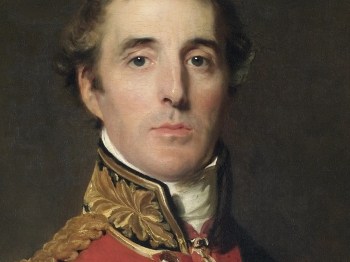
Sir Thomas Lawrence, Portrait of The Duke of Wellington, detail, ca. 1815 (London: English Heritage, Wellington Collection, Apsley House).
Through letters, portraits, and much more, on loan from public and private collections, Wellington, Women, and Friendship presents an intimate picture of a very public life, revealing Wellington’s social circle, his marriage, and how his friendships with women could sometimes provoke rumour and gossip.
From the moment he secured victory at the battle of Waterloo in June 1815, Wellesley’s legendary status was assured. He was not only a military hero but also a hugely influential figure in the high society of his day. As Sir Thomas Lawrence’s portraits attest, with his high cheekbones, aquiline nose and piercing blue eyes, the Duke was often the centre of female attention.
In 1806, after returning from eight years of service with the British Army in India, Wellesley married Catherine Pakenham, whom he had known from his formative years in Ireland. It soon sadly became apparent that they were ill matched—not least because the couple had neither seen nor spoken to each other during his time overseas. Shortly after their marriage Wellington was off again, and this time they were separated for nearly five years. This was the form the pattern for the rest of their married life. Over the years that followed the Duke gained a loyal circle of female friends who he regularly corresponded with.

Sir Thomas Lawrence, Portrait of Marianne Patterson, 1818 (Stratfield Saye Preservation Trust).
Wellington, Women and Friendship presents around fifteen works including paintings, miniatures, drawings, and previously unseen or published letters—even contemporary cartoons that give us a window onto the world of celebrity gossip. Many of these portraits of the woman he corresponded with hung in his own home during his lifetime.
Josephine Oxley, Keeper of the Wellington Collection says, “Wellington was a very private person, but after Waterloo he was of interest to everyone in society and he quickly became aware of the growing chatter about his female companions. It was well known that his marriage was not a happy one, but what was the truth behind all those other friendships? This exhibition will bring a new perspective on Wellington’s very private life and tackle some of the difficult questions.”
Apsley House is a unique survival of an aristocratic townhouse in the centre of London. The house was purchased in 1817 by Arthur Wellesley, 1st Duke of Wellington (1769–1852) after his victory at Waterloo and became known as ‘Number 1 London’. The house reflects the style and taste of the 1820s when it was remodelled for Wellington by his architect Benjamin Dean Wyatt. Today the house holds an important collection of fine art, including paintings by Velazquez, Goya, Titian, and Rubens alongside an outstanding display of porcelain and silver.
Online Talk | Anne Helmreich on the Future of Art Market Studies
From Art Market Studies:
Anne Helmreich | Charting our Future: Art Market Studies & Provenance Research in a Digital Age
The 2022 Hugo Helbing Lecture
Online, Zentralinstitut für Kunstgeschichte, Munich, 27 April 2022, 18.15 (CET)
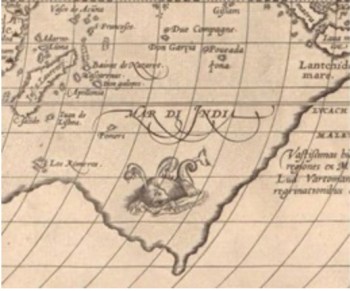
Frans Hogenberg and Abraham Ortelius, Typvs Orbis Terrarvm, detail (Antwerp: Abraham Ortelius, 1584?) https://www.loc.gov/item/2017585795/
‘Here be dragons’, a trope used by Western early modern mapmakers to signify uncharted or dangerous territories may also describe attitudes to digital approaches in art history within certain circles. But if we aim to understand the histories of art markets at scale and over space and time, we must set sail. This talk will chart potential future directions for art market studies and provenance research, exploring both possibilities and challenges offered by digital methods. To frame this exploration, the talk will draw on complex issues raised by the transatlantic art trade at the turn of the last century and its key nodes of New York and London. In particular, it is concerned with the role played by dealers, such as Boussod, Valadon & Cie, Knoedler, Yamanaka & Co., and Hagop Kevorkian, and the different forms of archival evidence we can deploy to study this question, ranging from paper documents produced at the time—stockbooks, exhibition catalogues and reviews, correspondence, photographs, etc.—to today’s digital databases and online museum catalogues.
Anne Helmreich is Associate Director, Getty Foundation, and formerly Associate Director, Digital Initiatives, Getty Research Institute, both of the J. Paul Getty Trust. She has also served as Dean, TCU College of Fine Arts; Senior Program Officer, The Getty Foundation; and Associate Professor of Art History and Director, Baker-Nord Center for the Humanities, Case Western Reserve University. Her current research focuses on the history of the art market and the productive intersection of the digital humanities and art history. Her essay “The Art Market as a System, Florence Levy’s Statistics” appeared in American Art in Fall 2020. “Purpose-built: Duveen and the Commercial Art Gallery,” co-authored with Edward Sterrett and Sandra van Ginhoven, was published by Nineteenth-Century Art Worldwide in Summer 2021. She and Pamela Fletcher recently co-authored “Digital Methods and the Study of the Art Market” for The Routledge Companion to Digital Humanities and Art History (Routledge, 2020) and the epilogue to Art Crossing Borders: The Internationalisation of the Art Market in the Age of Nation States, 1750–1914 (Brill, 2019).
The lecture will also take place via Zoom; you can attend via the following link:
https://us02web.zoom.us/j/85659345839?pwd=UmFZYU0xN1NxMGJ1MjlQM054NXgvZz09
Meeting-ID: 856 5934 5839 | Password: 148258
Exhibition | Boilly: Parisian Chronicles

Louis-Léopold Boilly, Trompe-l’oeil aux cartes et pieces de monnaie, detail, ca. 1808–15
(Lille: Palais des Beaux-Arts)
◊ ◊ ◊ ◊ ◊
From the Cognacq-Jay:
Boilly: Parisian Chronicles
Musée Cognacq-Jay, Paris, 16 February — 26 June 2022
Curated by Annick Lemoine and Sixtine de Saint-Léger
A virtuosic and prolific artist in a class of his own, Louis-Léopold Boilly (1761–1845) was the enthusiastic chronicler of Parisian life for sixty years, spanning a period from one revolution to the dawn of the next (1789 and 1848). In addition to being a portraitist for Parisians and a painter of city scenes, Boilly was also the inventor of stunning trompe-l’œil paintings and the author of witty caricatures. This monographic exhibition explores Boilly’s productive career through a selection of 130 works, giving us a glimpse into the artist’s uniqueness, brilliance, humour, and inventiveness. It presents several previously unseen masterpieces, some of which have never been shown in France.
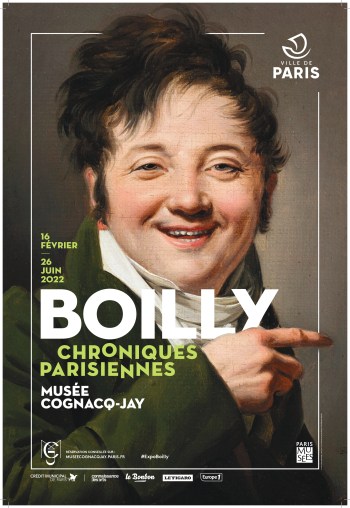 Born in the North of France, Boilly set out to win over the capital at the age of 24, in 1785. He would live there his whole life. Taking little interest in the grand history of Paris, he instead became fascinated by the city’s modernity, its hustle and bustle, and its many spectacles. As a true chronicler of everyday life, Boilly painted an intimate portrait of his generation. The artist developed a fondness for scrutinising the views and faces he came across in the city. He distinguished himself in the art of portraiture by capturing the faces of Parisians on the small formats that would become his trademark. The portraitist was also a keen caricaturist who looked at his fellow citizens with an amused, and perhaps even scathing, eye. His taste for provocation and technical proficiency can also be found in his stunningly illusionistic trompe-l’œil.
The exhibition also showcases the subtle tricks the artist employed to depict himself in his works. In addition to painting derisive self-portraits and using a variety of signatures, he also slid his likeness amongst the protagonists of his crowd scenes, just as Alfred Hitchcock did in his films. These stratagems establish a knowing relationship between the artist and viewer. Throughout the exhibition, visitors are taken along on a fun treasure hunt to find Boilly’s face or clues of his presence.
Organised as a follow-up to the publication of Étienne Bréton and Pascal Zuber’s catalogue raisonné of the artist’s work (Boilly: Le peintre de la société parisienne de Louis XVI à Louis-Philippe, Arthena, 2019), the exhibition is curated by Annick Lemoine and Sixtine de Saint-Lége. On display are several masterpieces never before shown in France on loan from prestigious private collections, including one of the largest, currently held by the Ramsbury Manor Foundation (United Kingdom).
Annick Lemoine, ed., with contributions by Etienne Bréton, Sixtine de Saint-Léger, Côme Fabre, Martial Guédron, Charlotte Guichard, Annick Lemoine, Susan L. Siegfried, Anne-Laure Sol, Francesca Whitlum-Cooper, and Pascal Zuber, Boilly: Chroniques Parisiennes (Paris: Musées, 2022), 160 pages, ISBN: 978-2759605187, €30.
New Book | Libel and Lampoon: Satire in the Courts, 1670–1792
Andrew Bricker will be speaking online (via Zoom) with Marissa Nicosia about his new book on Tuesday, 12 April 2022, at noon (ET) in a session sponsored by the Society of Fellows in Critical Bibliography and the Rare Book School. From Oxford UP:
Andrew Benjamin Bricker, Libel and Lampoon: Satire in the Courts, 1670–1792 (Oxford: Oxford University Press, 2022), 352 pages, ISBN: 978-0192846150, $90.
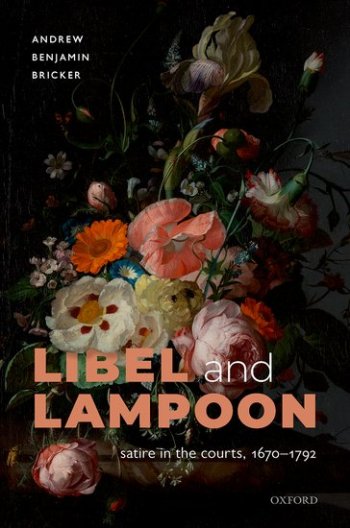 Libel and Lampoon shows how English satire and the law mutually shaped each other during the long eighteenth century. Following the lapse of prepublication licensing in 1695, the authorities quickly turned to the courts and newly repurposed libel laws in an attempt to regulate the press. In response, satirists and their booksellers devised a range of evasions. Writers increasingly capitalized on forms of verbal ambiguity, including irony, allegory, circumlocution, and indirection, while shifty printers and booksellers turned to a host of publication ruses that complicated the mechanics of both detection and prosecution. In effect, the elegant insults, comical periphrases, and booksellers’ tricks that came to typify eighteenth-century satire were a way of writing and publishing born of legal necessity. Early on, these emergent satiric practices stymied the authorities and the courts. But they also led to new legislation and innovative courtroom procedures that targeted satire’s most routine evasions. Especially important were a series of rulings that increased the legal liabilities of printers and booksellers and that expanded and refined doctrines for the courtroom interpretation of verbal ambiguity, irony, and allegory. By the mid-eighteenth century, satirists and their booksellers faced a range of newfound legal pressures. Rather than disappearing, however, personal and political satire began to migrate to dramatic mimicry and caricature-acoustic and visual forms that relied less on verbal ambiguity and were therefore not subject to either the provisions of preperformance dramatic licensing or the courtroom interpretive procedures that had earlier enabled the prosecution of printed satire.
Andrew Benjamin Bricker is an Assistant Professor of English Literature in the Department of Literary Studies at Ghent University and a Senior Fellow at the Andrew W. Mellon Society of Fellows in Critical Bibliography at the Rare Book School at the University of Virginia. He received his BA and MA from the University of Toronto and his PhD from Stanford University. Before joining UGent, he was a Mellon Foundation Postdoctoral Fellow in the Humanities at McGill University and a Killam Postdoctoral Research Fellow at the University of British Columbia.
C O N T E N T S
Introduction: The Perils of Satire
1 Keeping out of Court I: Libel and Lampoon after Hale and Dryden
2 Keeping out of Court II: Swift and the Illicit Book Trade
3 Irony in the Courts: Defoe and the Law of Seditious Libel
4 Naming in the Courts: Pope and the Dunciad
5 Allegory in the Courts: Satire and the Problem of ‘Libellous Parallels’
6 Keeping out of Court III: Caricature, Mimicry, and the Deverbalization of Satire
Epilogue: A Shandean History of the Press
Call for Papers | The Longue Durée of Cultural Heritage
From ArtHist.net:
The Longue Durée of Cultural Heritage: Curation of the Past from Antiquity to the Present Day
Norwegian Institute in Rome, 5–7 December 2022
Proposals due by 15 May 2022
An interdisciplinary conference at the Norwegian Institute in Rome (University of Oslo), in collaboration with the Heritage Experience Initiative (HEI), University of Oslo.
Across the world, there is a burgeoning interest in cultural heritage, among academics and professionals, as well as in politics. While heritage is typically thought of as a modern concept with origins in the late-eighteenth and nineteenth centuries, there is ample proof that pre-modern societies curated their pasts in highly comparable ways. Starting from the understanding of cultural heritage as a process, we recognize certain practices regarding the management of spaces, monuments, and objects in pre- and early modern societies as congruent to types of activity commonly placed within the heritage rubric. By adopting a long-term approach to the subject, this conference aims to create opportunities for new lines of research across disciplines. This includes examining historical examples to contextualize, interrogate, and deepen our understanding of modern approaches to heritage. Moreover, developments in contemporary heritage theory and practice can provide a fresh and productive framework for examining and categorizing processes in the past. By bringing together scholars working on issues of heritage in the present day with those studying similar ideas in more remote, historical contexts, this interdisciplinary conference aims to foster a dialogue which can enrich analyses of heritage practices in the past and in the present day.
We invite contributions from scholars with a contemporary and/or historical focus (in particular, we welcome research on pre-modern periods). Relevant themes include (but are not restricted to):
• Methodologies of heritage
• Case studies of pre-modern heritage curation/preservation
• Authenticity
• Destruction and iconoclasm
• Ruins and reconstructions
• Commodification
• Preservation as deconsecration
• Restoration
• Are texts intangible heritage? Textual heritage(s) and their material dimensions: epigraphy, archives, corpora, etc.
• Images/representations of heritage processes
Please submit a paper proposal of no more than 250 words and a short CV (half page) to k.b.aavitsland@roma.uio.no by 15 May 2022. Scholars without funding from their home institutions may apply for travel grants to the same address.
Confirmed invited speakers include Thora Petursdottir (HEI/University of Oslo), David C. Harvey (Aarhus University), Birgit Meyer (University of Utrecht), Chiara Mannoni (Ca’ Foscari University of Venice), Lars Boje Mortensen (University of Southern Denmark), Anne Eriksen (University of Oslo), Arnold Witte (University of Amsterdam), and Christopher Whitehead (Newcastle University).
Call for Articles | Black Artists in the Atlantic World, 1500–1900
From the Call for Papers at Arts:
Special Issue of Arts: Black Artists in the Atlantic World, 1500–1900
Guest edited by Paul Niell and Emily Thames
Abstracts due by 31 May 2022, with drafts of completed articles due by 31 March 2023
We are seeking submissions for a special issue of Arts, which will focus on Black Artists in the Atlantic World, ca. 1500–1900. Invoking the modern/colonial racial category of ‘black’ draws critical and much-needed attention to the role of race in the lives and careers of artists of African descent, and others who have had to negotiate being inscribed and socialized into blackness by Atlantic societies. We approach this topic hemispherically, considering both colonial and national socio-political frameworks bordering or shaped by the broader Atlantic arena, including the Americas, Europe, and Africa. In this way, we hope to foster a comparative conversation between scholars working on the various geographic spheres of the Atlantic in order to better understand the transnational and transimperial realities faced by black artists and how they have worked through their respective settings.
This special issue acknowledges and draws inspiration from recent scholarship on artists in the Spanish colonial territories throughout the Americas, such as the essay by Barbara Munday and Aaron Hyman, “Out of the Shadow of Vasari: Towards a New Model of The ‘Artist’ in Colonial Latin America,” Colonial Latin American Review 24.3 (2015): 283-317; the monograph by Susan Verdi-Webster, Lettered Artists and the Language of Empire: Painters and the Profession in Early Colonial Quito (University of Texas Press, 2017); the 2019 Hescah symposium at the University of Florida “Beyond Biography: Artistic Practice & Personhood in Colonial Latin America,” organized by Maya Stanfield-Mazzi; and the special edition of the Colonial Latin American Review, “Visualizing Blackness in Colonial Latin America,” co-edited by Kathryn Santner and Helen Melling, 30.2 (2021). The study of black artists and image makers in the southern Atlantic has been further advanced by the work of scholars, such as Ximena A. Gómez, Agnes Lugo-Ortiz, Linda Rodríguez, and Miguel Valerio. These studies shed light on the methodological challenges as well as the importance of considering the lives, careers, and agencies of Spanish colonial artists in the writing of these regions’ social and cultural histories. Among the salient dimensions addressed by these projects is the role of race in shaping the professional lives of artists. For the northern Atlantic, which is situated later in time than those of the Ibero-Americas and the Caribbean and in contexts informed by Protestant conceptions and practices of the image, relationships between the artist, the art, the viewer, and race have been examined in such works as Kirsten Pai Buick’s Child of the Fire: Mary Edmonia Lewis and the Problem of Art History’s Black and Indian Subject (Duke University Press, 2010), Anna O. Marley’s edited collection of essays Henry Ossawa Tanner: Modern Spirit (University of California Press, 2012), and Jasmine Nichole Cobb, Picture Freedom: Remaking Black Visual Culture in the Early Nineteenth Century (New York University Press, 2015).
Engaging with the subject of black artists in the Atlantic world raises a number of critical questions. How did racial blackness shape the professional worlds negotiated by artists in the Atlantic? How does race impact the ways in which we consider black artists in the Atlantic whose racial classification is not necessarily evident in the formal and stylistic properties of their work? If an artist is of African descent, must their art be a matter of race? What was the relationship between race, blackness, and the creation of the category of ‘artist’ in the Atlantic? What other forms of making and imagery are at stake in this field of inquiry beyond artist and art, as institutionally redefined by academies of art? How has the discourse of race obscured African and African American agency, awareness, and negotiations of imperial/colonial power? How do we address the limits of the historic archive in recovering the stories of such artists? What can be learned by looking across national and imperial boundaries in the Atlantic with respect to the histories of black artists? These questions will be considered and addressed within this special issue.
Dr. Paul Niell
Department of Art History, Florida State University, Tallahassee
Interests: Spanish colonial art; architecture and visual culture; the material culture of the African diaspora with an emphasis on the Caribbean region
Dr. Emily Thames
Department of Art History, Florida State University, Tallahassee
Interests: the visual and material cultures of the colonial Atlantic world; art and empire; art in the age of revolution and nationalism; the history of colonialism; the intersection of art and race; the visual and material cultures of the African diaspora










 Enfilade
leave a comment