Call for Papers | Women in Art and Music, ca. 1500–1800
From ArtHist.net:
Women in Art and Music, ca. 1500–1800
The Juilliard School, New York, and the National Gallery of Art, Washington DC, 18 and 20 October 2023
Proposals due by 9 December 2022
The Juilliard School in New York, and the Center for Advanced Study in the Visual Arts at the National Gallery of Art in Washington, DC are excited to announce a co-hosted global interdisciplinary symposium on women in art and music in the early modern period (ca. 1500–1800). Our goal is to think broadly about women as creators, as part of the cultural and global economy, and as experts in their chosen field of art. We suggest that visual art and musical performance were so tightly enmeshed at this time as to form their own language, particularly in women-centered spaces. We, therefore, seek a new way of addressing this shared space—not necessarily as an interdisciplinary zone where art and music always converge—but one in which modes of creation are shared in codependent and overlapping ways in the early modern period.

Lavinia Fontana, Portrait of Lucia Bonasoni Garzoni, ca. 1590, oil on canvas, 45 × 34 inches (Washington, DC: National Gallery of Art).
The National Gallery of Art’s recent acquisition of the Bolognese painter Lavinia Fontana’s portrait of 16th-century Bolognese singer and lute player Lucia Bonasoni Garzoni (b. 1561)—the first painting by an early modern Italian woman artist to enter the museum’s collection—is the impetus for this interdisciplinary conference. A prolific artist, Fontana depicts Garzoni in an exquisite and highly detailed portrait alongside her lute, displayed on the table next to a score which accurately represents music for a lute with soprano voice. We might imagine these notes emanating from her instrument in concert with her dulcet voice, garnering her the praise she received from her literary contemporaries and poets, as one asserted, “And the host of the Graces, and the whole array of Virtues, testify to this in singing her glories and honors.”
On 23 April 1595, Lavinia Fontana’s eleventh and last-born child was baptized in Bologna, and documents show that none other than Lucia Bonasoni Garzoni served as the child’s godmother, linking the two women together personally, in addition to professionally. This picture tells the story of two women, one a painter and the other a musician, who were able to overcome obstacles in a patriarchal society to succeed in the artistic spheres of painting and music. This early modern synergy between a painter and a singer will be the springboard for exploring how women succeeded as artists and musicians in the early modern period on a global stage, whether independently or collaboratively.
Early modern scholarship has recently suggested that identity is a process, a fluid phenomenon rather than fixed formation, in which the interaction between groups (be they national, religious, social, gendered, or racial) is the crucial point of study. What happens when we apply this idea to the realm of artistic identity? Some questions to consider: How does reading art and music as coexistent entities enhance our understanding of women in the early modern era? When women depicted or included other women in their art what were the societal ramifications? How did art and music-making offer women pathways for social advancement or even independence in the early modern period? How did issues of social class and race, in addition to gender, play into possible advances for women on the global stage in art and music?
The symposium will take place at The Juilliard School, New York, NY on Wednesday, 18 October 2023 and at the Center for Advanced Study in the Visual Arts, National Gallery of Art, Washington, DC on Friday, 20 October 2023.
We hope that the comingling of a museum and a conservatory will help to answer some of these questions in a lively and engaging symposium. Live music will be provided alongside papers at both institutions by the ensemble Sonnambula and musicians from Juilliard’s Historical Performance program, to reveal how crucial musical performance is to the study of music and the sister arts in the early modern period. Musicians will be on-hand to play any music discussed in papers as needed; public performances will also occur on both days of the symposium.
We invite paper submissions from scholars across the humanities that engage with early modern women as artists and/or musicians from the disciplines of history, music history, historical performance, and art history, in addition to other relevant disciplines. Papers are encouraged that consider cross-cultural connections in how they address issues of artmaking and performance, in both secular and religious contexts in Africa, the Americas, Asia, Europe, and beyond. Proposals that include music or performance as part of the talk are welcome. A selection of papers will be published following the conference in an edited volume published by the Center and distributed by Yale University Press.
To submit a proposal, please send the following by email to the co-organizers of the conference by Friday, 9 December 2022:
• Paper title (15-word maximum)
• Paper abstract (250-word maximum)
• CV/resume with your full name, affiliation, title (or ‘Independent Scholar’), and email address
Dr. Eve Straussman-Pflanzer, Curator and Head of Italian and Spanish Paintings, National Gallery of Art
e-straussman-pflanzer@nga.gov
Dr. Elizabeth Weinfield, Professor of Music History, The Juilliard School, Director, Sonnambula
eweinfield@juilliard.edu
New Book | Van Dyck and the Making of English Portraiture
From Yale UP:
Adam Eaker, Van Dyck and the Making of English Portraiture (London: Paul Mellon Centre for Studies in British Art, 2022), 250 pages, ISBN: 978-1913107345, £35 / $45.
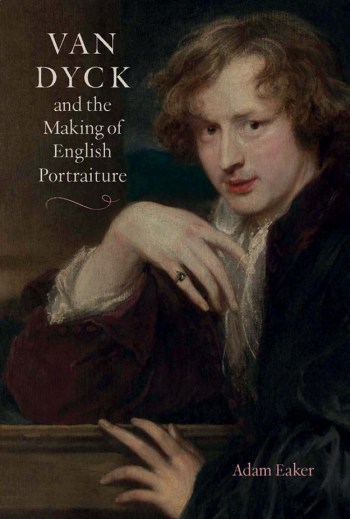 A new account of painting in early modern England centered on the art and legacy of Anthony van Dyck
As a courtier, figure of fashion, and object of erotic fascination, Anthony van Dyck (1599–1641) transformed the professional identities available to English artists. By making his portrait sittings into a form of courtly spectacle, Van Dyck inspired poets and playwrights at the same time that he offended guardians of traditional hierarchies. A self-consciously Van Dyckian lineage of artists, many of them women, extends from his lifetime to the end of the eighteenth century and beyond. Recovering the often surprising responses of both writers and painters to Van Dyck’s portraits, this book provides an alternative perspective on English art’s historical self-consciousness. Built around a series of close readings of artworks and texts ranging from poems and plays to early biographies and studio gossip, it traces the reception of Van Dyck’s art on the part of artists like Mary Beale, William Hogarth, and Richard and Maria Cosway to bestow a historical specificity on the frequent claim that Van Dyck founded an English school of portraiture.
Adam Eaker is an associate curator in the Department of European Paintings at The Metropolitan Museum of Art.
Call for Papers | Seeing Anatomy between Literature and the Arts
From ArtHist.net:
Seeing Anatomy between Literature and the Arts:
Words, Images, and Spaces from the Early Modern Age to the Present
Vedere l’anatomia tra letteratura e arti: parole, immagini e spazi dalla prima età moderna
Mendrisio/Lugano, Switzerland, 15–16 May 2023
Proposals due by 21 November 2022
The workshop intends to put into practice the interdisciplinary dialogue at the basis of the project ‘The Civilisation of Anatomy’: The Genre of Literary Anatomies in Seventeenth-century Italy (FNS 100012_204399), directed by Linda Bisello, in partnership with Carla Mazzarelli with regard to the visual arts and architecture. The research focuses on the epistemological effects of Andrea Vesalius’s De humani corporis fabrica (1543) on the early modern culture, from the literary imagination to other forms of knowledge (art and architecture, but also philosophy, grammar, rhetoric, geography, astronomy, etc.). Anatomy, in fact, “revolutionizes the way of feeling forms . . . by making scientific truth a means of enhancing visual reality” (Parronchi 1975).
While the core of the reflection lies in the early modern age (15th–17th centuries), a space for interventions with a broader chronology is nevertheless envisaged, starting from the early modern age to the contemporary age. Within the framework of the methodological reflections and the interdisciplinary perspective, the Workshop aims in particular to discuss topics such as the persistence of the anatomical paradigm in architectural theory or, in other respects, whether even today anatomy can still define a peculiar critical approach to literary criticism, image, and project.
We invite contributions which might relate, but not be limited, to the following fields:
• Institutions and spaces of anatomy: its performance, exposition, and spectacularisation (universities, academies, healthcare sites, theatres, museums, physical and digital libraries)
• The forms of visual and textual narration of anatomy (artistic anatomy, moral anatomy, encyclopaedic anatomy, anatomy as organisation, and visualisation of knowledge)
• Anatomy between allegory, symbol, and emblems
• Anatomy through interdisciplinary dialogue: frequentations and epistolary correspondence between physicians, humanists, and artists
• The ‘fabric of the body’: dialogues and intersections between medicine, architecture, design culture, and anatomy
• Anatomy in perspective: its metamorphoses, migrations and transpositions in the contemporary age (with particular reference to the intersection of literary criticism and visual arts)
Preference will be given to applications from young scholars (PhD and post-Doc students) with an interdisciplinary background or with research projects that fall within the scope of the digital humanities (e.g. digitisation of corpora concerning anatomy). Abstracts (max 2000 characters including spaces), together with a brief biography (max 1500 characters including spaces), and at least three keyword should be submitted to: vederelanatomia2023@gmail.com. Abstracts are welcome in Italian, English, French, and Spanish. The deadline for abstracts submission is 21 November 2022; the scientific board will confirm the acceptance of abstracts by 20 December 2022. Further information is available here.
French Historical Studies, August 2022
In the latest issue of French Historical Studies:
David Gilks, “Civilization and Its Discontents: Quatremère de Quincy and Directorial Political Culture,” French Historical Studies 45.3 (2022): 481–510.
This article reinterprets Antoine Quatremère de Quincy’s Letters on the Plan to Abduct the Monuments of Italy (1796). In response to official justifications that seizing cultural patrimony was France’s civilizing mission, Quatremère argued that civilization required all nations to leave Rome intact and respect eighteenth-century conventions. The article shows how he attempted to make his work acceptable to republican readers by using a language uncharacteristic of his other writings and by mimicking the concept of a singular and secular civilization that was central to the post-Thermidorian Republic’s identity. The Letters was part of the broader strategy of the royalist Clichy club to make republicans question the Republic. However, informed contemporaries saw through his conceit: they discerned an attack on the Directory in his description of how the papacy nourished and protected the civilization but endangered it in practice.
Conference | Asian Art in the World
From the conference website:
Asian Art in the World: Historical Influences on Culture and Society
Lisbon, Portugal, 24–26 November 2022
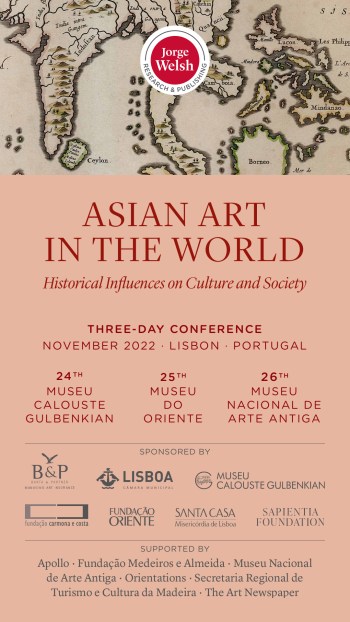 This three-day conference will highlight the important contribution made by Asia to world art and universal civilisation, from the remote ages of the Silk Road, and its land and sea routes, to the modern age of globalisation. Guest speakers will present comprehensive and partial perspectives of the strong or enduring ties and links established among the various regional Asian cultures present at any one time in history. These include the economic and cultural bonds that every single one of them forged with the Western cultures they came across, commencing from the period of the Roman Empire until the end of the Middle Ages and then from the first globalisation to the present day. Finally, it is our intention to show the huge prestige afforded to the many artistic cultures of Asia in the Western world. This was based primarily on admiration for their outstanding technical skills as seen in the use of a variety of materials, some of them unknown in the West, but also on general acknowledgment of the exemplary capacity to imaginatively reinvent motifs, narratives and symbolisms shown in these works of art, not to mention the many scenarios and rituals underlying those artistic manifestations, ranging from the visual and decorative arts to the performing arts.
Speaker information and abstracts are available here»
T H U R S D A Y , 2 4 N O V E M B E R 2 0 2 2
Museu Calouste Gulbenkian
9.10 Registration
9.50 Jorge Welsh, Opening Remarks
10.00 Morning Session
• Jorge Santos Alves, Fernão Mendes Pinto’s ‘Malay Mediterranean’: An Asian Geopolitical Concept in a Modern Europe Bestseller?
• Fernando A. Baptista Pereira, Identifying Indo-Portuguese Art and Its Impact in Worldwide Collections
• Brigitte Nicolas, From China to Chinoiserie: The Example of the Chinese Fan Trade and Its Legacy
• Li Zhongmou, Recent Discoveries, Exhibitions, and Researches on the Silk Roads in Mainland China
13.10 Lunch Break
14.40 Afternoon Session
• Cora Würmell, Asia in Dresden: Augustus the Strong’s Exceptional Porcelain Collection
• Clement Onn, A Transpacific Cabinet
• Nuno Senos, Asia in Portuguese Homes in the 16th Century
F R I D A Y , 2 5 N O V E M B E R 2 0 2 2
Museu do Oriente
10.00 Morning Session
• Christiaan Jörg, Functional Beauty: Japanese Lacquer and Porcelain for Europe
• Alexandra Curvelo, The Circulation of Folding Screens in the Early Modern World
• Sonia Ocaña-Ruiz, Novohispanic Enconchados: The Impact of Namban Lacquer and Beyond
• Maureen Cassidy-Geiger, Deciphering Asian Forms and Motifs in European Porcelain from the Meissen Manufactory
13.10 Lunch Break
14.40 Afternoon Session
• Alexandre Pais, The Blue, and the Binding Sea: Influences and Dissemination of Portuguese 17th-Century Ceramics
• Cristina Castel-Branco, Eastern Voyages and the Fascination of Exotic Gardens
• Rossella Menegazzo, Japanese Aesthetics in Western Contemporary New Perspectives of Space, Materials, and Colour
S A T U R D A Y , 2 6 N O V E M B E R 2 0 2 2
Museu Nacional de Arte Antiga
10.00 Morning Session
• William R. Sargent, America and China: ‘Adventurous Pursuits in Commerce …’
• Tianlong Jiao, Linking Asia and Beyond: Presenting Chinese Arts with a New Perspective
• Francisco Clode, The Archipelago of Madeira in the Context of the Portuguese Maritime Expeditions: Casa Colombo-Museum of Porto Santo
• Maria Antónia Pinto de Matos, From China to the World: Ceramics and Tea, Two Age-Old Commodities
13.10 Lunch Break
14.40 Afternoon Session
• Jessica Hallett, Crossing Cultures, Crossing Time: China, Iraq and Europe, c. 800
• Francisco Capelo, A Traveller’s Eye, 25 Years Travelling in Asia
• Valentina Bruccoleri, From the Royal Banquet to the ‘Porcelain House’: Use and Display of Chinese Porcelain in the Islamic World
Organized by Jorge Welsh Research & Publishing, the conference is sponsored by Barta & Partner, Câmara Municipal de Lisboa, Fundação Carmona e Costa, Fundação Oriente, Museu Calouste Gulbenkian, Santa Casa da Misericórdia de Lisboa, and Sapientia Foundation.
Supported by Apollo Magazine, Fundação Medeiros e Almeida, Museu Nacional de Arte Antiga, Orientations Magazine, Secretaria Regional de Turismo e Cultura da Madeira, and The Art Newspaper.
Strawberry Hill Acquires Walpole’s Iconic Blue and White Tub
Yes, that tub! Lots of places to go for more information, but one might start with Luisa Calè, “Gray’s ‘Ode’ and Walpole’s China Tub: The Order of the Book and The Paper Lives of an Object,” Eighteenth-Century Studies 45.1 (Fall 2011): 105–25. From the press release, via Art Daily:
 One of the most iconic and macabre objects owned by Horace Walpole (1717–1797) has been reacquired by Strawberry Hill House, thanks to the UK’s Acceptance in Lieu scheme. The beautiful, large blue and white vase achieved a certain notoriety after Walpole’s favourite cat, Selima, drowned in it while trying to catch goldfish, which the author kept in it. The incident was later immortalised in a mock-heroic ode by Walpole’s friend, the poet Thomas Gray, “Ode on the Death of a Favourite Cat, Drowned in a Tub of Gold Fishes” (1747).
The cat’s death actually occurred at Walpole’s London house, in Arlington Street. The bowl, along with many other works of art, was moved to Strawberry Hill sometime in the 1760s. In 1773, Walpole commissioned a Gothic-style pedestal for the tub and a label to be affixed to it with the first stanza of the poem. After 1778 the tub was moved to the Little Cloister, outside of the house, with the 1784 Description describing the new location: “On a pedestal, stands the large blue and white china tub in which Mr. Walpole’s cat was drowned; on a label of the pedestal is written the first stanza of Mr. Gray’s beautiful ode on that occasion, ‘Twas on this lofty vase’s side, Where China’s gayest art has dy’d. The azure flow’rs that blow, Demurest of the tabby kind, The pensive Selima reclin’d, Gaz’d on the lake below’.”
Research prompted by last year’s In Focus exhibition devoted to the tub, together with the expertise required to secure its return to Strawberry Hill House, demonstrated that it is an outstanding work of art in its own right—albeit with an extraordinary backstory. The quality of every aspect of the jardiniere is superior; from the shaping of the pot, to the glazing and firing, all demonstrate a remarkable level of artistry.
Announcing the permanent return of the vase, Derek Purnell, Director, Strawberry Hill House & Garden, said: “Once again, we are grateful to the Acceptance in Lieu scheme, which has allowed us to reacquire one of the most iconic objects in the collection. An object whose true value recently emerged, thanks to the attention prompted by our 2021 In Focus exhibition featuring the goldfish bowl. Traditionally described as a typical 18th-century Chinese product, made for a foreign clientele, Walpole’s porcelain vase is in reality an older and more valuable object. The jardinière, of exceptional quality, dates from the 17th century and is decorated with a continuous design of the ‘Three Friends of Winter’—pine, prunus, and bamboo—within a fenced garden of rocks and plants.”
Edward Harley OBE, Chairman of the AIL Panel said: “This Chinese jardinière is remarkable for its association with Horace Walpole and the drowning of his favourite cat. It was placed on prominent display in the cloisters at Strawberry Hill during Walpole’s lifetime, and it is fitting that, thanks to the Acceptance in Lieu scheme, it has been returned to its former home.”
Arts Minister Stuart Andrew said: “The Acceptance in Lieu scheme exists so important works of art and heritage objects can be owned by the nation and displayed for everyone to enjoy. It is fantastic that this vase has been returned to Horace Warpole’s former estate where it can go on permanent display in its rightful home.”
The porcelain vase will go on permanent display in the Hall at Strawberry Hill House, from Wednesday, 26 October 2022.
New Book | The Enlightened Mind
From Vernon Press:
Amanda Strasik, ed., The Enlightened Mind: Education in the Long Eighteenth Century (Wilmington, DE: Vernon Press, 2022), 164 pages, ISBN: 978-1648895142, $68. With contributions by Dorothy Johnson, Amanda Strasik, Rachel Harmeyer, Brigitte Weltman-Aron, Franny Brock, Madeline Sutherland-Meier, and Karissa Bushman
 The rise of Enlightenment philosophical and scientific thought during the long eighteenth century in Europe and North America (c. 1688–1815) sparked artistic and political revolutions, reframed social, gender, and race relations, reshaped attitudes toward children and animals, and reconceptualized womanhood, marriage, and family life. The meaning of ‘education’ at this time was wide-ranging and access to it was divided along lines of gender, class, and race. Learning happened in diverse environments under the tutelage of various teachers, ranging from bourgeois mothers at home, to Spanish clergy, to nature itself.
The contributors to this cross-disciplinary volume weave together methods in art history, gender studies, and literary analysis to reexamine ‘education’ in different contexts during the Enlightenment era. They explore the implications of redesigned curricula, educational categorizations and spaces, pedagogical aids and games, the role of religion, and new prospects for visual artists, parents, children, and society at large. Collectively, the authors demonstrate how new learning opportunities transformed familial structures and the socio-political conditions of urban centers in France, Britain, the United States, and Spain. Expanded approaches to education also established new artistic practices and redefined women’s roles in the arts.
Amanda Strasik is an Associate Professor of Art History at Eastern Kentucky University. She received her PhD in eighteenth- and nineteenth-century European art history from the University of Iowa. Her research focuses on representations of royalty, childhood and family relationships, and issues of gender identity in French art during the long eighteenth century. Strasik has received numerous grants and fellowships to conduct research in France at the Musée du Louvre, the National Museum of the History of Education in Rouen, the Palace of Versailles, as well as The Frick Collection in New York City.
C O N T E N T S
List of Figures
About the Editor
About the Contributors
Acknowledgements
The Enlightened Mind: Introduction — Amanda Strasik
1 Anatomy Lessons: Teaching Anatomy to Artists in Eighteenth-Century France — Dorothy Johnson
2 Painting Paradoxes: Jeanne-Elisabeth Chaudet’s Little Girl Teaching her Dog to Read — Amanda Strasik
3 The Education of Daughters: Embroidered Pictures after Angelica Kauffman — Rachel Harmeyer
4 Madame de Genlis’s New Method and Teaching Drawing to Children in Eighteenth-Century France — Franny Brock
5 Outside for Girls in Madame d’Epinay’s Conversations d’Emilie — Brigitte Weltman-Aron
6 Reforming Education in Eighteenth-Century Spain: Padre Sarmiento’s Reflections on Teaching Young Children — Madeline Sutherland-Meier
7 Religious Education and the Lasting Effect on Goya’s Depictions of Saints — Karissa E. Bushman
Index
Baltimore Museum of Art Announces New Appointments
From the BMA press release (22 September 2022) . . .
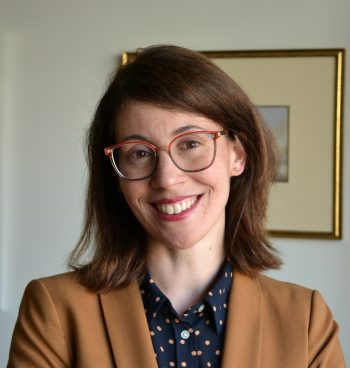
Dr. Lara Yeager-Crasselt has been named Curator of European Painting and Sculpture and Department Head at the Baltimore Museum of Art.
The Baltimore Museum of Art recently announced that Dr. Lara Yeager-Crasselt has been named Curator of European Painting and Sculpture and Department Head. Yeager-Crasselt is a scholar and curator of early modern European art, specializing in painting, sculpture, and tapestry produced in Northern Europe in the 16th and 17th centuries. As part of her new role, she will oversee the reconceptualization of the BMA’s galleries of 15th- through 19th-century European art, with a particular emphasis on expanding the narratives told through the museum’s expansive holdings.
The BMA has also promoted Dr. Leslie Cozzi to Curator of Prints, Drawings, and Photographs in recognition of her numerous contributions to the museum since she joined in 2018.
Additionally, the museum announced that it has received a generous $2 million gift from BMA trustee and longtime Baltimore-based philanthropist Anne L. Stone to endow a curatorial position in the Decorative Arts department. The funds are currently applied to the position of Assistant Curator of Decorative Arts, which is held by Brittany Luberda, a scholar of 18th-century objects and furniture who has been with the BMA since 2019. In recognition of Stone’s gift, the position is named the Anne Stone Assistant Curator of Decorative Arts. This named endowment will also follow future promotions in the department. The BMA’s Decorative Arts collection comprises approximately 8,000 works of art, including examples across media from North America, Europe, and non-Indigenous South America from around 2500 BCE to the present day.
Dr. Asma Naeem, Interim Co-Director and The Eddie C. and C. Sylvia Brown Chief Curator at the BMA states, “We are delighted to have such exceptional scholars to support the BMA’s mission. Dr. Lara Yeager-Crasselt’s appointment brings an incredible depth of knowledge, experience organizing world-class exhibitions, and alignment with our mission for equity and scholarship that will be invaluable to the ongoing development of the museum’s curatorial vision. Dr. Leslie Cozzi is an outstanding scholar, curator, and colleague who has a record of championing underrepresented artists with her acquisitions and exhibitions, and we are deeply grateful to our trustee and friend Anne Stone for her generous gift to endow the position of Assistant Curator of Decorative Arts, which highlights the importance of the department. The decorative arts are crucial to the museum’s mission to connect Baltimore communities and upend hierarchies of painting and sculpture.”
Yeager-Crasselt is a renowned scholar of early modern European art with significant experience in curating, teaching, and writing on a range of subjects in the field. Prior to joining the BMA, Yeager-Crasselt served as Curator of The Leiden Collection, a private collection of Dutch and Flemish art based in New York. There, she co-edited the online catalogue and oversaw the collection’s research, loans, and exhibitions, including co-curating its global tour with exhibitions at Louvre Abu Dhabi in the United Arab Emirates; the Pushkin State Museum of Fine Arts and The State Hermitage Museum in Russia; and the National Museum of China in Beijing. Closer to home, she developed the collection’s focus exhibitions with recent shows at the Loeb Art Center at Vassar College and Exchanging Words: Women and Letters in Seventeenth-Century Dutch Genre Painting, currently on view at the Timken Museum of Art in San Diego. Previously, Yeager-Crasselt held positions at the Clark Art Institute in Williamstown, MA; the National Gallery of Art in Washington, DC; and KU Leuven as a Belgian American Educational Foundation Post-Doctoral Fellow. Her publications include Michael Sweerts (1618–1664): Shaping the Artist and Academy in Rome and Brussels (Brepols, 2016), as well as contributions to exhibition catalogues and articles in journals. She has held teaching positions at several universities, and her research focuses on artists working in the Southern Netherlands and Brussels, the dynamics of artistic exchange between the Low Countries and Italy, as well as broader issues of artistic mobility, identity, and collaboration. Yeager-Crasselt earned her PhD in Art History from the University of Maryland and her BA in History, Art History, and French from Vassar College.
Dr. Leslie Cozzi joined the staff of the BMA in the fall of 2018 as Associate Curator in the department of Prints, Drawings, and Photographs. She is responsible for the museum’s post-1900 collection of works on paper, and over the past four years has curated exhibitions on the work of William Cordova, SHAN Wallace, Keith Calhoun and Chandra McCormick, Zackary Drucker, Ana Mendieta, and Valerie Maynard. She co-curated the critically acclaimed survey A Modern Influence: Henri Matisse, Etta Cone and Baltimore and is currently organizing solo exhibitions on Darrel Ellis and Omar Ba. Prior to her arrival at the BMA, Cozzi was the 2017–18 Andrew W. Mellon Foundation/National Endowment for the Humanities Post-Doctoral Rome Prize Winner in Modern Italian Studies at the American Academy in Rome, where she conducted research on the intersections between feminism, race, and text in post-war and contemporary Italian art. Between 2013 and 2017, Cozzi served as the Curatorial Associate at the Grunwald Center for the Graphic Arts at the Hammer Museum. She received her PhD from the University of Virginia in 2012 and her BA from Yale University in 2003.
Brittany Luberda is a scholar of 18th-century objects and furniture, and as the Anne Stone Assistant Curator of Decorative Arts, she oversees and works with a growing collection of approximately 8,000 objects and furniture from North America, Europe, and non-Indigenous South America. She curated the exhibition She Knew Where She Was Going: Gee’s Bend Quilts and Civil Rights, co-curated a major reinstallation of the American Modernism collection, and is currently organizing an exhibition of works by regional artists who have received a Baker Artist Award. Prior to joining the BMA in 2019, Luberda spent three years as the Research Assistant in Decorative Arts and Design at the Saint Louis Art Museum, where she studied European and American decorative arts from the 15th through 19th centuries. From 2013 to 2016, Luberda was a department assistant in both Conservation and Decorative Arts at The Frick Collection in New York. She has additional curatorial experience at the Dallas Museum of Art, the Art Institute of Chicago, and the Smart Museum of Art in Chicago. Luberda holds an MA in Art History from Southern Methodist University and a BA in Art History from the University of Chicago.
Anne L. Stone is a Baltimore native and a longtime supporter of local education and arts organizations. She has a passionate interest in the arts and collects fine art, craft furniture, and fine American antiques. A BMA Trustee since 2021, Stone has been very supportive of the museum for many years as an active Council Member and generous contributor of works of art. Her early education in Baltimore was at Calvert and Bryn Mawr schools, along with piano training at the Peabody Institute. After earning her master’s degree in Library Science, Stone worked in Manhattan at a publishing company before returning to Baltimore and working at the Enoch Pratt Free Library. She has previously served on the boards of the Choral Arts Society and Maryland SPCA and volunteered extensively at the Forbush School at Sheppard Pratt.
New Book | Industry and Ingenuity: Ince and Mayhew
From Bloomsbury:
Hugh Roberts and Charles Cator, Industry and Ingenuity: The Partnership of William Ince and John Mayhew (London: Philip Wilson Publishers, 2023), 448 pages, ISBN: 978-1781301098, $100.
 The first comprehensive study of William Ince and John Mayhew’s famous eighteenth-century cabinetmaking partnership, complemented by high-quality photographs of their work.
The partnership of William Ince (1737–1804) and John Mayhew (1736–1811) ran from 1758 to 1804, and was one of the most enduring and well-connected collaborations in Georgian London’s tight-knit cabinetmaking community. The partners’ clientele was probably larger, and their work was arguably more influential over a longer period, than most other leading metropolitan makers—perhaps even than that of their older contemporary, the celebrated Thomas Chippendale. Despite their considerable output and an impressive tally of clients and commissions, much of Ince and Mayhew’s work has remained unidentified until recent times. The authors’ substantial research in private family archives, county record offices and bank archives has allowed them to uncover much new evidence about the business and its influence within cabinetmaking circles. In Industry and Ingenuity, the results of these new investigations are presented alongside an impressive selection of more than 500 colourful, vibrant photographs of Ince and Mayhew’s works, many previously unpublished, which together emphasise the partnership’s proper position in the pantheon of great eighteenth-century cabinetmakers.
Sir Hugh Roberts, Surveyor Emeritus of The Queen’s Works of Art, was Director of The Royal Collection, the art collection of the British Royal Family, from 1996 until 2010, having joined the Royal Household in 1988. From 1970 to 1987 he worked at Christie’s, where he was a main board director from 1976. He has written extensively on English and French furniture and decorative arts in Royal Collection exhibition catalogues and major journals, and is the author of For The King’s Pleasure (2001) and The Queen’s Diamonds (2012).
Charles Cator has worked at Christie’s, the fine art auctioneers, since 1973 and is currently Deputy Chairman of Christie’s International. During his career there he has held a number of senior positions, notably in the furniture and decorative arts fields, and has contributed articles to leading journals in these areas on furniture-makers and the history of collecting. He is also the co-author (with David Linley and Helen Chislett) of Star Pieces (2009).
C O N T E N T S
Preface
Part One: The Business
Apprenticeship and Partnership
Premises and Family
Role of the Partners
The Universal System of Houshold Furniture
Branches of the Business
Workshop Management
Accounting and Finance
Clientele
Relationship with Architects
‘House Style’ and Stylistic Development
Dissolution of the Partnership
The Suit in Chancery
Part Two: Commissions
Documented Commissions
Possible Commissions
Part Three: Illustrations
Select Bibliography
Photographic Credits
Acknowledgements
Index
Lecture | Hugh Roberts on Ince & Mayhew

Marquetry top of one of a pair of tables made by Ince and Mayhew for the Earl of Caledon, 1785.
◊ ◊ ◊ ◊ ◊
From the FHS:
Sir Hugh Roberts | Ince & Mayhew: Interpreting the Record
The Furniture History Society Annual Lecture
In-person and online, Society of Antiquaries, Burlington House, London, 7 November 2022
The lecture marks the publication by Philip Wilson in 2023 of Industry and Ingenuity: the Partnership of William Ince and John Mayhew by Hugh Roberts and Charles Cator. This book is the culmination of many years of research by both authors. It brings together for the first time a corpus of well documented or firmly attributed work by one of the leading metropolitan cabinet-making firms of the eighteenth century, a firm which was as well-known and successful in its day as that of Thomas Chippendale.
By the time furniture history had become established as a serious area of study in the 20th century, much of the furniture produced by this long-lived business had lost its identity and no clear picture of the firm’s output existed. The lecture will examine the process by which the authors have been able to retrieve evidence of some ninety-seven commissions, and to reconnect around three hundred pieces of furniture with patrons and documents.
Admission to the lecture is free for FHS members, but attendance is by ticket only, which must be acquired in advance. Please apply to the Events Secretary by email or post. Numbers are limited to 90. We plan to live-stream the event for those who cannot attend in person.
Sir Hugh Roberts, GCVO, FSA, is Surveyor Emeritus of The Queen’s Works of Art and former Director of The Royal Collection.










 Enfilade
leave a comment