At Christie’s | Ann and Gordon Getty Collection
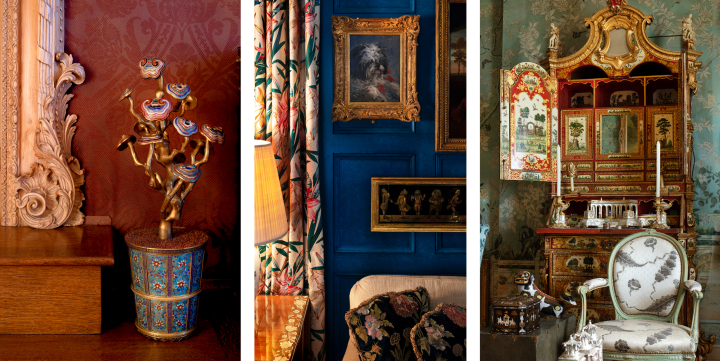
Installation Views: the music room, the blue parlor, and the primary bedroom of Ann and Gordon Getty’s San Francisco residence
(Photograph by Visko Hatfield © 2022)
◊ ◊ ◊ ◊ ◊
From the press release for the upcoming sales (with six online sales having already begun and additional information available here):
The Ann and Gordon Getty Collection
Christie’s, New York, October 2022
Part 1 | Important Pictures and Decorative Arts, Evening Sale, 20 October 2022 #21604
Part 2 | Old Master, 19th- and 20th-Century Paintings, 21 October 2022, #21605
Part 3 | English and European Furniture, Porcelain, and Silver, 22 October 2022, #21606
Part 4 | Chinese Works of Art, English and European Furniture and Decorative Arts, 23 October 2022, #21607
The legendary Ann & Gordon Getty Collection will be sold at Christie’s through a series of landmark auctions beginning October 2022. A symphonic tour-de-force of masterpieces drawn meticulously from history’s most esteemed collections and from one of America’s most storied interiors, The Ann & Gordon Getty Collection stands alone in its quality, rarity and beauty. Nearly 1,500 superlative works of decorative and fine arts will be offered by Christie’s from the couple’s San Francisco residence. Continuing the Gettys’ lifelong commitment to philanthropic causes, proceeds from the sales this October, which are expected to achieve as much as $180 million, will benefit the Ann and Gordon Getty Foundation for the Arts, devoted to the support of arts and science organizations. Designated beneficiaries will include leading California-based organizations with whom the Gettys have had a longstanding relationship, including the San Francisco Conservatory of Music, San Francisco Opera, San Francisco Symphony, University of San Francisco, Berkeley Geochronology Center, and the Leakey Foundation.
Gordon Getty commented: “Though she left us far too soon, I know Ann would be proud that her exquisite eye and unmatched dedication to craftsmanship and scholarship are being shared with the world, and that the philanthropic planning around our art collection is being realized. These sales are a continuation of the longstanding philanthropic goals of the Getty family first established by my father, J. Paul Getty.”
Ann Getty’s intellect, curiosity and masterful feel for assemblage guided the Gettys in curating a world-renowned museum-quality collection across their Californian houses, including the very finest examples of English and European furniture, Asian works of art, European ceramics, Chinese export porcelain, silver, European and Asian textiles, and Impressionist and Old Master paintings. Vivid, daring, and steeped in history, the Collection evokes the golden age of England’s great houses; the fabled Grand Tour; the exotic tastes of the European courts; the feats of women adventurers, such as Isabella Bird in India and Gertrude Bell in the Middle East; and the vibrant intellectual circle of the Blue Stockings in the mid-18th century, such as Mary Delany and Queen Charlotte. Ann Getty masterfully styled each of their residences with distinctive details, themes, and layering. The Collection encapsulated the couple’s intellectual curiosity about the arts, music, science, and travel. Every object was hand-picked with a deep appreciation of its beauty and the artisanship that went into its creation.
The full press release is available here»
A video tour is available here»
New Book | Growing Up Getty
From Simon & Schuster:
James Reginato, Growing Up Getty: The Story of America’s Most Unconventional Dynasty (New York: Simon & Schuster, 2022), 336 pages, ISBN: 978-1982120986, $28.
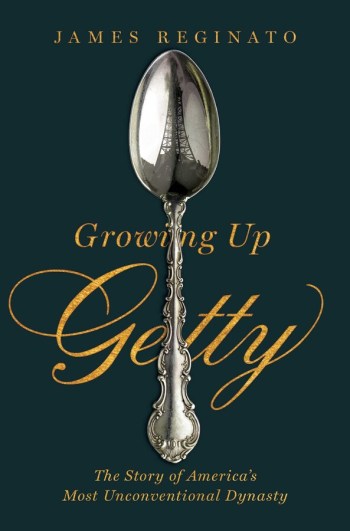 An enthralling and comprehensive look into the contemporary state of one of the wealthiest—and most misunderstood—family dynasties in the world, perfect for fans of Succession, The House of Gucci, The Cartiers, and Fortune’s Children.
Oil magnate J. Paul Getty, once the richest man in the world, is the patriarch of an extraordinary cast of sons, grandchildren, and great-grandchildren. While some have been brought low by mental illness, drug addiction, and one of the most sensational kidnapping cases of the 20th century, many of Getty’s heirs have achieved great success. In addition to Mark Getty, a cofounder of Getty Images, and Anne G. Earhart, an award-winning environmentalist, others have made significant marks in a variety of fields, from music and viniculture to politics and LGBTQ rights.
Now, across four continents, a new generation of lively, unique, and even outrageous Gettys are emerging, and not coasting on the dynasty’s still-immense wealth. August Getty designs extravagant gowns worn by Katy Perry, Cher, and other stars; his sibling, Nats—a fellow LGBTQ rights activist who announced his gender transition following his wedding to transgender icon Gigi Gorgeous—produces a line of exclusive streetwear. Their fascinating cousins include Balthazar, a multi-hyphenate actor-director-DJ-designer, and Isabel, a singer-songwriter-MBA candidate. A far-flung yet surprisingly close-knit group, the ascendant Gettys are bringing this iconic family onto the global stage in the 21st century.
Through extensive research, including access to J. Paul Getty’s diaries and love letters, and fresh interviews with family members and friends, Growing Up Getty offers an inside look into the benefits and burdens of being part of today’s world of the ultra-wealthy.
James Reginato, a writer-at-large for Vanity Fair and a contributor to Sotheby’s magazine, was formerly the features director for W magazine. He is the author of Great Houses, Modern Aristocrats, and The Carlyle. A graduate of Columbia University, he lives in New York City.
At Bonhams | Exploration and Travel Literature with Americana
From the press release for the upcoming auction:
Exploration and Travel Literature, Featuring Americana
Bonhams, New York, 25 October 2022

Lot 12, Miguel de Costansó, Manuscript Map of California, Carta Reducida del Occeano Asiatico ó Mar del Sur…, produced in conjunction with the Portola and Serra expedition, 30 October 1770, 84 × 84 cm, on four conjoined sheets. Estimate: $600,000–800,000. More information is available here.
On October 25, Bonhams will present the most important 18th-century map of California as the highlight of its Exploration and Travel Literature, featuring Americana sale in New York. Estimated at $600,000–800,000, this original manuscript map of coastal California is signed by Miguel de Costansó (1741–1814), a Catalan cartographer, cosmographer, and engineer for the Portola Expedition. Dated Mexico, 30 October 1770, Costanso’s map is the first to depict San Francisco Bay and marks the beginning of the Spanish settlement in the region. The map exists in three versions: an early version in manuscript, not showing San Francisco Bay; this version in manuscript; and the 1771 printed map produced in Spain from this version.
A selection of Americana also features in the sale, including a subpoena for then President Thomas Jefferson (1743–1826), the first to be issued to a sitting president, requiring evidence in the case of treason against Aaron Burr. The document provides one of the earliest and most prominent tests of the concept now known as executive privilege. Burr, the third Vice-President of the United States and a Founding Father, was arrested and accused of High Treason for his role in a wild conspiracy to raise an army to separate the Louisiana Territory and Western states from U.S. rule in 1807. The subpoena gave rise to a host of issues, including executive privilege, equal rights under the law, and the independence of the executive branch, as well as the idea of preservation of state secrets. It is estimated at $200,000–300,000.
Additional Americana sale highlights include
• A previously unknown 1847 letter written and signed by American abolitionist and former slave, Frederick Douglass (1817–1895), estimated at $50,000–70,000. Douglass had fled the United States in 1845 for fear of being taken up as a fugitive. Returning for the first time to America as a free man, Douglass here vividly describes his mistreatment during his return voyage aboard the Cambria, a pivotal experience in his life.
• An incredibly rare copy of the first federal copyright law signed in 1790 by Thomas Jefferson as the first United States Secretary of State, which laid the foundation of American copyright law, spurring 230 years of innovation and creating the framework for modern intellectual property law in the 21st century (est: $100,000–150,000).
The sale will also feature material related to exploration and travel literature including
• Thesaurus rei herbariae by Johann Wilhelm Weinmann (1683–1741), a German apothecary and botanist known his influential masterwork Phytanthoza iconographia (1737–45), which contained more than 1,000 hand-colored engravings of several thousand plants. Estimated at $40,000–60,000, this manuscript is a rare and valuable record of plants cultivated in the early 18th century, based on Weinmann’s own collection.
• Three rare photograph albums featuring the work of British photographer John Claude White (1853–1918), including the personal journal in photographs of his son-in-law Henry Hyslop during their expedition to the coronation of the King of Bhutan in 1907 (est: $30,000–40,000).
Exhibition | ‘I Made This …’: The Work of Black American Artists
From the press release (19 September 2022) for the exhibition:
‘I Made This …’: The Work of Black American Artists and Artisans
DeWitt Wallace Decorative Arts Museum, Colonial Williamsburg, 22 October 2022 — 31 December 2025
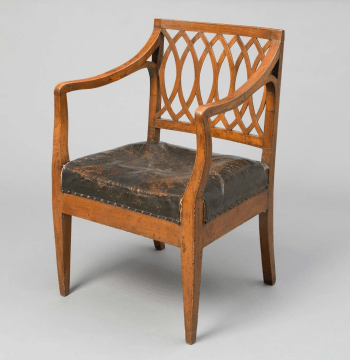
Armchair probably by enslaved artisans working in the Monticello Joinery, Albemarle County, Virginia, 1790–1815. Cherry, linen, tow, hair, leather, and brass (Colonial Williamsburg, 1994-107).
For the first time, the Art Museums of Colonial Williamsburg will display a wide range of works from their heralded decorative arts and folk arts collections made exclusively by Black artists from the 18th to the 20th centuries. The exhibition will include nearly 30 examples of paintings, furniture, textiles, decorative sculptures, quilts, ceramics, tools, metals, and more, including new acquisitions, and will focus on the makers and their stories. ‘I Made This …’: The Work of Black American Artists and Artisans will open on October 22 in the Miodrag and Elizabeth Ridgely Blagojevich Gallery of the DeWitt Wallace Decorative Arts Museum and will remain on view until 31 December 2025. Among the objects to be presented are works by noted Black artists and artisans including David Drake, Bill Traylor, Thornton Dial, Sr., Cesar Chelor, Clementine Hunter, William Edmondson, members of the Gee’s Bend quilting community, as well as less known or anonymous makers.
“Colonial Williamsburg has long sought to acquire objects that illustrate the diverse nature of early American society,” said Ronald Hurst, the Foundation’s Senior Vice President, Education and Historic Resources and The Carlisle H. Humelsine Chief Curator. “The documented works of gifted Black artists and artisans have long been included in our exhibitions, but we have rarely had the opportunity to mount an exhibition that looks solely at this rich body of material. This is an important and timely undertaking.”
The curation of ‘I Made This …’ is also an important first for the Art Museums. Colonial Williamsburg employees from across the Foundation’s various disciplines assembled to assist with the exhibition. The diverse advisory group—comprised of Black and white staff from the historic trades, museum theater, orientation, historic sites, curatorial services, archaeology, and conservation departments—met over the course of several months to discuss exhibit themes and to help with object selection. The outcome of their individual experiences, backgrounds, and perspectives guided important conversations, among them the decision to emphasize the personal stories of Black artists and makers alongside their objects in the exhibition. Committee members also worked with input from Foundation curators and conservators to refine a list of 140 objects from Colonial Williamsburg’s collections down to nearly 30 pieces in addition to several rotations of light-sensitive material.
A central concept of the exhibition is the idea to highlight makers from various circumstances and backgrounds in a way that celebrates their achievement, artistry, and craftsmanship over the course of three centuries. This was done by placing a diverse grouping of objects from various time periods alongside one another. While the creation of a multi-media, cross-disciplinary exhibition on African American art is new for Colonial Williamsburg, the acquisition and exhibition of Black-made objects goes back at least 75 years. The Foundation’s commitment to telling the larger story of American craft is also evident in the recent acquisition of important objects by Black artists and artisans. Nearly one third of the objects in the exhibition are comprised of pieces acquired within the past five years.
One exciting outcome of this project is new discovery. Ongoing research in the areas of furniture, textiles, mechanical arts, and painting has led to renewed scholarship, updated maker attributions, and groundbreaking findings on artists painting techniques. A symposium planned for November 2023 will feature scholars speaking on a variety of these topics related to African American art and craftsmanship.
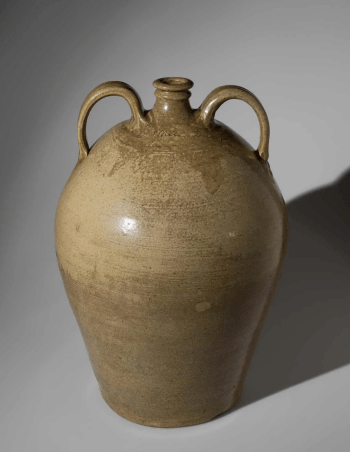
Jug by David Drake, Edgefield, South Carolina, 1842, alkaline-glazed stoneware (Colonial Williamsburg, 2021.900.24).
The exhibition’s title quote, “I made this …,” comes from David Drake (ca. 1801–ca. 1875), among the more well-known artisans whose work will be featured. Drake is one of the few enslaved potters in 19th-century America whose work can be specifically attributed. Working in the Edgefield district of South Carolina, Drake is one of the very few enslaved potters known to sign and date his wares at a time when literacy for the enslaved was illegal. He often inscribed verses on his pots; several began with the words, “I made this ….” Drake may have learned to read and write from his first enslaver, Harvey Drake.
A five-gallon jug, made by Drake of ash-glazed stoneware and on view for the first time at the Art Museums, is among the highlights of the exhibition. Very few two-handled Drake jugs are known, and even fewer are signed and dated. This example, made at Stoney Bluff plantation in Edgefield, is the tallest of his recorded jugs at nearly 20 inches and is a monumental example of his outstanding potting techniques. It is dated “April 26, 1842” on one side and reads “L. Miles Dave” on the other, referencing Lewis J. Miles and Drake himself. Drake began working for Lewis Miles in 1840, while enslaved by John Landrum who died in 1846. In 1849, Miles became Drake’s enslaver.
Another featured work that will delight visitors is a 1993 watercolor on paper by Thornton Dial, Sr. (1928–2016), simply titled Painting and made in Bessemer, Alabama. The artist lived his entire life around Bessemer. Always interested in working with his hands, Dial toiled at odd jobs ranging from carpentry to iron work. In his spare time, he made sculptures from recycled materials. He worked for 28 years for the Pullman Standard Company where he learned about drawing from studying machine illustrations. Once Dial began to draw, he was prolific in the production of his pictures using them as a means for expressing his ideas and feelings. Tigers symbolized empowerment for him and were often a subject in his art as exemplified by this painting. As Dial said in 1995 and 1996 interviews, “Art is like a bright star up ahead in the darkness of the world. It can lead peoples through the darkness and help them from being afraid of the darkness. Art is a guide for every person who is looking for something. That’s how I can describe myself: Mr. Dial is a man looking for something.”

Sampler by Sarrah Ann Pollard, 1818, flat silk embroidery threads on a linen ground of 27 × 27 threads per inch, 53 × 52 cm (Williamsburg Foundation, 2011-103).
One of the notable textile examples to be seen in this exhibition is a sampler made in Salem, Massachusetts, in 1818 by Sarrah Ann Pollard (dates unknown), a student at the Salem African School. The primary goal of African schools was to provide religious instruction to Black children. Making samplers provided instruction for girls in arithmetic and spelling in addition to stitching. Sarrah’s teacher was Clarissa Lawrence, who presided over the school from 1807 to 1823. In 1832 Lawrence became a charter member of the Salem Women’s Anti-Slavery Society, established by free Black women, and served as chair for the Society’s committee for the Salem African School, helping to underwrite the teacher’s salary and provide substitute teaching when necessary. Lawrence was chosen in 1839 as a delegate to the third annual Anti-Slavery Convention of American Women. During a discussion about improving education for Black children, Lawrence addressed the convention saying in part, “We meet the monster prejudice everywhere … we are blamed for not filling useful places in society; but give us light, give us learning, and see what places we can occupy.”
New to the Foundation’s furniture collection and included in ‘I Made This …’ is a side chair made by Thomas Day, a free Black craftsman from Milton, North Carolina. Day learned the art of cabinetmaking from his father, later operating his own shop from the early 1820s until his death in 1861. Day employed free Black, white and enslaved workers in the production of furniture and architectural woodwork. He was well-regarded by local society, often described by customers and neighbors as “steady and industrious,” and considered to be a “first rate workman,” and a “highminded, good, and valuable citizen.” His attendance at The Fifth Annual Convention for the Improvement of the Free People of Colour in Philadelphia in 1835 and ties to national abolitionist leaders suggests he quietly harbored anti-slavery sentiments that he likely dared not share outside his family. This chair may have been originally owned by Day’s neighbors and fellow Presbyterian parishioners Samuel and Elizabeth Watkins, owners of the building that Day purchased for his shop and home in 1848.
Special programming related to the exhibition will include ‘Expert Insights’ talks with Colonial Williamsburg curators and educators who will offer an in-depth look at the Black artists and artisans featured in I Made This …’ on Tuesdays at 10.30am October 25, November 1, 8, and 15. On Wednesday afternoons at 3.00pm (October 26, November 2, 9, and 16) visitors can join ‘Works by Black Artists and Artisans’ tours, in which they can tour the museum galleries, including this exhibition, to explore decorative arts and folk art made by Black artists and artisans.
Additionally, an exhibition conference will be held 10–11 November 2023, with keynote lectures from founding members of the Black Craftspeople Digital Archives, Dr. Tiffany Momon (visiting assistant professor at Sewanee: The University of the South) and Dr. Torren Gatson (assistant professor, University of North Carolina at Greensboro), along with an opening dinner and presentation specially designed by James Beard award-winning author Michael Twitty. Dr. Bernie Herman (the George B. Tindall Distinguished Professor of Southern Studies and Folklore at the University of North Carolina at Chapel Hill) rounds out the lineup of guest lecturers.
‘I Made This …’: The Work of Black American Artists and Artisans is generously funded by a grant from The Americana Foundation.
Smithsonian Commitments to the Center for the Study of Global Slavery
Brownell’s recent article for The New York Times highlights priorities of the National Museum of African American History and Culture—as first established under the leadership of Lonnie Bunch, the museum’s founding director, who now oversees the entire Smithsonian Institution—as well as forthcoming projects including the international exhibition In Slavery’s Wake.
Ginanne Brownell, “A Smithsonian Museum Sharpens Focus on the History of Slavery,” The New York Times (14 October 2022). Despite ambivalence from some on the topic, the institution’s latest leader “knew that slavery had to be at the heart of the museum.”

Exterior view of the National Museum of African American History and Culture; Washington, DC (Photo by Alan Karchmer/NMAAHC).
“Every nation is ambivalent about slavery,” said Mr. [Lonnie] Bunch, the first African American to lead the Smithsonian. “The people of color are ambivalent: Is this something to be embarrassed by? Is this something that is better left unsaid? So basically, I knew that slavery had to be at the heart of the museum.”
When the museum [National Museum of African American History and Culture] opened in 2017, so did the Center for the Study of Global Slavery within it. The center’s work focuses on three international collaborative initiatives: the Slave Wrecks Project, the Global Curatorial Project, and the Slave Voyages Consortium.
The Slave Wrecks Project helps coordinate searches for sunken slave ships and works on maritime archaeological research and historical recovery. This month in Senegal, the inaugural Slave Wrecks Project Academy’s cohort of African and diaspora students are being trained in diving and learning about the global slave trade. The center also works with slavevoyages.org to help expand data collection beyond the trans-Atlantic slave trade and is working to broaden research into both the Indian Ocean and inter-American slave trades.
Under the auspices of the Global Curatorial Project, a number of partner institutions—including Liverpool’s International Slavery Museum, Iziko Slave Lodge in Cape Town, and Belgium’s Royal Museum of Central Africa—are in the midst of putting together In Slavery’s Wake, a traveling exhibition that will open first at the museum in Washington in late 2024 and then move to Africa, Europe, and the Americas.
The center will be hosting an event in Lisbon, Portugal in January, with a tentative title Reckoning with Race: The Social Memory of the Slave Trade in Our World, that will aim to bring more public attention to the role that Portugal played in the slave trade. Mr. Bunch will be one of the event’s speakers. . . .
The full article is available here»
New Book | Black England: A Forgotten Georgian History
A new edition of this pioneering book, first published in 1995:
Gretchen Gerzina, with a foreword by Zadie Smith, Black England: A Forgotten Georgian History (London: John Murray Press, 2022), 304 pages, ISBN: 978-1399804882, £20.
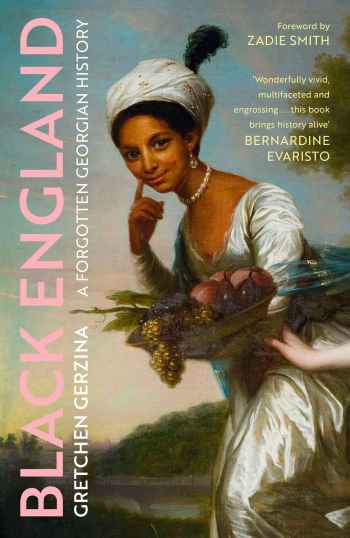 The idea that Britain became a mixed-race country after 1945 is a common mistake. Georgian England had a large and distinctive Black community. Whether prosperous citizens or newly freed slaves, they all ran the risk of kidnap and sale to plantations. Black England tells their dramatic, often moving stories.
In the eighteenth century, Black people could be found in clubs and pubs, there were special churches, Black-only balls and organisations for helping Black people who were out of work or in trouble. Many were famous and respected: most notably Francis Barber, Doctor Johnson’s beloved manservant; Ignatius Sancho, a correspondent of Laurence Sterne; Francis Williams, a Cambridge scholar, and Olaudah Equiano whose Interesting Narrative went into multiple editions. But far more were ill-paid and ill-treated servants or beggars, despite having served Britain in war and on the seas. For alongside the free world there was slavery, from which many of these Black Britons had escaped.
The triumphs and tortures of Black England, the Ambivalent relations between the races, sometimes tragic, sometimes heart-warming, are brought to life in this wonderfully readable history. Black England explores a fascinating chapter of our shared past, a chapter that has been ignored too long.
Information about Gretchen Gerzina is available from her faculty profile page at the University of Massachusetts Amherst and from her personal website.
Online Talk | Janet Couloute on Black Presence in the Wallace Collection
From The Wallace Collection:
Janet Couloute, Black Presence in the Wallace Collection
Online, Thursday, 20 October 2022, 13.00 (BST)

Govaert Flinck, A Young Archer, ca. 1639–40, oil on oak panel, 66 × 51 cm (London: The Wallace Collection, P238).
To mark Black History Month in Britain, join Janet Couloute for a virtual African Heritage tour of the Wallace Collection. Spanning 400 years of European art, Dr Couloute will place the presumed peripheral and unimportant black male and female figure centre stage. Through a closer look at how artists have created iconographies of blackness and whiteness, Couloute will illustrate how museums such as the Wallace Collection, through more inclusive and open history telling, can encourage visitors to respond more imaginatively to such iconographies. This talk will be hosted online through Zoom and YouTube. Please click here to register for Zoom.
Janet Couloute is a social work academic and art historian interested in revising and expanding current British art-historical canons. With a particular interest in works that are rarely discussed as visual indexes of ‘race’, she is currently working on a research project entitled Renaissance ‘Whiteness’: Reimaging ‘Race’ through the Prism of Early Modern Portraiture. Dr Couloute has also been a Tate guide for twenty years, and has developed an expertise in encouraging gallery audiences to engage with the histories of the Black presence in Europe.
Symposium | Early Modern Global Political Art
From the Krannert Art Museum:
Early Modern Global Political Art
In-person and online, Krannert Art Museum, University of Illinois, Urbana-Champaign, 20–21 October 2022
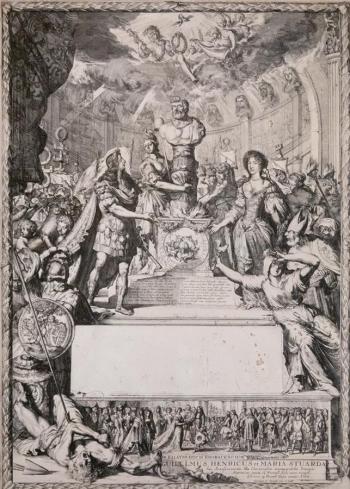
Romeyn de Hooghe, Marriage of William and Mary, 1677, etching (Krannert Art Museum, 2019.7.7).
Featuring emerging scholarship on the art of this period against the backdrop of the exhibition Fake News & Lying Pictures: Political Prints in the Dutch Republic, Krannert Art Museum hosts a symposium on Early Modern Global Political Art.
In the early modern period, nations, nobles, corporations, religious groups, and others found dynamic and innovative ways to use the visual arts for a wide range of political purposes. Nations dispatched elaborate diplomatic gifts to initiate and consolidate alliances. Aristocratic powers and individual collectors alike amassed collections to convey and enhance their political and economic power. Courts and cities produced ephemeral decorations to assert and display ideal political relations between nobility and their subjects, and between regional and outside authorities. Broadsheets addressing factional conflicts within and among institutions proliferated with the expansion of affordable print media. This symposium will investigate visual media that communicated political ideas, arguments, positions, and forms of resistance in the early modern period.
The event will be hybrid, blending in person presentations with online presentations via Zoom to facilitate greater accessibility and wider participation. All virtual components will be live captioned in English via Zoom. If you have a question or an accessibility request, please email us at kam-accessibility@illinois.edu. Registration is required for virtual and in-person components of the symposium.
Keynote Speakers
Dawn Odell (Lewis & Clark College) — Dr. Odell studies artistic exchange between China and northern Europe in the 17th and 18th centuries. She is currently writing a book on Andreas Everardus van Braam Houckgeest, an 18th-century Dutch Immigrant to the newly formed United States whose travelogues and Chinese porcelain collection were leveraged for social and political power.
Liza Oliver (Wellesley College) — Dr. Oliver’s research focuses on 18th- and 19th-century India, Europe, and the West Indies. Her current projects include the book Empire of Hunger: Representing Famine, Land, and Labor in Colonial India and work about British prints about abolition and the Haitian Revolution.
T H U R S D A Y , 2 0 O C T O B E R 2 0 2 2
9.00 Catholic Rulership around the World, Part One
• Moyun Zhou (PhD Candidate, University of Hong Kong), Can You Feel Me? The Global Space of St. Paul’s in Macao, 1592–1644
• Maria Vittoria Spissu (Senior Assistant Professor, University of Bologna and Marie Skłodowska-Curie Global Fellow), Bonds and Tenets in the Wider Iberian Catholic Universe: Fostering Political Unanimity by Means of Early Modern Altarpieces and Books
• Małgorzata Biłozór-Salwa (Curator of Old Master Drawings, University of Warsaw Library), Let’s Make A Crusade! Power of Images Under Louis XIII
10.20 Fashion, Part One
• Isabel Escalera (PhD Candidate, University of Valladolid), Jewelry as A Political Instrument: Renaissance Women and the Transmission of Their Power
• Diana Lucía Gómez-Chacón (Faculty, Complutense University of Madrid), Fashion as A Political Art: Gender, Monarchy, and Spectacle in Early Modern Castile
11.15 Negotiating Political Power in Republics
• Răzvan-Iulian Rusu (Graduate Student, Utrecht University), Global Gifts of Johan Maurits: Patronage, Image-Formation, Art & Material Culture
• Laura Blom (Postdoctoral Fellow, Dutch University Institute for Art History, Florence), Death as Dissent: The Macabre and the Medici in Renaissance Florence
5.30 Keynote Lecture
• Liza Oliver (Associate Professor of Art, Wellesley College), An Economy of Sentiment: The Shared Language of Abolitionists and the West India Interest in Late 18th-Century British Print Culture link»
This talk considers how spectatorial sympathy, a governing principle of 18th-century British art and literature, was deployed by opposing sides of the debate on Britain’s slave trade in the decades preceding its abolition. Considering broadsides, travel narratives, and caricatures, it argues for the ways in which sentiment became a common visual currency among both abolitionists and the pro-slavery lobby, with each side respectively seeking to sever or reaffirm the connection between morality on the one hand and self-interest and economic prosperity on the other.
F R I D A Y , 2 1 O C T O B E R 2 0 2 2
9.30 Coffee
10.00 Catholic Rulership around the World, Part Two
• Rachel Wise (2020 PhD in Art History, University of Pennsylvania), A Royal Devotion: Printed Habsburg Propaganda and the 80 Years’ War
• Angela Ho (Associate Professor, George Madison University), Risks and Payoffs: Ferdinand Verbiest’s World Map for Kangxi in Political Context
11.00 Fashion, Part Two
• Heather Hughes (Curator of Prints, Philadelphia Museum of Art), Recognizing the Enemy: The Spaniard in Dutch and Flemish Costume Prints
• Nancy Karrels (2022 PhD in Art History, University of Illinois Urbana-Champaign), Women for Bonaparte: Political Prints and Female Self-Fashioning in France’s Cultural Conquests
12.00 Lunch Break
1.30 Keynote
• Dawn Odell (Associate Professor of Art History, Lewis & Clark College), The Politics of Personhood in A.E. Van Braam Houckgeest’s China Memoir link»
Following his participation in the Dutch East India Company’s last embassy to the Chinese court (1794–95), A.E. van Braam Houckgeest moved to Philadelphia with an enormous personal collection of Chinese art. This talk explores van Braam’s self-fashioning through his collaboration with two unnamed Guangzhou artists and the French émigré printer and defender of race-based slavery, M.L.E. Moreau de Saint-Méry. The illustrated memoir these men produced places van Braam’s textual narrative within an expansive visual environment of Chinese landscape paintings and other works of Asian art, conjuring artistic presences as testaments to the author’s self-proclaimed virtue, prestige, and republican ideals.
3.00 Tour of Fake News and Lying Pictures: Political Prints in the Dutch Republic
◊ ◊ ◊ ◊ ◊
From the Krannert:
Fake News & Lying Pictures: Political Prints in the Dutch Republic
Krannert Art Museum, University of Illinois, Urbana-Champaign, 25 August — 17 December 2022
Curated by Maureen Warren
 Comedians, editorial cartoons, and memes harness the power of satire, parody, and hyperbole to provoke laughter, indignation—even action. These forms of expression are usually traced to eighteenth-century artists, such as William Hogarth, but they are grounded in the unprecedented freedom of artistic expression in the seventeenth-century Dutch Republic.
Maureen Warren, ed., with contributions by Wolfgang Cillessen, Meredith McNeill Hale, Daniel Horst, Maureen Warren, and Ilja Veldman, Paper Knives, Paper Crowns: Political Prints in the Dutch Republic (Champaign: Krannert Art Museum, 2022), 184 pages, ISBN: 978-1646570294, $40.
Exhibition | Painted Cloth: Fashion and Ritual in Colonial Latin America

From the press release for the exhibition:
Painted Cloth: Fashion and Ritual in Colonial Latin America
Blanton Museum of Art, The University of Texas at Austin, 14 August 2022 — 8 January 2023
The Blanton Museum of Art at The University of Texas at Austin is pleased to present Painted Cloth: Fashion and Ritual in Colonial Latin America, an ambitious and timely show that explores the production, meaning, and representation of fabric and garments as they were experienced in civil and religious settings across Latin America during the 1700s. Painted Cloth features over 70 objects produced in five countries from the Blanton’s growing collection of art of the Spanish Americas, alongside key loans from distinguished institutions and private collections around the world.

Our Lady of Bethlehem with a Donor, Cusco, 18th century, oil with gold leaf on canvas, 105 × 73 inches (Collection of Carl and Marilynn Thoma)
“With the opening of Painted Cloth, we’re thrilled to finally unveil the extraordinary exhibition made possible by our longstanding partnership with the Thoma Foundation, whose investment and belief in the Blanton over the years has strengthened our commitment to the study of art of the Spanish and Portuguese Americas,” said Blanton director Simone Wicha. “Thanks to their support, the work of Rosario I. Granados, the first Marilynn Thoma Associate Curator, Art of the Spanish Americas, has advanced significant scholarship in this still underrepresented era of art history. The elaborate fabrics, fashion, and other richly textured works in this show are not only a feast for the eyes, they also will give our audiences a good look into everyday life during an era of dynamic cultural exchange and show how clothing—then as now—is so intertwined with our identities. Equally beautiful as it is insightful, Painted Cloth is sure to inspire conversations about race and colonialism’s complex legacies and offer a greater understanding of this period in Latin America’s history.”
An unquestionable marker of identity, clothing distills complex relationships between race, gender, religion, and class. Painted Cloth reflects on the social roles of textiles and their visual representations, emphasizing how aesthetic traditions of Indigenous and European origin wove themselves into civil, religious, and artistic life at a time when the Spanish monarchy imposed their rule in the region.
As the title references, the exhibition foregrounds not only beautifully crafted garments and textiles, but also explores how the practice of depicting textiles in paintings, sculptures, prints, and furnishings created a visual artifice that captured their aesthetic, ritual, and commercial value. This interplay between objects and images courses through five visually striking sections: Cloth Making, Wearing Social Status, Dressing the Sacred, The Holiness of Cloth, and Ritual Garments.
“Collectively, these groupings address how cloth and their representation in other media articulated narratives of social privilege and survival of cultural traditions, while also highlighting the mixed identity of colonial Latin America,” said Granados. “Garments are a lens by which we can recognize the many inequalities and societal contradictions that characterized the social fabric of this contested era, which altered the lives of so many Indigenous communities, but also the beauty of the Spanish America’s artistic production and thereby the diverse cultures of its peoples.”

José Joaquin Magón, Two Casta Paintings, ca. 1770.
Cloth Making
Painted Cloth begins with the manufacture and artistry of textiles in the 1700s. Works in the first section on Cloth Making underscore how various kinds of European and Indigenous garments were manufactured, emphasizing the role persons of different social status played in the industry. Included are works from the only series of casta paintings (a Mexican artistic genre that documents mixed-race couples and their children according to a caste system defined by Spanish elites) to prominently showcase women as integral to the production of textile arts, from spinning and weaving wool to their work as seamstress and tailor’s aids. In one example of this series by Mexican painter José Joaquín Magón, a woman makes bobbin lace, a costly material that was commonly imported from Europe and adopted in local attire.
The interlacing of foreign materials and traditions with local practices is also present in a set of silk swatches from Mexico. Sent with official reports to the King of Spain, these rare fabric samples show the production of block-print patterns inspired by textiles from India that signal the presence of highly skilled silk weavers in the New Spanish (Mexican) capital. The Cuzqueña painting Virgen de los Sastres (Virgin of Tailors) gives evidence that tailors, many of whom were of mixed-race descent, produced liturgical vestments made from imported European silks and brocades—examples of which are seen in the last section of the exhibition.
Many of the works in this section also address how Indigenous and Christian notions of the sacred were combined. Christian missionaries in the Andes popularized iconography that linked spiritual devotion with the labor involved in manufacturing cloth, circulating paintings that depicted the Virgin Mary or Holy Family undertaking artistic or industrious activities. By depicting Mary embroidering and spinning, the two paintings La Casa de Nazareth (The House of Nazareth) and La Virgen niña hilando (The Child Mary Spinning) make a connection between Christianity and the Indigenous cultures’ regard for the sacred nature of textiles.
Wearing Social Status

Miguel Cabrera, Doña María de la Luz Padilla y Gómez de Cervantes, ca. 1760, oil on canvas, 43 × 33 inches (Brooklyn Museum).
The second and largest section of the exhibition, Wearing Social Status, explores how fashion codes determined social interactions and collective identities in terms of gender, race, and class. This is particularly visible in Mexican casta paintings and a unique series of Peruvian mestizaje paintings, on view in the U.S. for the first time, as well as in commissioned portraits—an increasingly popular genre in this period. Since few garments from the era have survived, such paintings, although ripe with artifices, serve as an invaluable source for the study of fashion and its social significance.
One of the most memorable features of this section is the pairing of painted garments in portraits with actual garments. Paintings of well-dressed Latin American sitters by Miguel Cabrera, one of the most celebrated and prolific artists of the period, demonstrate a desired social prestige, as evident in the great attention paid to the subject’s dress. These costly dresses and elegant three-piece suits are in dialogue with similar European costumes, illustrating the influence of global trade as well as French fashion.
Clothing is also relevant in the portraits Indigenous elite commissioned to assert noble ancestry. The figure in Inca Noblewoman, notably dressed in an intricate anuca, or women’s dress, resembles the first queen of the Inca dynasty, Mama Occllo. Such motifs and codes of dress establish the sitter’s connection to Inca royalty and, as the inscription makes clear, her status as the first Christian Inca woman. In conversation with this portrait is a late 17th-century camelid wool anacu embroidered with mermaids, Inca queens, and traditional Andean geometric patterns, accompanied by a silver fastening pin known as a ttipqui or tupo incised with the imperial double-headed eagle. These artifacts offer examples of fusing Incan and European motifs to negotiate identity in a colonial environment.
Dressing the Sacred
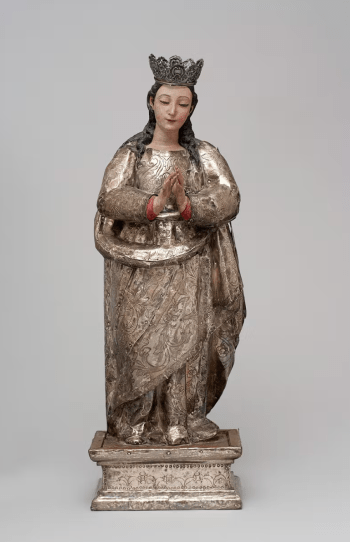
Inmaculada Concepción (Immaculate Conception), Guatemala, ca. 1740–80, silver and oil on wood, 34 inches high (Blanton Museum of Art, The University of Texas at Austin, 2019).
The exhibition’s third section exemplifies how religious material culture enhanced the experience of the holy for all social sectors. The use of fine materials in sacred objects amplified an object’s visual appearance, and with it, its sacred aura, thereby facilitating conversion and enhancing devotional practice. This is particularly true of the fabrics placed on imágenes de vestir, or ‘dress images’. These simple wooden structures were explicitly made to be clothed in rich fabrics, like the satin mantle on view, embroidered in gold and silver threads for a statue of the Virgin Mary.
In other instances, real fabrics were imitated by modeled silver, as in an example of a devotional sculpture from Guatemala, a practice that continues in the Central American country today. Fabrication of reality was likewise achieved by replicating golden embroideries and brocade fabrics using estofado, a technique that involves applying gold leaf to wooden surfaces. In two paintings from the so-called Cusco School, respectively depicting St. Lawrence and St. Jerome, gilded details emphasize the richness of saintly garments.
Brimming with golden brocades, the large painting Nuestra Señora de Belén con un donante (Our Lady of Bethlehem with a Donor) bookends this section. The work, a brilliant example of a verdadero retrato, or ‘true portrait’, depicts the 16th-century cult statue of Our Lady of Bethlehem of Cusco placed on a processional platform. Displayed in a dimly lit gallery that alludes to the painting’s original display, viewers can get a sense of the effect such objects were intended to evoke.

Presentation of the Virgin Mary at the Temple, Cusco, 18th century, oil and gold on canvas, 38 × 52 inches
(Collection of Carl and Marilynn Thoma)
Holiness of Cloth
The fourth section, Holiness of Cloth, illuminates how the actual depiction of fabric was central to images that were believed to be of miraculous nature. Cloth could provide material substance to help elucidate abstract notions of the divine, as in examples from the Cusco School of painting, which introduced Andean renditions of Catholic subjects.
The painting Virgen del Carmen salvando a las almas del Purgatorio (Virgin of Carmel Saving Souls in Purgatory) depicts the Virgin Mary with an open cloak—a familiar iconography across the Spanish Americas that symbolized protection. In a disparate work that renders the iconographic Presentation of the Virgin Mary at the Temple, tunics and mantles are gilded with brocateado, elaborate gold-brocade decoration, a technique characteristic of the Indigenous artistic production of Cusco.
In some cases, cloth becomes the divine itself, such as in Mexican painter José de Alzibar’s two works, united and on display together for the first time in history. The first, a representation of Our Lady of Guadalupe, the national patron of Mexico, depicts the cloak of an Indigenous man where the sacred image was thought to have been miraculously imprinted. The second, La Verónica, depicts the Veil of Veronica, one of the most recognizable images in which cloth is represented as a vehicle for the holy.
Ritual Garments
The final section focuses on the use of fabric in church interiors and ritual ceremonies as well as in the formation of clerical identities. Since much of the material used was extraordinarily delicate, prone to damage and decay, paintings of the era help reconstruct an understanding of the use of cloth.
The hierarchical position of Catholic clergy could be recognized by distinct, standardized liturgical clothing. A small glass painting from Bolivia details the repertoire of garments and accessories worn by priests, bishops, cardinals, and the pope, whereby the particular use of colors functioned as a key signifier of rank. In the case of the chasuble, the outermost vestment worn during the celebration of the Eucharist, four seasonal colors were used to represent the passage of time in the liturgical calendar. Although the chasuble was worn by the lowest rank of priest, the artifact on view from Mexico is crafted in fancy silks and embroidered with silken threads covered in silver and gold.
In the context of the Catholic church, the altar is an important ritual site; in the Spanish Americas it was lavishly decorated, as visual depictions like Misa frente al Cristo de los Temblores (Masses before Christ of the Earthquakes) convey. Like many works that depicted ideal Masses, this painting was created for a private home and painted from the view of a churchgoer to direct focus to the fine textiles and silverware covering the altar. On occasion, a less costly ‘painted cloth’ instead decorated the altar—exemplified by a canvas altar cloth with floral designs that mimic actual textiles. In contrast, a Guatemalan processional banner created entirely from silver emphasizes the use of even valuable materials to imitate cloth and create visual artifice.
 “Painted Cloth rejoices in the artifice of the visual arts to uncover the complexities of human nature,” concluded Granados. “Together, I hope these stunning artworks and artifacts encourage reflection on values of the past and shed new light on the factors that have shaped contemporary Latin American experience.”
The exhibition includes works from the Blanton’s collection, including from the recently acquired Huber Collection, and loans from: Benson Latin American Collection, The University of Texas at Austin; Brooklyn Museum of Art, New York; Carl & Marilynn Thoma Collection, Chicago and Santa Fe, NM; Colección Andrés Blaisten, Mexico City; Colección Barbosa Stern, Lima; Denver Art Museum; Hispanic Society of America, New York; Museo Franz Mayer, Mexico City; Museo de Arte de Lima; Museo Pedro de Osma, Lima; Museo de América, Madrid; Museo Nacional de Antropología, Madrid; Los Angeles County Museum of Art; San Antonio Museum of Art; Witte Museum, San Antonio.
Rosario Inés Granados, ed., Painted Cloth: Fashion and Ritual in Colonial Latin America (Austin: University of Texas Press, 2022), 248 pages, ISBN: 978-1477323977, $45. With contributions by Granados, Ana Paulina Gámez Martínez, Julia McHugh, Ricardo Kusunoki Rodríguez, Patricia Díaz Cayeros, and Maya Stanfield-Mazzi.
Symposium | The Fabric of the Spanish Americas

Domestic Landscape from Quito, in Jorge Juan and Antonio de Ulloa’s Relación histórica del viage a la América Meridional (Madrid: A. Marin, 1748). Benson Latin American Collection, LLILAS Benson Latin American Studies and Collections, The University of Texas at Austin.
◊ ◊ ◊ ◊ ◊
From the Blanton Museum of Art:
The Fabric of the Spanish Americas
Online, Friday, 21 October 2022
Organized in conjunction with the exhibition Painted Cloth: Fashion and Ritual in Colonial Latin America, on view at the Blanton Museum of Art at The University of Texas at Austin, this symposium will bring together scholars from Colombia, Mexico, the United Kingdom, and the United States to further explore the social role of textile arts in colonial Latin America. The keynote will be delivered by Dr. Elena Phipps, and speakers include historians Tamara Walker and Meha Priyadarshini, along with fashion historian James Middleton. The round table discussion will feature art historians Laura Beltrán-Rubio, Martha Sandoval, and Leslie Todd. Registration is available here.
P R O G R A M M E
Central Time
9.00 Keynote
• Elena Phipps (Independent Scholar), Garments and Identity: Textile Traditions in the Global World of Colonial Latin America
10.00 Morning Panel
• Tamara Walker (Barnard College), Fashioning Whiteness in Colonial Latin American Art
• James Middleton (Independent Scholar), They All Greatly Affect Fine Clothes: Textiles in Eighteenth-Century Lima-School Painting
• Meha Priyadarshini (University of Edinburgh), Global Trade, Local Fashion: The rebozo, piña and mantón de Manila
11.30 Q&A
12.00 Intermission
1.30 Round Table Discussion: Artifice in Fashion, Painting and Sculpture
• Laura Beltrán-Rubio (Universidad de los Andes), The Artifice of Fashion: Creating and Performing Identities through Clothing in Colonial Spanish America
• Martha Sandoval-Villegas (Instituto Tecnológico de Estudios Superiores de Occidente, ITESO), Habit Makes the Man… and the Woman: Portrait and New Spain Social ‘Fabric’
• Leslie Todd (Sewanee: The University of the South), The Brilliance and Brocateado of Eighteenth-Century Sculpture in Quito










 Enfilade
leave a comment