Exhibition | Finding Family
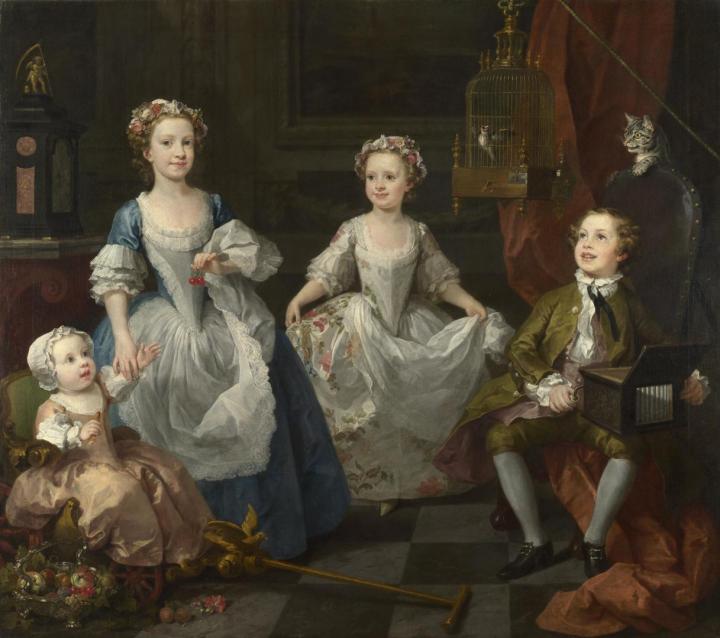
William Hogarth, The Graham Children, 1742, oil on canvas, 161 × 181 cm
(London: National Gallery)
◊ ◊ ◊ ◊ ◊
From the press release for the exhibition:
Finding Family
Foundling Museum, London, 17 March — 27 August 2023
One word, with many meanings: family lies at the heart of all our lives and is considered one of the most important units of society. The exhibition Finding Family, now on view at the Foundling Museum, explores the idea of family through art from the 17th century to the present day. Uncover and explore new perspectives on what family is and can be through this original, insightful exhibition. Involving participants of Tracing Our Tales, the Foundling Museum’s award-winning programme for young care leavers, Finding Family also includes their creative responses to works of art and the exhibition’s themes, from the context of their own lived experience, with challenging, moving, and surprising results.

Le Nain Brothers (Antoine, Louis, and Mathieu), Four Figures at a Table, ca. 1643, oil on canvas, 45 × 55 cm (London: National Gallery).
Is it Blood?
Is it Connection?
Is it Bond?
Is it Love?
Through these four themes, the exhibition presents a series of historic and contemporary works that explore blood relations, social bonds, personal connections, and love—to look at the ways in which artists have represented and responded to ideas of family, past, and present. The show encourages an exploration far beyond the idea of family in a nuclear sense, suggesting a broader, more inclusive definition that also invites us to consider where our own sense of connection and identity lie.
“Our family is always going to form in our hearts because we need role models, connection, and a sense of identity—so we learn to seek family in other places and things, like pets, fashion, friends, culture.” –Tracing Our Tales participant
“Family is very much what you make it. It doesn’t have to be those who you share the same blood with, but those who you share the same interest with.” –Tracing Our Tales participant

Thomas Gainsborough, The Painter’s Daughters Chasing a Butterfly, ca. 1756, oil on canvas, 114 × 105 cm (London: National Gallery).
In partnership with The National Gallery, the exhibition includes three large-scale masterpieces from the Gallery’s collection, by Hogarth, Gainsborough, and the Le Nain Brothers. Objects from the Foundling Museum’s collections and creative responses from the Tracing Our Tales participants invite visitors to look afresh at these well-loved paintings and to question their assumptions. Works by contemporary artists who have responded to the theme of family, as well as newly commissioned pieces, further enrich the exploration of the themes, revealing changes and continuities over time. Contemporary artists loaning work include Matthew Finn, Sunil Gupta, Chantal Joffe, Gillian Wearing, and Hetain Patel, alongside Mark Titchner, Annabel Dover, Tamsin van Essen, Harold Offeh, and Helen Barff who have created new work.
As a charitable home for children whose mothers could no longer keep or care for them, the Foundling Hospital was an alternative to family for the 25,000+ children who were admitted between 1741 and 1954. Without family, foundlings were forced to find connections elsewhere—through their foster families, peers, teachers, and places of employment. Within the context of the Museum’s historic story of care, Finding Family challenges the social construct of family and asks important questions about who and what defines who we are, how we interact with one another, and how we perceive others. The exhibition also showcases the ongoing power of art to challenge, question, and encourage us to see the world with new eyes.
“Writing poetry whilst being in the Foundling Museum is important because we get a sense of how we would feel in the foundlings’ shoes. We have a lot to relate to, especially if you’ve been in care.” –Tracing Our Tales participant
Exhibition | Seeing the Light

Joseph Wright of Derby, A Philosopher Giving That Lecture on the Orrery, in which a Lamp Is Put in Place of the Sun, ca. 1766, oil on canvas, 58 × 80 inches (Derby Museum & Art Gallery).
◊ ◊ ◊ ◊ ◊
Now on view at the Foundling Museum:
Seeing the Light
Foundling Museum, London, 7 March — 4 June 2023
We at the Foundling Museum are excited to display A Philosopher Giving That Lecture on the Orrery in Which a Lamp is Put in Place of the Sun by revered ‘painter of light’ Joseph Wright of Derby. First exhibited in London in 1766, this dramatic painting—on loan from Derby Museum & Art Gallery—offers a fascinating window to changing social attitudes and public understanding of science, education, and technology in the eighteenth century. Wright and his large network of friends and acquaintances had multiple points of connection with key people in the Foundling Hospital’s history and collections. Visit the Museum to discover the story of the Lunar Society and the threads that link a token admitting the holder to a lecture in experimental philosophy, a clock detailing the phases of the moon, and a letter written by girls apprenticed by the Hospital to Wright’s painting and the Age of Enlightenment it celebrates.
While The Orrery is on display in London, visitors can see the Foundling’s magnificent painting by William Hogarth, The March of the Guards to Finchley (1750), at Derby Museum & Art Gallery.
◊ ◊ ◊ ◊ ◊
Note (18 April 2023) — Although it it has yet to penetrate the widespread conception of Wright as a progressive revolutionary artists set, above all, on visualizing Enlightenment science, Matthew Craske’s book Joseph Wright of Derby: Painter of Darkness (Paul Mellon Centre for Studies in British Art, 2020) should be required reading for anyone trying to understand Wright as an eighteenth-century artist. –CH
Exhibition | Hogarth’s Britons
Now on view in Derby:
Hogarth’s Britons: Succession, Patriotism, and the Jacobite Rebellion
Derby Museum & Art Gallery, 10 March — 4 June 2023
Curated by Jacqueline Riding and Lucy Bamford
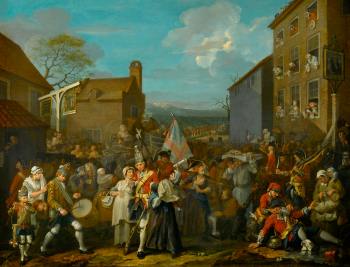
William Hogarth, The March of the Guards to Finchley, 1749–50, oil on canvas (London: The Foundling Museum).
No other artist defines our image of 18th-century Britain quite like William Hogarth. His vibrant narrative paintings, reproduced and circulated widely through print, engaged with some of the most pressing social and political issues of the times. Amongst these was Jacobitism, a campaign to restore the exiled Stuart dynasty to the throne of Great Britain. This exhibition explores Hogarth’s response to this threat, including the last and most serious of all attempts: the Jacobite Rebellion of 1745. Led by Prince Charles Edward Stuart (‘Bonnie Prince Charlie’) with support from France, the Jacobite Army would eventually reach Derby before retreating back north to Scotland and defeat at the Battle of Culloden.
Led by Derby Museums, Hogarth’s Britons has been produced in partnership with the National Gallery and the National Portrait Gallery and is the first exhibition of Hogarth’s works to be staged in Derby. It brings many pieces that have never before been seen in the city, including Hogarth’s masterpiece, The March of the Guards to Finchley (Foundling Museum, London). Others, such as the newly discovered portrait of the Prince by Allan Ramsay (National Galleries of Scotland), will be returning to Derby for the first time since the rebellion of 1745. The exhibition also brings together items from national and private collections, representing local divided loyalties and the experience of life under Jacobite-army occupation.
Hogarth’s Britons: Succession, Patriotism, and the Jacobite Rebellion is co-curated by Jacqueline Riding, acclaimed art historian and author of Jacobites (2016) and Hogarth: Life in Progress (2021); and Lucy Bamford, Senior Curator of Art at Derby Museums.
Jacqueline Riding, Hogarth’s Britons (London: Paul Holberton Publishing, 2023), 120 pages, ISBN: 978-1913645458, £18 / $25.
◊ ◊ ◊ ◊ ◊
Note (added 29 February 2024) — The original posting was updated to include information on the catalogue.










 Enfilade
leave a comment