Opinion | Patricia Marroquin Norby on Nuance and Repatriation
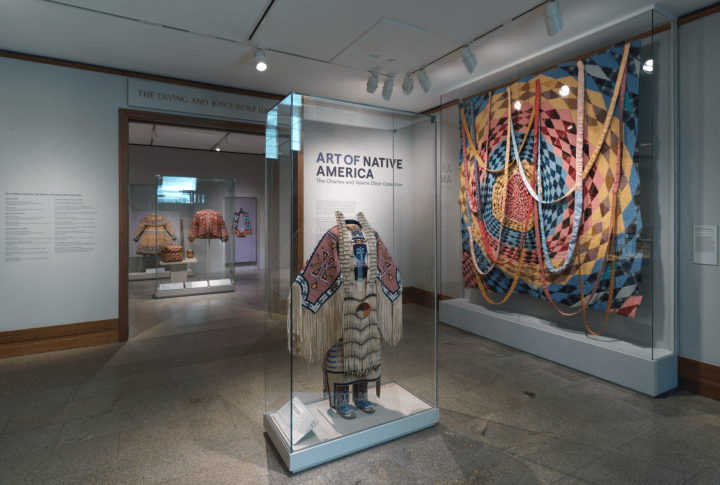
2021–22 entrance to The Met’s long-term exhibition Art of Native America: The Charles and Valerie Diker Collection.
◊ ◊ ◊ ◊ ◊
From Hyperallergic:
Patricia Marroquin Norby, “We Need More Nuance When Talking about Repatriation,” Hyperallergic (19 April 2023). Norby, the Met Museum’s curator of Native American Art, reflects on the lesser-discussed everyday challenges of repatriation work.
. . . The Met and I were both keenly aware that my appointment [as its first curator for Native American Art three years ago] was a milestone moment for the museum and the field. This curatorial position came about because of the promised gift of a prominent Native American collection of works from Charles and Valerie Diker. It’s a collection that had already been well-researched and exhibited at numerous institutions nationwide including the Smithsonian’s National Museum of the American Indian, the Seattle Art Museum, and the Amon Carter Museum of American Art. The gift and landmark curatorial role propelled significant changes at The Met, specifically, foregrounding the voices of Native peoples and presenting their historical and contemporary creative expressions to an international audience in a world-class institution. More important, but less visible to the public, were the much-needed collaborations with Native American source communities regarding the items currently in The Met’s care.
As the museum began exhibiting Native American collections in its American Wing for the first time, we also began working more collaboratively with source communities as exhibition advisors, co-curators, authors, and installation contributors. We listened. We learned. We are still learning.
Native American and Indigenous museum collections necessitate a commitment to long-term relationships with source communities. These relationships have provided some of the most meaningful experiences of my career. When I joined The Met, I emphasized the importance of meeting the needs of Native American communities. I worked to prioritize Indigenous voices in our exhibitions, programs, and collections care. As a woman of Purépecha descent, I understand feeling marginalized. I also understand the simultaneous sense of connection and loss toward items that embody cultural ties to my maternal ancestral community on view in museums. Such experiences are magnified in a historically colonial institution like The Met. . . .
As connections with source communities grew, some colleagues shared their surprise at how repatriation attitudes regarding specific items can differ. Some tribes seek repatriation, while others favor a co-stewardship approach or prefer that works remain at the museum. Community needs are diverse, yet very specific. One commonality across communities and cultures is the desire for a say in how and if works are publicly presented, and how they are cared for. The founding director of the Smithsonian’s National Museum of the American Indian in Washington DC, Richard West Jr., said it best: Indians love and hate museums because “they have our stuff.” For many Indigenous peoples, museums can awaken inner tensions and traumatic histories. For Indigenous museum professionals, these painful pasts are always present. . . .
The full essay is available here»
Lecture | Forgeries, Replicas, and Native American Art
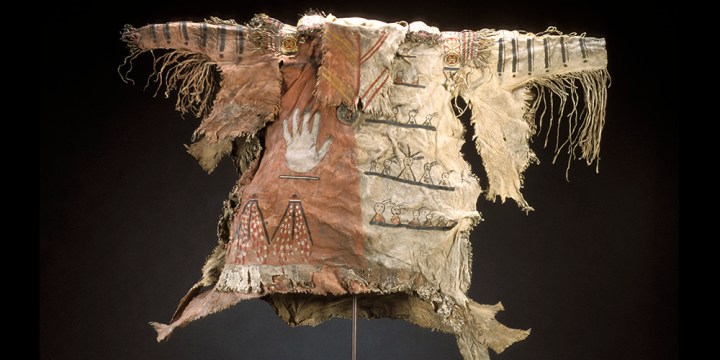
‘Mato-tope’s Shirt’, likely made by George Catlin (Washington, DC: National Museum of Natural History, Smithsonian Institution, NMNHanthropology 8420507). More information is available here»
◊ ◊ ◊ ◊ ◊
From the Bard Graduate Center:
Janet Catherine Berlo | Not Native American Art? Forgeries, Replicas and Other Vexed Identities
Bard Graduate Center, New York, 3 May 2023, 6.00pm
In Native North American artistic traditions, what is a replica? What constitutes a copy? In contrast with the larger field of art history, there is almost no literature on forgeries and replicas in this sub-field. Join us for Janet Catherine Berlo’s lecture, adapted from the introduction to her forthcoming book, Not Native American Art, where she considers notions of replicas, copies, tributes, forgeries, pastiches, and even digital surrogates as they apply to archaeological, historical, and contemporary Native arts of North America.
Register here»
Janet Catherine Berlo, professor of art history and visual and cultural studies emerita at the University of Rochester, holds a PhD in the history of art from Yale University. She is the author of many publications on the Indigenous arts of the Americas, including the most widely-used textbook in the field, Native North American Art, with Ruth B. Phillips (Oxford, second edition 2015). Berlo has also written on American art history and quilt history. Her forthcoming book, Not Native American Art: Fakes, Replicas, and Invented Traditions will be published by the University of Washington Press in July 2023.
New Book | Native American Art from the Weisel Collection
From the FAMSF press release for the catalogue, co-published with DelMonico Books:
Bruce Bernstein, Hillary C. Olcott, Christina Hellmich, Deana Dartt, and Jill D’Alessandro, eds., Native American Art from the Thomas W. Weisel Family Collection (New York: DelMonico Books, 2023), 432 pages, ISBN: 978-1636810966, $85.
 The Fine Arts Museums of San Francisco are pleased to announce the publication of Native American Art: From the Thomas W. Weisel Family Collection, co-published with DelMonico Books, and co-edited by Bruce Bernstein, Hillary C. Olcott, Christina Hellmich, and Deana Dartt with Jill D’Alessandro. The expansive 432-page catalogue celebrates a transformative gift to the Museums that spans nearly one thousand years of artistic creativity by Native American artists.
The volume brings together 206 works of art, exemplifying the exquisite artistry and rich cultural histories represented therein. Highlights of objects researched and presented in the book include 19th-century Diné/Navajo weavings, Ancestral and historic Pueblo pottery, Hopi and Zuni carved figures, and Yavapai and Apache basketry, as well as works from the Pacific Northwest and the Plains. Developed in collaboration with cultural advisors, including Joseph R. Aguilar (San Ildefonso), Stewart B. Koyiyumptewa (Hopi), Arden Kucate (Zuni), Christopher Toya (Jemez) and Brian Vallo (Acoma), the catalogue reflects the complex and multilayered nature of the works in the collection and, more broadly, the field of Native American art.
“The publication of Native American Art has been a monumental, five-year undertaking for the Fine Arts Museums of San Francisco,” said Thomas P. Campbell, Director and CEO of FAMSF. “Our team has worked directly with communities of origin represented in the collection, cultural practitioners, artists, art historians, and museum professionals to share different perspectives on the objects in this collection. We are enormously proud of this collaboration and grateful to each of our authors and advisors for the care they have extended to this project and the knowledge they have shared with us.”
Building upon the Fine Arts Museums’ first publication on the Thomas W. Weisel Family Collection, Lines on the Horizon (2014), Native American Art is an expanded scholarly catalogue that features new research, 30 specially commissioned essays, and 100 extended captions. Contributions by more than 80 authors from different disciplines and cultural backgrounds illuminate details about the living histories of the works. The multitude of perspectives and voices offered here embraces the complexity of the dialogue surrounding Native works past and present, ensuring that Native American Art will be a cornerstone publication in the field of Native American art history.
“The gift of the Thomas W. Weisel Family Collection of Native American Art to the Fine Arts Museums of San Francisco provided the extraordinary opportunity for an open-ended, two-year-long conversation between the Museums and Native communities about the display, imaging, care, and disposition of our Ancestral pottery.” write Joseph R. Aguilar, Stewart B. Koyiyumptewa, Arden Kucate, Christopher Toya and Brian Vallo in their introduction. The results of the dialogue are in this catalogue, including a culturally sensitive approach to reproducing Ancestral pottery images. Every pot was individually considered, most generating lively discussions, and others soliciting respectful silence. The work we have been doing together has been an opportunity to learn from one another.”
Among the important scholarly innovations in Native American Art is the representation of Mimbres bowls and other Ancestral Pueblo pottery forms. Working closely with cultural advisors from five Pueblo communities, the editors and advisory group developed three representative styles for the Mimbres bowls and other Ancestral pottery reproduced in the catalogue. A screen of gold dots takes the place of objects that are culturally sensitive; while drawings made by Acoma artist Michelle Lowden represent bowls that were determined to be from burial contexts but do not feature culturally sensitive imagery. Photography is used when objects are not culturally sensitive.
The catalogue was designed by James Brendan Williams of The Common Era.
A free, public launch event celebrating Native American Art was held Saturday, April 22 at the de Young’s Koret Auditorium. The program included an introduction by volume co-editor Deana Dartt (Coastal Band, Chumash), followed by presentations about Ancestral and historic Pueblo pottery by project contributors Bobby Silas (Hopi-Tewa) and Deborah A. Jojola (Isleta/Jemez Pueblo). The program concluded with a panel discussion between members of the book’s Pueblo Advisors group, Governor Arden Kucate (Zuni), Brian Vallo (Acoma), and Joseph R. Aguilar (San Ildefonso), with volume co-editor Bruce Bernstein.










 Enfilade
leave a comment