Call for Papers | Léopold Robert and Aurèle Robert
From the Call for Papers:
Frères d’art: Léopold et Aurèle Robert
Neuchâtel / La Chaux-de-Fonds, 9–10 November 2023
Proposals due by 31 May 2023 (extended from 14 May 2023)
Dans le cadre de l’exposition Léopold et Aurèle Robert présentée conjointement au Musée des beaux-arts de La Chaux-de-Fonds et au Musée d’art et d’histoire de Neuchâtel du 14 mai au 12 novembre 2023, l’Institut d’histoire de l’art et de muséologie de l’Université de Neuchâtel souhaite encourager la réflexion et l’échange d’idées à propos de ces deux figures artistiques à l’occasion d’un colloque international. Celui-ci se tiendra en présentiel le jeudi 9 novembre 2023 au Musée d’art et d’histoire de Neuchâtel, et le vendredi 10 novembre 2023 au Musée des beaux-arts de La Chaux-de-Fonds.
Graveur à ses débuts, encouragé à la peinture par son maître Jacques-Louis David, Leopold Robert développe, à partir des années 1820, une peinture de genre ennoblie à mi-chemin entre classicisme et romantisme. En y évoquant une vision idéalisée de l’Italie et de ses habitants, il séduit un important public européen nourri des écrits romantiques. Ses nombreuses commandes l’amènent rapidement à rationaliser sa production picturale selon des principes de déclinaison et de combinaison de motifs, et à solliciter l’aide de son cadet, Aurèle, dès 1822. Excellent dessinateur et peintre, Aurele Robert joue dès lors un rôle fondamental dans la promotion du travail de son frère. Du vivant de ce dernier comme après son décès tragique, Aurèle Robert assure, par la gravure, le dessin et la peinture, non seulement une large diffusion des œuvres de son aîné, mais en construit également la persona de créateur mélancolique et génial.
Afin d’enrichir les connaissances au sujet du travail de Léopold et Aurèle Robert, et d’encourager la recherche sur ces derniers, ce colloque international souhaite offrir un espace de débat en conviant aussi bien des jeunes chercheur.se.s que des chercheur.se.s avancé.e.s, et en invitant des spécialistes des questions évoquées. Les communications individuelles seront limitées à 30 minutes, celles en binôme à 40 minutes. Elles peuvent aborder les axes thématiques suivants mais sont également libres d’explorer d’autres pistes de réflexion :
• La fabrique picturale de Léopold et Aurèle Robert (pratiques d’atelier ; hiérarchie, statuts et rôles ; processus créateur, stratégies picturales, procédés compositionnels, rationalisation de la création)
• La peinture d’histoire et le regard ‘ethnographique’ de Léopold Robert (perception et normativité des corps ; idéalisation et genre ; fascination pour les costumes, objets, rites et musiques vernaculaires)
• L’intermédialité de l’œuvre et sa réception (diffusion multimédiale de l’œuvre peint; production d’œuvres falsifiées ou épigonales)
• Léopold et Aurèle Robert au prisme de leurs écrits (correspondance, carnets de voyage)
• Les réseaux et scènes artistiques et marchandes (amis, collègues, collectionneurs et mécènes, galeristes, etc.)
• Léopold et Aurèle Robert dans la presse et dans la littérature contemporaines
• La construction d’une figure artistique et le développement du culte de l’artiste (diffusion et promotion de l’œuvre ; mise en récit de la vie du peintre, etc.)
• Aspects mémoriels (tombeau vénitien de Léopold Robert et reliques de l’artiste, etc.)
• Aspects matériels des œuvres encore conservées, dans des perspectives de restauration ou d’attribution
Nous invitons toute personne désireuse de participer à ce colloque à soumettre une proposition de communication en français, allemand ou anglais. Les propositions doivent comprendre un titre, une esquisse de la communication (300 mots max.), et une brève biographie, et sont à envoyer sous forme de document PDF d’ici au 31 mai 2023 au courriel suivant: robert2023.iham@unine.ch. Les réponses seront communiquées début juin 2023.
Comité scientifique
Diane Antille (MAHN), Sarah Burkhalter (SIK-ISEA), Lisa Cornali (UNINE), Marie Gaitzsch (MBAC), Valérie Kobi (UNINE), David Lemaire (MBAC), Clara May (UNINE), Antonia Nessi (MAHN)
◊ ◊ ◊ ◊ ◊
Note (added 15 May 2023) — The due date has been extended from May 14 to May 31.
Research Lunch | Fionn Montell-Boyd on 18th-C Photography

David Allan, Lead Processing at Leadhills: Pounding the Ore, detail, 1780s, oil on canvas, 38 × 58 cm
(Edinburgh: National Galleries Scotland)
◊ ◊ ◊ ◊ ◊
From the Mellon Centre:
Fionn Montell-Boyd | Manufacturing Pictures: Photographic Experimentation at the End of the Eighteenth Century
Paul Mellon Centre for Studies in British Art, London, 5 May 2023, 1pm
In the decades before photography was announced to the public in 1839, a number of individual experimenters devised ways of using the light-sensitive properties of metallic salts to form images. This paper takes up two sets of investigations of particular significance, carried out between 1780 and 1802: those of Elizabeth Fulhame, an amateur chemist working in Edinburgh, who used metallic reductions to adorn textiles, and of Thomas Wedgwood, son of the famous Staffordshire potter Josiah, who developed a process by which images of objects of varying transparency could be formed on samples of prepared paper and leather.
Fulhame used photochemistry to transform pieces of silk, linen and calico into lustrous novelties, with elite consumption in mind. Creating maps of cities and waterways in silver and gold, her vision of commercial utility aligned with contemporary developments in the Forth valley, including the modernisation of the cloth trade and the introduction of a network of canals, described by Adam Smith in The Wealth of Nations as “the greatest of all improvements.” Wedgwood’s experiments, too, were enmeshed in an industrial landscape: new methods of chemical image transfer were on the rise in the potteries, a setting in which the division of labour had grown apace, stimulated by new mass markets and long-distance trade. Working in different parts of Britain, Fulhame and Wedgwood appear not to have been in contact, yet they moved in overlapping circles of industrialists and reformers who sought to define chemistry as an enterprise of public benefit.
Examining the ways in which these experiments were tied into industrial networks by way of both the materials from which they were made and their pictorial function, this paper traces early photography’s response to the demands of the manufacturing economy. Fulhame and Wedgwood’s published accounts both came to be cited by later experimenters in 1839, yet their roles have been minimised within a history of photography centred on figures for whom there are large bodies of extant photographs. This rereading of Fulhame and Wedgwood’s experiments seeks to open up the discussion over photography’s origins, providing an expanded frame through which to consider the medium’s relationship to modern industry.
Book tickets here»
Fionn Montell-Boyd is a doctoral candidate in history of art at the University of Oxford, whose thesis examines the political economy of the emergence of photography in Britain between 1780 and 1841, with a focus on the role of silver as the commodity which formed photography’s light-sensitive basis. Her research foregrounds the materials of photography and the labour behind their production; themes she has developed through teaching and exhibition making. Prior to her doctoral studies, she obtained degrees from the University of Oxford and University College London and worked as a curatorial researcher for the Ashmolean Museum.
Mellon Foundation Postdoc | Smarthistory
While Enfilade does not circulate regular job postings, postdoctoral fellowships are occasionally included. From Smarthistory:
Smarthistory, Andrew W. Mellon Foundation Postdoctoral Fellow
Applications due by 26 May 2023
Smarthistory is seeking applications for an Andrew W. Mellon Foundation Postdoctoral Fellow to develop public art history content. This is a one-year full-time position, beginning September 2023. Applicants will have a PhD in art history (within the last two years) as well as teaching experience. Applicants with diverse backgrounds are particularly encouraged to apply.
The successful applicant will have a commitment to public scholarship and teaching. The successful candidate will be self-motivated and comfortable working remotely for a small organization. Ideally, the candidate will have some facility with content management systems, audio and video editing, or an interest in learning these tools. The candidate will work closely with Smarthistory founders and Executive Directors Dr. Beth Harris and Dr. Steven Zucker on a range of activities including editing, producing, and publishing essays and video content for Smarthistory, working with contributors and content editors, seeking new contributors, reorganizing content as new material is added, and working to create consistency across the site. The candidate will contribute essays in their area of expertise.
The Fellow will receive professional development mentoring, periodic performance evaluations, and will be supported in developing professional relationships with academic contributors over the course of the year. This is a temporary full-time position with an annual salary of $55,000 (plus a generous health insurance option and a retirement match). The Andrew W. Mellon Foundation Postdoctoral Fellow can work remotely.
Smarthistory is a not-for-proft organization dedicated to making engaging yet rigorous art history accessible to learners around the world for free. Learn more about the organization and our mission here. We encourage applications from those who contribute to our diversity. Use this form to apply.
Online Conversation | Paris Spies-Gans, A Revolution on Canvas
From the invitation:
Paris Spies-Gans and Martina Droth in Conversation | A Revolution on Canvas: The Rise of Women Artists in Britain and France, 1760–1830
Online, 3 May 2023, 12.00pm (Eastern Daylight Time)

Maria Cosway, The Duchess of Devonshire as Cynthia from Spenser’s ‘Faerie Queene’, 1781–82 oil on canvas (Chatsworth: The Devonshire Collection).
Please join the MA State Committee of the National Museum of Women in the Arts (MA-NMWA) and our sister committees in the UK and France for an exciting virtual event on Wednesday, 3 May 2023. Paris Spies-Gans and Martina Droth will discuss Spies-Gans’ important first book, A Revolution on Canvas: The Rise of Women Artists in Britain and France, 1760–1830.
Just as the National Museum of Women in the Arts founder Wilhelmina Cole Holladay sought to challenge the assumption that there have been ‘no great women artists’ by collecting and publicly exhibiting many indisputably ‘great’ works of artist women, so too has Paris Spies-Gans investigated the same assumption, through evidence-based analysis. Her body of work includes site and time-specific research that reveals how women have found ways to achieve critical and commercial success despite the obstacles they have faced. Both women—Wilhelmina, the collector, and Paris, the scholar—intend their work not as end-points but as part of ongoing discussion and learning. Tracing the activity of more than 1,300 women who exhibited more than 7,000 works of art across genres at premier exhibition venues in London and Paris throughout the Revolutionary era, the book demonstrates that women artists professionalized in significant numbers a century earlier than scholars have previously thought.
Paris Spies-Gans’s scholarship and resultant discoveries complement the mission of the National Museum of Women in the Arts and its committees, three of which are presenting this event. Martina Droth, as interlocutor, will use her expertise to contextualize the material in A Revolution on Canvas: The Rise of Women Artists in Britain and France, 1760–1830. We hope you can join us for what promises to be a fascinating discussion. Although this event is free of charge, advance registration is required; details about the event will then be sent to registered attendees. International guests are invited to use this email to register: contact@ma-nmwa.org.
Paris Spies-Gans is a historian and historian of art with a focus on women, gender, and the politics of artistic expression. She holds a PhD and MA in History from Princeton University, an MA in Art History from the Courtauld Institute of Art, and an AB in History and Literature from Harvard University. Her work prioritizes women artists and their writings, paintings, drawings, sculptures, prints, illuminating how women have navigated sociopolitical barriers to participate in their societies through diverse forms of intellectual and creative expression, even with the obstacles they regularly faced—and especially at moments of political revolution and change. Her first book, A Revolution on Canvas: The Rise of Women Artists in Britain and France, 1760–1830, was published by the Paul Mellon Centre for Studies in British Art in Association with Yale University Press in June 2022. It was named one of the top art books of 2022 by The Art Newspaper and The Conversation and received the American Society for Eighteenth-Century Studies’ Louis A. Gottschalk Prize, Honorable Mention, for an outstanding historical or critical study on the eighteenth century. She is currently working on her second book, A New Story of Art (Doubleday/US and Viking/UK).
Martina Droth is Deputy Director and Chief Curator of the Yale Center for British Art, where she oversees collections, exhibitions, and publications. Her curatorial work and research focus on sculpture and British art. She was the Chair of the Association of Research Institutes in Art History from 2016 to 2022. Current and recent curatorial projects include: Bill Brandt | Henry Moore (Hepworth, Sainsbury Center, and YCBA, 2020–23); Things of Beauty Growing: British Studio Pottery (YCBA and Fitzwilliam Museum, 2017–18); and Sculpture Victorious: Art in an Age of Invention, 1837–1901 (YCBA and Tate Britain, 2014–15). Prior to joining the Center, she was at the Henry Moore Institute in Leeds, where her exhibitions included Taking Shape: Finding Sculpture in the Decorative Arts (HMI and John Paul Getty Museum, 2008–2009) and Bronze: The Power of Life and Death (HMI, 2005). Her forthcoming projects include an exhibition on Hew Locke.
Exhibition | Finding Family
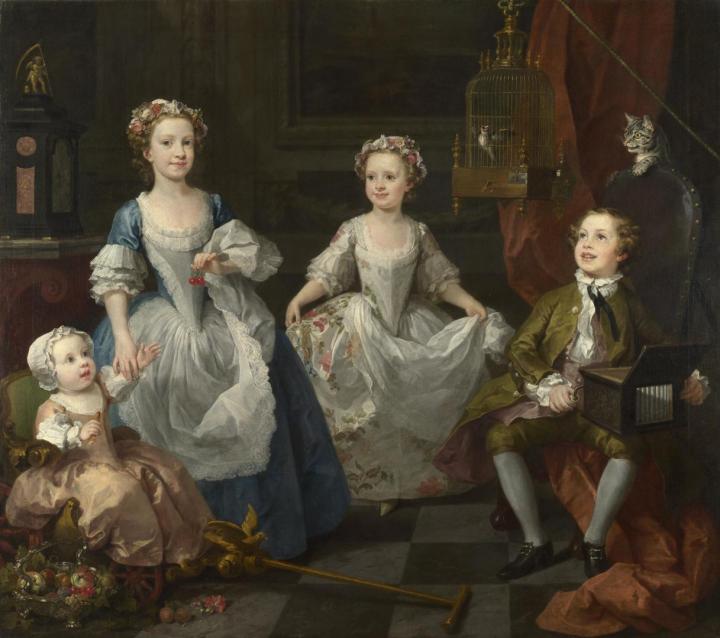
William Hogarth, The Graham Children, 1742, oil on canvas, 161 × 181 cm
(London: National Gallery)
◊ ◊ ◊ ◊ ◊
From the press release for the exhibition:
Finding Family
Foundling Museum, London, 17 March — 27 August 2023
One word, with many meanings: family lies at the heart of all our lives and is considered one of the most important units of society. The exhibition Finding Family, now on view at the Foundling Museum, explores the idea of family through art from the 17th century to the present day. Uncover and explore new perspectives on what family is and can be through this original, insightful exhibition. Involving participants of Tracing Our Tales, the Foundling Museum’s award-winning programme for young care leavers, Finding Family also includes their creative responses to works of art and the exhibition’s themes, from the context of their own lived experience, with challenging, moving, and surprising results.

Le Nain Brothers (Antoine, Louis, and Mathieu), Four Figures at a Table, ca. 1643, oil on canvas, 45 × 55 cm (London: National Gallery).
Is it Blood?
Is it Connection?
Is it Bond?
Is it Love?
Through these four themes, the exhibition presents a series of historic and contemporary works that explore blood relations, social bonds, personal connections, and love—to look at the ways in which artists have represented and responded to ideas of family, past, and present. The show encourages an exploration far beyond the idea of family in a nuclear sense, suggesting a broader, more inclusive definition that also invites us to consider where our own sense of connection and identity lie.
“Our family is always going to form in our hearts because we need role models, connection, and a sense of identity—so we learn to seek family in other places and things, like pets, fashion, friends, culture.” –Tracing Our Tales participant
“Family is very much what you make it. It doesn’t have to be those who you share the same blood with, but those who you share the same interest with.” –Tracing Our Tales participant

Thomas Gainsborough, The Painter’s Daughters Chasing a Butterfly, ca. 1756, oil on canvas, 114 × 105 cm (London: National Gallery).
In partnership with The National Gallery, the exhibition includes three large-scale masterpieces from the Gallery’s collection, by Hogarth, Gainsborough, and the Le Nain Brothers. Objects from the Foundling Museum’s collections and creative responses from the Tracing Our Tales participants invite visitors to look afresh at these well-loved paintings and to question their assumptions. Works by contemporary artists who have responded to the theme of family, as well as newly commissioned pieces, further enrich the exploration of the themes, revealing changes and continuities over time. Contemporary artists loaning work include Matthew Finn, Sunil Gupta, Chantal Joffe, Gillian Wearing, and Hetain Patel, alongside Mark Titchner, Annabel Dover, Tamsin van Essen, Harold Offeh, and Helen Barff who have created new work.
As a charitable home for children whose mothers could no longer keep or care for them, the Foundling Hospital was an alternative to family for the 25,000+ children who were admitted between 1741 and 1954. Without family, foundlings were forced to find connections elsewhere—through their foster families, peers, teachers, and places of employment. Within the context of the Museum’s historic story of care, Finding Family challenges the social construct of family and asks important questions about who and what defines who we are, how we interact with one another, and how we perceive others. The exhibition also showcases the ongoing power of art to challenge, question, and encourage us to see the world with new eyes.
“Writing poetry whilst being in the Foundling Museum is important because we get a sense of how we would feel in the foundlings’ shoes. We have a lot to relate to, especially if you’ve been in care.” –Tracing Our Tales participant
Exhibition | Seeing the Light

Joseph Wright of Derby, A Philosopher Giving That Lecture on the Orrery, in which a Lamp Is Put in Place of the Sun, ca. 1766, oil on canvas, 58 × 80 inches (Derby Museum & Art Gallery).
◊ ◊ ◊ ◊ ◊
Now on view at the Foundling Museum:
Seeing the Light
Foundling Museum, London, 7 March — 4 June 2023
We at the Foundling Museum are excited to display A Philosopher Giving That Lecture on the Orrery in Which a Lamp is Put in Place of the Sun by revered ‘painter of light’ Joseph Wright of Derby. First exhibited in London in 1766, this dramatic painting—on loan from Derby Museum & Art Gallery—offers a fascinating window to changing social attitudes and public understanding of science, education, and technology in the eighteenth century. Wright and his large network of friends and acquaintances had multiple points of connection with key people in the Foundling Hospital’s history and collections. Visit the Museum to discover the story of the Lunar Society and the threads that link a token admitting the holder to a lecture in experimental philosophy, a clock detailing the phases of the moon, and a letter written by girls apprenticed by the Hospital to Wright’s painting and the Age of Enlightenment it celebrates.
While The Orrery is on display in London, visitors can see the Foundling’s magnificent painting by William Hogarth, The March of the Guards to Finchley (1750), at Derby Museum & Art Gallery.
◊ ◊ ◊ ◊ ◊
Note (18 April 2023) — Although it it has yet to penetrate the widespread conception of Wright as a progressive revolutionary artists set, above all, on visualizing Enlightenment science, Matthew Craske’s book Joseph Wright of Derby: Painter of Darkness (Paul Mellon Centre for Studies in British Art, 2020) should be required reading for anyone trying to understand Wright as an eighteenth-century artist. –CH
Exhibition | Hogarth’s Britons
Now on view in Derby:
Hogarth’s Britons: Succession, Patriotism, and the Jacobite Rebellion
Derby Museum & Art Gallery, 10 March — 4 June 2023
Curated by Jacqueline Riding and Lucy Bamford
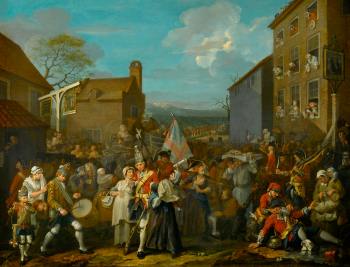
William Hogarth, The March of the Guards to Finchley, 1749–50, oil on canvas (London: The Foundling Museum).
No other artist defines our image of 18th-century Britain quite like William Hogarth. His vibrant narrative paintings, reproduced and circulated widely through print, engaged with some of the most pressing social and political issues of the times. Amongst these was Jacobitism, a campaign to restore the exiled Stuart dynasty to the throne of Great Britain. This exhibition explores Hogarth’s response to this threat, including the last and most serious of all attempts: the Jacobite Rebellion of 1745. Led by Prince Charles Edward Stuart (‘Bonnie Prince Charlie’) with support from France, the Jacobite Army would eventually reach Derby before retreating back north to Scotland and defeat at the Battle of Culloden.
Led by Derby Museums, Hogarth’s Britons has been produced in partnership with the National Gallery and the National Portrait Gallery and is the first exhibition of Hogarth’s works to be staged in Derby. It brings many pieces that have never before been seen in the city, including Hogarth’s masterpiece, The March of the Guards to Finchley (Foundling Museum, London). Others, such as the newly discovered portrait of the Prince by Allan Ramsay (National Galleries of Scotland), will be returning to Derby for the first time since the rebellion of 1745. The exhibition also brings together items from national and private collections, representing local divided loyalties and the experience of life under Jacobite-army occupation.
Hogarth’s Britons: Succession, Patriotism, and the Jacobite Rebellion is co-curated by Jacqueline Riding, acclaimed art historian and author of Jacobites (2016) and Hogarth: Life in Progress (2021); and Lucy Bamford, Senior Curator of Art at Derby Museums.
Jacqueline Riding, Hogarth’s Britons (London: Paul Holberton Publishing, 2023), 120 pages, ISBN: 978-1913645458, £18 / $25.
◊ ◊ ◊ ◊ ◊
Note (added 29 February 2024) — The original posting was updated to include information on the catalogue.
New Book | The Secret Diaries of Charles Ignatius Sancho
From Macmillan:
Paterson Joseph, The Secret Diaries of Charles Ignatius Sancho: A Novel (New York: Henry Holt and Company, 2023), 432 pages, ISBN: 978-1250880376, £17 / $28.
 It’s finally time for Charles Ignatius Sancho to tell his story, one that begins on a slave ship in the Atlantic and ends at the very center of London life. . . . A lush and immersive tale of adventure, artistry, romance, and freedom set in eighteenth-century England and based on a true story
It’s 1746 and Georgian London is not a safe place for a young Black man. Charles Ignatius Sancho must dodge slave catchers and worse, and his main ally—a kindly duke who taught him to write—is dying. Sancho is desperate and utterly alone. So how does the same Charles Ignatius Sancho meet the king, write and play highly acclaimed music, become the first Black person to vote in Britain, and lead the fight to end slavery? Through every moment of this rich, exuberant tale, Sancho forges ahead to see how much he can achieve in one short life: “I had little right to live, born on a slave ship where my parents both died. But I survived, and indeed, you might say I did more.”
Paterson Joseph is an award-winning actor who has been fascinated by Sancho for many years. He wrote and starred in the play Sancho: An Act of Remembrance in 2018, which was staged in the UK as well as the US. A veteran of the stage, TV, and film, Paterson has appeared on The Mosquito Coast, an Apple TV+ original series; Doctor Who; Noughts + Crosses; and other BBC programs. The Secret Diaries of Charles Ignatius Sancho is his first novel.
◊ ◊ ◊ ◊ ◊
Thomas Mallon recently reviewed the book for The New York Times (11 April 2023), observing that
. . . in an author’s note, Joseph explains his desire to present Black English characters “in the form in which I met Oliver Twist, David Copperfield and Jane Eyre.” Entering the realm of fiction, he catches the genre’s particular mood in Sancho’s 18th century. All the sudden shifts in fortune, the deathbeds and legacies, along with the guileful use of what Sancho calls “cheek”: These are elements in the episodic, picaresque adventures of every Tom Jones and Moll Flanders that elbowed a way through the Georgian era. . . .
The full review is available here»
New Book | Flora Macdonald: ‘Pretty Young Rebel’
The Battle of Culloden was fought on this day (16 April) in 1746. From Penguin Random House (I much prefer the British cover, shown here, over the American one. –CH) . . .
Flora Fraser, Flora Macdonald: ‘Pretty Young Rebel’: Her Life and Story (Knopf, 2023), 288 pages, ISBN: 978-0451494382, £25 / $30.
 A captivating biography of the remarkable young Scotswoman whose bold decision to help ‘Bonnie’ Prince Charlie—the Stuart claimant to the British throne—evade capture and flee the country has become the stuff of legend.
After his decisive defeat at the Battle of Culloden in 1746, Prince Charles Edward Stuart was a man on the run. Seeking refuge in the Outer Hebrides, hoping to escape to France, he found an unlikely ally in Flora MacDonald, a young woman in her early twenties, loyal to the Stuarts. Disguising the prince as an Irish maid, petticoats and all, Flora conveyed Charles by boat to Skye, where they lodged safely with her family, until the prince’s inexpert handling of feminine attire caused concern, and he was persuaded to forgo the ruse before fleeing the area undetected. Flora never saw him again.
This famous incident led to Flora’s enduring appeal as a courageous Scottish heroine, inspiring and influencing countless novels, poems, and songs—most notably, the classic ballad “Skye Boat Song” adapted from a traditional tune in the late nineteenth century. But her remarkable life didn’t come to a close with her clandestine mission to Skye. Faced with a confession from one of the boatmen, Flora was arrested and taken to London on charges of treason, where under interrogation, she wittily deflected questions and staunchly defended her motives. She was eventually released under the 1747 Act of Indemnity, but disaster would befall her yet again: in 1774, Flora and her husband, Allan MacDonald, fled the impoverished highlands for a brighter future in Cross Creek, North Carolina—utterly unaware of the burgeoning revolution that would upend their lives there, with Allan imprisoned and Flora fleeing, penniless, back home to the Hebrides.
In this probing, evocative portrait of a tumultuous life, Flora Fraser peels away the layers of misinformation, legend, and myth to reveal Flora MacDonald in full. Fraser presents a fascinating picture of this headstrong and irrepressible woman. As Samuel Johnson declared upon visiting her in Scotland, her name was “a name that will be mentioned in history, and if courage and fidelity be virtues, mentioned with honor.”
Flora Fraser is the author of The Washingtons: George and Martha; Beloved Emma: The Life of Emma, Lady Hamilton; The Unruly Queen: The Life of Queen Caroline; and Princesses: The Six Daughters of George III. She lives in London.
New Book | Beauty and the Brain
On Thursday, 4 May 2023, at 7pm (EST), Rachel Walker will discuss her book at the American Antiquarian Society in Worcester, Massachusetts. The event will be live-streamed via YouTube. Registration is required for both in-person and online attendance.
From The University of Chicago Press:
Rachel Walker, Beauty and the Brain: The Science of Human Nature in Early America (Chicago: The University of Chicago Press, 2022), 288 pages, ISBN: 978-0226822563, $45.
 Examining the history of phrenology and physiognomy, Beauty and the Brain proposes a bold new way of understanding the connection between science, politics, and popular culture in early America.
Between the 1770s and the 1860s, people all across the globe relied on physiognomy and phrenology to evaluate human worth. These once-popular but now discredited disciplines were based on a deceptively simple premise: that facial features or skull shape could reveal a person’s intelligence, character, and personality. In the United States, these were culturally ubiquitous sciences that both elite thinkers and ordinary people used to understand human nature. While the modern world dismisses phrenology and physiognomy as silly and debunked disciplines, Beauty and the Brain shows why they must be taken seriously: they were the intellectual tools that a diverse group of Americans used to debate questions of race, gender, and social justice. While prominent intellectuals and political thinkers invoked these sciences to justify hierarchy, marginalized people and progressive activists deployed them for their own political aims, creatively interpreting human minds and bodies as they fought for racial justice and gender equality. Ultimately, though, physiognomy and phrenology were as dangerous as they were popular. In addition to validating the idea that external beauty was a sign of internal worth, these disciplines often appealed to the very people who were damaged by their prejudicial doctrines. In taking physiognomy and phrenology seriously, Beauty and the Brain recovers a vibrant—if largely forgotten—cultural and intellectual universe, showing how popular sciences shaped some of the greatest political debates of the American past.
Rachel E. Walker is an Assistant Professor at the University of Hartford, where she teaches courses on the history of race, gender, and science in America. Her recent article “Facing Race,” received the Murrin Prize for the best article published in Early American Studies in 2021.
C O N T E N T S
Introduction
1 Founding Faces
2 A New Science of Man
3 Character Detectives
4 The Manly Brow Movement
5 Criminal Minds
6 Facing Race
Conclusion
Acknowledgments
Notes
Bibliography
Index










 Enfilade
leave a comment