Lecture Series | 2023 Wallace Seminars on Collections and Collecting
This year’s Wallace Seminar Series on Collections and Collecting:
2023 Wallace Collection Seminars on the History of Collections and Collecting
Online and/or In-Person (depending upon session), The Wallace Collection, London, last Monday of most months
Established in 2006, the Seminars in the History of Collecting series helps fulfil The Wallace Collection’s commitment to the research and study of the history of collections and collecting, especially in the 18th and 19th centuries in Paris and London. Seminars are normally held on the last Monday of every month, excluding August and December. They act as a forum for the presentation and discussion of new research into the history of collecting, and are open to curators, academics, historians, archivists and all those with an interest in the subject. Each seminar is 45–60 minutes long, with time for Q&A.
Book your place via the Wallace Collection website. Bookings will open a few weeks before each seminar. A detailed summary of each forthcoming seminar will be provided around the same time. The 2023 Seminars in the History of Collecting will be on Zoom and livestreamed via YouTube for the months of January to April. We hope to be able to hold our seminars in hybrid format from the month of May, in person at the Wallace Collection and live on YouTube. For enquiries or to join our mailing list, please contact collection@wallacecollection.org.
Monday, 30 January
Simon Spier (Curator, Ceramics and Glass 1600–1800, Victoria & Albert Museum, London), Creating the Bowes Museum: Collectors, Dealers, and Auctions in Mid-19th-Century Paris
Monday, 27 February
Caroline Dakers (Professor Emerita in Cultural History, University of Arts London), Millionaire Shopping: The Collections of Alfred Morrison (1821–1897)
Monday, 27 March
Thomas Cooper (PhD candidate, University of Cambridge), Reconstructing the Art Collection of May Morris (1862–1938)
Monday, 17 April
Diana Davis (Independent researcher), ‘Fertile in Resources and in Ingenious Devices’: Ferdinand de Rothschild and His Dealers Revealed through the Archive
More information available here»
Monday, 22 May
Jonathan Conlin (University of Southampton), Knickerbocker Glory? Alphonso Trumpbour Clearwater (1848–1933) and the Collecting of American Silver
More information available here»
Monday, 26 June
Alessia Attanasio (PhD candidate, University of Birmingham), The Fortunes of Baroque Neapolitan Art in English Collections during the Grand Tour, 1680–1800
Monday, 31 July
Sarah Thomas (Birkbeck, University of London), Slavery and the ‘Life’ of a Painting: Parmigianino’s Virgin and Child and the Taylor Plantations of Jamaica
Monday, 18 September
Ellinoor Bergvelt (University of Amsterdam), The Collection of William Cartwright (1606–1686) at Dulwich Picture Gallery
Monday, 30 October
Barbara Lasic (Senior Lecturer, MA in Fine and Decorative Art and Design, Sotheby’s Institute of Art), ‘Like a Tale from the Thousand and One Nights’: Reconstructing the Taste and Collections of William Williams-Hope (1802–1855)
Monday, 27 November
John Holden (Independent author, researcher, and an Associate at Demos) and Rebecca Wallis (Cultural Heritage Curator, National Trust), Ralph Dutton (1898–1985), 8th Baron Sherborne: The Life of a Collector
◊ ◊ ◊ ◊ ◊
Note (added 29 June 2023) — The posting was updated with a change for July’s presentation; originally Peter Humfrey (Emeritus Professor of Art History, University of St Andrews) was scheduled to speak on “The Picture Collections of the Poet Samuel Rogers (1763–1855) and of His Siblings.”
Royal Oak Programs, Spring 2023
18th-century offerings from the Royal Oak Foundation this spring:
Robert Sackville-West | Knole: A Private View into One of Britain’s Great Houses
Charleston Library Society, Charleston, 21 March 2023, 6pm ET
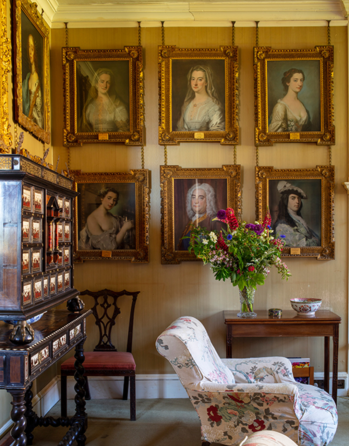
Set of pastels at Knole by Rosalba Carriera: Charles Sackville, 2nd Duke of Dorset at bottom right and his Italian mistress Lucia Panichi, at bottom left (Photo by Ashley Hicks, from Knole: A Private View of One of Britain’s Great Houses, Rizzoli, 2022).
The Sackvilles have inhabited Knole, one of Britain’s greatest houses, for more than 400 years. In his talk, Robert Sackville-West, the 13th generation of the family to live at Knole, will take Royal Oak members on a personal tour of this ‘calendar house’, with its legendary 365 rooms, 52 staircases, 12 entrances, and 7 courtyards. Lord Sackville will illustrate the smoldering spirit of Knole, from the state rooms—with the finest collection of 17th-century Royal Stuart furniture in the world and outstanding tapestries—to the private apartments filled with portraits by Van Dyck, Gainsborough, Sir Peter Lely, and Reynolds. He will include a trip behind-the-scenes into the labyrinth of cellars and show attics filled with family mementos.
He will describe his ancestors who inhabited his family home—the grave Elizabethan statesman, the good-for-nothing gadabout at the seedy court of James I, the dashing cavalier, the Restoration rake, the 3rd Duke of the ancien régime—who inhabited his family home and were described by Vita Sackville-West (born at Knole) as “a race too prodigal, too amorous, too weak, too indolent, and too melancholy.” Lord Sackville will talk about the way his family has shaped and furnished the house and describe how Knole itself has shaped the Sackvilles, influencing their lives and their relationships up to the present day. The talk will feature stunning images of the interiors and architectural and decorative features taken by Ashley Hicks for Knole: A Private View of One of Britain’s Great Houses, published by Rizzoli in 2022.
More information available here.
Robert Sackville-West, 7th Baron Sackville, studied history at Oxford University and went on to work in publishing. He now chairs Knole Estates, the property and investment company that, in parallel with the National Trust, runs the Sackville family’s interests at Knole.
◊ ◊ ◊ ◊ ◊
Oliver Gerrish | Distinguished to Eccentric: Norfolk Country Houses
Online, Zoom Webinar, 20 April 2023, 2.00pm ET
Also available as a digital rental from April 21 to May 5
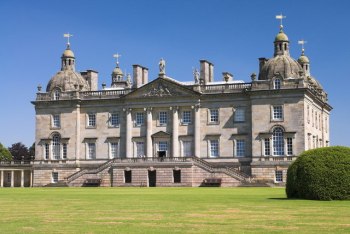
Houghton Hall.
For centuries, Norfolk’s wide-open skies, unspoilt coastline, and rich and beautiful agricultural land have inspired writers and poets, artists, and designers, as well as architects and builders. Join architectural historian Oliver Gerrish on an enchanting visual journey through Norfolk’s rich architectural heritage. From the Jacobean splendors of Blickling Hall, believed to be the birthplace of Anne Boleyn, to the early Palladian elegance of Raynham Hall, possibly influenced by Inigo Jones’ circle, and for 400 years the seat of the Townshend family.
When one thinks of Norfolk, two of the grandest private houses in England immediately come to mind: Houghton and Holkham Hall. More than a country house, Holkham, designed by William Kent and Lord Burlington for the Earls of Leicester, can be described as a symmetrical Palladian palace. The sublime grandeur continues inside in the Marble Hall, which was modelled on a Roman basilica, with steps leading to the impressive State Rooms on the piano nobile.
The other neo-Palladian Norfolk ‘palace’ is Houghton Hall, one of England’s most beautiful stately homes designed by Colen Campbell and James Gibbs, with lavish interiors by William Kent. Both of these stately homes were built to reflect the wealth, taste, collections, and power of its inhabitants. Oliver will also examine private Norfolk houses from the 19th and 20th century. One from the Arts & Crafts movement is E.S. Prior’s 17-bedroomed Voewood in High Kelling, Norfolk, which is now owned by a well-known book dealer.
Finally, we will see the quirky Edwardian Sennowe Park, remodeled by George Skipper in 1900–1907 for the grandson of the founder of Thomas Cook travel. Known for its imaginative design, barrel vaulted library, and Art-Deco style tiling, the house is rarely on view.
More information available here.
Oliver Gerrish has a Master’s degree in architectural history from the University of Cambridge. He is a trustee of the Derbyshire Historic Buildings Trust and helped to found their Architecture Awards. For over 10 years he was actively involved with The Georgian Group, for whom he re-founded and successfully led the Young Georgians from 2002 to 2016. He was one of the youngest feature writers for Country Life, and has written for The Georgian magazine and reviews for House and Garden and others. He has lectured nationally on subjects ranging from the masters of the Arts and Crafts to the role country houses play in the lives of younger people. He regularly organizes tours of historic buildings throughout Britain for private clients and charities.
◊ ◊ ◊ ◊ ◊
Rufus Bird | St. James Palace: From Leper Hospital to Royal Court
The Union League of Philadelphia, 2 May 2023, 6.30pm (with an option for dinner)
The General Society Library, New York, 4 May 2023, 6pm ET
Also available as a digital rental from May 5 to May 19

Bird’s eye view of St James Palace.
Visitors to London may recognize the red brick building at the bottom of St. James’ Street—St James’ Palace—and its location near many Pall Mall clubs and boutique hotels. St James’s Palace is a remarkable building at the heart of the history of the British monarchy and served as the official residence of the British monarchy from 1698 to 1837. However, despite its pivotal role in British history, St. James’s Palace is the least known of the royal residences.
While King Charles III and the Queen Consort live at Clarence House, their home is actually one of several structures which formed a part of the buildings that emerged from the Tudor palace in 1530s. St. James’s medieval origins were as a leper hospital dedicated to St. James. The palace’s history also includes stories of murder; family arguments between father and son; a lost masterpiece building by William Kent; and lavish royal apartments. Over the centuries, St. James’s Palace survived dilapidation and fire, 19th century reconstruction, and remained the location for important international diplomacy. Rufus Bird—whose office was in the heart of St. James’s Palace for over 10 years—will bring to life the stories of this remarkable palace. He will explore the role of the palace a principal seat of the British monarchy after fire consumed Whitehall Palace, and explain the building’s impact on the development of London and the West End.
More information on Philadelphia available here and for New York available here.
Rufus Bird is an art advisor at Gurr Johns where he is Director of Decorative Arts and Heritage Collections, Europe. After receiving History of Art from Cambridge University, he joined Christie’s as a graduate trainee and joined the Furniture Department in 1999. In 2010, he was appointed by HM Queen Elizabeth II as Deputy Surveyor of the Queen’s Works of Art, and then in 2018 as Surveyor of the Queen’s Works of Art. At the Royal Collection, he was responsible for about 500,000 works of decorative art across fifteen residences. He is one of the authors of the official history of St James’s Palace published by Yale University Press and Royal Collection Trust in 2022.
◊ ◊ ◊ ◊ ◊
Jeremy Musson | ‘Still Life Drama’: Dennis Severs’ House Revived
Online, Zoom Webinar, 9 May 2023, 2pm ET
Also available as a digital rental from May 10 to May 24
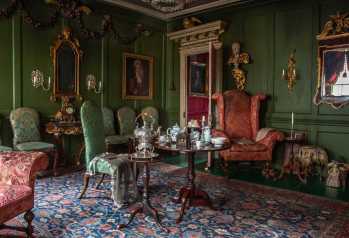
Drawing Room of the Dennis Severs’ House (Photo by Lucinda Douglas-Menzies).
Step back in time at the Dennis Severs’ House, located at 18 Folgate Street in London. Visitors are invited to participate in what the American founder called “a still life drama.” This extraordinary multi-sensory experience allows guests to walk through each room of the house feeling as if the 18th- and 19th-century inhabitants have only just withdrawn a moment before.
Collector and founder Dennis Severs bought the semi-derelict 18th-century Spitalfields house in the 1970s. With no desire to restore, Severs wanted to honor what he imagined were the echoes of the house’s history. He created the fictional story of a Huguenot silk merchant’s family named Jervis, who lived in the house for generations from 1724 to 1914. Each room tells the triumphs and tragedies of this fictional family through the original objects Severs bought from London’s street markets and sale rooms, atmospherically lit by candlelight. Painstakingly assembled over 20 years, many of the rooms were mocked up in the manner of stage scenery using inexpensive materials—all conveying a haunting sense of London’s past: silk waistcoats are flung on rumpled bed clothes, a card game has just ended, fires crackle, and steam rises from a filled punch bowl.
Jeremy Musson recently featured this unusual house in Country Life Magazine. Jeremy will speak about the house which he says “defies categorization…and is a house of mystery and paradox.” He will illustrate the rooms—recently repaired and conserved by the trustees during COVID lockdown—and show English houses that possibly influenced Severs’ designs. He also will show how the founder used costume and set designers, as well interior designers, to create a remarkable home that captures a moment in time and history.
More information available here.
Jeremy Musson is a leading authority on the English country house. He is a Fellow of the Society of Antiquaries and sits on a number of boards and trusts including the Country House Foundation. He was awarded an M Phil in Renaissance History at the Warburg Institute, University of London in 1989 and was architectural editor of Country Life from 1995 to 2007. Before joining Country Life in 1995, Jeremy was an assistant regional curator for the National Trust in East Anglia. He has written and edited hundreds of articles on historic country houses, from Garsington Manor to Knebworth House. He also presented 14 programmes on BBC 2, making up two series called The Curious House Guest in 2005–07. He lectures and supervises for academic programmes with Cambridge University, London University, and Buckingham University, as well as the Attingham Summer School. His books include Up and Down Stairs: The History of the English Country House Servant (2009), English Country House Interiors (2011), Robert Adam: Country House Design, Decoration & the Art of Elegance (2017), The Country House: Past, Present, Future: Great Houses of the British Isles (2018), and Romantics and Classics: Style in the English Country House (Rizzoli, 2021).
◊ ◊ ◊ ◊ ◊
Sophie Chessum | Clandon Park: Uncovering the Secrets of the Past
Online, Zoom Webinar, 23 May 2023, 2pm ET
Also available as a digital rental from May 24 to June 9

Recovered items following the fire at Clandon Park.
National Trust Curator Sophie Chessum witnessed the devastating fire at Clandon Park, Surrey on the night of April 29, 2015. The Palladian style house, a NT property, had been built in the early 1730s by Thomas Onslow and his wife to impress and entertain their friends, and included a Marble Hall with richly carved marble fireplaces by John Michael Rysbrack. Everyone was safely evacuated, but the 2015 fire raged through the house, leaving Clandon literally open to the skies.
Firefighters and NT staff tried to salvage some of the remarkable artifacts and objects, but the inside was gutted. Planning for the house’s future started almost before the cinders had cooled. Within weeks cranes removed the dangerous timbers and bricks, and a self-supporting scaffold was designed to wrap and roof the four-story structure. Everyone hoped for restoration, but after years of forensic investigation and consultation with experts, it was not deemed possible apart from the Speaker’s Parlour. The NT and teams of experts developed a new approach that celebrates what survives of the 18th-century building and seeks to tell the stories about how this masterpiece was built. The fire may have destroyed much of Clandon’s interior, but it also revealed how the house was constructed and crafted. Hidden secrets from Clandon’s history now revealed include: construction dating from timbers, stones reused from the previous Jacobean structure, hidden doorways and alcoves, and paneling in the State Bedroom.
Sophie will talk about that fateful night, show some of the salvaged fragments and objects under conservation—including the State Bed—and explain what curators and specialists have learned about the house. She will describe the current project which gives access to spaces conserved, offering visitors a unique ‘X-ray view’ and celebrating the craft skills of the people who created some of England’s greatest country houses.
More information available here.
Sophie Chessum is Clandon Park’s Senior Project Curator. Chessum has been with the National Trust since 1998, when she started as a Curatorial Researcher. Since 2002 she has been a curator for a number of internationally important houses, collections, gardens, and landscapes including Clandon Park, Claremont, Hatchlands Park, Hinton Ampner, Petworth House, Polesden Lacey, The Homewood, Uppark, and Woolbeding. She has been a consultancy manager at the National Trust since 2013, where she provides specific consultancy support to Ham House, Sutton House and 575 Wandsworth Road, Osterley Park, Morden Hall Park, Rainham Hall, Carlye’s House, Fenton House, Red House, and 2 Willow Road. In addition she is the curator for Ham House, Richmond Surrey. Since the fire at Clandon Park in April 2015, she has been seconded to lead the salvage elements of this project, providing curatorial expertise on the house and its collection and working closely with archaeologist and conservator.
◊ ◊ ◊ ◊ ◊
Justin Scully | Saving Fountains Abbey: Project Update
Online, Zoom Webinar, 1 June 2023, 2pm ET
Also available as a digital rental from June 2 to June 16
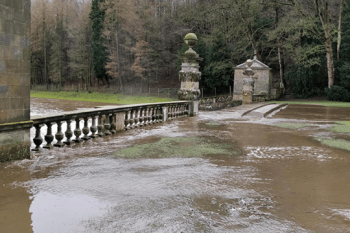
Flooding at Studley Royal Water Garden.
In 2020, Royal Oak donated $250,000 to preserve one of England’s most magnificent sites which was one of the first places in the UK to become a World Heritage Site in 1986. Fountains Abbey & Studley Royal Water Garden is an awe-inspiring landscape, owned by the National Trust since 1983. Cistercian monks established the Abbey in 1132, manipulating the River Skell to harness its power for grinding grain into flour. Over time, the Abbey became one of the largest, richest, and most influential Cistercian sites in Britain—until the Dissolution in the 1530s by Henry VIII.
In the early 18th century, John Aislabie began transforming his nearby landscape garden of Studley Royal into a picturesque design that incorporated the entire wooded valley and featured a huge water garden with lakes, grottos, canals, and cascades. Paths were created with viewpoints that centered on classical statues and follies. In 1767, his son William bought the neighboring Abbey ruins to incorporate them into the landscape and to create the ultimate vista or ‘Surprise View.’ Centuries later, the garden design is much the same, but this important landscape is often flooded from the River Skell. To save the site, the National Trust has partnered with conservation organizations, local farmers, and landowners to implement a natural flood management program.
Justin Scully, the site’s General Manager, will update Royal Oak members on the on-going progress of these efforts, including the planting of woodland and hedgerows and the creation of ponds and meadows to slow the water flow. He will illustrate the changes and explain the challenges faced by the preservation team. Additionally, he will talk about the surviving relics of the Chinese Garden and the wider 18th-century and monastic landscape, as well as exciting discoveries in the historic archives.
More information available here.
Justin Scully is General Manager at Fountains Abbey & Studley Royal Water Gardens, National Trust. The site is one of the busiest properties in the National Trust welcoming in excess of 600,000 visitors per year. Justin has worked for the National Trust for 14 years and in his 6 years at Fountains has overseen multi-million pound investment in visitor infrastructure and conservation, as well as the Skell Valley project, a £2.5m landscape scale conservation project.
Symposium | Georgian Group, Wren 300

Sir Godfrey Kneller, Portrait of Sir Christopher Wren, 1711, oil on canvas, 49 × 40 inches
(London: NPG).
◊ ◊ ◊ ◊ ◊
From The Georgian Group:
Wren 300: Georgian Group Symposium
Trinity College, Oxford, 15 April 2023
The Georgian Group’s 2023 Symposium, led by Geoffrey Tyack of Oxford University, will form a central focus of the Wren 300 Festival. Wren’s late work from 1690 to 1723, his subsequent reputation, and design legacy will be considered by leading scholars. Public tickets (£70) include a buffet lunch and drinks reception. A limited number of student tickets (£35) are available here. Please read the Terms and Conditions before booking. If tickets have sold out for this event, please email members@georgiangroup.org.uk to be added to the waiting list.
P R O G R A M M E
10.15 Registration
10.45 Session 1
• Geoffrey Tyack — Introduction / Wren’s Work in Oxford
• Rory Coonan — Wren before Architecture
• Jennifer Mitchell — Tom Tower
• Mark Kirby — The Furnishing of Wren’s Churches
12.45 Lunch
1.45 Session 2
• Anya Lucas — Greenwich
• Elizabeth Dean and Matthew Walker — Wren and Hawksmoor
• Will Aslet — Wren and Gibbs
4.00 Session 3
• Charles Hind — Wren’s Sale Catalogues
• David McKinstry — Wren’s 19th-Century Reputation
• Geoffrey Tyack — Destruction and Rebuilding: Wren’s Churches after 1945
5.45 Drinks Reception, The Garden Room, Trinity
New Book | The Anglican Episcopate, 1689–1800
Published by the University of Wales and distributed by The University of Chicago Press:
Nigel Aston and William Gibson, eds., The Anglican Episcopate, 1689–1800 (Cardiff: University of Wales Press, 2023), 368 pages, ISBN: 978-1786839763, £70 / $88.
 The eighteenth-century bishops of the Church of England and its sister communions had immense status and authority in both secular and religious society. In this volume, leading experts offer a comprehensive survey of all things episcopal between the ‘Glorious Revolution’ of 1688 and the early nineteenth century, when the Anglican Church enjoyed exclusive establishment privileges in much of Britain. The essays consider the appointment and promotion of bishops, their parliamentary duties, and their relation to Wales, Ireland, Scotland, and the American colonies.
Nigel Aston is a Research Associate at the University of York and Reader Emeritus in the School of History, Politics, and International Relations at the University of Leicester, where he taught for two decades. He is the author of several books and numerous articles on British and French eighteenth-century religious and political history, including the forthcoming book Enlightened Oxford: The University and the Cultural and Political Life of Eighteenth-century Britain and Beyond (Oxford University Press, 2023).
William Gibson is Professor of Ecclesiastical History at Oxford Brookes University and Director of the Oxford Centre for Methodism and Church History. His most recent book is Samuel Wesley and the Crisis of Tory Piety, 1685–1720 (Oxford University Press, 2021).
C O N T E N T S
Introduction — Nigel Aston and William Gibson
The Politics of Church and State
1 Securing the Mitre: The Promotion and Progress of a Bishop — Nigel Aston (University of Leicester)
2 Lord Bishops: The Episcopate in National Politics — Ruth Paley (History of Parliament)
3 Bishops and the Monarchy — Grayson Ditchfield (University of Kent)
Performance
4 Pastors of Their Flock: Visitation, Ordination, Confirmation — Colin Haydon (University of Winchester)
5 Authority, Conflict, and Consensus: Bishops, Their Clergy, and Diocesan Government — William Gibson (Oxford Brookes University)
6 Bishops and Patronage — Daniel Reed (Oxford Brookes University)
Cultures
7 Wives and Families: The Domestic Life of Bishops — Nigel Aston (University of Leicester) and William Gibson (Oxford Brookes University)
8 Bishops and Eighteenth-Century Intellectual Life — Robert Ingram (University of Ohio)
9 Bishops, Taste, and Culture — Matthew Craske (Oxford Brookes University)
Beyond England
10 Episcopacy in Scotland — Rowan Strong (Murdoch University)
11 Anglican Bishops in Wales — John Morgan-Guy (University of Wales: Trinity St David)
12 The Other Establishment: Bishops in the Church of Ireland — Toby Barnard, (University of Oxford)
13 Anglican Bishops, the Wider World, and the Other Christian Churches — Ted Campbell (Southern Methodist University)
Appendix: Episcopal Incomes — Ruth Paley (History of Parliament)
Summer Seminar | Material Religion in Early America
From the American Antiquarian Society:
Material Religion: Objects, Images, Books
2023 CHAViC-PHBAC Summer Seminar
American Antiquarian Society, Worcester, Massachusetts, 25–30 June 2023
Led by Christopher Allison and Sonia Hazard
Applications due by 17 April 2023
 Scholars of religion have taken a material turn, delving into the study of images, objects, monuments, buildings, books, spaces, performances, and sounds. What do these inquiries look like in the context of early America, and how did religious materialities shape early American worlds? The goal of this seminar is to explore this area’s exciting archives, theories, and methods, enabling participants to bring together religion and materiality in their own work in fresh ways.
The American Antiquarian Society provides an exceptional site for hands-on inquiries into the material worlds of early American religions. Collections at AAS furnish materials relating to religion before 1900 in North America, including Islam, Judaism, Mormonism, Catholicism, Protestantism, metaphysical religions, African-inspired religions, South Asian religions, and civil religion as well as collections that support studying religious hybridity and forms of Christianity as practiced in Hawaiian, Caribbean, and Indigenous nations and groups.
Topics will include lived religion, materialisms (old and new), sensory culture, books as objects, animisms and animacies, iconoclasm, visual piety, the ontological turn, residual transcription, and sacred objects in archival contexts. The seminar will be held from Sunday, June 25, through Friday, June 30, 2023, at the American Antiquarian Society in Worcester, Massachusetts. Co-leaders for the seminar will be Chris Allison and Sonia Hazard. Guest speakers will include Solimar Otero, Professor of Folklore and Ethnomusicology, Indiana University, Bloomington and Anthony Trujillo, doctoral candidate in American Studies, Harvard University.
Participation is intended for faculty, museum and library professionals, and graduate students. It welcomes researchers across fields such as art history, religious studies, history, anthropology, American studies, music, and literature. It is co-sponsored by the Center for Historic American Visual Culture (CHAViC) and the Program in the History of the Book in American Culture (PHBAC).
The format of the seminar will be select readings, highly interactive seminar discussion, collections explorations and archival sessions, individual research time with the collection, and site visits to notable collections and religious sites in the area, including the Worcester Art Museum, burial grounds, and sacred sites. The syllabus is available online. Information on access to the readings will be emailed to students.
Tuition for the seminar is $600, which includes lunch each day and some evening meals. Some financial aid is available for graduate students. The cost of housing is not included in the tuition fee. Housing is available at two nearby hotels.
Faculty
• Sonia Hazard is Assistant Professor of Religion at Florida State University. Her book, Building Evangelical America: How the American Tract Society Laid the Groundwork for a Religious Revolution, is forthcoming from Oxford University Press. She did her graduate work at Harvard Divinity School and Duke University.
• Christopher Allison is Director of the McGreal Center for Dominican Historical Studies, Department of History, Dominican University. He is the author of the forthcoming book, Protestant Relics: Capturing the Sacred Body in Early America, under contract with the University of Chicago Press. He did his graduate work at Yale Divinity School and Harvard University.
Guest Speakers
• Solimar Otero is Professor of Folklore and Ethnomusicology at Indiana University, Bloomington. She is the author of Archives of Conjure: Stories of the Dead in Afrolatinx Cultures (Columbia University Press, 2020).
• Anthony Trujillo is a doctoral candidate in American Studies at Harvard University. He works at the confluence of Native American and Indigenous studies, history, religious studies, anthropology, and the arts.
New Book | Inventing the Alphabet
From The University of Chicago Press (though not entirely clear from the blurb, Drucker’s book provides a historiography rather than a history of the alphabet—as stated in the introduction, excerpted below)
Johanna Drucker, Inventing the Alphabet: The Origins of Letters from Antiquity to the Present (Chicago: The University of Chicago Press, 2023), 384 pages, ISBN: 978-0226815817, $40.
 Inventing the Alphabet provides the first account of two-and-a-half millennia of scholarship on the alphabet. Drawing on decades of research, Johanna Drucker dives into sometimes obscure and esoteric references, dispelling myths and identifying a pantheon of little-known scholars who contributed to our modern understandings of the alphabet, one of the most important inventions in human history. Beginning with Biblical tales and accounts from antiquity, Drucker traces the transmission of ancient Greek thinking about the alphabet’s origin and debates about how Moses learned to read. The book moves through the centuries, finishing with contemporary concepts of the letters in alpha-numeric code used for global communication systems. Along the way, we learn about magical and angelic alphabets, antique inscriptions on coins and artifacts, and the comparative tables of scripts that continue through the development of modern fields of archaeology and paleography. This is the first book to chronicle the story of the intellectual history through which the alphabet has been ‘invented’ as an object of scholarship.
Johanna Drucker is the Breslauer Professor of Bibliographical Studies and a distinguished professor in the Department of Information Studies at the University of California, Los Angeles. She has been the recipient of Fulbright, Mellon, and Getty Fellowships and in 2019 was the inaugural Distinguished Senior Humanities Fellow at the Beinecke Library, Yale University. Her artist books are included in museums and libraries in North America and Europe, and her creative work was the subject of a traveling retrospective, Druckworks 1972–2012: 40 Years of Books and Projects. Her publications include Visualizing Interpretation, Iliazd: Meta-Biography of a Modernist, and The Digital Humanities Coursebook.
◊ ◊ ◊ ◊ ◊
From the introduction:
“. . . this study is not an addition to the number of authoritative books on alphabet history. . . Instead, this work is a contribution to the intellectual history of this topic. Who knew what when about the alphabet? And how did the way they knew it—through texts, images, inscriptions, or artifacts—affect their conception of the identity and origin of alphabetic writing? As a historiography, this account traces the ways knowledge and belief shaped the understanding of alphabetic writing.”
New Book | Blinded by Curiosity
Kate Heard’s review of Zelen’s book (published online in August 2022) appears in the latest issue of the Journal of the History of Collections 35.1 (March 2023). From Primavera Pers:
Joyce Zelen, Blinded by Curiosity: The Collector-Dealer Hadriaan Beverland (1650–1716) and His Radical Approach to the Printed Image (Leiden: Primavera Pers, 2022), 272 pages, ISBN: 978-9059973305, €35.
 This book explores a phenomenon in the history of print collecting that has never been extensively investigated: the cutting and pasting of prints in the early modern period. The book focuses on the colourful Dutch classical scholar and libertine Hadriaan Beverland (1650–1716). Beverland was banished from the Dutch Republic in 1679 for publishing blasphemous, heterodox, and provocative scholarly texts on sex and sin. Books that dealt with prostitution in ancient times, original sin as the first act of sexual intercourse, and the sexual lust of women, were considered dangerous to Dutch public morality. In 1680, Beverland fled to England, where his friend Isaac Vossius took him in. It was here that Beverland began cutting (nowadays) costly etchings and engravings and arranging the cuttings into collages. These collages, which again demonstrated his interest in sexual matters, survived in two illustrated manuscripts, now in the British Library in London and the Bodleian Library in Oxford.
This study aims: 1) to reconstruct Beverland’s life in England, primarily concentrating on his interests and dealing in art and books; 2) to map the early modern practice of cutting and pasting prints, on the basis of remaining cuttings as well as textual sources from Beverland’s day; and 3) to present a comprehensive analysis of the two illustrated Beverland-manuscripts in terms of form and function.
Joyce Zelen is a Jacoba Lugt-Klever Research Fellow at the RKD (Dutch Institute for Art History) in The Hague and the Fondation Custodia in Paris.
C O N T E N T S
Acknowledgments
Introduction
Part I | Hadriaan Beverland: A Passionate Man with a Passion for Art
1 The Life of Hadriaan Beverland: A Biographical Sketch
2 ‘Fair and Candid in all his Dealings’: Beverland as Agent and Collector of Art, Books, and Curiosities
3 The Self-Promotion of a Bad Boy: Beverland’s Portraits
Part II | Beverland’s Manuscripts with Prints
4 Early Modern Print Collecting: A Context for Beverland’s Manuscripts with Prints
5 Prints, Scissors, and Antiquarian Aspirations: Beverland’s Inscriptiones Singulares Manuscript
6 ‘Dirty’ Notes and Print Collages: Beverland’s Crepundia Lugdunensia Manuscript
Conclusion
Appendices
Abbreviations, Transcriptions, and Translations
Notes
Bibliography
Index
◊ ◊ ◊ ◊ ◊
Note (added 11 April 2023) — Also see Karen Hollewand’s recent book The Banishment of Beverland: Sex, Sin, and Scholarship in the Seventeenth-Century Dutch Republic (Leiden: Brill, 2019), reviewed by Benjamin Bernard in the latest issue of Eighteenth-Century Studies 56 (Spring 2023), pp. 473–79.
New Book | What Pornography Knows
From Stanford UP:
Kathleen Lubey, What Pornography Knows: Sex and Social Protest since the Eighteenth Century (Stanford: Stanford University Press, 2022), 312 pages, ISBN: 978-1503611665 (hardcover), $90 / ISBN: 978-1503633117 (paperback), $28.
 What Pornography Knows offers a new history of pornography based on forgotten bawdy fiction of the eighteenth century, its nineteenth-century republication, and its appearance in 1960s paperbacks. Through close textual study, Lubey shows how these texts were edited across time to become what we think pornography is—a genre focused primarily on sex. Originally, they were far more variable, joining speculative philosophy and feminist theory to sexual description. Lubey’s readings show that pornography always had a social consciousness—that it knew, long before anti-pornography feminists said it, that women and nonbinary people are disadvantaged by a society that grants sexual privilege to men. Rather than glorify this inequity, Lubey argues, the genre’s central task has historically been to expose its artifice and envision social reform. Centering women’s bodies, pornography refuses to divert its focus from genital action, forcing readers to connect sex with its social outcomes. Lubey offers a surprising take on a deeply misunderstood cultural form: pornography transforms sexual description into feminist commentary, revealing the genre’s deep knowledge of how social inequities are perpetuated as well as its plans for how to rectify them.
Kathleen Lubey is Professor of English at St. John’s University. She is the author of Excitable Imaginations: Eroticism and Reading in Britain, 1660–1760 (2012).
C O N T E N T S
List of Illustrations
Preface: Pornography in the Library
Acknowledgments
Introduction: Pornography without Sex
1 Genital Parts: Detachable Properties in the Eighteenth Century
2 Feminist Speculations: Penetration and Protest in Pornographic Fiction
3 The Victorian Eighteenth Century: Publishing an Erotics of Inequity
4 Uncoupling: Pornography and Feminism in the Countercultural Era
Coda: A Mindful Pornography
Notes
Bibliography
Index
Exhibition | Hair and Body Hair
From the Musée des Arts Décoratifs:
Des cheveux et des poils / Hair and Body Hair
Musée des Arts Décoratifs, Paris, 5 April — 17 September 2023
Curated by Denis Bruna

Poster for the exhibition Des cheveux et des poils © Aurélien Farina. Jacob Ferdinand Voet, Portrait of a Man, before 1689 (Sotheby’s / Art Digital Studio); model photographer: © Virgile Biechy.
Following the success of the exhibitions La mécanique des dessous (2013), Tenue correcte exigée! (2017), and Marche et démarche (2019), the Musée des Arts Décoratifs continues its exploration of the relationship between the body and fashion with an exhibition on hair styles and body hair grooming. Des cheveux et des poils (Hair & Hairs) demonstrates how hairstyles and the grooming of human hair have contributed to the construction of appearances for centuries. Hair is an essential aspect of one’s identity and has often been used as a means of expressing our adherence to a fashion, a conviction, or a protest while invoking much deeper meanings such as femininity, virility, and negligence, to name just a few.
Through 600 works, from the 15th century to the present, the exhibition explores themes inherent in the history of hairstyles, as well as questions related to facial hair and body hair. The trades and skills of yesterday and today are highlighted with iconic figures: Léonard Autier (favorite hairdresser of Marie-Antoinette), Monsieur Antoine, the Carita sisters, Alexandre de Paris, and more recently studio hairdressers. Great names in contemporary fashion such as Alexander McQueen, Martin Margiela, and Josephus Thimister are present with their spectacular creations made from this unique material that is hair.
Fashion and Extravagance
The exhibition opens with the evolution of feminine hairstyles as a social indicator and marker of identity. In the Middle Ages, in response to the command of Saint Paul, the wearing of the veil was imposed on women until the 15th century. Gradually, women abandoned it in favor of extravagant hairstyles that were constantly renewed. In the 17th century, hairstyles such as ‘to the Hurluberlu’ (dear to Madame de Sévigné) and ‘to the Fontange’ (after the name of Louis XIV’s mistress) were emblematic of a real fashion phenomena. Around 1770, high hairstyles known as Poufs appeared, among the most extraordinary of Western hair modes. Finally, in the 19th century, women’s hairstyles—whether inspired by ancient Greece, or known as ‘the giraffe’, in curls, or ‘the Pompadour’—could be just as convoluted.
To Beard or Not to Beard
After the hairless faces of the Middle Ages, a turning point occurred around 1520 with the appearance of the beard, symbol of courage and strength. In the early 16th century, the three great Western monarchs: Francis I, Henry VIII, and Charles V were young and wore beards, which were then associated with the virile and warrior spirit. From the 1630s until the end of the 18th century, the hairless face and the wig were the hallmarks of courtiers. Facial hair did not reappear until the early 19th century with the mustache, sideburns, and beard: the period was by far the hairiest in the history of men’s fashion. A multitude of small objects used (mustache wax, brushes, curling irons, wax, etc.) attest to the enthusiasm for mustaches and beards. During the 20th century, the rhythm of bearded, mustached, and smooth faces continued, until the return of the beard among Hipsters in the late 1990s. The maintenance of hairiness among these young urbanites has given rise to the profession of barber, which had disappeared since the 1950s. Today, the thick beards tend to give way to the mustache that had deserted faces since the 1970s.
Keeping, eliminating, hiding, or displaying hair on other parts of the body is a subject also addressed in the exhibition through the representation of nude bodies in visual arts and written testimonials. Hairiness is rare, or even absent from ancient painting. The hairless body is synonymous with the antique and idealized body, while the hairy body is associated with virility or triviality. Only enthusiasts of virile sports such as boxing and rugby, as well as erotic illustrations or medical engravings, show individuals covered in hair. Around 1910–1920, when women’s bodies were exposed, advertisements in magazines touted the benefits of hair removal creams and more efficient razors to eliminate them. In 1972 actor Burt Reynolds posed naked with his hairy body on display for Cosmopolitan magazine, but fifty years later, an abundance of hair is no longer in fashion, even for men. Since 2001, athletes being photographed naked for calendars like Les dieux du stade (The Gods of the Stadium) have had rigorously controlled hairiness.
Between True and False
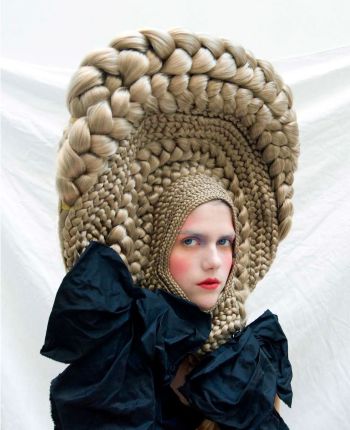
Marisol Suarez, Braided wig, © Katrin Backes.
Hair styling is an intimate act. Moreover, a well-born lady could not show herself in public with her hair down. A painting by Franz-Xaver Winterhalter, dated 1864, depicting Empress Sissi in a robe and with her hair untied, was strictly reserved for Franz Joseph’s private cabinet. Louis XIV, who became bald at a very young age, adopted the so-called ‘bright hair’ wig, which he then imposed on the court. In the 20th century, Andy Warhol had the same misfortune: the wig he wore to hide his baldness became an icon of the artist. Nowadays, hairpieces and wigs are used in high fashion, during fashion shows or, of course, to compensate for hair loss.
The natural hair colors and their symbolism are presented along with what they convey. Blonde is said to be the color of women and childhood. Red hair is attributed to sultry women, witches, and some famous stage women. As for black hair, it would betray the temperament of brown and brunettes. From the experimental colorations of the 19th century to the more certain dyes from the 1920s: artificial colors are not forgotten. The work of the hairdresser Alexis Ferrer who makes digital prints on real hair is also presented.
Trades and Skills
The exhibition reveals the different hair professions: barbers, barber-surgeons, hair stylists, wigmakers, ladies’ hairdressers, etc., through archival documents and a host of small objects: signs, tools, various products, and the astonishing perming machines and dryers of the 1920s.
In 1945, the creation of haute coiffure elevated the profession to the rank of an artistic discipline and a French savoir-faire. 20th-century hairdressing was marked by Guillaume, Antoine, Rosy and Maria Carita, and Alexandre de Paris styling princesses and celebrities. Nowadays, great hairstyling is mainly expressed during the fashion shows of prestigious fashion houses. Sam McKnight, Nicolas Jurnjack, and Charlie Le Mindu were invited to the exhibition to create extraordinary hairstyles for top models and show business personalities.
A Hairy Century
Finally, a special focus will allow us to evoke the iconic hairstyles of the 20th and 21st centuries: the 1900 chignon, the 1920s garçonne haircut, the 1930s permed and notched hair, the 1960s pixie and sauerkraut, the 1970s long hair, the 1980s voluminous hairstyles, the 1990s gradations and blond streaks, not to mention afro-textured hair.
The arrangement of hair in a particular form can reveal belonging to a group and manifest a political and cultural expression in opposition to society and the established order. More ideological than aesthetic, the Iroquois crest of the punks, the neglected hair of the grunges, or the shaved heads of the skinheads are strong moments of hair creativity.
Wearing the hair of another, known or unknown, has an eerie dimension, and this superstition seems well-entrenched. Despite these apprehensions, some creators choose to transcend this familiar material into fashion objects. This is the case of contemporary designers such as Martin Margiela, Josephus Thimister, and Jeanne Vicerial. The question of identity, treated lightly or more deeply, is often at the heart of the reasoning, whether the hair is real or fake.
Presented in the Christine & Stephen A. Schwarzman’s fashion galleries of the Musée des Arts Décoratifs, the exhibition is curated by Denis Bruna, Curator in Chief, Fashion and Textile Department, Collections before 1800. The scenography is by David Lebreton of the Designers Unit agency. The Musée des Arts Décoratifs has benefited from exceptional loans from the Château de Versailles, the Musée des Beaux-Arts d’Orléans, the Musée du Louvre and the Musée d’Orsay.
Denis Bruna, ed., Des cheveux et des poils (Paris: Les Arts Décoratifs, 2023), 288 pages, ISBN: 978-2383140139, €55. With contributions by Marie Brimicombe, Denis Bruna, Yanis Cambon, Astrid Castres, Pierre-Jean Desemerie, Ana Escobar Saavedra, Saga Esedín Rojo, Louise Guillot, Guillaume Herrou, César Imbert, Sophie Lemahieu, Maëva Le Petit, Aurore Mariage, Anne-Cécile Moheng, Sophie Motsch, Marie Olivier, Dominique Prevôt, Hélène Renaudin, Raphaël Sagodira, and Bastien Salva.
◊ ◊ ◊ ◊ ◊
Diane Pernet provides a useful summary with lots of images and an interview with Denis Bruna here»
◊ ◊ ◊ ◊ ◊
Note (added 11 August 2023) — Rosa Lyster reviewed the show for The NY Times: “Big Hair and Big Thoughts at a Paris Museum,” The New York Times (28 July 2023). An exhibition with over 600 items explores the evolution of women’s hairstyles, questions around body hair, and more. But hair is never just hair.
Exhibition | Doucet and Camondo: A Passion for the 18th Century
Now on view at the Musée Nissim de Camondo:
Doucet et Camondo: une passion pour le XVIIIe siècle
Musée Nissim de Camondo, Paris, 16 March — 3 September 2023
Curated by Juliette Trey
 Between 1906 and 1912, the celebrated couturier and great patron of the arts, Jacques Doucet (1853–1929), lived in an hôtel particulier built especially to house his collection of 18th-century art on the Rue Spontini in the 6th arrondissement of Paris. Drawings held a particularly important place in it. The exhibition Doucet et Camondo: une passion pour le XVIIIe siècle evokes the mansion through the watercolors done by the decorator Adrien Karbowsky (1855–1945) and forges the link between Doucet and Moïse de Camondo (1860–1935), who purchased some of the items in his collection from Doucet.
Les Arts Décoratifs et l’Institut national d’histoire de l’art (INHA) présentent, au musée Nissim de Camondo, une exposition consacrée à la riche collection d’œuvres d’art du XVIIIe siècle constituée par Jacques Doucet. Célèbre couturier et grand mécène, Jacques Doucet (1853–1929) est aussi l’un des plus importants collectionneurs de son temps. Une sélection de dessins, photographies et documents d’archives conservés à l’INHA retrace l’histoire de ce prestigieux patrimoine. L’exposition dévoile les décors éphémères de l’hôtel particulier situé rue Spontini dans le XVIe arrondissement que Doucet fait spécialement édifier pour accueillir cet ensemble de tableaux, dessins, sculptures, meubles et objets d’art du XVIIIe siècle. Elle met en lumière les œuvres ayant appartenu à Jacques Doucet, conservées notamment au musée Nissim de Camondo, ancien hôtel particulier de Moïse de Camondo, tissant ainsi le lien entre ces deux grands collectionneurs.
More information is available here»
Juliette Trey, Jacques Doucet et Moïse de Camondo: Une Passion pour le XVIIIe Siècle (Paris: Les Arts Décoratifs / INHA, 2023), 48 pages, €12.










 Enfilade
leave a comment