Call for Papers | J.M.W. Turner: State of the Field
From ArtHist.net:
J.M.W. Turner: State of the Field
Online, hosted by the Yale Center for British Art, 22 September 2023
Proposals due by 7 July 2023
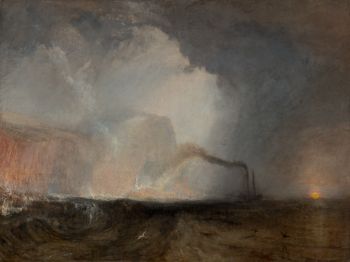
J.M.W. Turner, Staffa, Fingal’s Cave, 1831–32, oil on canvas, 91 × 121 cm (New Haven: Yale Center for British Art, Paul Mellon Collection).
On 22 September 2023, the Yale Center for British Art will host a one-day, online symposium titled J.M.W. Turner: State of the Field. This symposium will critically consider the state and meaning of Turner scholarship in advance of the 250th anniversary of Turner’s birth in 2025. Thinking through the extensive Turner historiography, the symposium seeks to explore the key ideas, underlying assumptions, and future direction of Turner research, and to consider its place within the broader field of British studies. We are particularly interested in critical analyses of the literature and studies that identify or exemplify potential new perspectives and approaches. We welcome proposals from established and emerging scholars on any topic within Turner studies and encourage participants to be imaginative in their approach.
Themes for consideration include but are not limited to
• The role of art historians, critics, curators, and institutions in building and maintaining Turner’s artistic prominence
• Turner’s place within past and contemporary approaches to British studies
• Turner’s place within discourses of modernity
• Turner’s own contribution to the construction of his artistic reputation
• ‘Realism’ and ‘idealism’ in Turner’s works
• Narrative and intentional meanings in Turner’s works, and what these might tell us about the artist’s broader social, cultural, and political positioning
• Issues of nationalism, race, and empire in Turner’s work
• Gaps that remain in studies of Turner’s artistic practice, including but not limited to his professional persona, relationships, and networks, and his engagement with the contemporary art market and/or print culture
• Innovative approaches to understanding Turner and his works, including new methodologies, critical perspectives, and future directions
Please submit an abstract of no more than 250 words and a short biography by 7 July 2023. Final presentations should not exceed twenty minutes in length.
New Book | Wedgwood: Craft & Design
From Thames & Hudson:
Catrin Jones, with a foreword by Tristram Hunt, Wedgwood: Craft & Design (London: Thames & Hudson, 2023), 144 pages, ISBN: 978-0500480755, $20.
 Looking back at key moments in Wedgwood’s design history, this book celebrates the manufacturer’s visual power and great design from its founding in 1759 to the present day.
The name Wedgwood has come to stand for something far beyond its illustrious and energetic founder: it has united art and industry; introduced design and artistic collaborations; and pioneered the development ofthe firm’s iconic blue-and-white jasperware. This book tells that story through design, reflecting the continuing role that Wedgwood and its designers, artists, and employees have played in setting trends—including collaborations with many British artists and designers such as Christopher Dresser, Eric Ravilious, and Keith Murray. Wedgwood continuously responds to the market and produces high-quality, desirable ceramicsfor a broad range of consumers, yet remains faithful to the traditions established by Josiah Wedgwood in the eighteenth century. The book presents highlights from the internationally renowned V&A Wedgwood Collection, praised by the Art Fund—one of the UK’s leading art organizations—as “one of the most important industrial archives,” containing around 80,000 objects. This archive reflects the unique proposition of Wedgwood’s business: by operating in both the ‘ornamental’ and ‘useful’ markets, Wedgwood has been able to bring innovative ceramic design to a broad and increasingly international clientele. These ceramics and their stories demonstrate the artistic heritage, craft, and innovation that have become synonymous with the Wedgwood name for more than 250 years.
Catrin Jones is a curator specializing in historic and contemporary applied arts. She joined the V&A in 2020 as Chief Curator, V&A Wedgwood Collection.
Tristram Hunt is the Director of the V&A and former Member of Parliament for Stoke-on-Trent, where the Wedgwood factory is located.
Symposium | Unpacking the V&A Wedgwood Collection
Unpacking the V&A Wedgwood Collection
Barlaston (Stoke-on-Trent) and London, 7–8 July 2023
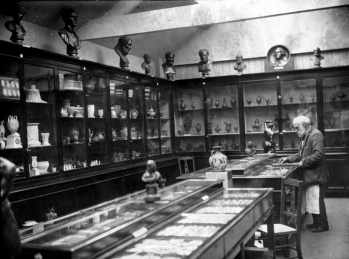
Isaac Cook, curator of the first Wedgwood Museum at the Etruria factory, sorting trays of Josiah Wedgwood’s trials © Fiskars.
Join leading ceramic artists, scholars, and emerging voices for a two-day symposium exploring fresh avenues of research into Wedgwood. We look forward to conversations that expand our understanding of Wedgwood and push scholarship in new directions. This dual-site landmark conference honours Gaye Blake-Roberts MBE, former curator of the V&A Wedgwood Collection, and her contribution to ceramic research. It will take place at the V&A Wedgwood Collection in Barlaston, Stoke-on-Trent (Friday) and at the V&A South Kensington, London (Saturday). A small number of bursaries for early career professionals will be available (generously funded through the Paul Mellon Centre); please send a 300-word application to wedgwood@vam.ac.uk by 5 June, outlining how attending the conference will benefit your professional development.
Book Day 1 here»
Book Day 2 here»
Please scroll down to ‘related events’ to book afternoon options and the evening dinner.
F R I D A Y , 7 J U L Y 2 0 2 3
Barlaston, Stoke-on-Trent, 10.00–17.00
• Kate Turner (Acting Chief Curator, V&A Wedgwood Collection) — Welcome
• Robin Emmerson (former Head of Decorative Art Department, National Museums Liverpool) — Gaye Blake-Roberts MBE: The Story So Far
Panel 1 | Beyond Josiah Wedgwood: Re-examining the Narrative
Chair: Oliver Cox (Head of Academic Partnerships VARI, NAL and Archives)
• Iris Moon (Assistant Curator European Sculpture and Decorative Arts, Metropolitan Museum of Art) — Phantom Urn: Wedgwood’s Disability
• Nicola Scott (Curator of Decorative Art, National Museums Liverpool) — Joseph Mayer (1803–1886): Portrait of a Victorian Wedgwood Collector
• Rebecca Klarner (Assistant Curator, V&A Wedgwood Collection, PhD Researcher University of Leeds) — Who Made It? Questions of Authorship, Authorising, and Authority in Wedgwood’s 20th-Century Design and Marketing
Bookable Afternoon Options for Day 1
2.00 Randeep Atwal and Lucy Lead — Extraordinary Wedgwood Women: Celebrating the Lives of Mary Euphrasia Wedgwood and Lucie Wedgwood
2.30 Alice Walton — Impressions from a Contemporary Ceramic Maker
2.00 Kate Turner — Wedgwood’s Anti-Slavery Medallion: A Re-display at the V&A Wedgwood Collection
2.00 Isabel Clanfield — Highlights of the Museum Store: A Guided Handling Session
A Wedgwood factory tour and have-a-go pot throwing sessions are also available to book.
Panel 2 | Impressions of the Past and Contemporary Ceramic Making
Chair: Catrin Jones (Chief Curator, V&A Wedgwood Collection)
• Matt Smith (Artist and Curator) — Remaking the Museum
Clare Twomey (Artist and Researcher) — Wedgwood: Identity and Practice
• Adam Hemming (Vice President of Marketing, Fiskars) — Making Wedgwood Today
Evening at Lunar restaurant, to be booked separately
With dinner speakers Tristram Hunt (Director, Victoria and Albert Museum) and Aileen Dawson (Former Curator, 1660–1800, Britain, Europe and Prehistory, British Museum)
S A T U R D A Y , 8 J U L Y 2 0 2 3
South Kensington, 10.00–17.30
• Antonia Boström (Director of Collections, V&A South Kensington) — Welcome
Panel 3 | Narratives of Creativity, Technology, Economics, and Labour
Chair: Caroline McCaffrey-Howarth (Lecturer in History of Art, 1650–1900, University of Edinburgh)
• Paul Greenhalgh (Director, Zaha Hadid Foundation) — Mimesis, Method, and Money: Wedgwood and His Forebears
• Claire Blakey (Curator of Modern Decorative Arts, National Museums Scotland) — Wedgwood and the Industrial Museum of Scotland
• Samantha Lukic-Scott (PhD Researcher, University of York) — Wedgwood and Pictorial Translation
• Paul Scott (Artist and Researcher) — Wedgwood’s American Transferware Patterns: New American Scenery, Archives, and Insights
Bookable Afternoon Options for Day 2
1.45 Angus Patterson — Cut Steel Dress Accessories with Jasperware Plaques: A Collaboration between Josiah Wedgwood and Matthew Boulton
2.05 Simon Spier and Florence Tyler — Wedgwood at the V&A South Kensington
Panel 4 | Global Wedgwood
Chair: Patricia Ferguson (Independent Researcher)
• Kate Smith (Associate Professor in 18th-Century History, University of Birmingham) — Clay, Labour, and Heat: Making Ceramics in a Global World
• Brigid von Preussen (Junior Research Fellow in History of Art, University of Oxford) — Model Colonies: Australian Clay, British Moulds, and the New Etruria
• Raffaella Ausenda (Professor, Freelance Historian of Italian Ceramics, Milan) — Italian Creamware ‘ad uso d’Inghilterra’ in Northern Italy and Beyond
• Rachel Gotlieb (Curator of Ceramics, Crocker Art Museum) — Viola Frey (1933–2004): Disrupting Josiah Wedgwood’s Portland Vase in Northern California
Colonial Williamsburg in 2023

The Foundations of the Governors Palace in 1930. (Visual Resources, John D. Rockefeller Jr. Library, The Colonial Williamsburg Foundation; photo by Thomas Layton). As Jennifer Scheussler writes, Colonial Williamsburg is now “a 301-acre complex consisting of more than 60 restored or reconstructed 18th-century buildings, 30 gardens, five hotels, three theaters, two art museums and a long, tangled history of grappling with questions of authenticity, national identity and what it means to get the past ‘right’.”
◊ ◊ ◊ ◊ ◊
Schuessler’s feature article on Williamsburg is useful for both the history of the Foundation and its present-day vision and commitments. –CH
Jennifer Schuessler, with photographs by Matt Eich, “Building a Better Colonial Williamsburg,” The New York Times (8 May 2023). Virginia’s reconstructed colonial capital, long criticized as presenting an idealized image of the American Revolution, brings its history into the 21st century.
“. . . After decades of declining attendance and financial instability, the Colonial Williamsburg Foundation, the private entity that owns and operates the site, is rethinking not just some of its structures, but also the stories it tells, adding or expanding offerings relating to Black, Native American, and L.G.B.T.Q. history.
And it’s doing so amid a fierce partisan battle over American history, when the date “1776”—emblazoned on souvenir baseball hats on sale here—has become a partisan rallying cry.
Some conservative activists have accused Colonial Williamsburg of going “woke,” a charge also lobbed against Monticello and Montpelier, James Madison’s home. But Cliff Fleet, a former tobacco executive who took over as the foundation’s president and CEO in early 2020, firmly rejects it. Fleet describes his approach as leaning into Colonial Williamsburg’s longtime mission of presenting “fact-based history,” grounded in rigorous research. “That’s true to our brand,” he said. “Everything is going to be what actually happened. That’s who we are.”
Recounting “what actually happened” is no simple matter, as any historian will tell you. But when it comes to the state of contemporary Colonial Williamsburg, some facts speak powerfully.
In 2021, the foundation raised a record-breaking $102 million, up 42 percent from the previous high in 2019. To date, it has collected more than $6 million for the excavation and reconstruction of the First Baptist Church, home to one of the earliest Black congregations in the United States (founded in 1776), and more than $8 million for the restoration of the Bray School, which educated free and enslaved Black children in the 1760s and ’70s.
Those projects have won support across the political spectrum, including from Gov. Glenn Youngkin. In February, the governor—a Republican who on his first day in office signed an executive order banning the teaching of critical race theory and other “inherently divisive concepts” in public schools—spoke at an event for the Bray School, citing the need “to teach all of our history, all of it, the good and the bad.”
For some longtime Williamsburg-watchers, the institution’s leadership has deftly steered through today’s choppy political waters by staying true to the past.
“It’s a remarkable shift, but in some ways a return to C.W.’s original mission,” said Karin Wulf, a historian and the former executive director of the Omohundro Institute, an independent research group at the College of William & Mary. “The scholarship of decades has shown us this fuller, richer picture of Early America,” Wulf said. “It’s diverse, it’s complex, it’s violent. But it’s the real thing.” . . .
After World War II, Colonial Williamsburg became a patriotic shrine and “symbol of democracy in the troubled world,” as a top executive put it. The Bicentennial brought a new boom, with annual paid attendance peaking in the mid-1980s at 1.1 million visitors, many of whom bedded down in period-style inns (or snapped up authorized colonial-style home products).
But not everyone appreciated the tastefully spic-and-span aesthetic. Writing in The New York Times in 1963, the architecture critic Ada Louise Huxtable called it a “superbly executed vacuum,” which fostered “an unforgivable fuzziness between the values of the real and the imitation.”
The carefully tended history also stirred criticism, particularly as social history, with its emphasis on ordinary people and marginalized groups, surged in the academy.
In the 1770s, more than half of the town’s 1,800 residents were Black, though visitors to the modern-day recreation would not always have known it. . . .
“True” is a word heard often at Williamsburg, where interpreters—including one portraying Oconostota, an 18th-century Cherokee diplomat who came to Williamsburg in 1777—regularly break character to explain the evidence behind their stories.
The foundation’s audience research, Fleet said, indicates that showing your work helps built trust. “One of the most important things to do, particularly in this age of polarization, is to let them know how you know,” he said.
The First Baptist Church project exemplifies how Colonial Williamsburg’s storytelling is literally built from the ground up, and rooted in discoveries—and rediscoveries—on site. . . .
The full article is available here»
At Auction | Significant Colonial Notes
From the press release (via Art Daily) for the sale:
Significant Colonial Notes from the John J. Ford Collection
Live Online Sale, Kagin’s Auctions, Tiburon, California, 20 May and 23 September 2023
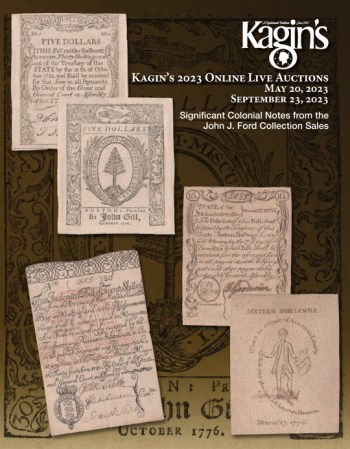 Historic, colonial-era paper money printed by Benjamin Franklin and Paul Revere with provenance from a famous collection formed starting in the 1940s is coming to market. The first of two auctions of the rare, early American money will be conducted online by Kagin’s Auctions of Tiburon, California on 20 May 2023, with the second sale scheduled for 23 September.
“These important notes were previously in the collection of John J. Ford, a prominent New York City collector and influential dealer who passed away at the age of 81 in 2005. Some of the notes are unique with no other examples known, and many others are the finest surviving 18th-century notes of their kind,” explained Dr. Donald Kagin, president of the auction company.
Notes from all 13 original colonies and Georgia are represented in the auctions, including a dozen notes produced by Franklin and 34 made by Revere. Writer, inventor and statesman Benjamin Franklin printed money for Delaware, New Jersey, and Pennsylvania. Those notes’ designs include the words, “Printed by B. Franklin,” or, “Printed by B. Franklin and D. Hall.” David Hall emigrated to Philadelphia from Scotland and was an early American printer, publisher, and business partner with Franklin. Boston silversmith, engraver, and patriot Paul Revere printed money for Massachusetts and New Hampshire without placing his name or initials on the money. One of the notes has the authorization signature of a signer of the Declaration of Independence, William Ellery of Rhode Island.
Kagin states: “John J. Ford began assembling his collection of early American money in the 1940s. There are 375 of Ford’s Colonial and Revolutionary War era notes that will be offered in the two auctions, and 58 of them were used as illustrations in the standard reference book on the topic, The Early Paper Money of America, [by Eric Newman, the first edition of which appeared in 1967]. These are examples of the types of money printed in the colonies in the mid-1700s and used by the public for daily commerce or to pay soldiers fighting in the Revolutionary War. All of these notes are early American history you can hold in your hands.”
Nearly four dozen notes in the May 20 auction were printed with the unmistakable warning, “To Counterfeit is DEATH.” Denominations of some notes are in English Pence, Shillings, or Pounds; others are in dollar denominations depending on when and where the notes were printed. A few notes are even denominated in both Pounds and Dollars. Some carry patriotic messages or symbolism, such as the “sword in hand” design on some notes printed by Revere. Those depict a Colonial era man holding a sword in one hand and a copy of the Magna Carta in the other. The motto above him reads “IN DEFENSE OF AMERICAN LIBERTY” and below in Latin is a phrase translated as “By arms he seeks tranquility under freedom.”
Exhibition | Giuseppe Marchesi (il Sansone)

Giuseppe Marchesi, known as il Sansone, Moses and the Daughters of Jethro / Mosé e le figlie di Jethro, ca. 1720–25, oil on canvas
(Private Collection)
◊ ◊ ◊ ◊ ◊
Bologna’s Musei Civici d’Arte Antica hosts the first monographic exhibition on the early career of the painter Giuseppe Marchesi, known as Samson.
Leggiadro Barocco: L’attività giovanile di Giuseppe Marchesi detto il Sansone
Collezioni Comunali d’Arte, Palazzo d’Accursio, Bologna, 1 April — 2 September 2023
Curated by Antonella Mampieri and Angelo Mazza
Giuseppe Marchesi (1699–1771)—of restless temperament and imposing build, to which he owed his nickname ‘Samson’—was among the most fruitful painters in cosmopolitan 18th-century Bologna, where the art scene was as lively as ever. He was, however, forgotten as a result of changes in the history of taste. Leggiadro Barocco: L’attività giovanile di Giuseppe Marchesi detto il Sansone aims to rediscover this significant painter from the classicist side of the Bolognese school. A pupil of leading artists of the previous generation, including Aureliano Milani and Marcantonio Franceschini, Marchesi was part of the local painting tradition that found an indispensable model in the Carracci and their pupils—particularly Guido Reni, Francesco Albani, and Domenichino.
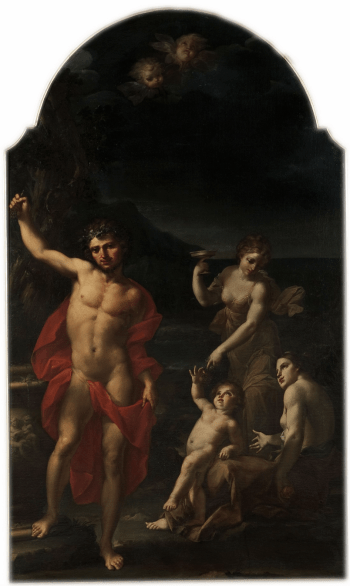
Giuseppe Marchesi, known as il Sansone, Autumn, from The Four Seasons, ca. 1725, oil on canvas (Bologna: Pinacoteca Nazionale).
This stylistic orientation was also supported and promoted by the city’s main artistic institution, the Accademia Clementina, to which Marchesi belonged, holding a variety of positions, didactic and directorial, until his appointment as Principe in 1752. His subsequent artistic evolution led him to the gradual abandonment of an Arcadian classicism in favor of an almost Mannerist style, similar to that of Francesco Monti and Vittorio Maria Bigari. Marchesi’s biography, present only in the manuscript lives composed by the Bolognese scholar Marcello Oretti in the second half of the century, is missing in Luigi Crespi’s Felsina Pittrice (1739) and appears only marginally in the Storia dell ’ Accademia Clementina by Giampietro Zanotti (1739), who nevertheless recognized, along with Luigi Lanzi, Marchesi’s remarkable artistic qualities for “a manner of painting so beautiful and so strong, that all delight, and good, and great fame comes to him.”
Early on there was overlap between Marchesi’s work and that of his contemporary Ercole Graziani, so much so that at the 1935 Mostra del Settecento Bolognese, which marked the resurgence of interest in this period of local art history, many of the works now ascribed to Marchesi were attributed to Graziani. It was up to critic Renato Roli to make a brilliant first reconstruction of Marchesi’s oeuvre in 1971, distinguishing the hands of the two painters. Subsequent studies, conducted mainly by Antonella Mampieri and Angelo Mazza, expanded the catalogue of known paintings, adding specimens of graphics and engravings made from Marchesi’s drawings. The ability to blend warm colors and strong musculature, derived from the Carracci, with the Arcadian grace of drawing, typical of Franceschini’s painting, made Samson a fashionable painter, up to date with the post-Baroque trends that were already in vogue in France and Austria, appreciated by the public and his colleagues.
A prolific and garrulous petit maître, his lively narrative vein yielded extremely pleasing results, especially in his younger years. The culmination of this phase was the fresco decoration of the vault and apse of the church of Santa Maria di Galliera, in Bologna, Marchesi’s first great public commission (1732–44), which established his reputation as a painter at home, in other Italian regions, and in other European countries, including England and Holland.
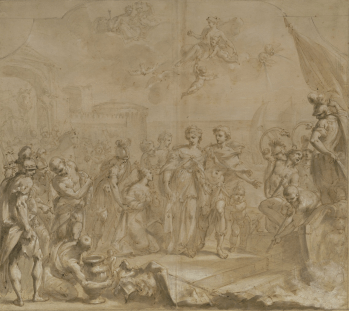
Giuseppe Marchesi, known as il Sansone, The Abduction of Helen, 1725 (Bologna: Collezioni d’Arte e di Storia della Cassa di Risparmio).
The exhibition, designed for the Collezioni Comunali d’Arte, which keeps in its permanent collection the painting Clement VIII Returning the Keys of the City to the Elders of Bologna, focuses on the early period of the artist’s elegant and graceful career: his relationship with Marcantonio Franceschini, who transmitted to him his moderate Arcadian taste, to 1725, the conventional starting point of Marchesi’s independent career. Two paintings recently found on the antiques market and exhibited here for the first time from a private collection—Moses and the Daughters of Jethro and Solomon Censoring the Idols, the success of which is demonstrated by the presence of copies at the Museo Diocesano in Imola—and other examples of paintings of sacred and profane themes demonstrate the artist’s youthful style. These include the Four Seasons from the Pinacoteca Nazionale in Bologna and The Drunkenness of Noah, now in a private collection. Completing the exhibition are a miniature Portrait of a Maiden preserved at the Museo Civico d’Arte Industriale and Galleria Davia Bargellini and two lively drawings from the the Fondazione Cassa di Risparmio in Bologna: The Abduction of the Sabine Women and The Abduction of Helen, preparatory projects for a large painting to be made in the hall of honor of the house that later belonged to the Buratti merchants, promoters of the arts and various Bolognese artists. Only the second one, dated 1725, was later realized by the painter, opening his documented career.
Leggiadro Barocco: L’attività giovanile di Giuseppe Marchesi detto il Sansone proposes a renewed reading of this protagonist of the Bolognese ’barocchetto’, allowing new hypotheses on the chronological ordering of his early work. The exhibition is accompanied by a publication edited by Antonella Mampieri and Angelo Mazza, with the collaboration of Silvia Battistini, a preface by Massimo Medica, text by Mirko Bonora, and essays by Antonella Mampieri and Angelo Mazza.
Exhibition | Louis XVI, Marie-Antoinette, and the Revolution
From the French National Archives and the Boutiques de musées:
Louis XVI, Marie-Antoinette, and the Revolution: The Royal Family at the Tuileries, 1789–1792
Archives Nationales / Hôtel de Soubise, Paris, 29 March — 6 November 2023
Curated by Isabelle Aristide-Hastir, Jean-Christian Petitfils, and Emmanuel de Waresquiel
 A period of almost three years separated the end of the ancien régime from the collapse of the French monarchy. Between 1789 and 1792, the royal family, forced to leave Versailles and its splendour, lived under house arrest in Paris, in the Tuileries Palace. Through archival documents, engravings, works of art, and pieces of furniture from the Tuileries, this tumultuous period is presented in the exhibition with a particular focus on the daily life of the royal couple, Marie-Antoinette’s secret correspondence with the Swedish Count Axel de Fersen, and the intimacy of a palace that has since disappeared.
Les Archives nationales éclairent d’un jour nouveau la période méconnue qui a suivi les événements de 1789. Cette exposition rassemble une centaine de documents, tableaux, gravures et plusieurs éléments de mobilier, et propose une immersion dans le quotidien de la famille royale, depuis son départ de Versailles pour les Tuileries jusqu’à la chute de la monarchie.
Comment la famille royale a-t-elle vécu la période de grande tension politique qui a suivi le déclenchement de la Révolution ? À quoi ressemblait la vie de la cour dans l’enceinte des Tuileries ? De quelle manière le roi et la reine ressentaient-ils le tumulte de la rue et la pression de l’opinion publique ? Autant de questions qui sont au cœur de l’exposition Louis XVI, Marie-Antoinette et la Révolution. La famille royale aux Tuileries, 1789–1792, présentée par les Archives nationales, à l’hôtel de Soubise, du 29 mars au 6 novembre 2023.
Riche en événements politiques, cet épisode de mille jours est bien représenté dans les archives et l’iconographie. Entre autres documents inédits ou méconnus, les visiteurs pourront ainsi découvrir le prAdolf Ulrik Wertmüller, Portrait de la reine Marie-Antoinette, vers 1785–1788. Marie-Antoinette est ici représentée dans une tenue d’intérieur. Le peintre suédois Wertmüller a aussi peint la reine en 1785 avec ses deux enfants dans le jardin de Trianon, et en 1788 en habit d’amazone. Collection particulièreé-cieux journal de Louis XVI (« Mardi 14 juillet : rien ») ouvert aux pages des années 1791–1792, son manifeste politique aux Français (20 juin 1791), un portrait de la reine très rarement exposé et la correspondance secrète entre Marie-Antoinette et le comte de Fersen. Pour la première fois, le contenu de leurs lettres codées, chiffrées et caviardées sera révélé au grand public. L’une des facettes les plus fascinantes de cette période fondatrice de l’histoire de France, marquée Lettre de Marie-Antoinette à Fersen (copie faite par Fersen), avec passages caviardés. Autographe, 26 septembre 1791par la fin d’un règne et la naissance d’un monde nouveau.
Isabelle Aristide-Hastir, Jean-Christian Petitfils, Emmanuel de Waresquiel, Lucien Bély, and Philip Mansel, Louis XVI, Marie-Antoinette et la Révolution: La famille royale aux Tuileries, 1789–1792 (Paris: Éditions Gallimard, 2023), 192 pages, ISBN: 978-2072974618, €30.
The cover of the catalogue comes from a print after Jean-Louis Prieur, Siege and Capture of the Château des Tuileries on 10 August 1792 / Siège et prise du château des Tuileries le 10 août 1792, ca. 1792 (Paris: Archives nationales, AE/II/3019).
New Book | Barnave: The Revolutionary
From Yale UP:
John Hardman, Barnave: The Revolutionary Who Lost His Head for Marie Antoinette (New Haven: Yale University Press, 2023), 416 pages, ISBN: 978-0300270846, $40.
 A major new biography of Antoine Barnave—the politician and writer who advocated for a constitutional monarchy in revolutionary France
Antoine Barnave was one of the most influential statesmen in the early French Revolution. He was a didactic man of austere morals and vaulting ambition who dressed as an English dandy, running up considerable tailor’s bills. Before his execution at age thirty-two, he played a decisive role in revolutionary politics and even governed France in 1791 through a secret correspondence with Marie-Antoinette. In the first biography for more than a century, John Hardman traces Barnave’s life from his youth in Dauphiné to his role in the Constituent Assembly and his part in forming the Feuillants, the party dedicated to the moderate cause. Despite his early death, Barnave left a remarkable volume of material, from published works to thousands of manuscript pages. Hardman uses this rich archive to explore the life of this elusive writer, politician, and thinker—and sheds new light on the revolutionary period.
John Hardman is one of the world’s leading experts on the French Revolution and the author of several distinguished books on the subject, including Marie-Antoinette and The Life of Louis XVI, which was shortlisted for the Elizabeth Longford Prize for Historical Biography and won the Franco-British Society Prize.
C O N T E N T S
Introduction
1 Reluctant Lawyer
2 The Origins of the French Revolution according to Barnave
3 Political Awakening: Barnave in the Pre-Revolution, 1787–89
4 The Assemblies at Romans: The Last Estates of Dauphiné
5 From Estates-General to National Assembly
6 The Decisive Phase, 14 July – 6 October 1789
7 The Year 1790
8 Barnave’s Private Life
9 Barnave and the Court before the Flight to Varennes
10 Barnave on the Defensive
11 Varennes and Its Repercussions
12 The Revision of the Constitution
13 Governing in Secret
14 The Return of the Native: January – August 1792
15 A Long Incarceration
16 Trial and Death
Conclusion
Endnotes
Bibliography
Index
Lecture | Michael Yonan on the Bavarian Rococo
This week in Chicago, at Northwestern:
Michael Yonan | The Bavarian Rococo, the Outlier of Eighteenth-Century Art
Block Museum of Art, Northwestern University, Evanston, Illinois, Wednesday, 17 May 2023, 5pm

Wieskirche, designed by the Zimmermann brothers, near Steingaden, Germany, 1745–55, view toward altar (Wikimedia Commons, 2019).
Bavarian rococo art and architecture has long received both attention and derision from art historians. It is incredibly sophisticated in design and seemingly totally out of sync with the broader narrative of European art: backward-looking, regionally influential, and exuberantly unrestrained in its abundant use of ornamentation. As part of the Warnock Lecture Series, this talk will explore what we can do with this visually arresting art and suggest that it deserves a firmer place in art history.
Michael Yonan is Professor of Art History and Alan Templeton Endowed Chair in the History of European Art, 1600–1830, at the University of California, Davis. His areas of research are eighteenth-century European art, the decorative arts, material culture studies, and art historical historiography and methodology. He is the author of Empress Maria Theresa and the Politics of Habsburg Imperial Art (2011), Messerschmidt’s Character Heads: Maddening Sculpture and the Writing of Art History (2018), and with Stacey Sloboda is co-editor of Eighteenth-Century Art Worlds: Global and Local Geographies of Art (2019). In 2022 he was visiting guest professor at the Institute for Culture and Aesthetics, Stockholm University, Sweden. He is currently writing a book on materiality in art history.
Online Conversation | Material Cultures of the Global 18th Century
Material Cultures of the Global 18th Century: Art, Mobility, and Change
HECAA Zoom Event, Wednesday, 17 May 2023, 6.30–8.00pm EST
 This upcoming Zoom event, sponsored by the Historians of Eighteenth Century Art and Architecture (HECAA), celebrates the publication of a new volume dedicated to global eighteenth-century material cultures. The editors, Wendy Bellion and Kristel Smentek, will offer remarks and invite conversation. There will also be presentations by select authors: Douglas Fordham, Yve Chavez, Matthew Gin, and Tara Zanardi.
This online event is open to all; HECAA membership is not required. Please register in advance here».
Wendy Bellion and Kristel Smentek, eds., Material Cultures of the Global Eighteenth Century: Art, Mobility, and Change (London: Bloomsbury Visual Arts, 2023), 288 pages, ISBN: 978-1350259034, $115. Also available as an ebook.










 Enfilade
leave a comment