Symposium | Evoking the Incommensurable: Painting the Sublime

Philip James De Loutherbourg, An Avalanche in the Alps, 1803, oil on canvas, 110 × 160 cm
(London: Tate, T00772).
◊ ◊ ◊ ◊ ◊
From the conference website:
Evoking the Incommensurable: Painting the Sublime
In person and online, Friedrich Schiller University, Jena, 26–28 July 2023
Organised by Johannes Grave, Sonja Scherbaum, and Arno Schubbach
Collaborative Research Center (SFB) 1288 “Practices of Comparing,” Bielefeld University, and Research Center for European Romanticism, Friedrich Schiller University Jena.
In the 18th century, the concept of the sublime constitutes a genuine novelty and a driving force for advancements in the theoretical reflection on the arts throughout Europe. Edmund Burke and Immanuel Kant distinguished the sublime sharply from the beautiful, i.e., the traditional organizing subject of treatises on painting and literature, and emphasized its excessive strain on the senses, its incommensurability with any measure, and its irreducibility to any bounded shape. It thus constituted a harsh contrast to the beautiful and challenged the aesthetic values of pictorial or literary representation.
Moreover, the sublime was also a challenge to artistic practice. Theoretical discourse concerning the sublime often referred much more directly to our experience of nature than to our experience of artistic works. Particularly in the case of Kant, it was not evident that the arts are at all able to evoke anything sublime. Nevertheless, various attempts to paint the sublime can be seen in the genre of landscape painting. The sublime stimulated painters to push the limits of painting and to explore its capabilities anew.
The international conference Evoking the Incommensurable: Painting the Sublime will discuss the question of how artists purposefully explored and exploited the limits and capabilities of painting in order to evoke the incommensurable and paint the sublime. Participation is possible both on-site or via Zoom. Please register at paintingthesublime@uni-jena.de by 24 July 2023. The conference will be held in a hybrid format. Please let us know if you would like to attend in person or via Zoom.
w e d n e s d a y , 2 6 j u l y 2 0 2 3
13.00 Arrival and Registration
13.30 Welcome and Introduction
14.00 Panel 1
Chair: Johannes Grave
• Aris Sarafianos (Ioannina), Hard Imitation and the Sublime Real: Art, Exhibitions, Panoramas, Casts, and Displays at the Far Ends of Visibility, c. 1800
• Elisabeth Ansel (Jena), ‘Most Magnificent and Sublime’: Ossian, Blindness, and the Sublime in the Visual Arts
• Hélène Ibata (Strasbourg), Temporal Vertigo and the Historical Sublime in Turner’s Venice Paintings
17.30 Coffee Break
18.00 Keynote Lecture
• Robert Doran (Rochester), ‘Moving Us to Pity’: Visual Art and Sublimity in Burke, Du Bos, and Kant
20.00 Conference Dinner
t h u r s d a y , 2 7 j u l y 2 0 2 3
9.15 Welcome
9.30 Panel 2
Chair: Mira Claire Zadrozny
• Yvon Le Scanff (Paris), Victor Hugo, ‘Bringing out the Sublime’
• Caroline van Eck (Cambridge), The Animal Sublime, c. 1800
• Sarah Gould (Paris), Mary Somerville’s Scientific Sublime: Picturing the Immaterial
13.00 Lunch Break
14.30 Panel 3
Chair: Britta Hochkirchen
• Laure Cahen-Maurel (Bonn), Viewing beyond the Visible: The Power of the Imagination from the Kantian to the Romantic Sublime
• Mark Cheetham (Toronto), The Incommensurability of Arctic Sublimity: Environmental Stereotypes and the Specificity of the Sublime
• Craig Hanson (Grand Rapids), Before & After: Temporal Strategies for Effecting the Sublime
19.30 Reception at Schillers Gartenhaus
f r i d a y , 2 8 j u l y 2 0 2 3
9.15 Welcome
9.30 Panel 4
Chair: Arno Schubbach
• Marie-Louise Monrad Møller (Leipzig), Pauelsen, Dahl, Lundbye: Aspects of the Sublime in Scandinavian Landscape Painting
• Adèle Akamatsu (Paris), Fjords, Waterfalls and High Mountains: Painting the ‘Rough’ and ‘Grand’ Landscapes of Norway from Germany, 1820s–1860s
• Nikita Mathias (Oslo), Painting the Sublime beyond Painting: From the Easel to the Cinema
13.00 Concluding Discussion
Call for Essays | Interpretations of Longinus in the Early Modern Period
From ArtHist.net:
Interpretations of Longinus in the Literature, Painted and Printed Imagery of the Early Modern Period
Edited Volume of Essays To Be Published in 2025
Proposals due by 15 July 2023; final chapters due by 1 July 2024
This volume of the series Trends in Classics (to be published by De Gruyter) seeks to explore aspects of Longinian ideas, addressing in particular the concept of the sublime. It will bring together scholars of art history, history of ideas, literature, and philosophy to reflect upon the reception of these ideas in the literature and the art of Italy, Spain, and the Low Countries from the 15th through the 18th century. Considering that there is probably no direct evidence concerning the Longinian sublime as a productive theory in the early modern times, the primary interest lies in possible interpretations of works in certain artistic media (paintings and prints) as well as re-readings of the Peri hypsus in the literature of the period.
The starting point is the relationship among artists, literati, and patrons; the connections of artworks to various textual sources; the existence of sublime/Longinian literature in libraries of the period; and the tracing of relevant text dissemination. The network of acquaintance with the notion of the sublime may be opened up towards other directions, such as politics, the treatment of the human body, the aesthetics of antiquity, and the Renaissance. The tackling of a complex problem such as the reception of Longinian ideas, makes cross-disciplinary research imperative.
The completed volume will be published in 2025. Drafts from participants will be discussed during an online workshop in February 2024. The presentations will be 20 minutes long. Contributors are invited to submit their proposals in English. There is a two-stage submission procedure.
15 July 2023
Please send a 250-word proposal (in English) and a short cv (500 words) to all the members of the editorial board:
• Ianthi Assimakopoulou, National Kapodistrian University of Athens, ianthiassim@icloud.com
• Nafsika (Nancy) Litsardopoulou, Athens School of Fine Arts, nancylitsardo@hotmail.com
• Evina Sistakou, Aristotle University of Thessaloniki, sistakou@gmail.com
15 September 2023
Selected abstracts will be invited to participate in the online international workshop in February 2024, under the aegis of the National and Kapodistrian University of Athens – Department of History and Archaeology.
February 2024
Online workshop.
1 July 2024
Submission of final versions of the papers (up to 7000 words, excluding bibliography). Following a peer review process, the editorial board will make final decisions on the acceptance of papers.
Exhibition | Sensing Naples
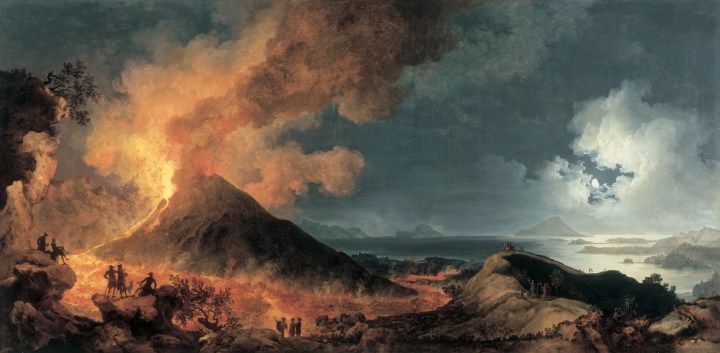
Pierre-Jacques Volaire, An Eruption of Vesuvius by Moonlight, 1774, oil on canvas, 130 × 260 cm (Compton Verney; photo by John Hammond). As noted at ArtUK, this is the largest of Volaire’s many views of the volcano.
◊ ◊ ◊ ◊ ◊
With scents in the gallery, readers may recall The Essence of a Painting: An Olfactory Exhibition on view last summer at the Prado. From Madrid to Compton Verney:
Sensing Naples
Compton Verney, Warwickshire, 1 April — 31 December 2023
Come and be transported to Naples—where the scent of orange blossom drifts on the air and the spectacle of Vesuvius smoulders in the distance. Bringing to life the smells, sounds, sights, tastes, and sensations of visiting this vibrant Italian city, Sensing Naples will see the exquisite historic works in our Naples Collection rehung and reimagined. Interactive elements and new wall texts will foreground exciting new research into objects in the collection undertaken in collaboration with the University of Oxford and the Centre for the Art and Architectural History of Port Cities, Naples.

Installation view of Sensing Naples at Compton Verney, 2023.
The display features new interactive elements, including samples of music from the period and six bespoke fragrances, which are paired with specific paintings. Developed in collaboration with a specialist fragrance house, the scents have been designed to highlight elements within the paintings and to evoke the experience of visiting the city of Naples in the period 1600–1800. Some are pleasant, others not so: they include the smells of the Bay of Naples, perfumed gloves, a fish market, tobacco smoke, a floral still life, and an eruption of Mount Vesuvius. You will also find a new, interactive play table modelled on an erupting Vesuvius, a permanent fixture in the galleries aimed at engaging our youngest visitors.
Additional works on display include examples of souvenirs made from the lava of Vesuvius and brought back to Britain in the eighteenth and nineteenth centuries, as well as two new commissions produced by artists working today.

Aaron McPeake, Commissioned work for the exhibition, three bronze bells suspended from the ceiling above a lava rock. More information is available here.
The new artworks respond to the theme of the senses and also to works in the historic collection, and have been commissioned in partnership with disability arts platform Unlimited. DYSPLA, a neuro-divergent led award-winning arts studio, have created a work that speaks to Lorenzo Vaccaro’s marble busts of The Four Continents, through four new performative digital sculptures. Accessed via a QR code, these holographic sculptures invite you to engage with your own physicality through touch. The senses of sight, hearing, and touch are further addressed in the second new artwork, which takes the form of three bronze bells suspended above a piece of Vesuvius lava rock. The bells, which can be gently rung, were created for Compton Verney by Aaron McPeake, an artist whose practice explores his own experience of sight loss later in life.
Lecture | Alessia Attanasio on Neapolitan Art in English Collections
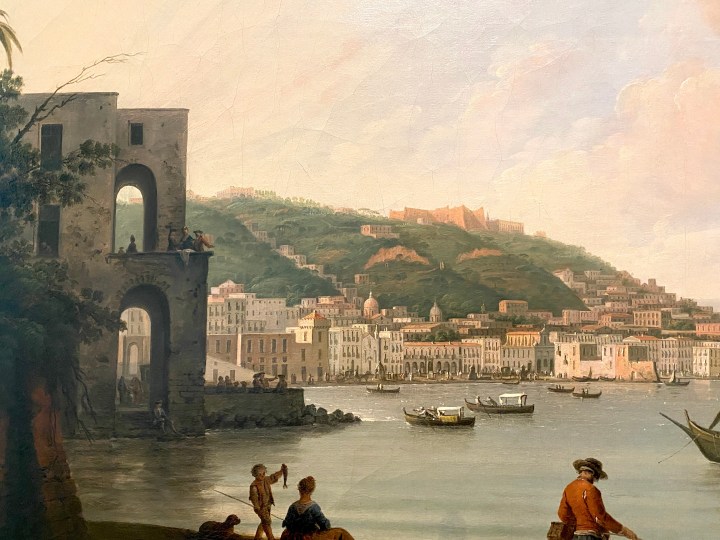
Pietro Fabris, The Bay of Naples from Posillipo, detail, ca. 1770, oil on canvas, 75 × 128 cm
(Compton Verney, Warwickshire)
◊ ◊ ◊ ◊ ◊
From The Wallace Collection:
Alessia Attanasio, The Fortunes of Baroque Neapolitan Art in English Collections during the Grand Tour, 1680–1800
Wallace Collection Seminars on the History of Collections and Collecting
Online and in-person, The Wallace Collection, London, Monday, 26 June 2023, 5.30pm
This talk aims to provide an overview of the history of collecting Baroque Neapolitan art in England from 1680s to 1800s, a period when many English artists and collectors travelled to Naples during the Grand Tour. Based on Alessia Attanasio’s PhD research, it will introduce artists from the Kingdom of Naples who enjoyed considerable success among English patrons, demonstrating how the Grand Tour influenced the market for Baroque Neapolitan art—not just for the newly discovered antiquities in Pompeii, Herculaneum, and Stabiae.
Today, Baroque Neapolitan paintings form a significant part of private and public English art collections; yet there is no publication exploring the significance of these collections as a whole. Therefore, the lecture aims to fill this gap by identifying and locating Neapolitan art in public and private English collections, now disclosed in an up-to-date database. The database will include images, references, notes on subject, author, and context, as well as acquisition and provenance details, providing the first comprehensive view of Neapolitan paintings in England. Alessia will focus on specific private British collections held in country houses such as Compton Verney, with the new redisplay of its unique Neapolitan collection, and Holkham Hall, which owns several Neapolitan paintings, both of which reflect the changes in art collecting in England. The lecture will bring together different fields of study, from the history of art to the art market, and shed new light on the material conditions that made art collecting possible.
Alessia Attanasio is a PhD candidate at the University of Birmingham, focusing on Baroque Neapolitan art that was collected in England during the Grand Tour (1680s–1820s), with particular interests in country houses, history of collecting, and museum studies. Alessia’s interest in museums is supported by eight years of experience working in museums as an assistant curator and museum educator, including Capodimonte Museum in Naples, and the Royal Collection Trust in London. Most recently, Alessia has been undertaking research into Baroque artworks in the Neapolitan Collection of Compton Verney, contributing to the curation of its permanent redisplay, Sensing Naples.
New Book | Jacopo Alessandro Calvi (1740–1815)
From Silvana Editoriale:
Irene Graziani, with contributions by Francesca Maria Conti, Igino Conti, and Ilaria Negretti, Jacopo Alessandro Calvi, detto Il Sordino (1740–1815): Accademico e Pittore (Milan: Silvana Editoriale, 2022), 512 pages, ISBN: 978-8836652884, €40.
 Nella Bologna della seconda metà del Settecento Jacopo Alessandro Calvi (Bologna, 1740-1815) diviene il principale competitore dei fratelli Ubaldo e Gaetano Gandolfi. Formatosi sotto l’ala di Giampietro Zanotti, segretario dell’Accademia Clementina, fin dagli anni giovanili si sperimenta nelle «dive arti sorelle» della pittura e della poesia, privilegiando un criterio elettivo nel processo di imitazione della natura. Testimoniano il suo successo l’annessione all’Accademia Clementina (1770) e il gran numero di commissioni, soprattutto pale di destinazione ecclesiastica.
Anche nel tempo della «fatal rivoluzione», che comporta una drastica riduzione delle opportunità di lavoro per tutti gli artisti, Calvi regge il colpo, superando le difficoltà del momento, sia attraverso l’intensificarsi dell’attività letteraria — gli si devono fra l’altro la prima monografia critica di Guercino, edita nel 1808, e uno studio su Francesco Francia, pubblicato nel 1812 — sia attraverso lo svolgimento di un ruolo di perito presso l’Accademia Clementina, impegnata nell’ingrato compito di governare il rischio di dispersione dei beni d’arte durante le spoliazioni napoleoniche.
Pur estraneo ai valori giacobini, viene convocato come commissario nel Concorso per la ‘Riconoscenza Nazionale’ (1802), indetto a Milano allo scopo di celebrare il ritorno di Napoleone dopo la parentesi austriaca; e nel 1804 sarà annoverato fra i professori della nuova Accademia di Belle Arti di Bologna. Con il nuovo secolo la sua carriera riesce a trovare ragioni di soddisfazione anche sul fronte della produzione artistica: attraverso un’intelligente lettura critica della maniera del tardo Guercino e del dolce e devoto Francesco Francia, la sua pittura saprà farsi anticipatrice di istanze poi affermatesi nella Bologna tornata papale, appena prima della morte di Calvi, avvenuta a un mese dalla Battaglia di Waterloo.
C O N T E N T S
Catalogo delle opere
Dipinti e bozzetti
Disegni
Stampe su disegno o da dipinti di Jacopo Alessandro Calvi
Opere espunte
Opere segnalate dalle fonti, ma non reperite, non identificate o non ancora rintracciate — Irene Graziani
Disegni di animali di Jacopo Alessandro Calvi: inediti — Francesca Maria Conti
Tavole
Jacopo Alessandro Calvi collezionista: dipinti, disegni e altre opere presenti nello ‘Studio del Sordino’ — Igino Conti
Ferdinando Belvisi, Elogio storico di Jacopo Alessandro Calvi — a cura di Ilaria Negretti
Apparati — a cura di Irene Graziani
Regesto
Appendice documentaria
Indice topografico delle opere
Indice dei nomi
Bibliografia
Exhibition | Giacomo Ceruti: A Compassionate Eye
From The Getty:
Giacomo Ceruti: A Compassionate Eye
Brescia Musei Foundation, 14 February — 11 June 2023
The Getty Center, Los Angeles, 18 July — 29 October 2023
 In a group of remarkably haunting paintings by the Italian 18th-century artist Giacomo Ceruti, beggars, vagrants, and impoverished workers are portrayed in mesmerizing realism, emanating a sense of dignity and emotional depth. Why were these subjects painted? Where and how were these works displayed, and for whom? At a time when severe inequalities continue to mark even the wealthiest societies, Ceruti’s work testifies to the enduring power of art to reflect our shared humanity.
Organized with Fondazione Brescia Musei.
From The Getty Shop:
Davide Gasparotto, ed., with contributions by Roberta D’Adda, Francesco Frangi, Alessandro Morandotti, and Lorenzo Coccoli, Giacomo Ceruti: A Compassionate Eye (Los Angeles: J. Paul Getty Museum, 2023), 128 pages, ISBN: 978-1606068366, $28.
The northern Italian artist Giacomo Ceruti (1698–1767) was born in Milan and active in Brescia and Bergamo. For his distinctive, large-scale paintings of low-income tradespeople and individuals experiencing homelessness, whom he portrayed with dignity and sympathy, Ceruti came to be known as Il Pitocchetto (the little beggar). Accompanying the first US exhibition to focus solely on Ceruti, this publication explores relationships between art, patronage, and economic inequality in early modern Europe, considering why these paintings were commissioned and by whom, where such works were exhibited, and what they signified to contemporary audiences. Essays and a generous plate section contextualize and closely examine Ceruti’s pictures of laborers and the unhoused, whom he presented as protagonists with distinct stories rather than as generic types. Topics include depictions of marginalized subjects in the history of early modern European art, the career of the artist and his significance in the history of European painting, and period discourses around poverty and social support. A detailed exhibition checklist, along with provenance, exhibition history, and a bibliography, provides information critical for the further understanding of Ceruti’s oeuvre.
Davide Gasparotto is senior curator of paintings and chair of curatorial affairs at the J. Paul Getty Museum.
◊ ◊ ◊ ◊ ◊
Note (added 6 August 2023) — The posting was updated to include the Brescia venue, where the exhibition was entitled Miseria & Nobiltà: Giacomo Ceruti nell’Europa del Settecento.
New Book | In the Herbarium
From Yale UP:
Maura Flannery, In the Herbarium: The Hidden World of Collecting and Preserving Plants (New Haven: Yale University Press, 2023), 336 pages, ISBN: 978-0300247916, $35.
 Collections of preserved plant specimens, known as herbaria, have existed for nearly five centuries. These pressed and labeled plants have been essential resources for scientists, allowing them to describe and differentiate species and to document and research plant changes and biodiversity over time—including changes related to climate.
Maura C. Flannery tells the history of herbaria, from the earliest collections belonging to such advocates of the technique as sixteenth-century botanist Luca Ghini, to the collections of poets, politicians, and painters, and to the digitization of these precious specimens today. She charts the growth of herbaria during the Age of Exploration, the development of classification systems to organize the collections, and herbaria’s indispensable role in the tracking of climate change and molecular evolution. Herbaria also have historical, aesthetic, cultural, and ethnobotanical value—these preserved plants can be linked to the Indigenous peoples who used them, the collectors who sought them out, and the scientists who studied them.
This book testifies to the central role of herbaria in the history of plant study and to their continued value, not only to biologists but to entirely new users as well: gardeners, artists, students, and citizen-scientists.
Maura C. Flannery is professor emerita of biology at St. John’s University, New York, and research affiliate in the A. C. Moore Herbarium at the University of South Carolina. She is the author of two previous books and a blog, herbariumworld.wordpress.com. She lives in Aiken, SC.
c o n t e n t s
Acknowledgments
Introduction: Opening Hidden Gardens
1 Rooted in an Herbarium
2 Early Botany
3 The Technology and Art of Herbaria
4 Early Exploration
5 The Value of Collecting
6 Linnaeus and Classification
7 Botanical Exploration
8 Gardens
9 Managing Exploration and Collecting
10 Natural History and Botany
11 Evolution and Botany
12 Changing Botany
13 Useful Plants and Ethnobotany
14 Understanding and Conserving Biodiversity
15 Online Herbaria
16 A Broader Vision: Herbaria and Culture
Epilogue: Herbaria Blooming
Notes
Bibliography
Index
Call for Applications | Getty Residential Scholars: Extinction
From ArtHist.net:
Getty Residential Scholars: Extinction
Getty Research Institute, Los Angeles, 2023–24
Applications due by 2 October 2023
The Getty Research Institute is pleased to announce the theme for residential grants and fellowships for pre-docs, post-docs, and scholars at the Getty Center and Villa for the 2024/25 academic year. Applications will open on 1 July 2023 and are due by 2 October 2023.
In this moment of extreme environmental decay and monumental epidemic loss, the Getty Scholars Program invites applications on the pressing topic of extinction and its bearing on the visual arts and cultural heritage. Scholars are asked to contemplate how representational practices are deployed to cope with the precarious survival of plants, animals, and humans; the ever-present specter of species-level extinction and resource exhaustion; and, at the most extreme pole, the brutality of mass atrocity. On another level, atrophy, decay, and obsolescence constitute the temporal dimensions of certain artistic practices, especially as creative approaches, technologies, media, formats, and ideals become outmoded or superseded. The finality of disappearance may also portend a certain amount of hope for rebirth, innovation, or recovery. We invite proposals on these topics from art historians and those from related to disciplines. Please find the full call for applications and theme text on the Scholars Program webpage.
Applicants need to complete and submit the online Getty Scholar Grant application form by the deadline, which requires the following attachments:
• Project Proposal (not to exceed five pages, typed and double-spaced), which must include a description of the applicant’s proposed plan of study. The description should indicate 1) how the project addresses the annual theme and 2) how it would benefit from the resources at the Getty, including its library and collections. Applicants for the AAAHI Fellowship are not required to address the annual theme. Rather, they should describe how their projects will generate new knowledge in the field of African American art history.
• Curriculum Vitae
• Optional Writing Sample
Applicants will be notified of their application outcome approximately six months after the deadline.
Contact
researchgrants@getty.edu
Attn: Getty Scholar Grants
Call for Papers | Materialising Loss: Absence and Remaking

From CIHA, whose 2024 conference is organized around the theme ‘Matter Materiality’:
Materialising Loss: Absence and Remaking in Art History
36th Congrès du Comité International d’Histoire de l’Art (CIHA), Lyon, 23–28 June 2024
Chaired by Francesca Borgo and Felicity Bodenstein
Proposals due by 15 September 2023
Paper proposals are currently invited for the session “Materialising Loss: Absence and Remaking in Art History” at the 36th Congrès du Comité International d’Histoire de l’Art (CIHA) in Lyon, 23–28 June 2024, co-chaired by Francesca Borgo (University of St Andrews/ Bibliotheca Hertziana) and Felicity Bodenstein (Université Sorbonne).
The material turn in art history has reinstated a sensibility for the ‘thingness’ of things (Brown, 2001), the properties of their constitutive materials (Ingold, 2007), and the activity of their matter (Miller & Poh, 2022; Latour 1991; Gell 1998; Bennett, 2010). More recently still, interest has extended beyond making and materials: processes of unmaking, deterioration, care, and preservation have become subjects of investigation, accompanied by growing critical engagement with conservation (Fowler, 2019; Fowler & Nagel, 2023) and increasing attention to the behaviour of matter across the deep time of geological history (Borgo & Venturi, CIHA 2019).
But what happens when—despite all our best efforts to conserve, protect, and make last—things disappear? Taking this question as its starting point, we invite papers that reconsider matter and materiality from an unusual point of view: the object’s loss or inaccessibility and the practices undertaken to compensate for its absence, via physical replicas or virtual reconstructions. In centring itself on what has long been considered an epistemological endpoint in art historical studies—the disappearance of the original object—the session proposes a critical assessment of material and virtual remaking as site of art-historical knowledge. It asks how we might integrate that knowledge into the analytical methods of art history.
Looking at materiality from the seemingly paradoxical standpoint of absence reveals how much material studies takes for granted in terms of the object’s presence, permanence, and accessibility. Loss forcefully confronts us with the enabling operations and grounding conditions that go into writing material art history. It permeates everything we do, and yet it is distinctively undertheorized (Fricke & Kumler, 2022). What are the stakes of absence and reclamation? How does loss help us rethink the relationship between matter and form beyond the hylomorphic model? How do art historians deal with missing evidence, and how does its resurfacing or remaking change the canon and the narrative? Whose loss is worth talking about and why?
The threats of war, climate change and mass tourism give these questions a pressing relevance today, amplified by debates over sustainability, inclusion, and property rights. But art history seems sceptical of efforts to work against these risks: despite recent calls for ‘militant reproductions’ (Bredekamp, 2016), campaigns to widen the notion of originality (Lowe & Latour, 2010) and emphasize the seriality of the Classic (Settis & Anguissola, 2015), and appeals to the greater inclusivity of digital heritage (Terras, 2022; Michel, 2016), much of the discipline remains ambivalent about the remade, regarding it as ludic and nostalgic.
We live in a world in which heritage is constantly de- and re-materialised, formed and reformed in an unprecedented interplay between the material, immaterial, and neomaterial. And although the implications for objects and their histories are manifold, they remain largely unexplored. This session aims at remedying that imbalance, reflecting on the impact of physical loss on material art history and examining the value of remaking as historical method. In the interests of crafting a more inclusive narrative of loss and remaking and of fostering exchange between scholars from different geographical and professional backgrounds, we especially welcome papers offering global perspectives.
Proposals are due 15 September 2023 and must be submitted via the CIHA platform. Instructions on how to submit your proposal can be found here.
London Art Week, Summer 2023
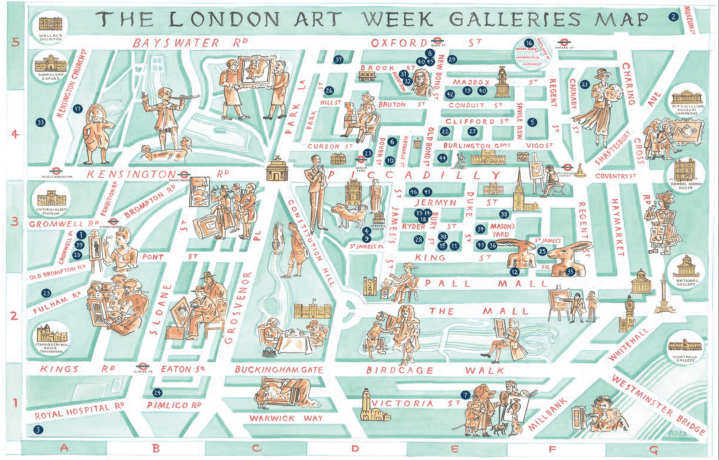
The London Art Week Galleries Map, drawn by Adam Gant; the map with a key to exhibitors is available here.
◊ ◊ ◊ ◊ ◊
From the art fair’s website:
London Art Week, Summer 2023
30 June — 7 July 2023
The UK’s leading fine arts selling event is held both in galleries around central London and as exhibitions online. This summer it features 53 participants, all internationally-acknowledged specialists in their chosen fields. Expert dealers offer museum-quality examples of decorative arts, paintings, sculpture, and works on paper of all periods from antiquity to contemporary, as well as—for the first time this year—rare books, maps, and manuscripts. The week coincides with the summer series of Old Master and Classic auctions held by Christie’s, Bonhams, and Sotheby’s. LAW provides a happy art-filled opportunity to explore the city’s major gallery areas such as St. James’s, Mayfair, and South Kensington, whilst browsing, admiring, and learning about works from antiquity to the present day. All works on show are for sale. Soak up the unique flavour of each locality and individual gallery, whilst enjoying unparalelled access to works of museum calibre as well as entry-level examples and rediscovered masters.
◊ ◊ ◊ ◊ ◊
A selection of gallery offerings:
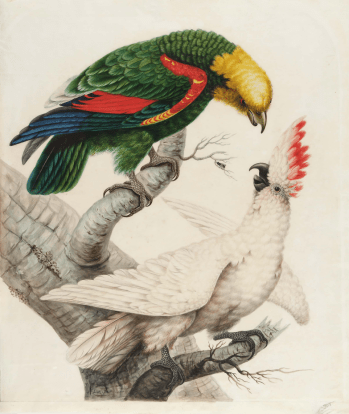
Sarah Stone, Yellow-Headed Amazon Parrot (Amazona ochrocephala oratrix) with Hybrid Cockatoo, 1801, 45 × 37 cm.
Sarah Stone’s Unseen World: A Rare Collection of 18th-Century Ornithological Watercolours
Finch & Co
The exhibition presents 23 watercolours by the trailblazing 18th-century artist Sarah Stone, accompanied by a new book on the artist. Written by Errol Fuller and Craig Finch, the publication will be the first major work on Stone since Christine Jackson’s 1999 book Sarah Stone: Natural Curiosities from the New Worlds. Although long highly acclaimed for their historical and artistic importance, Sarah Stone’s paintings in private hands are rare, and this important collection has only recently come to light. Stone might be compared to her contemporary Mary Anning, the woman from Lyme Regis who kick-started the science of palaeontology. Like the activities of Anning, Sarah Stone’s work proved to be of enormous historical and scientific value.
European and British Paintings, Watercolours, and Drawings, 1780–1860
James Mackinnon
Works include portrait drawings made in Italy by Jean-Baptiste Wicar, whose remarkable career encompassed fame as a neo-classical painter, collector, and dealer in Italian master paintings and drawings by Michelangelo and Raphael among others. After 1896, Wicar served as Napoleon’s Commissioner for Science and Arts in Italy.
Travel, 1600–1900
Nonesuch Gallery
We are pleased to present this second iteration of our catalogues on the theme of travel, accompanied by an exhibition coinciding with London Art Week. The Nonesuch Gallery was set up by Tom Mendel in 2020 to provide high-quality, fully researched and above all interesting pictures to established collectors, institutional collections, and first-time buyers. The gallery specialises in works on paper from the 16th to 19th centuries; with a focus on landscape and topographical subjects, particularly as related to the Grand Tour.
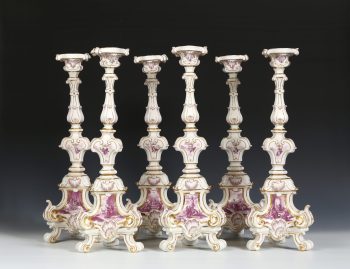
Giovanni Caselli and Gaetano Fumo, Set of Six Altar Candlesticks 1745–52, soft-paste porcelain, each about 50 cm high, fleur-de-lys marks in blue, £85,000.
A Survey of European Ceramics, 1500–1800
E&H Manners
Established in 1986 when Errol and Henriette left Christie’s after working in the Chinese and European ceramic departments. Henry joined in 2015. We deal in ceramics, glass and enamels of the world from the Middle Ages to the 20th century. We focus on European pottery and porcelain of the 17th and 18th century and East Asian, Middle-Eastern and Mexican colonial period wares and ceramics of the Arts and Crafts and Modern Movement. We take pride in the quality and rarity of the pieces that we offer, many of which are now in the great museums and collections of the world.
The Chinese Export Interior
Thomas Coulborn & Sons (digital participant)
Thomas Coulborn & Sons has a reputation for producing eclectic collections of exceptional furniture and works of art. The stock is centred by superb examples of English furniture and works of art ranging from the Tudor period through to Regency, interwoven with stellar items from the Continent. Jonathan Coulborn has a particular interest in objects which reflect the historic intersection of cultures and design. In recent years we have become one of the world’s leading dealers in Chinese export furniture.
Face to Face: Portraits Spanning Five Centuries
Moretti Fine Art
The Galleria Moretti was founded in 1999 in Florence by Fabrizio Moretti. It opened to the public and private collectors with the inaugural exhibition From Bernardo Daddi to Giorgio Vasari and immediately distinguished itself with its specialization in Italian old masters paintings. Moretti Fine Art opened in London in 2005 and it became a point of reference for collectors who seek a confidential and discreet approach. In 2022, the gallery moved in the new building in Duke Street, St. James’s.
◊ ◊ ◊ ◊ ◊
A sampling of particular works on offer:
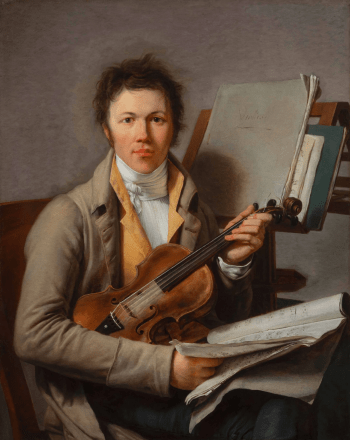
Attributed to Jacques Antoine Marie Lemoine, Portrait of the Violinist Jacques Pierre J. Rode, ca. 1810, oil on canvas, 92 × 72 cm.
• Antonio Gionima, Mucius Scaevola before Lars Porsenna, ca. 1720–25, oil on canvas, 156 × 198 cm. Offered by Fondantica di Tiziana Sassoli (digital participant) as part of a selection of Emilian Old Master paintings.
• Thomas Bardwell, Portrait of Henry Herbert, 10th Earl of Pembroke, 1757, oil on canvas, 137 × 168 cm. Offered by Lowell Libson & Jonny Yarker Ltd.
• Paul Sandby, Capriccio Landscape, 1792, pencil and watercolour. Offered by Abbott & Holder, the drawing once belonged to King Willam IV (and then to his illegitimate son, Lord Frederick Fitzclarence).
• Attributed to Jacques Antoine Marie Lemoine, Portrait of the Violinist Jacques Pierre J. Rode, ca. 1810, oil on canvas, 92 × 72 cm. Offered by Maurizio Nobile Fine Art (digital participant).










 Enfilade
leave a comment