Online Talk | Kate Hunter on Three Maps
From the SHARP listserv and Eventbrite:
Kate Hunter | Unexpected Adventures Told in Three Maps: Western Australia, the Indian Ocean, and Captain James Cook’s First Voyage
Online, Thursday, 8 June 2023, 1pm (EDT)
Kate Hunter, Senior Specialist at Daniel Crouch Rare Books, in conversation with Arthur Dunkelman, Curator of the Jay Kislak Collection, University of Miami Libraries
The University of Miami Special Collections cordially invites you to a ‘Conversation on Cartography’. Kate Hunter will share stories about three maps. The first is a map of Western Australia, where she grew up. The second is a Dutch East India Company [VOC] 18th-century chart of the Indian Ocean on vellum that helped the company establish a trade route that netted a fortune. Last, Hunter will look at a silver punch bowl whose upside-down surface includes an engraved early rendering of Captain James Cook’s first voyage (1769–70).
Kate Hunter has helped private collectors and institutional libraries to acquire and catalog maps, globes, and atlases the world over. Currently, she is the senior specialist at the New York office of Daniel Crouch Rare Books. She is also consulting curator and cataloger for the Map and Atlas Museum of La Jolla, California. During her three-decade career, Hunter has witnessed great changes, from a landscape over-populated by independent bookshops, to one almost bereft of them. According to Hunter, much of today’s commerce takes place online, and that has transformed the way collectors collect—from compulsive completists focused with detailed wish-lists to trophy-hunting connoisseurs.
The program will be followed by an audience question and answer session. Free and open to the public, the event will be hosted via Zoom. It will also be streamed via Facebook Live. All events in this series will be recorded for on-demand access following the broadcasts.
The Burlington Magazine, May 2023
The eighteenth century in the May issue of The Burlington . . .
The Burlington Magazine 165 (May 2023)
E D I T O R I A L
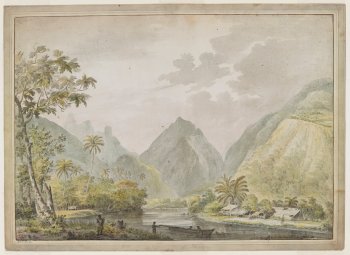
John Webber, A View Looking up the Vaitepiha River with Two Tahitians in a Canoe in the Foreground and Two Others on the Bank with Tahitian Houses to the Right. August 1777, 1777, pen, wash, and watercolour, 45 × 63 cm (London: British Library, Add. 15513, No.13).
• Digitizing the Conway and Witt Libraries, p. 491.
L E T T E R S
• Peter Barber, “The Background of Portrait of Mai,” pp. 492–93.
“Given Reynolds’s lack of interest in landscape painting, but the special place of the portrait of Mai in his oeuvre, it is at least possible that Reynolds may have decided to paint an authentically Tahitian background in order to add further ‘authenticity’. Given his high opinion of [John] Webber, it would have been natural to have copied the scene from one of his friend’s ‘excellent’ paintings of Vaitepiha Bay” (493).
• Christina Strunck, “Laguerre’s Painted Hall at Chatsworth,” p. 493.
“Since in his article ‘A Modello by Louis Laguerre and the Programme of the Painted Hall at Chatsworth’, published in The Burlington Magazine in August 2022 (pp. 760–67), François Marandet came to the same conclusions [that I did in my 2021 monograph Britain and the Continent, 1660–1727: Political Crisis and Conflict Resolution in Mural Paintings at Windsor, Chelsea, Chatsworth, Hampton Court and Greenwich], I thought your readers might like to be referred to the more extended analysis of the programme in both my book and an article I published in January 2022 that discusses the channels through which the two versions of Maratta’s painting may have been known to Laguerre and his patron, William Cavendish.”
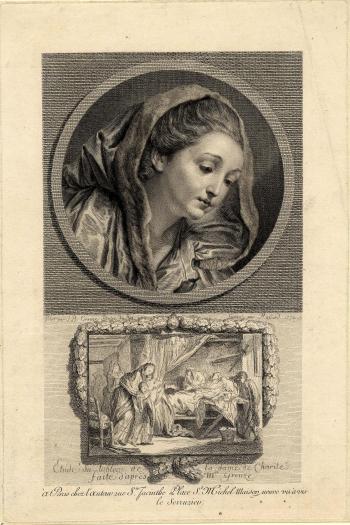
Jean Massard, after Jean Baptiste Greuze, A Woman (Madame Greuze) with a Fur-trimmed Hood Drawn over Her Head, Detail from Greuze’s ‘La Dame de Charité’ above a Sketch of the Painting, 1772, etching and engraving, 24 × 16 cm (London: British Museum, 1978,0121.291).
R E V I E W S
• Mark Evans, Review of Leopoldine van Hogendorp Prosperetti, Woodland Imagery in Northern Art, c.1500–1800: Poetry and Ecology (Lund Humphries, 2022), pp. 568–69.
• Alastair Lang, Review of Yuriko Jackall, Jean-Baptiste Greuze et ses têtes d’expression: La fortune d’une genre (CTHS and INHA, 2022), pp. 569–71.
• Lisa Monnas, Review of Michael Peter, Gewebtes Gold: Eine Kleine Geschichte der Metallfadenweberei von der Antike bis um 1800 (Abegg-Stiftung, 2022), p. 576.
• Alexandre Maral, Review of Christopher Tadgell, The Louvre and Versailles: The Evolution of the Proto-Typical Palace in the Age of Absolutism (Routledge, 2020), pp. 576–77.
• Wim Nys, Review of Beatriz Chadour-Sampson, Sandra Hindman, and Carla Van De Puttelaar, eds., Liber Amicorum in Honour of Diana Scarisbrick: A Life in Jewels (Ad Ilissvm, 2022), p. 577.
O B I T U A R Y
• Elizabeth Pergam, Obituary for Duncan Robinson (1943–2022), p. 578–79.
Successively the Director of the Yale Center for British Art, New Haven, and the Fitzwilliam Museum, Cambridge, Duncan Robinson had a major influence on the appreciation, study, and collecting of historic and modern British art in both the United States and the United Kingdom.
Call for Papers | Early Dance Symposium
From the Call for Papers:
New Work on Old Dance: A Pre-1800 Dance Studies Symposium
Online, 22–24 February 2024
Proposals due by 15 September 2023
What does it look like for historical expressions of dancing and movement arts to break out of traditional academic and performative boxes? How do scholars and practitioners escape the boundaries of discipline, chronology, geography, and methodology subsumed under the conventional appellation of ‘early dance’? Conversely, how can we demonstrate the ways in which our work complements and completes the work of other disciplines in light of these distinctions? This symposium explores early dance as an idea, a time, a place, a locus of cultural meaning and aims to draw together scholars working across disciplines and geographies who are nevertheless invested in ‘early’ dance and movement.
We invite papers for this virtual symposium from scholars across disciplines, exploring aspects of dance and movement from all methodological perspectives, nding commonality in the antecedental nature of their work. Whether looking at the musical, literary, cultural, political, religious, or social contexts of dance, or expanding knowledge of its somatic and kinesthetic dimensions, we nd unity in the chronological earliness of our work. We encourage papers that explore dance outside of Western European frameworks of knowledge and movement production, including comparative or transhistorical perspectives on pre-1800 or ‘early’ dance.
Possible Themes for Papers
• Dance, music, and choreomusicology
• Notation and choreographies
• Transmission, translation, and circulation
• Expanding geographies (pre-1800 dance across Asia, SWANA, the Americas and beyond)
• Race and racialization in pre-1800 dance practices
• Literature, textuality, and dance
• Representations of dance in art and literature
• Dance as metaphor/metaphors of dance
• Intersections of dance and/in theology, philosophy, theory, theater, art, philosophy, economics, etc.
• Theories and philosophies of dance
• Dance practices from page to stage: recreation, reconstruction, reenactment
• Costuming, clothing, and vestments
• Body politics/political bodies in historical dance
• Sociability and social life
• Translation problems: languages, historical periods, cultures
• Dance or movement as aide-memoire/embodied cognition
• Dance ontologies and dance as a way of knowing
Possible Themes for Roundtables and Forums
• What is ‘early dance’? Definitions and boundaries
• Early dance in global perspectives: expanding geographies
• Scholar/Practitioner: How does dance training aid or hinder research on early dance?
• Methodologies in research
• Graduate studies in early dance studies
• Interdisciplinary scholarship and dance studies: barriers and openings?
• Dance as knowledge production within academia
The program committee welcomes proposals for presentations in a variety of formats. Alternative formats may also be proposed. Graduate students, junior scholars, and unaffiliated scholars and performers are especially encouraged to submit proposals.
• Paper presentations (20 minutes)
• Work-in-progress presentations (5–10 minutes)
• Lecture-performances
• Workshops
• Roundtables (for themes listed above or entirely new roundtables)
• A collaborative performance, paper, manifesto, video, etc.
Please submit a proposal via the submission portal by 15 September 2023. Proposals should include your name, affiliation (if any), and email address; an abstract of 250–350 words; a short bibliography (optional); and a brief bio (100 words). All submissions materials must be in English, though presentations in other languages may be possible (please contact organizers).
This symposium is organized by members of the Early Dance Working Group of the Dance Studies Association. Please contact chair of the Organization Committee, Mary Channen Caldwell (maryca@sas.upenn.edu), with any questions.










 Enfilade
leave a comment