Exhibition | The Shape of Time: Art and Ancestors of Oceania
A portion of The Met’s Oceanic Collection, now on view in Shanghai at the Museum of Art Pudong:
The Shape of Time: Art and Ancestors of Oceania
Museum of Art Pudong, Shanghai, 1 June — 20 August 2023
National Museum of Qatar, Doha, 16 October 2023 — 15 January 2024
Accompanies the reopening of The Michael C. Rockefeller Wing at The Metropolitan Museum of Art, Spring 2025

Maori Weaving Peg (Turuturu), late 18th–early 19th century, wood, 14 inches high (NY: The Metropolitan Museum of Art, The Michael C. Rockefeller Memorial Collection, Bequest of Nelson A. Rockefeller, 1979.206.1600. ‘Ko te taura whiri, he whiri i te tangata’ (‘The woven cord is like the cord that connects people’). –Māori proverb
The exhibition The Shape of Time: Art and Ancestors of Oceania from The Metropolitan Museum of Art is produced by the Lujiazui (Group) Co., Ltd., and co-organized by The Metropolitan Museum of Art (The Met) and the Museum of Art Pudong (MAP). The exhibition marks the first time that MAP collaborates with The Met, a world-renowned art institution. Meanwhile, it is also the first time ever that an exhibition taken entirely from The Met’s collection has come to Shanghai, China, adding extraordinary historical significance to the event.
The Shape of Time centers around The Met’s Oceanic art collection, showing the exuberant and diverse culture of Oceania. Divided into three main sections— Voyaging, Ancestors, and Time—the exhibition displays more than 110 valuable artworks from the past four centuries. Encompassing the arts and cultures of the Pacific Islands, The Met’s collection of Oceanic art comprises over 2,800 works that reflect the rich history of creative expression and innovation that is emblematic of the region. Since joining in The Met’s permanent collection, these treasures of Oceania have never left New York. The exhibition The Shape of Time therefore is the first time after about half a century that these works will travel out of the United States, and MAP is honoured to be the first stop of this historic voyage.
From The Met’s catalogue entry for the weaving peg (at right):
This weaving peg incorporates a distinctively carved male figure with elaborate designs that accentuate his tattooed skin (moko). Carved in the round, intricate low-relief carvings cover the entire surface of the figure’s body except for the back of his head, which is the seat of an individual’s mana or personal sanctity. With elbows resting on each knee, the arms extend up towards the chin, which is supported by five-fingered hands. The face is dynamic—serial notching accentuates the pronounced arch of each brow, giving way to more fluid grooves, lengthened lines that delineate elongated eyes and the contours of the lips and mouth. The nostrils flare, the mouth is wide open and gaping, as if to consume this flow of energy. Spiral designs on each knee spill over onto the top section of the polished shaft and create a characteristic double spiral motif. This feature frames the face of a further face which faces the other direction, drawing the eye around to the back, creating an energy and dynamism much admired in Māori figural sculpture. . . . The process of twining began when the weaver drove two pegs into the ground and stretched between them a single cord from which the strands of flax were hung. The left-hand peg was always left plain, while the right-hand one was carved and dedicated to the female deity associated with the moon, Hine-te-iwaiwa. The more complex form of carved weaving pegs, such as this one, were designed to incorporate the spiritual potency associated with the goddess whose efficacy was believed to become integrated into the bound texture of the cloak, thus enhancing the spiritual armature of the wearer. . .
The catalogue is published by Yale UP:
Maia Nuku, Oceania: The Shape of Time (New Haven: Yale University Press, 2023), 208 pages, ISBN: 978-1588397669, $50.
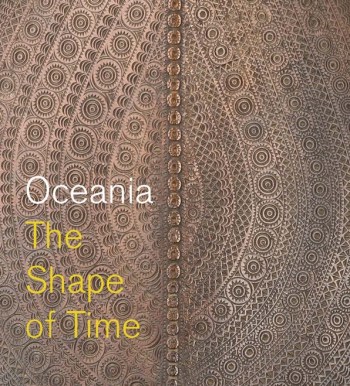 The visual arts of Oceania tell a wealth of dynamic stories about origins, ancestral power, performance, and initiation. This publication explores the deeply rooted connections between Austronesian-speaking peoples, whose ancestral homelands span Island Southeast Asia, Australia, Papua New Guinea, and the island archipelagoes of the northern and eastern Pacific. Unlike previous books, it foregrounds Indigenous perspectives, alongside multidisciplinary research in art history, ethnography, and archaeology, to provide an intimate look at Oceania, its art, and its culture. Stunning new photography highlights more than 130 magnificent objects, ranging from elaborately carved ancestral figures in ceremonial houses, towering slit drums, and dazzling turtle-shell masks to polished whale ivory breastplates. Underscoring the powerful interplay between the ocean and its islands, and the ongoing connection with spiritual and ancestral realms, Oceania: The Shape of Time presents an art-focused approach to life and culture while guiding readers through the artistic achievements of Islanders across millennia.
Maia Nuku is Evelyn A. J. Hall and John A. Friede Associate Curator for Oceanic Art at The Metropolitan Museum of Art.










 Enfilade
leave a comment