Cultural Heritage Magazine, May 2023

Cultural Heritage Magazine is published twice each year, in May and October by the National Trust:
Cultural Heritage Magazine, issue 2 (May 2023)
4 Welcome — Tarnya Cooper, the National Trust’s Curatorial and Conservation Director introduces the spring issue
6 Briefing: News, Events, and Publications, Plus Research and Conservation Round-ups
A la Ronde Interiors: The major project to conserve and repair this unique 18th-century property has now begun in earnest, with specialists working to secure the fragile and intricate decorative features. A la Ronde is a 16-sided house designed to catch the natural daylight through its unusual diamond-shaped windows as the sun moves around the building. The creation of Jane and Mary Parminter, two dynamic and well-travelled cousins who commissioned the house following their travels across Europe, it originally sat within a wider estate containing almshouses, gardens, a chapel and orchards.
14 In Conversation — John Orna-Ornstein talks to Tristram Hunt about design, creativity and the heritage sector today
24 Treasured Connections, Treasured Possessions: The Formation of Margaret Greville’s Collection — Richard Ashbourne, James Rothwell, and Alice Strickland
Treasured Possessions: Riches of Polesden Lacey — A major exhibition marking 80 years since Dame Margaret Greville left Polesden Lacey and her collection to the National Trust (1 March — 29 October 2023).
34 Dynamic and Resonant: The Sculpture of Anthony Twentyman at Dudmaston — Brendan Flynn
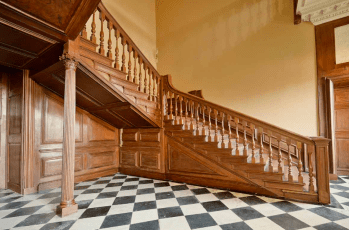
Old Staircase of Dyrham Hall, in 2019 after restoration, with old paint removed and completed graining (Photo: National Trust/David Evans).
40 Dyrham Transformed: Revealing Hidden Schemes and Re-examining Historic Narratives — Eilidh Auckland, Amy Knight-Archer and Claire Reed
Crossing the threshold back in 2015, there was a sense that something had been lost. Rooms and staircases had been painted white, decorative surfaces had deteriorated and spaces that had once glittered in candlelight seemed dimly lit and uninspiring. The National Trust’s project to transform the house, recently completed, has attempted to recapture something of its original vibrancy and dynamism and to enable visitors to step inside the world of the late 17th century. Historic schemes and historic narratives have been uncovered and unpicked, and the project concluded with the installation of new interpretation in January 2023. . . Senior National Curator Rupert Goulding’s research of the Blathwayt archives, which are scattered around the world, fuelled the core narrative.
Following this extensive research and preparation, those schemes that were anachronistic or failing were selected for re-presentation, with the aim of recreating the interiors of 1692–1710. This was the period in which the current house was built and furnished by William Blathwayt, then at the peak of his career.
As work to the main body of the house progressed, the stories it had to tell came into sharper focus. The building of the house at Dyrham Park took place in the early years of the transatlantic slave trade and William Blathwayt was one of the key colonial figures of that time. As Surveyor and Auditor General of Plantations, Blathwayt accounted for income due to the Crown from different royal colonies. He received part of his salary from colonies that were economically reliant on slavery—Barbados and Virginia each contributed £150 per year (the equivalent of around £18,000 today). Blathwayt’s house reflected his colonial connections. . .

From Melchisédech Thévenot, The Art of Swimming (1699) (National Trust Images/ Leah Band).
50 Sink or Swim: An Intriguing Manual from Kedleston’s Library — Nicola Thwaite
Melchisédech Thévenot (c.1620–92), a French diplomat fluent in several languages, was appointed Royal Librarian to Louis XIV in 1684. . . . Thévenot’s L’art de Nager—published posthumously in 1696—was largely based on De Arte Natandi by the English clergyman Everard Digby (d.1605), although there is only a brief acknowledgement of this in Thévenot’s preface. An English translation—The Art of Swimming—was published only three years later in two issues and both French and English editions were reissued over the next century, indicating a contemporary demand for instruction on the subject.
54 Shaped by Love and Loss: A Collection of Ancient Greek Vases at Nostell Priory — Abigail Allan
Nostell is full of treasures. Among the less well-known items is a group of painted Greek vases made in Athens and South Italy c.500–300BC, which were collected by John Winn (c.1794–1817) and his younger brother Charles (1795–1874). Mistakenly called ‘Etruscan’ until the mid-19th century, these 12 vases once belonged to a collection of over 130 at Nostell, sold at Christie’s in 1975 and 1998, before some were repurchased by the National Trust.
62 Loans: Selected Highlights, 2023
68 Meet the Expert: Lottie Allen, Head Gardener at Hidcote Manor, Gloucestershire










 Enfilade
leave a comment