New Book | Rosalba Carriera
Oberer’s first biography of Carriera appeared in 2020 from Amsterdam UP; her second is available from The Getty and Lund Humprhies:
Angela Oberer, Rosalba Carriera (Los Angeles: Getty Publications, 2023), 144 pages, ISBN: 978-1606068601, $45 / (London: Lund Humprhies, 2023), 144 pages, ISBN: 978-1848225190, £35.
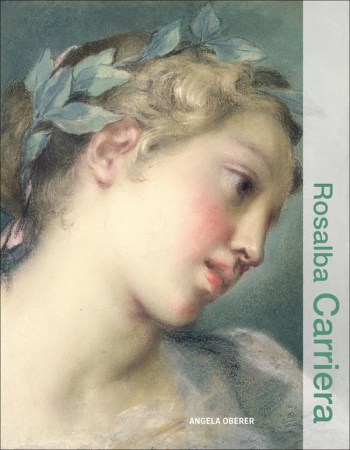 This stunning new volume is the first accessibly written, illustrated, English-language biography of Rosalba Carriera, one of the most famous women artists in eighteenth-century Europe.
Born in Venice in 1673 to a lawyer and a lace maker, Rosalba Carriera began her career painting decorative objects and rose to international renown as a portraitist in Italy, Germany, France, and England. In 1757 she died nearly blind from cataracts, a tragic end for a painter acclaimed for exquisite miniatures and innovative pastels. During the 1700s she was deemed “the most talented female artist of our century,” so famous that she was referred to by her first name only. Today, however, she is little known outside Venice, despite the attribution to her of more than seven hundred surviving artworks.
This accessibly written, gorgeously illustrated biography surveys Carriera’s career, considering her miniatures alongside better-known works of larger scale. Interpreting her oeuvre against the historical context of her experience as a single woman in Venice, the book takes readers through the full arc of her life, including the people she met, her clients, and her artistic approach. Author Angela Oberer’s original iconographic analysis of some of Carriera’s work reveals that she was an erudite painter who drew on antiquity as well as Renaissance precedents such as Leonardo da Vinci and Paolo Veronese. Published in conjunction with the 350th anniversary of her birth, this book is a long overdue tribute to an important and prolific artist.
Angela Oberer is a lecturer in art history with a PhD from the Technische Universität Berlin. She has written and lectured extensively on the work of Rosalba Carriera.
C O N T E N T S
Acknowledgements
1 Venice at the Dawn of the Eighteenth Century and the Beginning of Carriera’s Artistic Career
2 An Independent Single Female Painter
3 Carriera, the First Female Trendsetter in Technique and Style
4 Invitations Abroad and Carriera’s International Network
5 Pastel Painting: Carriera’s Greatest Success
6 An Exceptional Life Comes to an End
Notes
Bibliography
Index
Exhibition | Rosalba Carriera: Perfection in Pastel

Rosalba Carriera, Portrait of an Unknown Lady in a Blue Coat over a Light Dress, detail, pastel on paper, 76 × 64 cm
(Dresden: Gemäldegalerie Alte Meister)
◊ ◊ ◊ ◊ ◊
From Dresden’s Zwinger:
Rosalba Carriera – Perfection in Pastel / Perfektion in Pastell
Gemäldegalerie Alte Meister, Zwinger, Dresden, 9 June — 24 September 2023
On the occasion of the 350th anniversary of the birth of Rosalba Carriera (1673–1757), the Gemäldegalerie Alte Meister (Old Masters Picture Gallery) is dedicating a special exhibition to the most famous pastel painter. More than 100 objects will be presented, including around 70 works by the portraitist, who was one of the first female artists to enjoy success throughout Europe. With 73 pastels, Dresden possesses the world’s largest collection of the Venetian artist’s work. Under August III, more than twice as many pieces by Carriera were in the gallery’s holdings, and in 1746 a separate pastel cabinet was even set up in the Johanneum near the Frauenkirche and named after her.
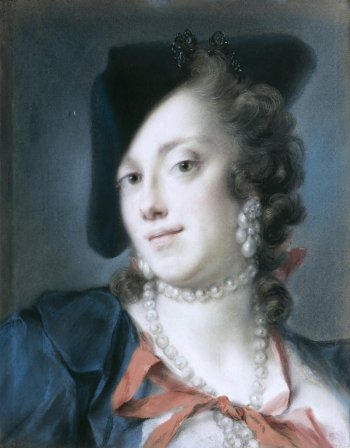
Rosalba Carriera, A Venetian from the House of Barbarigo (Caterina Sagredo Barbarigo), ca. 1735/40, pastel on paper, 42 × 33 cm (Dresden: Gemäldegalerie Alte Meister).
Pastel painting was still considered a comparatively young genre at the time. Carriera was instrumental in making this technique a valued form of painting. The many portraits of princes of the ruling dynasties of Europe show how much in demand the artist was. But she also captured the likenesses of literary figures, musicians, and dancers from her native Venice; a visit to her studio was part of the regular programme of the numerous travellers through Italy. Thus, portraits constitute the largest part of her oeuvre.
Carriera’s pastels bear witness to the beauty ideals of the Rococo period, whose cosmetics were dominated by powder: pale, even skin, powdered hair, and wigs. The powdery surfaces of pastel painting reflect this fashion and thus bring us closer to this bygone era. In cooperation with the Theatre Design/Mask Design course at the Dresden University of Fine Arts, students are illustrating the maquillage of the 18th century in a project that will thus be brought to life in the exhibition.
Carriera’s artistic beginnings lay in miniature painting, as she had little competition to fear from male painter colleagues in this field. In 1705, the San Luca Academy of Art in Rome appointed her a member. This high distinction was bestowed on only a few women, especially as academic training was still denied them for a long time. The Accademia Clementina in Bologna also accepted her as a member in 1720, and a year later the Académie Royale in Paris.
The exhibition shows over 100 objects, taking the public first to the lagoon city of Venice, with views of the Grand Canal, where Carriera had her residence. In addition to the pastel paintings, there are also typical Venetian handicraft products such as glass, lace, and fine cloth to discover.
Roland Enke and Stephan Koja, Rosalba Carriera: Perfection in Pastel (Dresden: Staatliche Kunstsammlungen Dresden, 280 pages, ISBN: 978-3954987580 (English) / ISBN 978-3954987573 (German), €44.
Installation | Nicolas Party and Rosalba Carriera
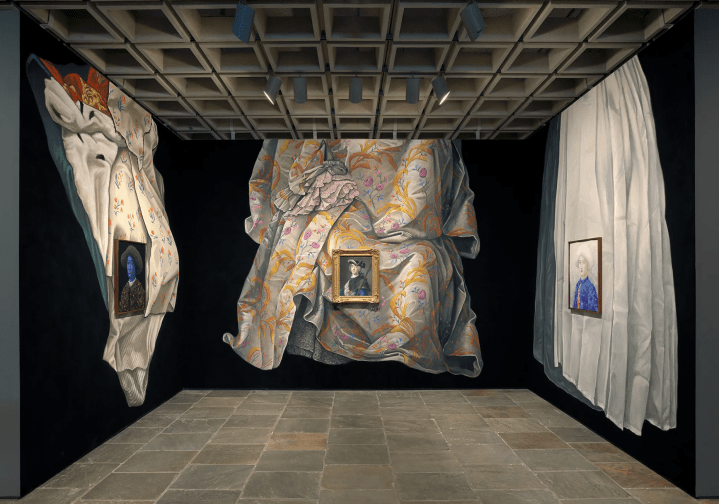
Installation View of Nicolas Party and Rosalba Carriera at Frick Madison, 2023
(Photo by Joseph Coscia Jr.)
◊ ◊ ◊ ◊ ◊
From the press release for the installation:
Nicolas Party and Rosalba Carriera
The Frick Madison, New York, 1 June 2023 — 3 March 2024
Organized by Xavier F. Salomon
The Frick Collection has unveiled a large pastel mural commissioned from the Swiss-born artist Nicolas Party at the museum’s temporary home, Frick Madison. This site-specific work was created in response to Rosalba Carriera’s Portrait of a Man in Pilgrim’s Costume—one of two eighteenth-century pastels by Rosalba bequeathed to the Frick by Alexis Gregory in 2020. The installation features Rosalba’s superb portrait at the center of a three-wall mural designed by Party, as well as two new related works specially created by Party for this presentation.
On view from 1 June 2023 through the remainder of the Frick’s residency at the Breuer building (until 3 March 2024), this installation will inspire the Frick’s summer and early fall programming as well as a new publication.
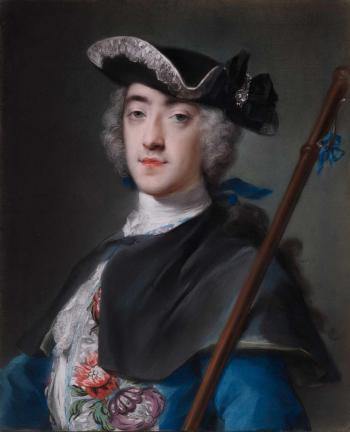
Rosalba Carriera, Portrait of a Man in Pilgrim’s Costume, ca. 1730. pastel on paper, glued to canvas, 59 × 48 cm (New York: The Frick Collection, Gift of Alexis Gregory, 2020.3.01).
The project, which also marks the 350th anniversary of Rosalba’s birth, is organized by Xavier F. Salomon, the Frick’s Deputy Director and Peter Jay Sharp Chief Curator. Salomon comments, “It has been a particular pleasure to work with Nicolas Party. I met Nicolas in April 2021 and since then have enjoyed an ongoing and enlightening conversation on pastels. Nicolas’s installation at Frick Madison is the result of our exchanges, and I am delighted with the result.”
Party adds, “When I first fell in love with pastels, some ten years ago, my research quickly led me to the queen of pastel, Rosalba. Her practice and love for the powdery sticks increased the popularity of the medium and were crucial to the development of the art form. I felt a powerful attraction to her pastels. Today, I like to think our approaches might not be all that different.”
Born in Venice, Rosalba Carriera (1673–1757) was celebrated throughout Europe during her lifetime for her portraiture. She was the preeminent portraitist in Venice in the mid-eighteenth century, at the same time the Venetian Carnival reached its zenith. During this period, foreign travelers flocked to Venice for the masked revelries that became synonymous with the city, and Rosalba’s studio was a popular stop for visiting foreigners, who often posed for her in their elegant Carnival costumes. Portrait of a Man in Pilgrim’s Costume (ca. 1730) is most likely one such work. The sitter is possibly French, British, or German, but his identity remains unknown. With his black cape, staff, and jaunty tricorn hat, he is depicted as a pilgrim.
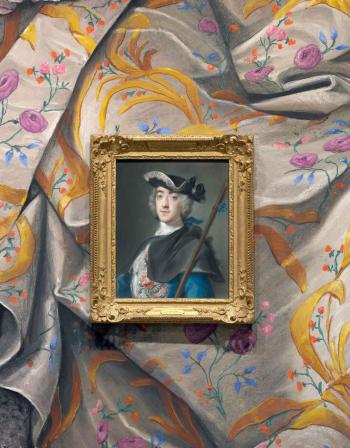
Installation View of Nicolas Party and Rosalba Carriera at Frick Madison, 2023 (Photo by Joseph Coscia Jr.)
Party’s mural includes elaborate draperies that highlight the Rosalba portrait along with two additional pastel portraits he created in response to it. These ornate draperies evoke the work of two other towering figures in European pastels—Jean-Étienne Liotard (1702–1789) and Maurice-Quentin de La Tour (1704–1788)—echoing the function of Venetian Carnival masks, designed to conceal and reveal the features of their wearers. Party’s installation engages devices of disguise and disclosure, from masks to draperies to makeup (often produced with the same chemical components used to make pastel sticks).
The large-scale murals created by Party, whose primary medium since 2013 has been pastel, are ephemeral, lasting only for the duration of a specific exhibition at a unique location. The historical nature of his practice aligns perfectly with the installation at Frick Madison, which has given the museum a unique opportunity to re-imagine its permanent collection display, presented for the first time outside the domestic setting of the Gilded Age mansion at 1 East 70th Street.
This project is part of a series of initiatives in recent years that invite contemporary responses to the Frick’s holdings. Party’s installation not only offers a fresh perspective on an important recent acquisition, but furthers Frick Madison’s prompting of visitors to question the impact of site and setting on their perception of historic objects in the collection.
Born in Lausanne in 1980, Party is a figurative painter who has achieved critical admiration for his familiar yet unsettling landscapes, portraits, and still lifes that simultaneously celebrate and challenge conventions of representational painting. His works are primarily created in soft pastel, which allows for exceptional degrees of intensity and fluidity in his depictions of objects both natural and manmade. Transforming these objects into abstracted, biomorphic shapes, Party suggests deeper connections and meanings. His unique visual language has coalesced in a universe of fantastical characters and motifs where perspective is heightened and skewed to uncanny effect.
Over the years, Party has created work in response to that of European painters including Louis-Léopold Boilly (1761–1845), Arnold Böcklin (1827–1901), and René Magritte (1898–1967). In 2019, Party organized the pastel exhibition at the FLAG Art Foundation in New York, where he created large—and ephemeral—pastel murals inspired by French eighteenth-century artists including François Boucher (1703–1770) and Jean-Honoré Fragonard (1732–1806), both of whom are represented in the Frick’s permanent collection.
Nicolas Party and Xavier Salomon, Rosalba Carriera’s Man in Pilgrim’s Costume (London: Giles, 2023), 80 pages, ISBN: 978-1913875510, £20 / $25.
Funding for the installation is generously provided by The Christian Humann Foundation and the David L. Klein, Jr. Foundation, with the support of the Swiss Arts Council Pro Helvetia.
◊ ◊ ◊ ◊ ◊
Note (added 25 August 2023) — The posting was updated with details on the publication.










 Enfilade
leave a comment