New Book | Media and the Mind
To mark the book’s launch, Matthew Eddy will give a 45-minute talk this Friday (16 June, 5pm) at the University of Edinburgh Main Library to mark the book’s launch; there will also be on view a small exhibition of student manuscripts that Eddy used in writing the book. From The University of Chicago Press:
Matthew Daniel Eddy, Media and the Mind: Art, Science, and Notebooks as Paper Machines, 1700–1830 (Chicago: The University of Chicago Press, 2023), 512 pages, ISBN: 978-0226183862, $65.
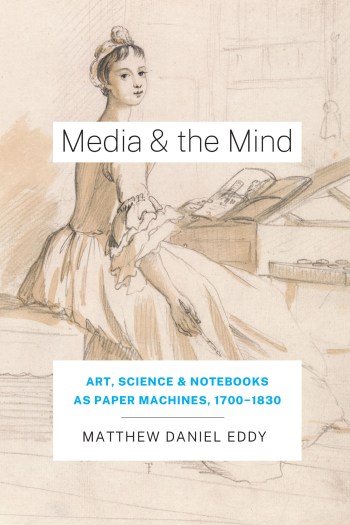 A beautifully illustrated argument that reveals notebooks as extraordinary paper machines that transformed knowledge on the page and in the mind.
Information is often characterized as facts that float effortlessly across time and space. But before the nineteenth century, information was seen as a process that included a set of skills enacted through media on a daily basis. How, why, and where were these mediated facts and skills learned? Concentrating on manuscripts created by students in Scotland between 1700 and 1830, Matthew Daniel Eddy argues that notebooks functioned as workshops where notekeepers learned to judge the accuracy, utility, and morality of the data they encountered. He shows that, in an age preoccupied with ‘enlightened’ values, the skills and materials required to make and use notebooks were not simply aids to reason—they were part of reason itself.
Covering a rich selection of material and visual media ranging from hand-stitched bindings to watercolor paintings, the book problematizes John Locke’s comparison of the mind to a blank piece of paper, the tabula rasa. Although one of the most recognizable metaphors of the British Enlightenment, scholars seldom consider why it was so successful for those who used it. Eddy makes a case for using the material culture of early modern manuscripts to expand the meaning of the metaphor in a way that offers a clearer understanding of the direct relationship that existed between thinking and notekeeping. Starting in the home, moving to schools, and then ending with universities, the book explores this argument by reconstructing the relationship between media and the mind from the bottom up.
Matthew Daniel Eddy is professor and chair in the history and philosophy of science at Durham University. He is the author and editor of numerous works on the cultural history of Britain and its former empire.
C O N T E N T S
Bibliographic Note
Prologue
Introduction
1 Recrafting Notebooks
The Tabula Rasa and Media Interface
Notebooks as Artifacts
Notekeeping as Artificing
Notekeepers as Artificers
Thought as a Realtime Activity
Science as a System
Book Outline
Part I | Inside the Tabula Rasa
2 Writing
Writing as a Knowledge-Creating Tool
The Place of Writing within Literacy
Script and Observational Learning
Grids and Verbal Pictures
Copies and the Exercise of Memory
3 Codexing
Paper Machines as Material Artifacts
Paper as an Informatic Medium
Quires and Knowledge Management
Books and Customized Packaging
4 Annotating
Revisibilia Made through Annotation
Marginalia as Scribal Interface
Paratexts and Editorial Training
Ciphers and the Acquisition of Numeracy
Part II | Around the Tabula Rasa
5 Categorizing
Headings as Realtime Categories
Headings as Mnemonic Labels
Headings as Visual Cues
Headings as Coordinates for Scanpaths and Sightlines
6 Drawing
Description and Movement across a Page
Learning to Draw a Picture
Figures as Developmental Tools
Scenes as Observational Training
Observation and the Utility of Perception
7 Mapping
Mapkeepers and Knowledge Systems on Paper
Map-Mindedness and Embodied Experience
Desk Maps as Crafted Constructions
Field-Mindedness in the Classroom
Field Maps and Visualized Data
Maps as Mnemonic Devices
Part III | Beyond the Tabula Rasa
8 Systemizing
The Syllabus as a System and a Machine
Lecture Notebooks and Knowledge Formation
The Syllabus and Its Organizational Technologies
Scroll Books and the Strategies of Realtime Learning
Transcripts and the Extension of Memory
Lines and the Media of the Mind
9 Diagramming
Paths and Diagrammatic Knowledge
Schemata as Useful Mnemonic Aids
Shapes as Repurposed Perceptual Devices
Pictograms and Visual Judgment
Tables as Kinesthetic Diagrams
Traces and Realtime Observation
10 Circulating
Local and Global Networks
Personal and Institutional Libraries
Commodities within Knowledge Economies
Courts of Law and Public Opinion
Conclusion
11 Rethinking Manuscripts
The Tabula Rasa and Manuscripts
Manuscripts as Dynamic Artifacts
Manuscript Skills as Artifice
Manuscript Keepers as Artificers
Acknowledgments
Bibliography
Abbreviations
Primary Sources
Manuscripts and Ephemera
Printed Primary Sources
Secondary Sources
Index
New Book | Great Irish Households: Inventories
From Distributed by ACC Art Books:
Tessa Murdoch, ed., with a foreword by Toby Barnard, a preface by Leslie Fitzpatrick, inventory transcriptions by Jessica Cunningham and Rebecca Campion, and inventory preambles by Jessica Cunningham Rebecca Campion, Edmund Joyce, Alec Cobbe, and John Adamson, Great Irish Households: Inventories from the Long Eighteenth Century (Cambridge: John Adamson, 2022), 436 pages, ISBN: 978-1898565178, £75.00 / $115.
 Inventories of fourteen great Irish country houses, three Dublin town houses, and one London town house yield remarkable insights into the lifestyle of leading families across Ireland and the households that supported them. With startling directness, they record in detail the goods and chattels inherited, accumulated, or acquired for enjoyment or everyday use.
Two sections in colour feature likenesses of many of the owners or householders of the properties at the time, including portraits by Pompeo Batoni, Michael Dahl, Thomas Gainsborough, Godfrey Kneller, Thomas Lawrence, and Joshua Reynolds, as well as the Irish artists Hugh Douglas Hamilton and Charles Robertson.
The value of inventories in charting how houses were arranged, furnished and used is now widely appreciated. Typically, the listings and valuations were occasioned by the death of an owner and the consequent need to deal with testamentary dispositions. That was not always so. The inventory for Castlecomer House, Co. Kilkenny, for example, was drawn up to make a claim following the house’s devastation in the 1798 uprising. Mostly hitherto unpublished, the inventories chosen give new-found insights into the lifestyle and taste of some of the foremost families of the day. Above stairs, the inventories show the evolving collecting habits and tastes of eighteenth-century patrons across Ireland and how the interiors of great town and country houses were arranged or responded to new materials and new ideas. The meticulous recording of the contents of the kitchen and scullery likewise sheds light on life below stairs. Itemized equipment required for the brewhouse, dairy, stables, garden and farmyard reflects the at times significant scale of the communities the houses supported and the remarkable degree of self-sufficiency at some of the demesnes.
A comprehensive index facilitates access to the myriad items within the inventories, while the books listed at three of the houses are tentatively identified in separate appendices. A foreword, together with preambles to the inventories, sets the households in their historical context. Illustrated with historical engravings of the houses and with portraits of the owners of the time, the inventories will appeal to country-house visitors, historians of interiors, patronage, collecting and material culture as well as to scholars, curators, collectors, creative designers, film directors, bibliographers, lexicographers, and historical novelists.
The eighteenth century is the period onto which the Knight of Glin directed his penetrating gaze as art historian. The book is dedicated to his memory.
Tessa Murdoch, FSA, is Research Curator, Rosalinde and Arthur Gilbert Collection at the Victoria and Albert Museum. Toby Barnard, FBA, is Emeritus Fellow in History at Hertford College, University of Oxford, and a specialist in the political, social and cultural histories of Ireland and England, c. 1600–1800. Leslie Fitzpatrick is the former Samuel and M. Patricia Grober Associate Curator, European Decorative Arts, at the Art Institute of Chicago.
C O N T E N T S
1 Lismore Castle, Co. Waterford, 1702/3
2 Kilkenny Castle, Co. Kilkenny, 1705
3 Dublin Castle, 1707
4 The Duke of Ormonde’s House, London, c. 1710
5 Bishop’s mansion house, Elphin, Co. Roscommon, 1740
6 Captain Balfour’s town house, auction sale, Dublin, 1741/2
7 Hillsborough Castle, Co. Down, 1746 and 1777
8 Kilrush House, Freshford, Co. Kilkenny, 1750
9 No. 10 Henrietta Street, Dublin (Luke Gardiner’s house), 1772
10 Morristown Lattin, Co. Kildare, 1773
11 Baronscourt, Co. Tyrone, 1782
12 Castlecomer House, Co. Kilkenny, 1798
13 Killadoon, Co. Kildare, 1807–29
14 Shelton Abbey, near Arklow, Co. Wicklow, 1816
15 Borris House, Co. Carlow, 1818
16 Carton House, Co. Kildare, 1818
17 Newbridge House, Co. Dublin, 1821
18 Mount Stewart, Co. Down, 1821
Glossary
Appendix I: Buyers at Captain Balfour’s Town House Sale, 1741/2
Appendix II: Books in the Second Duchess of Ormonde’s Closet at Kilkenny Castle, 1705
Appendix III: Books in the Study at the Bishop’s Mansion House, Elphin, Co. Roscommon, 1740
Appendix IV: Books in the Library at Newbridge House, Co. Dublin, 1821
List of Inventory Sources
List of Plates
Bibliography
Index of Personal Names
General Index










 Enfilade
leave a comment