Exhibition | Sensing Naples
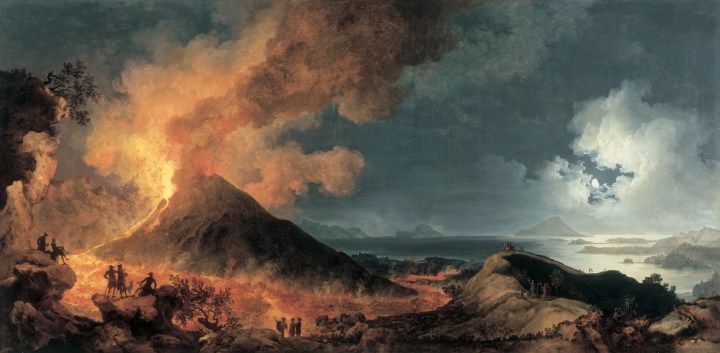
Pierre-Jacques Volaire, An Eruption of Vesuvius by Moonlight, 1774, oil on canvas, 130 × 260 cm (Compton Verney; photo by John Hammond). As noted at ArtUK, this is the largest of Volaire’s many views of the volcano.
◊ ◊ ◊ ◊ ◊
With scents in the gallery, readers may recall The Essence of a Painting: An Olfactory Exhibition on view last summer at the Prado. From Madrid to Compton Verney:
Sensing Naples
Compton Verney, Warwickshire, 1 April — 31 December 2023
Come and be transported to Naples—where the scent of orange blossom drifts on the air and the spectacle of Vesuvius smoulders in the distance. Bringing to life the smells, sounds, sights, tastes, and sensations of visiting this vibrant Italian city, Sensing Naples will see the exquisite historic works in our Naples Collection rehung and reimagined. Interactive elements and new wall texts will foreground exciting new research into objects in the collection undertaken in collaboration with the University of Oxford and the Centre for the Art and Architectural History of Port Cities, Naples.

Installation view of Sensing Naples at Compton Verney, 2023.
The display features new interactive elements, including samples of music from the period and six bespoke fragrances, which are paired with specific paintings. Developed in collaboration with a specialist fragrance house, the scents have been designed to highlight elements within the paintings and to evoke the experience of visiting the city of Naples in the period 1600–1800. Some are pleasant, others not so: they include the smells of the Bay of Naples, perfumed gloves, a fish market, tobacco smoke, a floral still life, and an eruption of Mount Vesuvius. You will also find a new, interactive play table modelled on an erupting Vesuvius, a permanent fixture in the galleries aimed at engaging our youngest visitors.
Additional works on display include examples of souvenirs made from the lava of Vesuvius and brought back to Britain in the eighteenth and nineteenth centuries, as well as two new commissions produced by artists working today.

Aaron McPeake, Commissioned work for the exhibition, three bronze bells suspended from the ceiling above a lava rock. More information is available here.
The new artworks respond to the theme of the senses and also to works in the historic collection, and have been commissioned in partnership with disability arts platform Unlimited. DYSPLA, a neuro-divergent led award-winning arts studio, have created a work that speaks to Lorenzo Vaccaro’s marble busts of The Four Continents, through four new performative digital sculptures. Accessed via a QR code, these holographic sculptures invite you to engage with your own physicality through touch. The senses of sight, hearing, and touch are further addressed in the second new artwork, which takes the form of three bronze bells suspended above a piece of Vesuvius lava rock. The bells, which can be gently rung, were created for Compton Verney by Aaron McPeake, an artist whose practice explores his own experience of sight loss later in life.
Lecture | Alessia Attanasio on Neapolitan Art in English Collections
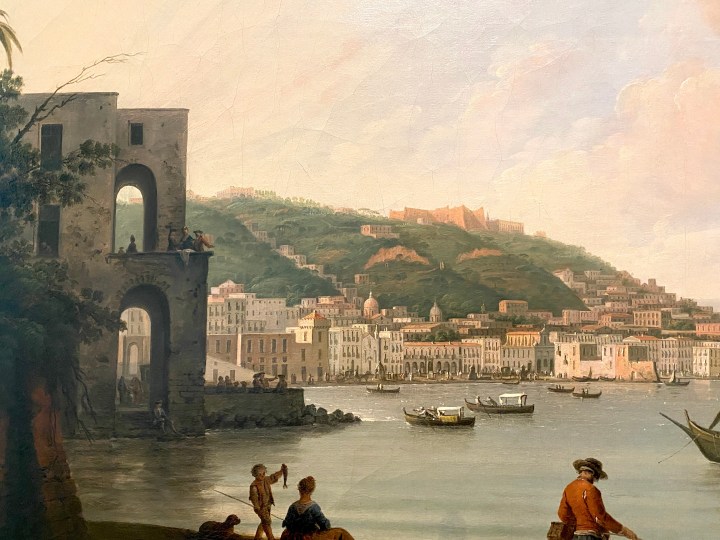
Pietro Fabris, The Bay of Naples from Posillipo, detail, ca. 1770, oil on canvas, 75 × 128 cm
(Compton Verney, Warwickshire)
◊ ◊ ◊ ◊ ◊
From The Wallace Collection:
Alessia Attanasio, The Fortunes of Baroque Neapolitan Art in English Collections during the Grand Tour, 1680–1800
Wallace Collection Seminars on the History of Collections and Collecting
Online and in-person, The Wallace Collection, London, Monday, 26 June 2023, 5.30pm
This talk aims to provide an overview of the history of collecting Baroque Neapolitan art in England from 1680s to 1800s, a period when many English artists and collectors travelled to Naples during the Grand Tour. Based on Alessia Attanasio’s PhD research, it will introduce artists from the Kingdom of Naples who enjoyed considerable success among English patrons, demonstrating how the Grand Tour influenced the market for Baroque Neapolitan art—not just for the newly discovered antiquities in Pompeii, Herculaneum, and Stabiae.
Today, Baroque Neapolitan paintings form a significant part of private and public English art collections; yet there is no publication exploring the significance of these collections as a whole. Therefore, the lecture aims to fill this gap by identifying and locating Neapolitan art in public and private English collections, now disclosed in an up-to-date database. The database will include images, references, notes on subject, author, and context, as well as acquisition and provenance details, providing the first comprehensive view of Neapolitan paintings in England. Alessia will focus on specific private British collections held in country houses such as Compton Verney, with the new redisplay of its unique Neapolitan collection, and Holkham Hall, which owns several Neapolitan paintings, both of which reflect the changes in art collecting in England. The lecture will bring together different fields of study, from the history of art to the art market, and shed new light on the material conditions that made art collecting possible.
Alessia Attanasio is a PhD candidate at the University of Birmingham, focusing on Baroque Neapolitan art that was collected in England during the Grand Tour (1680s–1820s), with particular interests in country houses, history of collecting, and museum studies. Alessia’s interest in museums is supported by eight years of experience working in museums as an assistant curator and museum educator, including Capodimonte Museum in Naples, and the Royal Collection Trust in London. Most recently, Alessia has been undertaking research into Baroque artworks in the Neapolitan Collection of Compton Verney, contributing to the curation of its permanent redisplay, Sensing Naples.










 Enfilade
leave a comment