U of Buckingham | MA in French and British Decorative Arts
From the University of Buckingham:
MA in French and British Decorative Arts and Historic Interiors
University of Buckingham (study based in London), starting September 2023
Bursary applications due by 10 July 2023
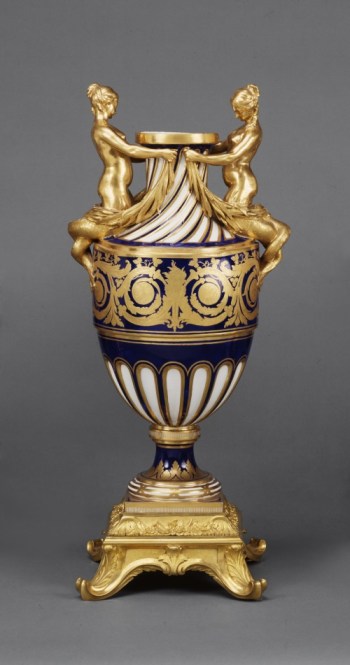
Vase ‘sirènes’, Manufacture de Sèvres, probably Josse-François-Joseph Le Riche, designer; Etienne-Henry Le Guay, the Elder, gilder, ca. 1776, soft-paste porcelain, gilded, 49 cm high (London: The Wallace Collection, C333).
Applications are invited for a bursary on the University of Buckingham’s MA in Decorative Arts and Historic Interiors starting September 2023. Generously funded by The Leche Trust, the award is worth £7,500 and will contribute towards course fees. The deadline for bursary applications is Monday, 10 July, 4pm UK time.
This unique MA in French and British Decorative Arts and Interiors, taught in collaboration with the curatorial and conservation teams at the Wallace Collection, focuses on the development of interiors and decorative arts in England and France in the ‘long’ eighteenth century (c.1660–c.1830) and their subsequent rediscovery and reinterpretation in the nineteenth and twentieth centuries. A key element of the course is the emphasis on the first-hand study of furniture, silver, and ceramics, where possible in the context of historic interiors. Based in central London, it draws upon the outstanding collections of the nearby Wallace Collection and the Victoria and Albert Museum as well as the expertise of leading specialists who participate in the teaching.
Bursary priority will be given to applicants:
• with excellent academic qualifications, seeking, or currently pursuing careers in museums, the built heritage or conservation,
• in need of financial assistance,
• have a strong interest in the decorative arts and historic buildings,
• or, for those wishing to go on to pursue academic research in the decorative arts and historic interiors.
The bursary is also open to part-time students commencing their studies in 2023 for whom the funding would be spread over two years. To be eligible for the bursary, students will need to have applied for and been offered a place on the course.
Call for Articles | Queerness in 18th- and 19th-C. European Art
From Arts:
Queerness in 18th- and 19th-Century European Art
Special Issue of Arts, edited by Andrew Shelton
Proposals due by 15 August 2023; final manuscripts due by 30 November 2023
A special issue of the international, peer-reviewed, open-access journal Arts dedicated to Queerness in 18th- and 19th-Century European Art and edited by Andrew Carrington Shelton (Department of History of Art, The Ohio State University) seeks essays on a wide variety of topics that subvert or disrupt heteronormative interpretations of the art and visual culture of this period. Topics to be addressed include, but are not limited to:
• Works of art produced by or under the auspices of personages who can plausibly be identified as attracted to members of the same sex
• Works or creative situations that can be construed as expressing or eliciting same-sex sexual desire or attraction
• Works or creative situations in which the heteronormative polarity of the processes of identification and desire can be perceived as having been collapsed or scrambled
• Works or creative situations that involve gender-bending or gender fluidity
• Works or creative situations that either deepen or complicate our understanding of sexuality and/or sexual identity
• Works that eroticize individuals or situations that are normally regarded as lying outside the realm of the erotic
Interested scholars should send an abstract (maximum 250 words) and CV to shelton.85@osu.edu, copying sylvia.hao@mdpi.com, by 15 August 2023. Final manuscripts must be submitted for blind peer-review no later than 30 November 2023. Due to journal restrictions, all articles must be submitted in English. Questions or concerns can be addressed to shelton.85@osu.edu or sylvia.hao@mdpi.com. More information is available here.
Exhibition | Object Lessons in American Art
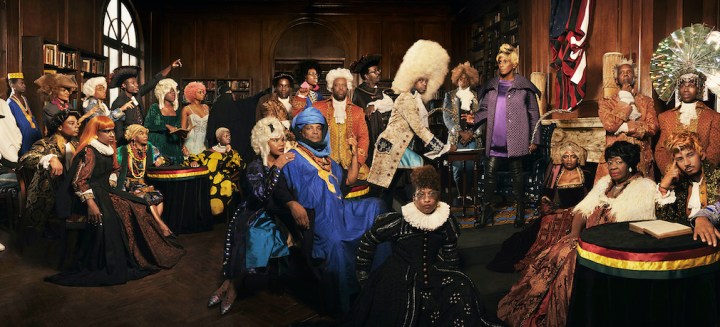
Renee Cox, The Signing, 2018, inkjet print, 122 × 213 cm
(Princeton University Art Museum)
◊ ◊ ◊ ◊ ◊
From Princeton University Art Museum:
Object Lessons in American Art: Selections from the Princeton University Art Museum
Georgia Museum of Art, University of Georgia, Athens, 4 February — 14 May 14 2023
Florence Griswold Museum, Old Lyme, Connecticut, 3 June — 10 September 2023
Speed Art Museum, Louisville, 29 September 2023 — 7 January 2024
Curated by Karl Kusserow

Henry Inman, O-Chee-Na-Shink-Ka a, 1832–33, oil on canvas, 78 × 645 cm (Promised gift from a Private Collection, member of Class of 1982).
Object Lessons in American Art features four centuries of works from the Princeton University Art Museum that collectively explore American history, culture, and society. Inspired by the concept of the object lesson—the study of a material thing to communicate a larger idea—the exhibition brings groups of objects together to ask fundamental questions about artistic significance, materials, and how meaning changes across time and contexts. With a focus on race, gender, and the environment, these pairings demonstrate the value of juxtaposing diverse objects to generate new understanding. Object Lessons presents Euro-American, Native American, and African American art from contemporary perspectives, illustrating how fresh investigations can inform and enrich its meaning, affording new insights into the American past and present. Curated by Karl Kusserow, John Wilmerding Curator of American Art.
Karl Kusserow, ed., with contributions by: Horace Ballard , Kirsten Pai Buick , Ellery Foutch , Karl Kusserow , Jeffrey Richmond-Moll, and Rebecca Zorach, Object Lessons in American Art (Princeton: Princeton University Press, 2023), 200 pages, ISBN: 978-0691978857, £35 / $40.
Object Lessons in American Art explores a diverse gathering of Euro-American, Native American, and African American art from a range of contemporary perspectives, illustrating how innovative analysis of historical art can inform, enhance, and afford new relevance to artifacts of the American past. The book is grounded in the understanding that the meanings of objects change over time, in different contexts, and as a consequence of the ways in which they are considered. Inspired by the concept of the object lesson, the study of a material thing or group of things in juxtaposition to convey embodied and underlying ideas, Object Lessons in American Art examines a broad range of art from Princeton University’s venerable collections as well as contemporary works that imaginatively appropriate and reframe their subjects and style, situating them within current social, cultural, and artistic debates on race, gender, the environment, and more.
C O N T E N T S
Foreword
Preface and Acknowledgments
• Introduction — Lenticular: Subject and Object in American Art — Karl Kusserow
• ‘Race’ as Object Lesson: Objects of Rebellion — Kirsten Pai Buick
• Looking Back and Looking Forward: A Feminist Lens on a Collection of American Art — Ellery E. Foutch
• Oblique Assemblies: Toward Queer Ecologies in American Art — Horace D. Ballard
• Intimations of Ecology: Varieties of Environmental Experience in American Art — Karl Kusserow
• Material Echoes, Traumatic Histories, and Liquid Transformations: The Romance of the Sea in American Art — Rebecca Zorach
• Learning from Object Lessons: Toward a Curatorial Pedagogy of Unfixing and Defamiliarizing the Past — Jeffrey Richmond-Moll
Contributors
Index
Photography Credits
Exhibition | Peter Brathwaite: Rediscovering Black Portraiture
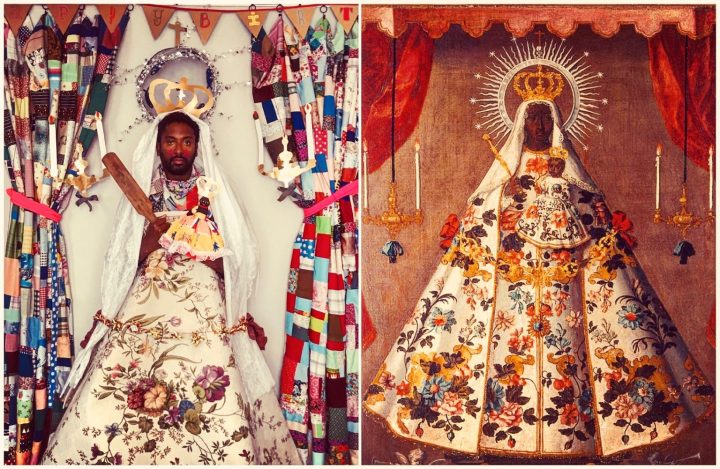
Left: Peter Brathwaite’s restaged version of The Virgin of Guadalupe. Right: Unknown painter, The Virgin of Guadalupe, oil painting, 1745 (London: Wellcome Collection), cropped from original and colour saturated.
◊ ◊ ◊ ◊ ◊
From the Bristol Museum & Art Gallery:
Peter Brathwaite: Rediscovering Black Portraiture
King’s College London, Strand Campus, October 2021 — February 2022
Bristol Museum & Art Gallery, 14 April — 3 September 2023
During the first lockdown in 2020, with all his performances cancelled, baritone, artist, broadcaster, and writer Peter Brathwaite began researching and reimagining more than 100 artworks. These artworks featured portraits of Black sitters, as part of the online #GettyMuseumChallenge to use household objects to restage famous paintings. He called the photographic series Rediscovering Black Portraiture. Alongside this project he also intensified his research into his dual heritage Barbadian roots, uncovering a wealth of detail about his enslaved and enslaver ancestors and their history, including an uprising of enslaved people in 1816 and songs of resistance they sang. Three years on, with a London exhibition behind him and a book out with Getty Publications, Peter Brathwaite brings his whole practice to the history of Georgian House Museum and the collections of Bristol Museum & Art Gallery. New interventions and sound installations reveal the Black presence hidden at the heart of our spaces and objects. The exhibition opened to coincide with the anniversary of the Barbados insurrection, 14 April 1816.
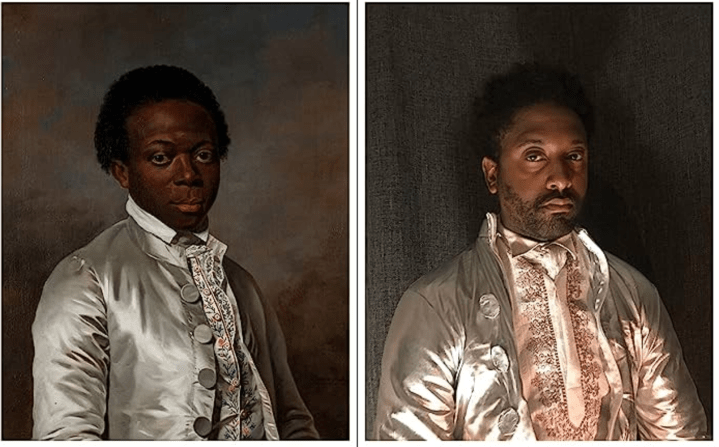
Left: Marie-Victoire Lemoine, Portrait of a Youth in Embroidered Vest, 1785, oil on canvas, 68 × 50 cm (Jacksonville, Florida: Cummer Museum of Art & Gardens). Right: Peter Brathwaite’s restaged version of a Youth in Embroidered Vest.
◊ ◊ ◊ ◊ ◊
From The Getty:
Peter Brathwaite, with contributions by Cheryl Finley, Temi Odumosu, and Mark Sealy, Rediscovering Black Portraiture (Los Angeles, Getty Publications, 2023), 168 pages, ISBN: 978-1606068168, $40.
 Join Peter Brathwaite on an extraordinary journey through representations of Black subjects in Western art, from medieval Europe through the present day. Since the beginning of the COVID-19 pandemic, Peter Brathwaite has thoughtfully researched and reimagined more than one hundred artworks featuring portraits of Black sitters—all posted to social media with the caption “Rediscovering #blackportraiture through #gettymuseumchallenge.”
Rediscovering Black Portraiture collects more than fifty of Brathwaite’s most intriguing re-creations. Introduced by the author and framed by contributions from experts in art history and visual culture, this fascinating book offers a nuanced look at the complexities and challenges of building identity within the African diaspora and how such forces have informed Black portraits over time. Artworks featured include The Adoration of the Magi by Georges Trubert, Portrait of an Unknown Man by Jan Mostaert, Rice n Peas by Sonia Boyce, Barack Obama by Kehinde Wiley, and many more. This volume also invites readers behind the scenes, offering a glimpse of the elegant artifice of Brathwaite’s props, setup, and process. An urgent and compelling exploration of embodiment, representation, and agency, Rediscovering Black Portraiture serves to remind us that Black subjects have been portrayed in art for nearly a millennium and that their stories demand to be told.
Peter Brathwaite is an acclaimed baritone who performs in operas and concerts throughout Europe. He is a presenter on BBC Radio 3 and has been shortlisted for a Royal Philharmonic Society Award. Cheryl Finley is inaugural distinguished visiting director of the Atlanta University Center Art History and Curatorial Studies Collective and the author of Committed to Memory: The Art of the Slave Ship Icon (2018). Temi Odumosu is an art historian, curator, and assistant professor at University of Washington Information School and the author of Africans in English Caricature 1769–1819: Black Jokes, White Humour (2017). Mark Sealy is director of Autograph and professor of photography, race, and human rights at University of the Arts London. His numerous publications include Different (2001), coauthored with Stuart Hall; Decolonising the Camera: Photography in Racial Time (2019); and Photography: Race, Rights, and Representation (2022).
New Book | The Nation That Never Was
From The University of Chicago Press:
Kermit Roosevelt, The Nation That Never Was: Reconstructing America’s Story (Chicago: The University of Chicago Press, 2022), 256 pages, ISBN: 978-0226817613, $25.
 Our idea of the Founders’ America and its values is not true. We are not the heirs of the Founders, but we can be the heirs of Reconstruction and its vision for equality.
There’s a common story we tell about America: that our fundamental values as a country were stated in the Declaration of Independence, fought for in the Revolution, and made law in the Constitution. But, with the country increasingly divided, this story isn’t working for us anymore—what’s more, it’s not even true. As Kermit Roosevelt argues in this eye-opening reinterpretation of the American story, our fundamental values, particularly equality, are not part of the vision of the Founders. Instead, they were stated in Lincoln’s Gettysburg Address and were the hope of Reconstruction, when it was possible to envision the emergence of the nation committed to liberty and equality.
We face a dilemma these days. We want to be honest about our history and the racism and oppression that Americans have both inflicted and endured. But we want to be proud of our country, too. In The Nation That Never Was, Roosevelt shows how we can do both those things by realizing we’re not the country we thought we were. Reconstruction, Roosevelt argues, was not a fulfillment of the ideals of the Founding but rather a repudiation: we modern Americans are not the heirs of the Founders but of the people who overthrew and destroyed that political order. This alternate understanding of American identity opens the door to a new understanding of ourselves and our story, and ultimately to a better America.
America today is not the Founders’ America, but it can be Lincoln’s America. Roosevelt offers a powerful and inspirational rethinking of our country’s history and uncovers a shared past that we can be proud to claim and use as a foundation to work toward a country that fully embodies equality for all.
Kermit Roosevelt III is a professor of constitutional law at the University of Pennsylvania Law School. A former law clerk to Supreme Court Justice David Souter, he is the author of The Myth of Judicial Activism, as well as two novels, Allegiance and In the Shadow of the Law.
C O N T E N T S
Introduction
1 Stories of America
2 Questioning the Standard Story: Dissenters
3 The Exclusive Declaration
4 The Ambiguous Revolution
5 The Geostrategic Constitution
6 The Story of Continuity
7 The March of the Declaration
8 Why We Tell the Standard Story
9 Why We Shouldn’t Tell the Standard Story
10 Magic Tricks and Revolutions
11 Why, How, and Who We Are
12 Redemption Songs: Inclusive Equality and Exclusive Individualism in Modern America
13 The Better Story
Bibliographical Essay
Acknowledgments
Notes
At Bonhams | Old Master Paintings

Lot 80: J.M.W. Turner, East Cliff Lodge, Ramsgate, the Seat of Lord Keith, 1796–97, pencil and watercolour. 31 × 41 cm.
Estimate: £30,000–50,000.
◊ ◊ ◊ ◊ ◊
Press release, via Art Daily, for Turner’s View of East Cliff Lodge, included in the July 5 sale at Bonhams:
Old Master Paintings
Bonhams, London, 5 July 2023
An early architectural watercolour, East Cliff Lodge, Ramsgate, the Seat of Lord Keith, by J.M.W. Turner (1775–1851) is to be offered at Bonhams Old Master Paintings sale in London on Wednesday 5 July 2023 (Lot 80). It is estimated at £30,000–50,000.
Bonhams Director of Old Master Paintings, Caroline Oliphant, said: “East Cliffe Lodge dates from 1796–97 when the artist was in his early 20s and is one of several architectural watercolours Turner executed around this time. Topographical commissions were a good and dependable way of earning a living for young aspiring painters but, this being Turner, the results are, of course, rather special.”
East Cliff Lodge was designed in the gothic revival style by Charles Boncey and completed by 1794. Early owners included George Elphinstone, 1st Viscount Keith (1764–1823), a Scottish-born naval officer who served in the American Revolutionary and Napoleonic Wars. He was Commander in Chief of the North Sea Squadron while living at Cliff Lodge; the house gave him an excellent view of the Downs anchorage.
In 1831, East Cliff was acquired by Moses Haim Montefiore (1784–1885), a British financier, banker, activist, and philanthropist. Sheriff of London, Fellow of the Royal Society, President of the Board of Deputies of British Jews, and a key figure in British Jewish history. He was knighted in 1837. Moses and his wife Judith spent their honeymoon in Ramsgate, fell in love with the area, and rented East Cliff Lodge for some years before buying it. Montefiore built a private synagogue in the grounds of East Cliff and, following his wife’s death in 1862, commissioned a mausoleum where they both now lie. On nearby land he founded the Judith Montefiore College. Most of the house was demolished in 1954, but the synagogue, mausoleum, and college remain.
At Auction | ‘Charles Monro’s House at Finchley’ by Turner

Lot 2143: J.M.W. Turner, Charles Monro’s House at Finchley, 1793–94, 22 × 29 cm
(Estimate: £30,000–50,000)
◊ ◊ ◊ ◊ ◊
From the press release (via Art Daily) for the sale:
Fine Art and Silver
Ewbank’s, Surrey, 22 June 2023
An early watercolour by J.M.W. Turner, consigned by the descendants of the patron for whom it was painted, comes to auction at Ewbank’s in Surrey on 22 June 2023 (Lot 2143: estimated at £30,000–50,000). Charles Monro’s House at Finchley (1793–94) is a signed corner view of an imposing mansion set among trees. It depicts the home of the brother of Turner’s patron Dr. Thomas Monro (1759–1833), a serious collector who also supported Peter De Wint, Thomas Girtin, and John Sell Cotman, among others, and established an academy and what became known as ‘The Monro Circle’ of artists. Dr. Monro rose to prominence, not just as a patron and art collector, but also as one-time consulting physician to King George III.
The painting, whose subject was the home of Dr. Monro’s elder brother Charles, passed to Charles’s son and namesake, before descending through the family to the current day. It was exhibited at the Royal Academy in 1887 and in the Monro Academy Exhibition at the Victoria & Albert Museum in 1976. The house is identified by a signed inscription to the reverse of the artwork by his son, the younger Charles, reading: “Original drawing of my father’s House Nether Street Finchley made for him about the year 1793 or 4. Charles Monro.” The reverse of the frame bears an inscription by Robert W. Monro, nephew of the younger Charles Monro and the son of Thomas Monro, dated 23rd July 1874 and alluding to the main inscription by Charles Monro to the reverse.
Partner Andrew Ewbank said: “This is a delightful painting packed with detail and character, as well as demonstrating considerable draughtsmanship. Turner would have been about 18 when he painted it, and his assured hand in its composition makes this an important historical document in the story of the artist, as its inclusion in distinguished public exhibitions has shown.”
New Installation | Joana Vasconcelos’s Wedding Cake at Waddesdon
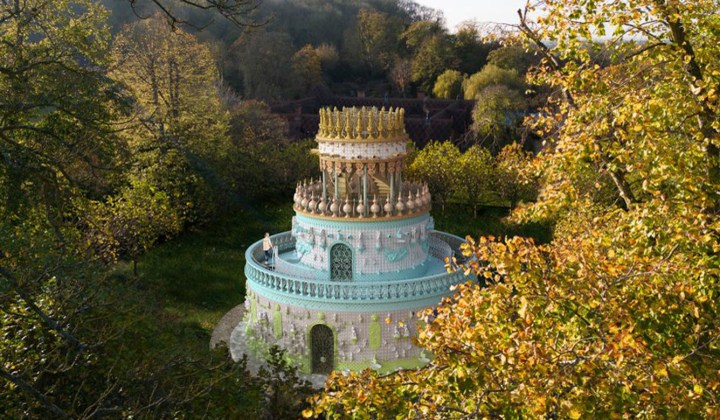
Joana Vasconcelos, Wedding Cake, at Waddesdon Manor in Aylesbury, installed 2023.
◊ ◊ ◊ ◊ ◊
From the press release for the new installation at Waddesdon:
Joana Vasconcelos: Wedding Cake at Waddesdon
The Dairy at Waddesdon Manor, open from 8 June 2023, with tours available until 26 October
Wedding Cake—a 12-metre-high sculptural pavilion in the form of a three-tiered wedding cake, clad entirely in ceramic tiles—is a major new work at Waddesdon by celebrated Portuguese artist Joana Vasconcelos (b. 1971). Almost five years in the making, Wedding Cake was commissioned by the Rothschild Foundation for Waddesdon, prompted by the relationship between visionary collector Lord Rothschild and Vasconcelos.
Part sculpture, part architectural garden folly, Wedding Cake is an extraordinary, enormous, fully immersive sculpture that combines pâtisserie and architecture. Gleaming and icing-like outside and in, it offers an intricate and richly sensory experience—glazed in pale pinks, greens, and blues, beset with sculptural ornament, and complete with the sounds of trickling water and a site-specific lighting scheme. Wedding Cake is Vasconcelos’s most ambitious commission to date, described by the artist as “a temple to love” celebrating festivity and marriage.
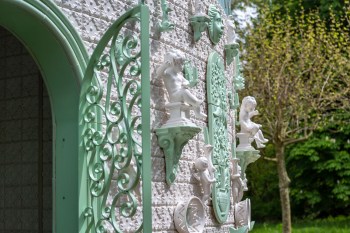
Joana Vasconcelos, Wedding Cake, at Waddesdon, detail of the ground level.
The history of the wedding cake is long and varied, full of symbolism and tradition—from ancient Rome where bread was broken over the bride’s head to bring good fortune to the couple, to contemporary confections that embody celebration and social status. Vasconcelos’s Wedding Cake is a playful addition to this rich history. Inspired by the exuberant Baroque buildings and highly decorative ceramic traditions of Lisbon—where Vasconcelos lives and works—the work is also a contemporary response to the great Rothschild traditions of hospitality with echoes of 18th-century garden pavilions.
At Waddesdon Wedding Cake will stand in a grove of trees alongside the 19th-century Dairy, built by Baron Ferdinand de Rothschild to entertain and charm guests at his famous house parties, and described by contemporaries as “a treasure house of what is beautiful, curious, or ancient.” It reminds us of the long European history of placing fanciful buildings in gardens and landscapes and forms part of a growing collection of significant contemporary and historic sculpture, brought together by Lord Rothschild. Today, the Dairy is still a much sought-after entertaining space, and the presence of the Wedding Cake, a symbol of love and happiness, is a perfect complement.
Wedding Cake is emblematic of Vasconcelos’s practice. She is deeply influenced by the artistic traditions of her home country, and the way in which she combines her materials reflects international influences on Portuguese culture over centuries—born from a history of exploring and seafaring, from Chinese and Japanese ceramics to Brazilian carnival, incorporating colour and light. Her work is often playful, manipulating scale to dramatic effect and using familiar daily objects in surprising, charming, and inventive ways. On a deeper level, her work explores notions of domesticity, femininity, empowerment, and the tension between private and public realms.
Vasconcelos’s work often challenges the assumptions of traditional hierarchies of ‘noble’ materials, such as marble, used frequently to embellish grand structures and often set above more everyday substances like ceramics and textiles. Her practice champions traditional, hand-made objects and techniques, and the ceramics for Wedding Cake have been made by the Viúva Lamego manufactory, which has been operating in Sintra for 170 years. The company’s standard 14×14cm tiles determined the size of the overall structure of Wedding Cake, whose 11m diameter is the smallest circle that can be made with whole tiles.
At Waddesdon, this combination of materials and the exploration of scale and technique is a perfect fit. The house is famous for its ceramics, particularly Sèvres and Meissen porcelain. The fashions and traditions of 18th- and 19th-century dining, entertaining, and festivity are also deeply embedded in the collections, whether a silver dinner service made for King George III, an 18th-century book recording the festivities laid on to mark a royal wedding, or a manual illustrating sugar sculpture. The sumptuous decoration of the Wedding Cake also speaks to the architecture of the house, itself covered in ornament and designed to complement the collections inside and the carefully laid out garden and landscape. These include the fanciful buildings in Waddesdon’s grounds like the Dairy, Flint House, and the Aviary, all intended to surprise and delight visitors.
According to Joana Vasconcelos, “An enormous project such as this one could only happen with the vision and encouragement provided by a generous and extraordinary patron such as Lord Rothschild. He could see its dreamlike potential, believe in it, and provide the means to make it come true. I have been addressing the subject of love through my career for almost 30 years now, but this is my biggest challenge so far. Many artists have the ‘impossible project’ and this is mine. I wanted people to have three different approaches to it: looking from the outside, enjoying the surroundings from the different levels or balconies, and rising to the top, finally completing the artwork with their presence. Above all, I always thought of it as a temple to love.”
Lord Rothschild says, “We are delighted to be collaborating again with Joana Vasconcelos, whose work is already magnificently represented at Waddesdon by her giant candlesticks, Lafite. The vision, imagination, and ambition exemplified in the Wedding Cake is a perfect match for the passion which drove Baron Ferdinand, the creator of Waddesdon, to build the Manor and the Dairy, where he intended that his many friends would be surprised and delighted at every turn. I am sure that the Wedding Cake will have just as great an impact on visitors and wedding guests today.”
Pippa Shirley, Director of Waddesdon says, “Waddesdon was built to entertain; so, what better way to mark the continuity today of that spirit of hospitality, artistic creativity, and Rothschild family patronage than through the commission of this magical object, an emblem of love and celebration. Projects like this require a leap of faith from both artist and patron, and we are proud to have been a partner in this innovative work.”
Recipe for Wedding Cake
• 1 creative artist
• 1 visionary patron
• 2 international teams
• Pinch of experts
• 3500 wrought iron parts
• 21,815kg iron sheet
• Approximately 25,150 Viúva Lamego ceramic tiles (99 different types) and 1,238 Viúva Lamego ceramic pieces (52 different types). Ceramic tile area: 365 m2
• Plethora of ornaments — mermaids, dolphins, candles, globes, etc
• Indoor and outdoor lights — 350 glass flames receiving optical fiber (about 3,000 meters)
• 592 light points
• Rivers of glaze
• Sprinklings of water
• Hope, belief, and effort
Blend the circa 50 tons with generous amounts of creativity and patience. Bind into different panels; raise tier by tier to height of 12 meters. Assemble at Waddesdon. Serve with love.
Joana Vasconcelos’s Lafite, two giant candlesticks made of illuminated Chateau Lafite Rothschild magnums (commissioned in 2015 by the Rothschild Foundation in celebration of the family associations with the world of great Bordeaux wine), will be moving to the Dairy. In 2012, her Pavillon de Thé, a giant wrought-iron tea pot, was the focal point of House of Cards, a contemporary sculpture exhibition in the gardens, and in 2016 her Cup Cake (2011) was exhibited on the North Front.
Vasconcelos’s work is also represented in major collections around the world, such as those of Calouste Gulbenkian, François Pinault, and the Louis Vuitton Foundation. She has exhibited regularly since the mid-1990s. Her work became known internationally after her participation in the 51st Venice Biennale in 2005, with the work A Noiva [The Bride] (2001–05). She was the first woman and the youngest artist to exhibit at the Palace of Versailles, in 2012. Other highlights of her career include a solo exhibition at Guggenheim Museum Bilbao (2019); the project Trafaria Praia for the Pavilion of Portugal at the 55th Venice Biennale (2013); the participation in the group exhibition The World Belongs to You at the Palazzo Grassi/François Pinault Foundation, Venice (2011); taking part in Un Certain Etat du Monde? A Selection of Works from the François Pinault Foundation at the Garage Center for Contemporary Culture in Moscow (2013); and her first retrospective Sem Rede held at the Museu Coleção Berardo, Lisbon (2010). Her solo show Time Machine was on view at Manchester Art Gallery in 2014; in London she exhibited at Royal Academy of Arts’ Summer Exhibition in 2018; and she was given a major show at the Yorkshire Sculpture Park, Beyond in 2021.
Visitors to Waddesdon will be able to visit Wedding Cake on a guided tour that will include the impressive collection of contemporary sculpture situated in the Water Garden at the Dairy. Wedding Cake tours will run from 8 June until 26 October on Thursdays and selected Sundays.
Enfilade turns 14!
From the Editor
As Enfilade turns fourteen (22 June), I write with keen appreciation: thanks to you all for still reading. And so, as is the custom, please celebrate by buying an art book! Yale UP is offering 50% off books with free shipping (some restrictions apply), until the 23rd. Now is also a fine time to renew your HECAA membership and sign up for this fall’s HECAA@30 conference.
Best for a good summer!
Craig Hanson
Symposium | Belatedness and Historiographies of N. American Art
The last event in the Belatedness and North American Art series, from The Courtauld:
Belatedness and Historiographies of North American Art
Courtauld Institute, Vernon Square Campus, London, 16–17 June 2023
Focused on historiographies of North American Art, the symposium asks, how has belatedness shaped the historiography of the arts of North America? How have projections of belatedness shaped the inclusion or exclusion of African American, Latinx, Caribbean, and Native American art in the canon of ‘American art’, as well as art from regions outside the Northeast? How have the arts of Canada and Mexico been framed in dialogue with the art of the United States? Has visual studies recentred these hierarchies? In the context of the United States, how has the discipline’s emergence in dialogue with the American Mind school of American studies continued to shape the sub-field’s relationships with the wider field and canons of the history of art? How have narratives of modernist progress in abstraction shaped critics’ constructions of belatedness around artists who retain figuration? How have artists operating outside geographic and cultural ‘centres’ of art production taken up, mimicked, or inverted expectations of cultural belatedness?
Abstracts and registration information can be found here»
F R I D A Y , 1 6 J U N E 2 0 2 3
12.45 Registration
1.15 Welcome and Introductory Comments
1.30 Session 1 | Belatedness as Difference
• Emmanuel Ortega — From New Spain to Mexico, Belatedness as a Tool of Empire
• Alexis L. Boylan — Always Late to the Party: North American Art, Science, and Epistemological Anxiety in the Twentieth Century
2.45 Coffee Break
3.15 Session 2 | Belatedness as Positionality
• Jessica L. Horton — Tipi and Dome: Indigenous Futurism at Expo 70
• Leon Wainwright — Between the United States, Britain and the Caribbean: A Historiography of Belatedness
4.30 Reception
S A T U R D A Y , 1 7 J U N E 2 0 2 3
10.00 Registration
10.30 Welcome and Introductory Comments
10.45 Session 3 | Belated Inclusions
• Elizabeth Hutchinson — When Did Indigenous Art Become ‘American’?
• Tanya Sheehan — American Art Historiography, Slavery, and Its Aftermath
12.00 Lunch Break
1.30 Session 4 | Belatedness and American Art Histories
• Juliet Sperling — The Late Jacob Lawrence
• Martha Langford — Belatedness, Near and Far
• Nicholas Robbins — ‘Yet-to-be-dismantled’: Elizabeth Bishop and Winslow Homer in 1974
3.15 Concluding Remarks










 Enfilade
leave a comment