Exhibition | Visions in Porcelain: A Rake’s Progress
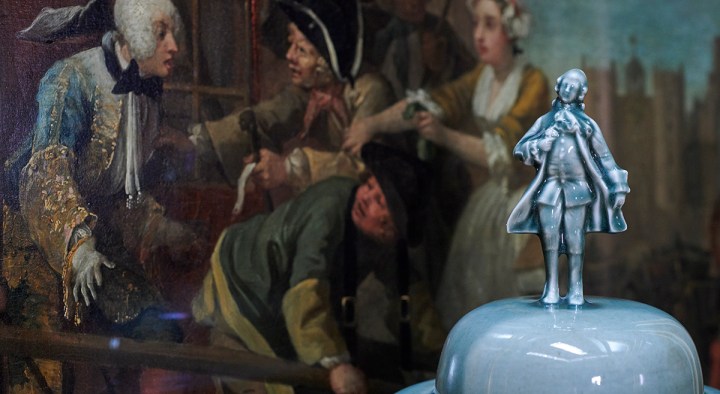
Opening this week at the Soane Museum:
Visions in Porcelain: A Rake’s Progress
Sir John Soane’s Museum, London, 7 June — 10 September 2023
Bouke de Vries’ latest work—beautifully displayed in the Museum’s Foyle Space— responds to William Hogarth’s A Rake’s Progress.
Inspired by Hogarth’s series of original paintings at the Soane Museum, de Vries draws on his love of storytelling, and talent for symbolism through ceramics, with eight newly created porcelain vases presented in various states of (dis)repair. Starting with an immaculate celadon vase, de Vries treats the following seven increasingly deteriorating vases with a variety of restoration processes and glazes, which parallel the moral and physical degeneration of Hogarth’s anti-hero Tom Rakewell. Cracks appear in the surface, the vessels slump and implode—with obvious and drastic methods of repair failing to save the vase or Rake from their ultimate demise.
Originally working in fashion before retraining as a restorer, Bouke de Vries began creating his works of art in 2008. He has since gained a significant following and now has work in an impressive range of international public collections, including the National Museum of Scotland; the National Museum of Art, Architecture, and Design in Oslo; and the Philadelphia Museum of Art. De Vries sees an inherent value in the discarded objects he reinvents, giving a new lease of life to a broad spectrum of ceramics otherwise destined to be thrown away.
Bouke de Vries in Conversation with Louisa Buck
13 June 2023, 7pm BST
To celebrate the opening of his new exhibition Visions in Porcelain: A Rake’s Progress, ceramic artist Bouke de Vries will discuss his latest work with Louisa Buck, a contributing editor and London contemporary art correspondent for The Art Newspaper and a regular reviewer and commentator on BBC radio and TV. The evening includes an exclusive out-of-hours viewing of the exhibition and the opportunity to view Hogarth’s paintings that inspired the series in the Picture Room.
Book tickets here»
Lecture Series | Peter Miller on Conservation as a Human Science
From the Warburg:
Peter Miller, On Conservation as a Human Science
E. H. Gombrich Lecture Series
In-person and online, Warburg Institute, London, 13, 14, 15 June 2023
‘Conservation’, ‘preservation’, ‘care’—these words are frequently used today, but by different people, speaking to different audiences. On Conservation as a Human Science makes the case for treating conservation as a single human activity with an intellectual history of its own. Then, focusing more particularly on the kind of conservation done to man-made things it explores the entwined relationship between conservation and history. Like archaeology, to which it bears a close resemblance, conservation explores the depth of time stratigraphically to answer questions about what was in the past from what survives into our present. But, turned around, history, too, can function as a form of conservation—indeed, this was an initial self-definition that persisted into the age of modern, academic history. The ambition of this project is to shift how we understand conservation for a twenty-first century in which climate change will make the task of conservation and the challenge to conservation a more urgent part of public and private life. Moreover, rethinking conservation as a human science also opens up a new perspective on the organization of knowledge at a time when inherited distinctions between disciplines and fields and ‘pure’ and ‘applied’ learning, like those between the ‘head’ and the ‘hand’, are being reconsidered.
Lecture 1 | Tuesday, 13 June, 5.30–7.00pm
In Search of Conservation’s History
Lecture 2 | Wednesday, 14 June, 5.30–7.00pm
Conservation as History
Lecture 3 | Thursday, 15 June, 5.30–7.00pm
History as Conservation
Free and open to all with advance booking, in person at the Warburg Institute, or online via Zoom.
Organised by the Warburg Institute and sponsored by Princeton University Press, the E. H. Gombrich Lecture Series features prominent humanities scholars who address pressing concerns in art, literature, and ideas, across historical periods.
Peter N. Miller is Dean and Professor of Cultural History at the Bard Graduate Center in New York City, and incoming President of the American Academy in Rome. He is the author of a series of books on the early seventeenth-century antiquarian, Nicolas Fabri de Peiresc, on the history of antiquarianism, and on the modern study of objects as evidence. He co-curated Dutch New York between East and West: The World of Margarieta van Varick (BGC, 2009); What Is the Object? (BGC, 2022); and Conserving Active Matter (BGC, 2022), the exhibition and website that concluded the ten-year long project he directed, “Cultures of Conservation,” funded by the Andrew W. Mellon Foundation. His main current interest is in the how and why of research, whether done by professional historians or by curators, conservators or artists. He has been at Bard since 2001. He previously taught at the University of Cambridge, University of Chicago, and University of Maryland, College Park. He was a research fellow at the Warburg Institute, the Wissenschaftskolleg zu Berlin, and visiting professor at the École des Hautes Études en Sciences Sociales in Marseille and École Normale Supérieure in Paris. He has been the recipient of fellowships from the National Endowment for the Humanities, the John Simon Guggenheim Foundation, and the John D. and Catherine T. MacArthur Foundation.
Conference | The Mutability of Collections
From ArtHist.net and the Seminar on Collecting and Display website:
The Mutability of Collections: Transformation, Contextualisation, and Re-interpretation
Online and in-person, Birkbeck College, London, 7 July 2023
Registration due by 7 June 2023
This one-day conference concentrates on the ways in which objects in collections are added, exchanged or disposed of, translated and transformed. Items can be moved to new surroundings and different decorative settings, resulting in altered contexts of display, meaning, and significance. This conference thus aims to explore the various issues underlying the mutability of collections:
• the ways in which intentionality, taste, and the periodically fluctuating finances of collectors influenced the composition and display of a collection, sometimes more than once within a collection’s biography
• the ways in which fashion may have directed a collector towards particular groups of objects, as well as their alteration according to the taste of the time
• the ways in which collections may be reinterpreted and take on new meanings according to the spaces in which they were displayed
• the different associations and meanings given to individual objects through their changing representations, displays, or associations
Conference Fees
Regular booking fee (including lunch and tea & coffee), £42
Student booking fee, £25
Conference dinner on Friday evening (to be paid on the evening), £30
Zoom participation only, £15
Booking information is available here, or email collectingdisplay@gmail.com in case of difficulties.
P R O G R A M M E
9.00. Introduction
9.15. Morning Session
• Laura Moretti — Object History and Museum Display: The Adventurous Life of the Berlin Adorante
• Vincent Pham — Vernacular Veneration: Lord Chesterfield’s Library Portraits and Their afterlives
• Lara Pitteloud — From a Private to an Imperial Cabinet: The Various Re-interpretations of the Comte de Baudoin’s Collection
• Emily Monty — Prints and Books in the Dutch Fagel Collection: Continuity and Disjuncture in the London Market around 1800
• Ludovica Scalzo — Collections on Display in the Braccio Nuovo: A New Interpretation
12.45 Lunch Break
13.30 Afternoon Session
• Hannah McIsaac — Dutch Botanical Gardens: Visual Representation and the Impermanence of Collections
• Michal Mencfel — The Pulawian Relics of Unhappy Lovers, or the Poetics of Framing
• Solmaz Kive — Framing the Other: Decorative Art at the South Kensington Museum
• Maria Silina — Re-making Soviet Collections: Knowledge Production and Border Divisions, via Zoom
• Renata Komiƈ Marn — ‘Sammlung Attems’: The Identity of the Collection in Its Changing Contexts
16.40 Closing Discussion
Online Talk | Kate Hunter on Three Maps
From the SHARP listserv and Eventbrite:
Kate Hunter | Unexpected Adventures Told in Three Maps: Western Australia, the Indian Ocean, and Captain James Cook’s First Voyage
Online, Thursday, 8 June 2023, 1pm (EDT)
Kate Hunter, Senior Specialist at Daniel Crouch Rare Books, in conversation with Arthur Dunkelman, Curator of the Jay Kislak Collection, University of Miami Libraries
The University of Miami Special Collections cordially invites you to a ‘Conversation on Cartography’. Kate Hunter will share stories about three maps. The first is a map of Western Australia, where she grew up. The second is a Dutch East India Company [VOC] 18th-century chart of the Indian Ocean on vellum that helped the company establish a trade route that netted a fortune. Last, Hunter will look at a silver punch bowl whose upside-down surface includes an engraved early rendering of Captain James Cook’s first voyage (1769–70).
Kate Hunter has helped private collectors and institutional libraries to acquire and catalog maps, globes, and atlases the world over. Currently, she is the senior specialist at the New York office of Daniel Crouch Rare Books. She is also consulting curator and cataloger for the Map and Atlas Museum of La Jolla, California. During her three-decade career, Hunter has witnessed great changes, from a landscape over-populated by independent bookshops, to one almost bereft of them. According to Hunter, much of today’s commerce takes place online, and that has transformed the way collectors collect—from compulsive completists focused with detailed wish-lists to trophy-hunting connoisseurs.
The program will be followed by an audience question and answer session. Free and open to the public, the event will be hosted via Zoom. It will also be streamed via Facebook Live. All events in this series will be recorded for on-demand access following the broadcasts.
The Burlington Magazine, May 2023
The eighteenth century in the May issue of The Burlington . . .
The Burlington Magazine 165 (May 2023)
E D I T O R I A L
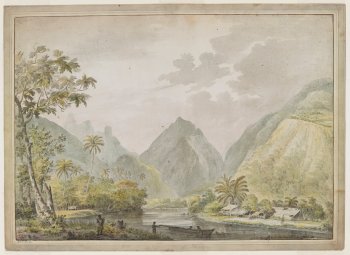
John Webber, A View Looking up the Vaitepiha River with Two Tahitians in a Canoe in the Foreground and Two Others on the Bank with Tahitian Houses to the Right. August 1777, 1777, pen, wash, and watercolour, 45 × 63 cm (London: British Library, Add. 15513, No.13).
• Digitizing the Conway and Witt Libraries, p. 491.
L E T T E R S
• Peter Barber, “The Background of Portrait of Mai,” pp. 492–93.
“Given Reynolds’s lack of interest in landscape painting, but the special place of the portrait of Mai in his oeuvre, it is at least possible that Reynolds may have decided to paint an authentically Tahitian background in order to add further ‘authenticity’. Given his high opinion of [John] Webber, it would have been natural to have copied the scene from one of his friend’s ‘excellent’ paintings of Vaitepiha Bay” (493).
• Christina Strunck, “Laguerre’s Painted Hall at Chatsworth,” p. 493.
“Since in his article ‘A Modello by Louis Laguerre and the Programme of the Painted Hall at Chatsworth’, published in The Burlington Magazine in August 2022 (pp. 760–67), François Marandet came to the same conclusions [that I did in my 2021 monograph Britain and the Continent, 1660–1727: Political Crisis and Conflict Resolution in Mural Paintings at Windsor, Chelsea, Chatsworth, Hampton Court and Greenwich], I thought your readers might like to be referred to the more extended analysis of the programme in both my book and an article I published in January 2022 that discusses the channels through which the two versions of Maratta’s painting may have been known to Laguerre and his patron, William Cavendish.”
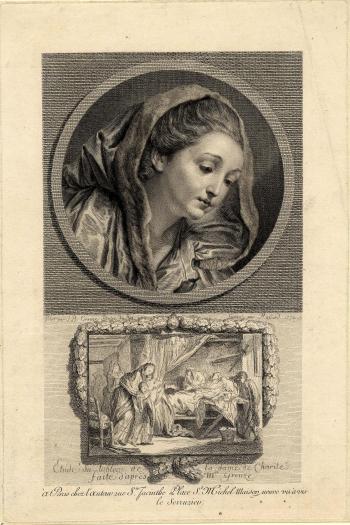
Jean Massard, after Jean Baptiste Greuze, A Woman (Madame Greuze) with a Fur-trimmed Hood Drawn over Her Head, Detail from Greuze’s ‘La Dame de Charité’ above a Sketch of the Painting, 1772, etching and engraving, 24 × 16 cm (London: British Museum, 1978,0121.291).
R E V I E W S
• Mark Evans, Review of Leopoldine van Hogendorp Prosperetti, Woodland Imagery in Northern Art, c.1500–1800: Poetry and Ecology (Lund Humphries, 2022), pp. 568–69.
• Alastair Lang, Review of Yuriko Jackall, Jean-Baptiste Greuze et ses têtes d’expression: La fortune d’une genre (CTHS and INHA, 2022), pp. 569–71.
• Lisa Monnas, Review of Michael Peter, Gewebtes Gold: Eine Kleine Geschichte der Metallfadenweberei von der Antike bis um 1800 (Abegg-Stiftung, 2022), p. 576.
• Alexandre Maral, Review of Christopher Tadgell, The Louvre and Versailles: The Evolution of the Proto-Typical Palace in the Age of Absolutism (Routledge, 2020), pp. 576–77.
• Wim Nys, Review of Beatriz Chadour-Sampson, Sandra Hindman, and Carla Van De Puttelaar, eds., Liber Amicorum in Honour of Diana Scarisbrick: A Life in Jewels (Ad Ilissvm, 2022), p. 577.
O B I T U A R Y
• Elizabeth Pergam, Obituary for Duncan Robinson (1943–2022), p. 578–79.
Successively the Director of the Yale Center for British Art, New Haven, and the Fitzwilliam Museum, Cambridge, Duncan Robinson had a major influence on the appreciation, study, and collecting of historic and modern British art in both the United States and the United Kingdom.
Call for Papers | Early Dance Symposium
From the Call for Papers:
New Work on Old Dance: A Pre-1800 Dance Studies Symposium
Online, 22–24 February 2024
Proposals due by 15 September 2023
What does it look like for historical expressions of dancing and movement arts to break out of traditional academic and performative boxes? How do scholars and practitioners escape the boundaries of discipline, chronology, geography, and methodology subsumed under the conventional appellation of ‘early dance’? Conversely, how can we demonstrate the ways in which our work complements and completes the work of other disciplines in light of these distinctions? This symposium explores early dance as an idea, a time, a place, a locus of cultural meaning and aims to draw together scholars working across disciplines and geographies who are nevertheless invested in ‘early’ dance and movement.
We invite papers for this virtual symposium from scholars across disciplines, exploring aspects of dance and movement from all methodological perspectives, nding commonality in the antecedental nature of their work. Whether looking at the musical, literary, cultural, political, religious, or social contexts of dance, or expanding knowledge of its somatic and kinesthetic dimensions, we nd unity in the chronological earliness of our work. We encourage papers that explore dance outside of Western European frameworks of knowledge and movement production, including comparative or transhistorical perspectives on pre-1800 or ‘early’ dance.
Possible Themes for Papers
• Dance, music, and choreomusicology
• Notation and choreographies
• Transmission, translation, and circulation
• Expanding geographies (pre-1800 dance across Asia, SWANA, the Americas and beyond)
• Race and racialization in pre-1800 dance practices
• Literature, textuality, and dance
• Representations of dance in art and literature
• Dance as metaphor/metaphors of dance
• Intersections of dance and/in theology, philosophy, theory, theater, art, philosophy, economics, etc.
• Theories and philosophies of dance
• Dance practices from page to stage: recreation, reconstruction, reenactment
• Costuming, clothing, and vestments
• Body politics/political bodies in historical dance
• Sociability and social life
• Translation problems: languages, historical periods, cultures
• Dance or movement as aide-memoire/embodied cognition
• Dance ontologies and dance as a way of knowing
Possible Themes for Roundtables and Forums
• What is ‘early dance’? Definitions and boundaries
• Early dance in global perspectives: expanding geographies
• Scholar/Practitioner: How does dance training aid or hinder research on early dance?
• Methodologies in research
• Graduate studies in early dance studies
• Interdisciplinary scholarship and dance studies: barriers and openings?
• Dance as knowledge production within academia
The program committee welcomes proposals for presentations in a variety of formats. Alternative formats may also be proposed. Graduate students, junior scholars, and unaffiliated scholars and performers are especially encouraged to submit proposals.
• Paper presentations (20 minutes)
• Work-in-progress presentations (5–10 minutes)
• Lecture-performances
• Workshops
• Roundtables (for themes listed above or entirely new roundtables)
• A collaborative performance, paper, manifesto, video, etc.
Please submit a proposal via the submission portal by 15 September 2023. Proposals should include your name, affiliation (if any), and email address; an abstract of 250–350 words; a short bibliography (optional); and a brief bio (100 words). All submissions materials must be in English, though presentations in other languages may be possible (please contact organizers).
This symposium is organized by members of the Early Dance Working Group of the Dance Studies Association. Please contact chair of the Organization Committee, Mary Channen Caldwell (maryca@sas.upenn.edu), with any questions.
Call for Papers | Sound, Image, Text

François Denis Née, after Joseph Barthélemy Le Bouteux, Le Concert (detail) in Jean Benjamin de Laborde, Choix de Chansons, 4 vols. (Paris: De Lormel, 1773). Binding with the arms of Marie-Antoinette (Paris: Bibliothèque nationale de France, Cotes RES-YE-778, Cotes RES-YE-779, Cotes RES-YE-780, Cotes RES-YE-781). The Bibliothèque Condé at the Château de Chantilly possesses a unique example printed on vellum bound with the original designs for the engravings; more information is available here.
◊ ◊ ◊ ◊ ◊
From the Call for Papers:
Sound, Image, Text
Australian National University, Canberra, 24–25 August 2023
Proposals due by 23 June 2023
This symposium hosted by the Centre for Art History and Theory in the ANU School of Art and Design will be of interest to scholars, curators, or creative practitioners interested in the relationship between sound, image, and text in the history of music, art, and literature. The event is inspired by the digital critical edition of Jean-Benjamin de Laborde’s Choix de Chansons (1773), developed by an interdisciplinary team of art historians, musicologists, and literary scholars from the Australian National University, University of Sydney, University of Oxford, and the Sorbonne. The project explores the interrelation and interactivity of images, music, and text in the Choix de Chansons and similar cultural objects in the eighteenth century.

François Denis Née, after Joseph Barthélemy Le Bouteux, Le Concert in Jean Benjamin de Laborde, Choix de Chansons, 1773 (Paris: Bibliothèque nationale de France, Cotes RES-YE-778, Cotes RES-YE-779, Cotes RES-YE-780, Cotes RES-YE-781). The inscription below the image reads “Vos yeux commencent nos tourmens, / Et vos doigts charmans / Achévent leur ouvrage” (Your eyes commence our torments / And your charming fingers / Accomplish their work). More information is available here.
We seek papers and interventions from artists, curators, publishers, and academics that include, but are not limited to, the following themes:
• Digital publication
• Multimedia research
• Interrelations of sound, image, and text.
• Digital methods for art history/musicology/literary studies
• Digital methods for researching the eighteenth century
• Book history (especially relating to music)
• History of image and text in performance
• Print culture and music
We strongly encourage participation from scholars, visual artists, and musicians who seek to develop, remake, rework, or remix the sound, image, and text of the digital critical edition of Choix de Chansons.
The symposium runs in conjunction with the Choix de Chansons exhibition at the School of Art and Design Gallery, which opens on Thursday, 24 August, and a concert of selected music from the Choix de Chansons held at the School of Music on Friday, 25 August. Modest bursaries to contribute towards travel and accommodation will be provided to international and interstate delegates. Please direct enquiries and paper submissions to Robert Wellington, Director, Centre for Art History and Art Theory, ANU at robert.wellington@anu.edu.au.










 Enfilade
leave a comment