Exhibition | The World Made Wondrous
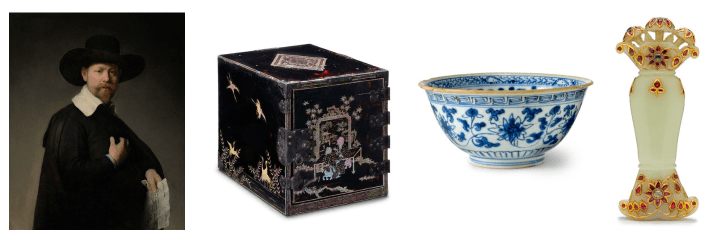
From left to right: Rembrandt Harmensz. van Rijn, Portrait of Marten Looten, 1632 (LACMA, gift of J. Paul Getty); Chest with Figures, Flowers, and Birds, Ryukyu Islands, ca. 1650–1750 (LACMA, gift of Mr. and Mrs. Leo Krashen); Bowl (Wan) with Floral Scrolls, China, Qing dynasty, Kangxi period, 1662–1722 (LACMA, gift of Ambassador and Mrs. Edward E. Masters); Dagger Hilt with Triple Lotus Bud Pommel, India, Mughal empire, ca. 1700–50 (LACMA, from the Nasli and Alice Heeramaneck Collection, Museum Associates Purchase).
◊ ◊ ◊ ◊ ◊
The World Made Wondrous may initially sound like a 17th-century exhibition, but the fact that three of the four objects used to publicize the show may actually have been made in the 18th century underscores the value of holding century designations loosely. –CH
From the press release for the exhibition:
The World Made Wondrous: The Dutch Collector’s Cabinet and the Politics of Possession
Los Angeles County Museum of Art, 17 September 2023 — 3 March 2024
Curated by Diva Zumaya
The Los Angeles County Museum of Art (LACMA) presents The World Made Wondrous: The Dutch Collector’s Cabinet and the Politics of Possession, an immersive exploration of the economic and political structures that laid the groundwork for today’s museums. Assembling an imagined 17th-century Dutch collector’s cabinet, the exhibition brings together over 300 artworks, animal and mineral specimens, scientific instruments, books, and maps, with a rich landscape of multivocal narratives by experts ranging from environmental historians and zoologists to contemporary artists and Indigenous activists.
Across Europe in the 16th and 17th centuries, wealthy people established collector’s cabinets, vast collections that they claimed contained art and natural specimens representing the entirety of the known world. As Europeans amassed these collections, they ordered the world in deliberate ways, asserting judgments and hierarchies on the value of natural materials, craftsmanship, and human worth. In many ways, these cabinets acted as prototypes for—and in some cases direct predecessors of—modern encyclopedic museums, including LACMA. Using the 17th-century Dutch example as a starting point, The World Made Wondrous unpacks the mercantile and colonial contexts that facilitated these foundational collections. While previous studies of collector’s cabinets have centered the narrative of the owner, this exhibition investigates the journey of the objects and the stories of those who produced them. The exhibition is curated by Diva Zumaya, Assistant Curator, European Painting and Sculpture, at LACMA.
“In engaging these objects through an expansive historical lens, we hope to shine a light on how the interconnected legacies of capitalism and colonialism that began in Europe in the 16th and 17th centuries continue to this day and how the human and environmental devastation that they enact affect not only museums and the collections they care for, but the entire world,” said Zumaya. “By uncovering and critically examining these legacies, museums can find new pathways forward that allow us to serve our communities while building futures together outside of colonial frameworks.”
“This exhibition reveals how new connections and critical histories arise from deep collaboration across our departments,” said Michael Govan, LACMA CEO and Wallis Annenberg Director. “While many museums have global collections, LACMA is one of the few taking such an approach. This allows us to meaningfully reconsider the topic of the collector’s cabinet and the relationships between collecting, global trade, and the environment in contemporary Los Angeles.”
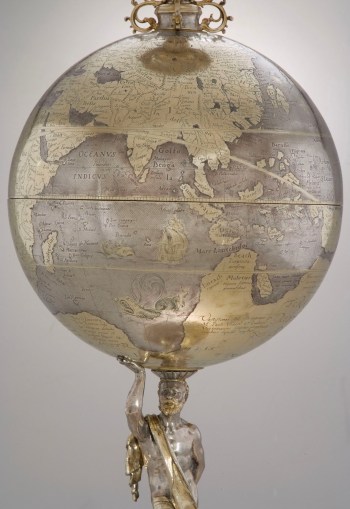
Abraham Gessner, Globe Cup (detail), ca. 1600 (Los Angeles County Museum of Art, William Randolph Hearst Collection).
Staged with dynamic lighting, warm colors, and other design elements that transport the visitor to a 17th-century collector’s cabinet, The World Made Wondrous examines over 170 works from LACMA’s permanent collection, including examples from Brazil, China, Egypt, India, Iran, Japan, Peru, Turkey, and Sri Lanka, and never-before-shown objects such as Francesco da Castello’s miniature Salvator Mundi (c. 1580–90), a large 16th-century Belgian tapestry, a recently acquired Rembrandt etching, and two Chinese cups from the late Ming dynasty, carved from rhinoceros horn.
Marking one of the largest collaborations between LACMA and the Natural History Museum of Los Angeles to date, the exhibition also draws 80 gems and minerals, shells, taxidermy, and other objects from the Natural History Museum, as well as rare books and maps from the Getty Research Institute, the UCLA Biomedical Library, and the Huntington Library, Art Museum, and Botanical Gardens, and scientific instruments from Chicago’s Adler Planetarium. In addition to these historical objects and natural specimens, works by four contemporary artists—Jennifer Ling Datchuk, Todd Gray, Sithabile Mlotshwa, and Uýra Sodoma—act as cornerstones for the exhibition. These contemporary works offer significant political and personal reflections on the histories that unfold in the exhibition.
Exhibition Guide
The World Made Wondrous features an interactive exhibition guide that creates an immersive journey through the exhibition. Accessible as audio via personal mobile devices and in-gallery printed handouts, visitors can engage with a series of commentaries accompanying select objects. These narratives are voiced by a wide range of speakers, including contemporary artists, scientists, Indigenous activists, and environmental historians. Through this diverse breadth of expertise, the exhibition guide encourages visitors to question dominant historical perspectives and consider the broader contexts surrounding the objects on view.
Exhibition Organization
The World Made Wondrous is organized into four sections: The Collector, Water, Earth, and Fire.
In the exhibition’s first section visitors are introduced to the figure of the Dutch collector and how his cabinet has been assembled to reflect his character and position. This section features heraldic imagery, portraits of historical figures to whom the collector seeks to liken himself—such as Rembrandt’s Portrait of Dirck Jansz. Pesser (c. 1634) and Portrait of Marten Looten (1632)—religious images signifying his faith, and objects that represent his access to leisure. The section provides a social and political foundation for the ways the collector has constructed the world through his collection, with the Dutch Republic at its center.
Water explores narratives around the ocean, materials extracted from it, and images of Dutch maritime power. When encountering a Japanese lacquer chest, visitors can listen to Japanese artist Shinya Yamamura discuss the particularities of working with lacquer, and a malacologist explain the function of mother of pearl as a part of a living organism. Responding to specimens from the Natural History Museum, LA-based artist Todd Gray reflects on the role of the cowrie shell in the slave trade, while a labor and migration historian discusses the process of shipping such specimens on Dutch East India Company ships.
Earth engages the natural world through a series of landscape and still life paintings, land-based natural specimens, and objects that incorporate materials like ebony, ivory, and feathers. Here, visitors are prompted to compare Frans Post’s Imagined Landscape of Dutch Brazil (c. 1655) with a work by Indigenous Brazilian artist Uýra Sodoma that addresses the contemporary deforestation of the Amazon rainforest. In the audio guide, visitors can engage with the artist’s account of the far-reaching effects of settler colonialism on her land, a sociologist’s discussion of deforestation in the Amazon, and an art historian’s discussion of Post’s motives. The visitor is also invited to consider Abraham van Beyeren’s painting Banquet Still Life (1667) in concert with artist Sithabile Mlotshwa’s response to its representation of Dutch wealth. Other narratives in this section address the practice of European natural history, Indigenous Brazilian foodways, and rhinoceros conservation.
The final section, Fire, spotlights earthenware, metals, minerals, porcelain, and gems. While viewing a Chinese porcelain bowl from the late Ming dynasty, visitors can listen to American artist Jennifer Ling Datchuk discuss her relationship with the fraught history of this material and its role in her own works Ache Like a Girl (2021) and Break Like a Woman (2021), which are featured in the gallery. As they engage with a selection of gems and minerals from the Natural History Museum and a Mughal gem-inlaid dagger hilt from LACMA’s collection, visitors can hear experts discuss the geological origins of gems and the human consequences of mining practices. Additional discussions in this section highlight the ecological effects of mining, the environmental and human costs of tobacco cultivation, and the shipping of porcelain from China to Europe.
The World Made Wondrous is accompanied by a Collator publication—available as a PDF or a printed book—through which readers can explore essays and entries by curator Diva Zumaya alongside high-resolution images of thirty-five objects from across LACMA’s collection featured in the exhibition.
Exhibition | Eternal Medium: Seeing the World in Stone
From the press release for the exhibition:
Eternal Medium: Seeing the World in Stone
Los Angeles County Museum of Art, 20 August 2023 — 11 February 2024
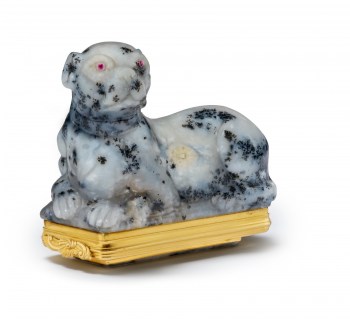
Snuffbox in the Shape of a Dog, ca. 1740–50, Dresden (LACMA, gift of The Rosalinde and Arthur Gilbert Foundation and the 2022 Decorative Arts and Design Acquisitions Committee).
The Los Angeles County Museum of Art presents Eternal Medium: Seeing the World in Stone, an exhibition that focuses on the role of the imagination in perceiving images in the natural markings of stones. The product of a collaboration between LACMA, the Rosalinde and Arthur Gilbert Collection, and the Victoria and Albert Museum in London, this exhibition brings together objects that utilize the natural features of stones and places them alongside similar works in other mediums for context and comparisons. Objects range from historical to contemporary, from ca. 2200–1800 BCE to recent pieces by Analia Saban, Alma Allen, and Ben Gaskell. Featuring a selection of 125 works, the exhibition is drawn from LACMA’s collection with loans from the Rosalinde and Arthur Gilbert Collection on loan to the V&A and the V&A’s own collections, as well as public and private collections in California.
“Making sense of enigmatic visual phenomena such as the moon, clouds, and inkblots is a fundamental human ability that excites curiosity and inspires creativity,” said Rosie Mills, The Rosalinde and Arthur Gilbert Foundation Associate Curator, Decorative Arts and Design. “Stone, especially vividly colored and richly patterned stone, is an impressive medium because the right stone can be difficult to source and carve. Eternal Medium: Seeing the World in Stone invites visitors to look for themselves as well as consider the works in their cultural and historical contexts.”
“This exhibition is the result of a meaningful collaboration between LACMA, the Rosalinde and Arthur Gilbert Collection, and the Victoria and Albert Museum in London,” said Michael Govan, LACMA CEO and Wallis Annenberg Director. “Through the sharing of collections and expertise, this partnership has facilitated new approaches to established subjects. The LACMA/V&A Staff Exchange Program was created in 2017, thanks to the generous support from The Rosalinde and Arthur Gilbert Foundation in Los Angeles, and the Gilbert Trust for the Arts in London. This exchange program is intended to encourage the exploration of new models for research, audience engagement, and scholarship. Eternal Medium is the result of this groundbreaking program.”

Dagger of Emperor Aurangzeb, India, Mughal Empire, 1660–61, nephrite (LACMA).
Tristram Hunt, Director of the V&A and Gilbert Trust for the Arts Trustee said, “The Gilbert collection of works of art made of stone is iconic and comprehensive. It is wonderful to see so many of these treasures come back to LACMA for this exhibition, alongside other works of art from the V&A, and all set in a wider context where visitors can understand the visual and artistic power of stones across continents and centuries.”
The exhibition is comprised of nine interrelated sections: ‘Hard’ stones, Sourcing Specimens, Manipulating Multicolored Stones, Seeing Images in Stones, Fooling the Eye, Flora and Fauna, Heaven and Earth, Stone for Stone, and Transcending Stone. Each section considers where the materials came from, demonstrates how their innate characteristics were translated into illusionistic stone pictures and coloristic stone sculptures, and encourages visitors to understand the works in relation to similar images in other media as well as use their own imaginations to complete the imagery suggested by the stones and their markings.
Claus Benjamin Freyinger and Andrew Holder of The Los Angeles Design Group (LADG) have created an immersive and contemplative installation design that supports an intimate viewing of the sumptuous and detailed artworks in the exhibition. The collaboration between LACMA and LADG is one of many examples of the museum working with renowned L.A. architects on exhibition design.
Exhibition Highlights
Dagger of Emperor Aurangzeb, India, Mughal empire, 1660–61
Imperial khanjars, like this one belonging to the Mughal Emperor, were typically made of precious materials. This particular specimen of nephrite jade retains its burnt-orange skin to add contrast to the horse’s meticulously delineated mane.
Snuffbox in the Shape of a Dog, Germany, ca. 1740–50
In the 18th century, Dresden’s lapidary artists incorporated the naturally occurring patterns of Saxony’s unusually rich and varied minerals into some of the most ingenious designs. For this exquisite snuffbox in the shape of a dog, the stone specimen was carefully selected for the shape and distribution of its dark inclusions that evoke the hound’s spotted fur.
Table, Italy, ca. 1870
Contoured stone mosaics are pieced together like a jigsaw puzzle, except that each piece is individually shaped to correspond to the image’s outlines (making the joins invisible). The still life on this tabletop demonstrates the extraordinary illusionism achieved using this technique.
Ben Gaskell, Breakbox with Split Crystal, United Kingdom, London, 2016
The exceedingly beautiful fracture in the transparent rock crystal cube was achieved by applying immense force at just the right angle. It celebrates the material’s physical properties as well as the artist’s technical mastery.










 Enfilade
leave a comment