Exhibition | Eternal Medium: Seeing the World in Stone
From the press release for the exhibition:
Eternal Medium: Seeing the World in Stone
Los Angeles County Museum of Art, 20 August 2023 — 11 February 2024
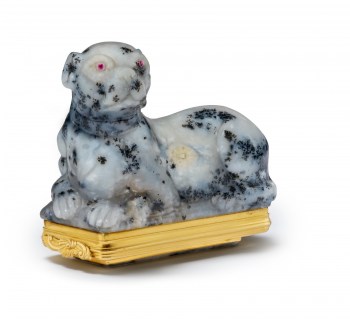
Snuffbox in the Shape of a Dog, ca. 1740–50, Dresden (LACMA, gift of The Rosalinde and Arthur Gilbert Foundation and the 2022 Decorative Arts and Design Acquisitions Committee).
The Los Angeles County Museum of Art presents Eternal Medium: Seeing the World in Stone, an exhibition that focuses on the role of the imagination in perceiving images in the natural markings of stones. The product of a collaboration between LACMA, the Rosalinde and Arthur Gilbert Collection, and the Victoria and Albert Museum in London, this exhibition brings together objects that utilize the natural features of stones and places them alongside similar works in other mediums for context and comparisons. Objects range from historical to contemporary, from ca. 2200–1800 BCE to recent pieces by Analia Saban, Alma Allen, and Ben Gaskell. Featuring a selection of 125 works, the exhibition is drawn from LACMA’s collection with loans from the Rosalinde and Arthur Gilbert Collection on loan to the V&A and the V&A’s own collections, as well as public and private collections in California.
“Making sense of enigmatic visual phenomena such as the moon, clouds, and inkblots is a fundamental human ability that excites curiosity and inspires creativity,” said Rosie Mills, The Rosalinde and Arthur Gilbert Foundation Associate Curator, Decorative Arts and Design. “Stone, especially vividly colored and richly patterned stone, is an impressive medium because the right stone can be difficult to source and carve. Eternal Medium: Seeing the World in Stone invites visitors to look for themselves as well as consider the works in their cultural and historical contexts.”
“This exhibition is the result of a meaningful collaboration between LACMA, the Rosalinde and Arthur Gilbert Collection, and the Victoria and Albert Museum in London,” said Michael Govan, LACMA CEO and Wallis Annenberg Director. “Through the sharing of collections and expertise, this partnership has facilitated new approaches to established subjects. The LACMA/V&A Staff Exchange Program was created in 2017, thanks to the generous support from The Rosalinde and Arthur Gilbert Foundation in Los Angeles, and the Gilbert Trust for the Arts in London. This exchange program is intended to encourage the exploration of new models for research, audience engagement, and scholarship. Eternal Medium is the result of this groundbreaking program.”

Dagger of Emperor Aurangzeb, India, Mughal Empire, 1660–61, nephrite (LACMA).
Tristram Hunt, Director of the V&A and Gilbert Trust for the Arts Trustee said, “The Gilbert collection of works of art made of stone is iconic and comprehensive. It is wonderful to see so many of these treasures come back to LACMA for this exhibition, alongside other works of art from the V&A, and all set in a wider context where visitors can understand the visual and artistic power of stones across continents and centuries.”
The exhibition is comprised of nine interrelated sections: ‘Hard’ stones, Sourcing Specimens, Manipulating Multicolored Stones, Seeing Images in Stones, Fooling the Eye, Flora and Fauna, Heaven and Earth, Stone for Stone, and Transcending Stone. Each section considers where the materials came from, demonstrates how their innate characteristics were translated into illusionistic stone pictures and coloristic stone sculptures, and encourages visitors to understand the works in relation to similar images in other media as well as use their own imaginations to complete the imagery suggested by the stones and their markings.
Claus Benjamin Freyinger and Andrew Holder of The Los Angeles Design Group (LADG) have created an immersive and contemplative installation design that supports an intimate viewing of the sumptuous and detailed artworks in the exhibition. The collaboration between LACMA and LADG is one of many examples of the museum working with renowned L.A. architects on exhibition design.
Exhibition Highlights
Dagger of Emperor Aurangzeb, India, Mughal empire, 1660–61
Imperial khanjars, like this one belonging to the Mughal Emperor, were typically made of precious materials. This particular specimen of nephrite jade retains its burnt-orange skin to add contrast to the horse’s meticulously delineated mane.
Snuffbox in the Shape of a Dog, Germany, ca. 1740–50
In the 18th century, Dresden’s lapidary artists incorporated the naturally occurring patterns of Saxony’s unusually rich and varied minerals into some of the most ingenious designs. For this exquisite snuffbox in the shape of a dog, the stone specimen was carefully selected for the shape and distribution of its dark inclusions that evoke the hound’s spotted fur.
Table, Italy, ca. 1870
Contoured stone mosaics are pieced together like a jigsaw puzzle, except that each piece is individually shaped to correspond to the image’s outlines (making the joins invisible). The still life on this tabletop demonstrates the extraordinary illusionism achieved using this technique.
Ben Gaskell, Breakbox with Split Crystal, United Kingdom, London, 2016
The exceedingly beautiful fracture in the transparent rock crystal cube was achieved by applying immense force at just the right angle. It celebrates the material’s physical properties as well as the artist’s technical mastery.










 Enfilade
leave a comment