Lecture | Pascal Bertrand on Boucher and the Decorative Arts
From BGC:
Pascal Bertrand | Boucher and the Decorative Arts: Promoting and Maintaining His Fame
A Françoise and Georges Selz Lecture on Eighteenth- and Nineteenth-Century French Decorative Arts and Culture
Bard Graduate Center, New York, 20 September 2023, 6.00pm
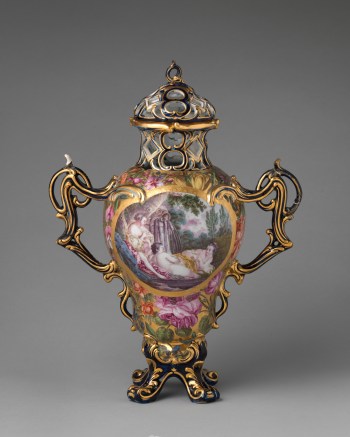
One of a pair of perfume vases, Chelsea Porcelain Manufactory (British, Gold Anchor Period, 1759–69), ca. 1761, soft-paste porcelain, burnished gold ground, 36 cm high (New York: The Metropolitan Museum of Art, 64.101.509a, b). The vase depicts three nymphs after the painting La Source by Francois Boucher.
In this lecture, Pascal Bertrand will explore the role of the decorative arts in the process of making and maintaining an artist’s fame, using the example of the quintessentially Rococo painter François Boucher. Boucher’s art was translated to a wide range of mediums—primarily tapestry and porcelain, but also gold and lacquer objects as well as printed fabrics and fans. How did he use these decorative arts to build his own reputation? And how did the decorative arts transmediate his paintings, prints, and drawings to disseminate them during his lifetime and preserve them after his death, right up to the present day? While the first question has been the subject of specific in-depth studies in one medium or another (porcelain in particular), Dr. Bertrand’s lecture considers the second question and the significance of intermediality.
Registration is available here»
Pascal Bertrand is Professor of Art History at the Université Bordeaux Montaigne in Pessac. His areas of research include the history of European tapestries, furniture, and the decorative arts generally.
Bard Graduate Center is grateful for the generous support of the Selz Foundation.
Lecture | Peter Burke on the Invention of Connoisseurship
From BGC:
Peter Burke | The Invention of Connoisseurship
Bard Graduate Center, New York, 6 September 2023, 6.00pm
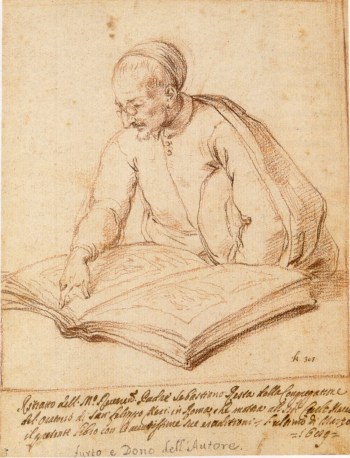
Carlo Maratti, Padre Sebastiano Resta Examining a Folio of Drawings (The Devonshire Collections). The drawing was included in the exhibition Lines of Beauty: Master Drawings from Chatsworth, on view in the fall of 2021 at The Lightbox in Woking, Surrey.
Connoisseurship—a bundle of practices combining a sense of the quality of works of art, the ability to attribute them to their makers, and to discriminate between originals, copies, and forgeries—is a contested term with a contested history. In this lecture, Peter Burke argues that the ‘invention’ of connoisseurship happened gradually rather than suddenly and took place in the West neither, as has sometimes been argued, in the nineteenth century, nor—perhaps surprisingly—in the Renaissance, but in the seventeenth century when treatises on the subject begin to appear.
Registration is available here»
Peter Burke is a cultural and social historian who was born in 1937, studied at Oxford (1957–62), and taught at the Universities of Sussex (1962–78) and Cambridge (1979–2004). He is a Life Fellow of Emmanuel College. His publications have focused in turn on historiography, the Renaissance, popular culture, and the history of knowledge, including the distinctive roles of exiles and polymaths. His latest book is a history of ignorance, and his next will be a history of connoisseurship.
New Book | Small Spaces: Recasting the Architecture of Empire
From Bloomsbury:
Swati Chattopadhyay, Small Spaces: Recasting the Architecture of Empire (London: Bloomsbury Visual Arts, 2023), 360 pages, ISBN: 978-1350288225 (hardback), $100 / ISBN: 978-1350288232 (paperback), $35. Also available as an ebook.
 Small Spaces recasts the history of the British empire by focusing on the small spaces that made the empire possible. It takes as its subject a series of small architectural spaces, objects, and landscapes and uses them to narrate the untold stories of the marginalized people-the servants, women, children, subalterns, and racialized minorities-who held up the infrastructure of empire. In so doing it opens up an important new approach to architectural history: an invitation to shift our attention from the large to the small scale. Taking the British empire in India as its primary focus, the book presents eighteen short, readable chapters to explore an array of overlooked places and spaces. From cook rooms and slave quarters to outhouses, go-downs, and medicine cupboards, chapters reveals how and why these kinds of minor spaces are so important to understanding colonialism. With the focus of history so often on the large scale—global trade networks, vast regions, and architectures of power and domination—Small Spaces shows instead how we need to rethink this aura of magnitude so that our reading is not beholden to such imperialist optics. With chapters that can be read separately as individual accounts of objects, spaces, and buildings and introductions showing how this critical methodology can challenge the methods and theories of urban and architectural history, Small Spaces is a must-read for anyone wishing to decolonize disciplinary practices in the field of architectural, urban, and colonial history. Altogether, it provides a paradigm-breaking account of how to ‘unlearn empire’, whether in British India or elsewhere.
Swati Chattopadhyay is Professor in the Department of History of Art and Architecture with an affiliated appointment in the Department of Comparative Literature at the University of California, Santa Barbara.
c o n t e n t s
Preface and Acknowledgments
I | Small Spaces
1 Of Small Spaces
2 Empire of Small Spaces
II | Trade and Labor
3 Dependency
4 Locating the Bottlekhana
5 Potable Empire
6 Europe Goods
7 Strange Tongues
8 Making Invisible
III | Land Imagination
9 Vantage
10 Connective Spaces
11 Anomalous Spaces
12 An Aesthetic Episode
13 Roofscape
IV | A Geography of Small Spaces
14 Collections and Containment
15 Portable Geographies
16 A Good Shelf
17 A Box of Medicine
18 Epilogue
Appendix A
Index










 Enfilade
leave a comment