Online Talks | Digital Art History
From the series webpage:
Narrowing the Divide: A Dialogue between Art History and Digital Art History
Artl@s Conversation Series in Digital Art History, Visual Contagions, 2023–24
Organized by Béatrice Joyeux-Prunel, Catherine Dossin, and Nicola Carboni
The the Artl@s Lectures are a series of conversations that Artl@s will organize throughout the 2023–2024 academic year on the theme of Narrowing the Divide: A Dialogue between Art History and Digital Art History.
The field of Digital Art History (DAH) is currently experiencing a notable shift towards establishing its autonomy as a distinct discipline. However, its survival is challenged by the limitations of its investigations. The lack of relationships between computational effort and traditional analysis often limits the generation of novel insight. Digital art history risks becoming a mere spectacle when it relies solely on stunning visualizations without engaging in rigorous research questions. Conversely, art history limits itself from harnessing robust methodologies by disregarding computational approaches.
The digital approach increasingly demands advanced technical skills, thereby often placing art historians in a position where they lack the means and expertise to engage with it. Yet, art historians possess a keen awareness of the pressing issues within the discipline and possess the knowledge of which corpuses are relevant for addressing them. They could potentially provide their questions and corpuses to experts in digital art history. Hence, it is crucial to establish more frequent and substantive opportunities for collaboration between these two approaches. The 2023–2024 Artl@s Conversation Series aims to cultivate a convergence between the field of digital art history and the discipline of art history. The exchange of ideas and results among digital art history specialists, art historians, and the audience will foster a deeper understanding of the possibilities and implications of computational methodologies in the study of art history.
Each event will facilitate a unique encounter between two experts engaged in overlapping subject areas but employing markedly different methodologies. Within this framework, art historians will put forth inquiries and collections to experts in digital approaches, while scholars in digital art history will present the outcomes of their methodologies, along with the aspects they would readily suggest for monographic or non-digital explorations. The aim is to foster collaborations and a heightened mutual understanding of the outcomes between the realms of art history and digital art history. These gatherings provide valuable opportunities for aspiring PhD students in digital humanities and art history to discover new subjects and gain insights into the notable progress being made in both disciplines.
Organizers: Béatrice Joyeux-Prunel (UNIGE), Catherine Dossin (Purdue University), and Nicola Carboni (UNIGE)
s e s s i o n s
AI for Art History, Art History of AI
Online, Friday, 8 September 2023, 14.15–15.45 (Paris and Geneva time) / 8.15–9.30am (EST)
• Leonardo Impett, University of Cambridge
• Pascal Griener, Université de Neuchatel
Click here to join us on Zoom || Read more about the speakers.
◊ ◊ ◊ ◊ ◊
Do We Need Digital Visual Studies?
Online, Friday, 29 September 2023, 14.15–15.45 (Paris and Geneva time) / 8.15–9.30am (EST)
• Béatrice Joyeux-Prunel, Université de Geneve
• Leora Auslander, University of Chicago
Click here to join us on Zoom || Read more about the speakers.
New Book | The A–Z of Regency London, 1819
From the London Topographical Society:
Sheila O’Connell, ed., with an introduction by Paul Laxton and indexes by Roger Cline, The A–Z of Regency London 1819 (London: London Topographical Society, 2023), 159 pages, £36.
 The A–Z of Regency London 1819 reproduces at two-thirds actual size the 4th and last edition of Richard Horwood’s map of London. As a guide to the topography of early-nineteenth-century London it is unequalled. The 40 sheets of the map are accompanied by an introductory essay describing its making, assessing its qualities, and casting new light on the life of the map-maker, as well as indexes to streets and buildings showing the juxtaposition of residential and industrial premises.
As described in a recent issue of Salon (the newsletter of The Society of Antiquaries of London, 30 August 2023):
In about 1790, Richard Horwood (1758–1803) embarked on what was to be the largest map of London ever published. He told his subscribers that it would be “on a Scale so extensive and accurate as to exhibit, not only every Street, Square, Court, Alley, and Passage therein, but also each individual House, the Number by which it is distinguished.” It was completed in 32 sheets in 1799. William Faden reissued the map in 1807, 1813, and 1819, adding eight new plates to cover developments to the east. The publication reproduces at two-thirds actual size the 4th and last edition of Richard Horwood’s map of London. As a guide to the topography of early-nineteenth-century London it is unequalled. The 40 sheets of the map are accompanied by an introductory essay describing its making, assessing its qualities, and casting new light on the life of the map-maker (including a surprising link with the emerging United States of America), as well as indexes to streets and buildings showing the juxtaposition of residential and industrial premises.
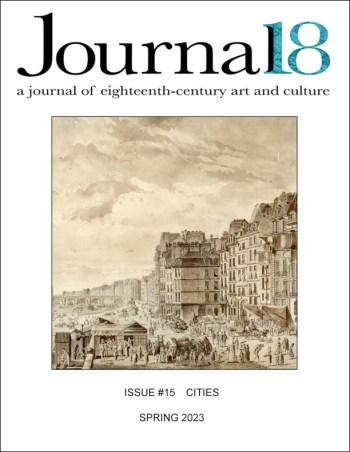
Journal18, Spring 2023 — Cities
For anyone who may have missed it, the latest issue of J18, along with lots of interesting reviews:
Journal18, Issue #15 (Spring 2023) — Cities
Issue edited by Katie Scott and Richard Wittman
Katie Scott and Richard Wittman — “Introduction”
Art history has traditionally narrated the early modern city through the monuments and buildings that constituted its environment and with reference to its spatial distribution. This special issue invites readers to consider the city instead via the social: to think about the people who once inhabited those buildings, admired those monuments, those who shared the spaces and resources of the city, and the ideas, beliefs, and practices invested in and inspired by it.
 For Aleksandr Bierig, the social is social life literally speaking, and that which the city must foster through clean air. In a close reading of Timothy Nourse’s 1700 critique of London’s coal-induced smog, and his proposal to purify the capital’s atmosphere by reverting to wood, Bierig shows that Nourse’s “restoration” acknowledged various trade-offs between social needs and industry but did not propose to turn back the clock, either socially or ecologically. Rather than retreat to pastoral, Nourse envisioned the relocation of industry to the city limits, as well as the plantation of an orbital forest to supply London. He viewed nature as a resource—in the modern sense of an object uniquely for commercial exploitation—of the good city.
Stacey Sloboda’s essay on London’s St. Martin’s Lane engages with the social on the scale and in the terms of neighborhood, a concept in which the built and the social are united. By following inhabitants of St. Martin’s Lane through rent registers and other sources, she explores the imbrication of artistic and artisanal practices that academies and art theory often obscure. Moreover, she complicates the binaries we draw to distinguish the modern and pre-modern city: between an older world of dense, low-rise housing and inward-looking community living, and the modern, outward-facing city produced by industrialization and migration. The St. Martin’s Lane school drew both some of its agents and some its artistic ideas from Europe and thought its taste modern.
Questions of place and emplacement are key also to Anne Hultzsch’s essay. However, she explores not the community and the rootedness associated with neighborhoods, but the individual’s embodied relationship to site. She reviews Sophie von La Roche’s writings on the city as “situated criticism,” situated both in the literal sense of point of view, and sociologically as a woman of a certain class. What distinguishes Hultzsch’s take on the social and sets it apart from late twentieth-century social and political histories of art criticism is her discussion of La Roche’s experience of the visual, and her use of biography to lay bare her subject’s identity in its intersectional complexity.
The two shorter pieces, each with a more historiographical focus, center on the figure of the urban observer. Richard Wrigley argues that the personage of the flâneur, normally characterized as disengaged and associated with the July Monarchy, had in fact originated in the political culture of the French Revolution, and as an effect of self-determined mobility within the city enabled by liberty. In so doing, he restores an essential political context to the phenomenon of flânerie that has long been obscured by its limiting association with the burgeoning consumer culture emblematized by the Paris passages. Sigrid de Jong, meanwhile, analyses the eighteenth-century literary trope of urban comparison. Situating such description in relation to current scholarly recourse to comparative history, she focuses on Paris and London in texts by Louis Sebastien Mercier and Helen Maria Williams, respectively. She suggests that their kind of explicitly situated subjectivity offers a privileged entry to the specifically social limitations and possibilities that structure real experiences of the city.
By variously answering such historical questions as—How did the city make room for sharing (air, ideas, experiences, space)? How did different kinds of urbanites (writers, artists, tourists, women) use, exploit and otherwise appropriate urban space? And how were the limits and possibilities of city social life made sensible in word and image (maps, views, description)?—these case studies collectively propose a richer yet less stable view of the proto-modern European city.
a r t i c l e s
• Aleksandr Bierig — “Restorations: Coal, Smoke, and Time in London, circa 1700”
• Stacey Sloboda — “St. Martin’s Lane: Neighborhood as Art World”
• Anne Hultzsch — “The City ‘en miniature’: Situating Sophie von La Roche in the Window”
s h o r t p i e c e s
• Richard Wrigley — “The Revolutionary Origins of the Flâneur”
• Sigrid de Jong — “The City and its Significant Other: Lived Urban Histories beyond the Comparative Mode”
All articles are available here»
Call for Articles | Fall 2024 Issue of J18: Craft
From the Call for Papers:
Journal18, Issue #18 (Fall 2024) — Craft
Issue edited by Jennifer Chuong and Sarah Grandin
Proposals due by 15 September 2023; finished articles will be due by 31 March 2024
When, where, and why does craft matter? Craft, by definition, is any activity involving manual skill. But in the modern western world, the term typically implies specific kinds of activities that produce specific kinds of objects: things like baskets, lace, and lacquerware. In a culture that has historically privileged rationality and innovation, craft’s commitment to tradition, reliance on haptic knowledge, and association with marginalized subjects have rendered it the minor counterpart to more ‘serious’ forms of material production. As a subsidiary to art and industry, craft has often occupied a circumscribed role in accounts of modern art and modernity’s origins in the eighteenth century. Recently, however, craft—as a more capacious category of material production—has become a crucial term in efforts to expand and diversify the study of eighteenth-century art.

Spouted bowl, stoneware with orange markings, Japan, Bizen kilns, 1700–1850, 20cm diameter (London: V&A, 199-1877). Possibly intended as a fresh water jar, of stoneware with streaks of glaze resulting from wrapping in saltwater-soaked straw.
This special issue builds on recent investigations while considering how craft’s ancillary role within the Anglo-European tradition has limited its capacity to transform the field. Drawing inspiration from the absence of an art/craft divide in many cultures, we are interested in exploring craft’s potential to radically reframe, reconceptualize, and globalize the history of art. By investigating craft, we also aim to shed new light on related questions of value, skill, and creativity in the making of different kinds of objects. We are inspired by recent scholarship that has asked, for example, how the repetitive nature of American schoolgirl samplers challenges celebrations of the individual maker, or how the meaningfully protracted time of wampum-making diverges from industry’s strict calculations of time and labor. Looking at the issue from a different angle, what would be the implications of discussing academic painting and sculpture as forms of craft?
By bringing together a range of studies that critically engage with handwork, we aim to highlight both the distinctive and shared concerns of craft in different making traditions. We welcome proposals for full-length articles as well as shorter pieces that explore new methods of studying craft. Taking advantage of Journal18’s online platform, the latter could take the form of photo essays, videos, interviews, or other formats that grapple with the complexities of documenting, understanding, and communicating craft-based knowledge.
To submit a proposal, send an abstract (250 words) and brief biography to editor@journal18.org and journal18craft@gmail.com by 15 September 2023. Articles should not exceed 6000 words (including footnotes) and will be due by 31 March 2024. For further details on submission and Journal18 house style, see Information for Authors.
Issue Editors
Jennifer Y. Chuong, Harvard University
Sarah Grandin, Clark Art Institute










 Enfilade
leave a comment