Exhibition | Hokusai: Beyond the Great Wave

Katsushika Hokusai, Under the Wave off Kanagawa (The Great Wave), from Thirty-Six Views of Mt Fuji, late 1831, color woodblock print (London: The British Museum, acquired with the assistance of Art Fund and a contribution from the Brooke Sewell Bequest, 2008,3008.1).
◊ ◊ ◊ ◊ ◊
Opening in October at the Bowers Museum:
Beyond the Great Wave: Works by Hokusai from the British Museum
The British Museum, London, 25 May — 13 August 2017
Bowers Museum, Santa Ana, California, 21 October 2023 — 7 January 2024
Katsushika Hokusai (Japanese, 1760–1849) is the renowned artist behind The Great Wave, one of the most iconic prints ever made. Originally part of the series Thirty-Six Views of Mount Fuji, this seminal vision of man in nature is just one of the estimated 30,000 prints that Hokusai designed over his 70-year career. This exhibition includes a beautiful early example of The Great Wave and ventures beyond to feature a broad selection of works that Hokusai produced right up to his death at the age of 90.
 Visitors will be able to examine Hokusai’s personal beliefs through more than 100 paintings, drawings, woodblock prints, and illustrated books that speak to his early career, rise to fame, interest in the natural and supernatural worlds, personal life, and search for immortality. Distinct from the art of his Japanese contemporaries, Hokusai’s work is intensely individual, subjective, energized, and sublime; and the exhibition will provide a powerfully emotional and spiritual experience.
Hokusai never left Japan, but his work traveled around the globe to inspire many European artists and collectors such as Monet and Van Gogh. The exhibition includes biographical portraits of six individuals who helped build the Hokusai collection at the British Museum and shows how these scholars and proponents of Japanese art understood and appreciated Hokusai’s genius, skill, and invention.
The presentation of this exhibition is a collaboration between the British Museum and the Bowers Museum.
Timothy Clark, ed., Hokusai: Beyond the Great Wave (London: Thames & Hudson, 2017), 352 pages, ISBN: 978-0500094068, $65.
An 18th-C. Japanese Shōya House Arrives at The Huntington

Shōya House, ca. 1700, moved to The Huntington from Marugame, Kagawa prefecture, Japan
(San Marino: The Huntington Library, Art Museum, and Botanical Gardens, from Los Angeles residents Yohko and Akira Yokoi)
◊ ◊ ◊ ◊ ◊
Opening next month at The Huntington, from the press release (25 July 2023) . . .
Japanese Shōya House
The Huntington Library, Art Museum, and Botanical Gardens, San Marino, opening 21 October 2023
The Huntington Library, Art Museum, and Botanical Gardens will offer visitors a unique opportunity to see a restored residential compound from 18th-century rural Japan. Opening 21 October 2023, the Japanese Heritage Shōya House, a 3,000-square-foot residence built around 1700, served as the center of village life in Marugame, Japan. The compound has been reconstructed on a 2-acre site, which includes a newly constructed gatehouse and courtyard based on the original structures, as well as a small garden with a pond, an irrigation canal, agricultural plots, and other landscape elements that closely resemble the compound’s original setting. Visitors will be able to walk through a portion of the house and see how inhabitants lived their daily lives within the thoughtfully designed and meticulously crafted 320-year-old structure.

Illustrated aerial view of the Shōya House.
Los Angeles residents Yohko and Akira Yokoi offered their historic family home to The Huntington in 2016. Huntington representatives made numerous visits to the structure in Marugame and participated in study sessions with architects in Japan before developing a strategy for moving the house and reconstructing it at The Huntington. Since 2019, artisans from Japan have been working alongside local architects, engineers, and construction workers to assemble the structures and re-create the traditional wood and stonework features, as well as the roof tiles and plaster work, prioritizing the traditions of Japanese carpentry, artisanship, and sensitivity to materials.
“The new Japanese Heritage Shōya House will offer a glimpse into rural Japanese life some 300 years ago and provide insights into that culture and its sustainability practices,” Huntington president Karen Lawrence said. “We are very grateful to the Yokoi family for giving The Huntington the opportunity to tell this important story as an immersive experience for visitors.”
The historic house was the residence for successive generations of the Yokoi family, who served as the shōya, or village leaders, of a small farming community near Marugame, a city in Kagawa prefecture, Japan. Chosen by the feudal lord, a shōya acted as an intermediary between the government and the farmers. His duties included storing the village’s rice yield, collecting taxes, and maintaining census records, as well as settling disputes and enforcing the law. He also ensured that the lands remained productive by preserving seeds and organizing the planting and harvesting. The residence functioned as the local town hall and village square.
Sustainability is a major theme of the interpretive scheme. “We aim to present a working model of Edo period permaculture and regenerative agriculture,” said Robert Hori, the gardens cultural curator and programs director at The Huntington. “It represents real-life circumstances. An authentically constructed Japanese house using natural materials, combined with careful attention to agricultural practices, will demonstrate how a community became self-sufficient. We will show how emphasis was placed on reducing waste and repairing items so they could be reused or repurposed. Visitors will see how this 18th-century Japanese village maintained a symbiotic relationship between humans and the surrounding landscape.”
The compound occupies a recently developed area along the north end of The Huntington’s historic Japanese Garden. While the garden has featured an iconic Japanese House for the last 100 years, this new structure and surrounding elements will provide visitors with a fully immersive experience, allowing them to walk through it and learn about 18th-century rural Japanese life.
◊ ◊ ◊ ◊ ◊
The landscape surrounding the Japanese Heritage Shōya House is based on rural Japan in the preindustrial, mid–Edo period (1700–1760). Before arriving at the main house, visitors will pass through a small orchard of persimmon, citrus, and mulberry trees and a formal gatehouse, featuring black clay roof tiles and exterior walls adorned with a lattice design made of plaster. The original Shōya House was surrounded by solid walls, and the gates were locked at night for privacy and to shield the residents from a possible attack. Most villagers lived outside the gates and would pass through the gatehouse for community gatherings or business dealings with the shōya. The gatekeeper lived in one of the rooms in the structure. Servants and horses occupied the other spaces. A typhoon in the 1970s destroyed the majority of the original gatehouse, so The Huntington re-created the structure, which, in its new iteration, includes office space for Shōya House staff and docents, as well as public restrooms.
After visitors walk past the gatehouse, they will find themselves in a courtyard of compacted soil, where such life events as weddings, funerals, and annual celebrations would have been held; it was also where crops were dried before storage. The exterior of the home is made of wood and plaster that is punctuated by entryways and windows of glass and rice paper. The gradually sloping roof is adorned with clay tiles; around the edge of the roof are decorative tiles illustrated with a symbol representing a seed and sprout. On the corners of the roof, visitors can spot the Yokoi family crest, which includes sword blades and katabami, or wood sorrel, to symbolize their military might, abundance, and continued family line.

Exterior view of the Shōya House.
The house has two main entryways: The formal entrance on the left was originally for samurai and government officials, and the doorway on the right, which Huntington visitors will use, was for daily use by farmers and craftspeople. Inside the main house, visitors will first see the front rooms, which were used for official functions. The shoya carried out duties for the community, met with government officials, and hosted religious ceremonies and celebrations in these rooms. The house has multiple levels: The earthen-floored entryway was used by farmers as a workspace, while the higher levels were for more prestigious guests and used by the shōya for record keeping and tax payments. Sliding doors can divide the space into small rooms or be opened to create one large room.
The Shōya House experience will include interpretive materials, such as a video showing the disassembly and relocation of the house and its integration with the surroundings at The Huntington. In addition, visitors will be able to learn about the traditional skills and tools of Japanese carpentry, such as the wood joinery that was used in constructing the house.

Illustration looking down into the front rooms of the Shōya House.
Wide-open doorways toward the back of the house allow visitors to see the more private rooms where daily family life occurred; these spaces include a rustic kitchen and rooms used for eating, entertaining, and sleeping. Evidence of fine craftsmanship abounds throughout the house: Tatami mats, similar to those used in the original home, will cover the floors; decorative plates hide joinery; and ornate ranmas, or panels made of carved wood, are positioned to allow for ventilation in the home.
The room where special guests were once received, at the front west side of the residence, looks onto a formal garden containing carefully shaped pines and camellias, as well as cycads, a plant that was considered a symbol of luxury in 18th-century Japan. The rocks in the garden came directly from the original property and were placed in the exact same spots in relation to the house and a koi pond.
Outside of the house, visitors can peek into what was once the pit lavatory. A water drainage canal nearby will show how water runs from a reserve to the crops, which include rice, buckwheat, and sesame. Signage about traditional sustainable water systems will illustrate how the residential area connects to the surrounding agricultural plots.
Note: The Shōya House will be open from noon to 4pm.
Exhibition | Paintings in Print: Studying Art in China
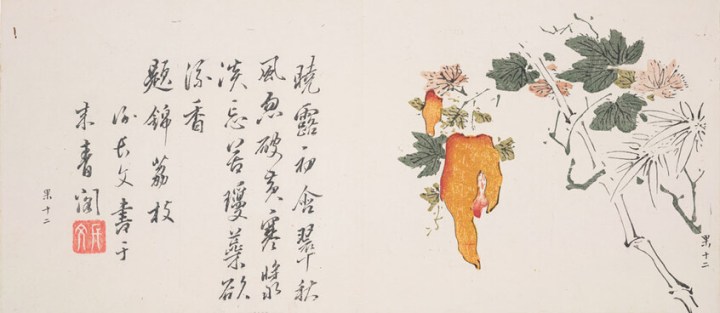
Bitter Melon in Ten Bamboo Studio Collection of Calligraphy and Painting, ca. 1633–1703, woodblock-printed book mounted as album leaves, ink and colors on paper (multi-block technique), published in Nanjing (San Marino: The Huntington Library, Art Museum, and Botanical Gardens).
◊ ◊ ◊ ◊ ◊
Opening next month at The Huntington:
Paintings in Print: Studying Art in China
The Huntington Library, Art Museum, and Botanical Gardens, San Marino, 7 October 2023 — 27 May 2024
The exhibition Paintings in Print: Studying Art in China examines the ways painting manuals published in the 17th and 18th centuries used innovative printing methods to introduce the techniques, history, and appreciation of painting to widening audiences in early modern China.
In the 16th century, Chinese publishers began creating educational art manuals filled with colorful prints of paintings and texts on the history and methods of brush arts. The manuals were unprecedented because they taught aspiring painters and collectors from the growing merchant class how to create and appreciate literati art—a combination of painting, calligraphy, and poetry long practiced by elite scholars. Drawing from The Huntington’s collection, the exhibition focuses on two books: The Mustard Seed Garden Manual of Painting and Ten Bamboo Studio Collection of Calligraphy and Painting. The books will be displayed together, in their entirety, for the first time in the United States. The texts will be presented in their original form as well as digitized to allow visitors to explore the materials more closely. They will be complemented with paintings—including recent donations from the Berman Foundation—that exemplify how artists studied manuals like these to learn the basics of their art.










 Enfilade
leave a comment