Exhibition | William Blake: Visionary
Opening this fall at The Getty:
William Blake: Visionary
Getty Center, Los Angeles, 7 October 2023 — 14 January 2024
 A remarkable printmaker, painter, and poet, William Blake (1757–1827) developed a wildly unconventional world view, representing universal forces of creation and destruction—physical, psychological, historical—through his own cast of characters. By combining his poetry and images on the page through radical graphic techniques, Blake created some of the most striking and enduring imagery in British art. This major international loan exhibition explores the artist-poet’s imaginative world through his most celebrated works.
Organized by the J. Paul Getty Museum in cooperation with Tate.
Edina Adam and Julian Brooks, with an essay by Matthew Hargraves, William Blake: Visionary (Los Angeles: J. Paul Getty Museum, 2020), 168 pages, ISBN: 978-1606066423, $35.
Celebrated for his boundless imagination and unique vision, William Blake (1757–1827) created some of the most striking and distinctive imagery in art, often combining his poetry and visual images on the page through innovative graphic techniques. He has proven an enduring inspiration to artists, musicians, poets, and performers worldwide and a fascinating enigma to generations of admirers. Featuring over 130 color images, this catalogue brings together many of Blake’s most iconic works. Organized by theme, it explores Blake’s work as a professional printmaker, his roles as both painter-illustrator and poet-painter, his relationship to the medieval, Renaissance, and Baroque artists that preceded him, and his legacy in the United States. It also examines his visionary prophetic books, including all eighteen plates of America a Prophecy.
A specialist in works on paper, Edina Adam is assistant curator of drawings at the J. Paul Getty Museum. Julian Brooks is senior curator and head of the Department of Drawings at the J. Paul Getty Museum and is the author of many books, most recently The Lure of Italy: Artists’ Views (Getty Publications, 2017) and Andrea del Sarto: The Renaissance Workshop in Action (Getty Publications, 2015). Now the director of the Wadsworth Atheneum Museum of Art, Matthew Hargraves was previously chief curator of art collections and head of collection information and access at the Yale Center for British Art.
Conference | Rethinking British and European Romanticisms, Part II
From ArtHist.net and the University of York:
Rethinking British and European Romanticisms in Transnational Dimensions, Part II
University of York, King’s Manor, 19–21 September 2023
Organized by Elisabeth Ansel, Johannes Grave, Richard Johns, Christin Neubauer, and Elizabeth Prettejohn
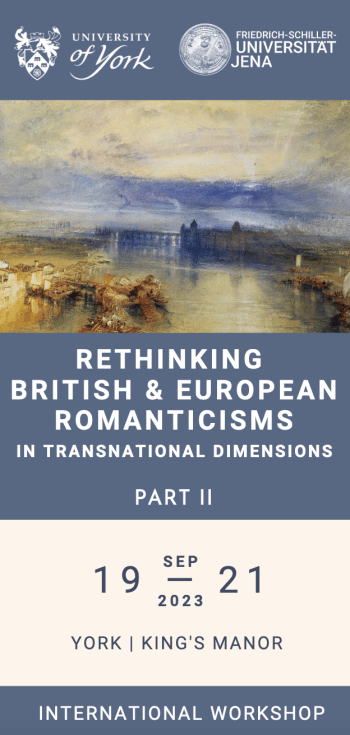 The event is the second part of a cooperative two-part workshop between the History of Art Departments of the University of York and the Friedrich Schiller University Jena. Considering the institution’s main research areas, the event aims to discuss the different concepts of Europe present in the art and culture of Romanticism.
In recent years, national tendencies have challenged the European idea, exemplified by the wake of Brexit and its aftermath. In this context, the question arises to what extent European and national identity concepts can be reconciled. Today’s debate between Britain and Europe still roots in the divergent notions of national identity that manifested in several European countries in the 1800s.
Therefore, the workshop addresses the relationship between visual images and constructions of nationality and questions how European Romanticism can be understood. In contrast to literary studies, investigating transnational transfer processes of Romantic movements has been a desideratum in art historical research. Considering transcultural methods, the participants will reflect national patterns of thought and Romantic identities not as fixed but as processual and hybrid phenomena within the framework of the binational exchange. Based on individual case studies, the event aims to reevaluate the complex interplay of alterity and reciprocity of the relations between cultural spaces.
Funded by University of York and Deutsche Forschungsgemeinschaft (German Research Foundation)
t u e s d a y , 1 9 s e p t e m b e r 2 0 2 3
9.45 Welcome and Introduction — Richard Johns
10.15 Morning Papers
• Marte Stinis (York) — ‘Sound Resounded from All the Treetops’: The Musical Landscape
• Sammi Lukic-Scott (York) — The Language of the Copy
• David Grube-Palzer (Jena) — Copy and Self-Repetition in the Age of Genius: Using the Example of Caspar David Friedrich
13.00 Lunch
14.30 Afternoon Papers
• Christin Neubauer (Jena) — Debts to German Romanticism in Joseph Noel Paton’s Luther: Dawn at Erfurt (1861)
• Miguel Angel Gaete Cáceres (York) — Johann Moritz Rugendas’ Picturesque Slavery: Denounce or Morbid Sublime Pleasure?
17.00 Evening Presentation
• Elizabeth Prettejohn (York) — Romanticism and Renaissance: Ideas for an Exhibition
18.30 Reception at King’s Manor
w e d n e s d a y , 2 0 s e p t e m b e r 2 0 2 3
10.00 Greeting
10.15 Morning Papers
• Richard Johns (York) — Further Thoughts on the Artist’s Bequest as a Romantic Phenomenon
• Elisabeth Ansel (Jena) — Heroic Femininity and the ‘Joy of Grief’ in Elizabeth Harvey’s Malvina Lamenting the Death of Oscar (1806)
• Mira Claire Zadrozny (Jena) — Emergent Pictoriality: Images of Ruins in 19th-Century France
13.00 Lunch
14.30 Afternoon Papers
• Helena Cox (York) — The Mánes Family: Bohemian Romanticism and (Inter)National Belonging
• Kayleigh Williams (York) — ‘Her Eyes Were Wild’: Transmediation of Gender and Gaze in Rossetti’s La Belle Dame Sans Merci
16.45 York Museum Garden
18.00 Evening Presentation
• Johannes Grave (Jena) — Duality and Temporality: Evocations of the Sublime in Romantic Paintings
20.00 Dinner at House of Trembling Madness
t h u r s d a y , 2 1 s e p t e m b e r 2 0 2 3
9.15 Greeting
9.30 Morning Papers
• Johannes Rössler (Jena) — An Imagined Journey? Caspar David Friedrich and Switzerland
• Wanda Sue Warning (Jena) — Romanticising Youth: Sir Henry Raeburn’s Boy and Rabbit (1814) and the Portraiture of Anonymous Children
• Justus Hierlmeier (Jena) — Ligne et couleur in Théophile Thoré’s Des envois de Rome
12.15 Concluding Discussion
14.30 Afternoon Field Trip
• York Art Gallery
• Stroll through York
20.00 Dinner at Côte Brasserie
Call for Papers | HNA Conference 2024, Britain and the Low Countries

From HNA:
HNA Conference | Britain and the Low Countries: Cultural Exchange Past, Present, and Future
London and Cambridge, 10–13 July 2024
Proposals due by 29 September 2023
2024 marks the first time in the forty-year history of the Historians of Netherlandish Art that the biennial conference will be held in the UK. Cultural, political, and economic exchange has been pivotal to the histories of the UK and the Low Countries, and these relationships have taken on new significance and have new potential as the UK renegotiates its relationship with Europe after Brexit. Britain and the Low Countries: Cultural Exchange Past, Present & Future considers the extraordinary depth and breadth of the relationships between the constituent nations of the UK, Belgium, and The Netherlands.
The conference is comprised of workshops in London and Cambridge on 10 and 13 July and 40 paper sessions to be delivered at West Road Concert Hall in Cambridge on 11 and 12 July. Thirteen of the sessions relate to the subject of Britain and the Low Countries. These fall under three broad themes: technology and the natural sciences, key themes in scholarship on British-Netherlandish culture, and medium-based scholarship in the British-Netherlandish context. There are 25 further sessions on a broad range of themes and 2 career-development sessions.
The call for papers is now open for all sessions. Each session is 90-minutes long and, unless otherwise specified, will comprise three 20-minute papers and 30 minutes for discussion. Applicants must be HNA members and are allowed to submit multiple proposals but may not participate in more than one session. We ask that applicants inform the session chairs about the other sessions they are applying to. Unless specified otherwise, please send proposals of about 500 words, clearly stating the goals of the paper, along with a CV (no longer than one page) to the email address(es) ascribed to the session descriptions below.
The deadline for proposals is Friday, 29 September 2023. Applicants will be notified by the programme committee no later than four weeks after the submission deadline.
Please consider contributing to HNA IDEA’s appeal for contributions to an equitable conference.
s e s s i o n s a t a g l a n c e
• Copies and Reproductions in Netherlandish Art, 1400–1800
• Existential In(ter)ventions: Modernity as Makeability in the Dutch Republic
• Infinite Concordances: Elaborating on Visual Typology in Early Modern Netherlandish Art
• The ‘Inventions’ of Early Netherlandish Painting: Thirty Years since Hans Belting and Christiane Kruse’s Die Erfindung des Gemäldes: Das erste Jahrhundert der niederländischen Malerei (1994)
• Embracing the Digital Age: New Prospects for Researching Northern European Art with Computational Methods
• The ‘More-Than-Human World’ in 17th-Century Dutch Visual and Material Culture
• The Multidimensionality of Netherlandish Grotesques
• What is Anglo-Dutchness?
• Netherlandish-isms: Making Nationhood and Art History
• Reading Pendants and Multiples in Dutch and Flemish Art
• Gender and the Home across Cultures
• Remarkable Women Artists, 1500–1700
• Multiple Masculinities in Netherlandish Art
• Sound and Silence: Soundscapes, Noise, Music, and Quiet Pauses in Dutch and Flemish Art
• New Views on Vermeer: Reflections, Opinions, Reconsiderations
• Moving Dutch Knowledge: Collections as Knowledge Repositories and Sites of Transformation and Transfiguration (ANKK sponsored session)
• Museums in Conflict: Lessons Learned, 1930–1950
• Technical Art History: Material Stories – Object Itineraries
• Do We Belong Together? Case Studies into Portrait Pendants
• The Interconnected Nature between Britain and the Low Countries in the Production and Decorating of Glass
• Art and Nature in the Dutch Colonial World
• Worldly Images and Images of the World in Netherlandish Art
• Half the World Away: Cultural Circulations between Isfahan and the Early Modern Low Countries
• Mutual Appreciation and Exchanges between Artists of Northern and Southern Europe, 1590–1725
• Culture and Climate Change
• The Landscapes of Artists from the Netherlands Who Worked in Britain during the Long 17th Century
• ‘Soft Power’: The Material Legacy of William and Mary
• Netherlandish Migrant Artists and the emergence of Creativity in Late 17th-Century London
• Collecting and Exchange between North Sea Neighbours
• Netherlandish Art in Renaissance Florence: Architectural Exchanges from North to South?
• Print Culture between the UK and the Low Countries
• Print Exhibitions in the Making and Related Research
• New Research on Dutch and Flemish Drawings in the UK
• Immigrants and Excellence: Sculptors from the Low Countries at the English and Scottish Courts in the 17th and 18th Centuries
• Connecting Threads: Tapestries and Cultural Exchange in the Low Countries and England
• Material Depiction and (Cut-out) Trompe l’oeils: The Enchantment of Material Depiction by Netherlandish Painters and the Development of British Traditions
• Visual Sovereignty in Dutch and Indigenous Histories
• Visual Cultures of Cartography in the Low Countries, 1500–1800
• Professional Insights and Practical Advice for Early Career Researchers
• Pecha Kucha Workshop for Graduate Students and Early Career Researchers
Session descriptions are available here»
New Book | The Tsarina’s Lost Treasure
First published in 2020, the book appeared in paperback in 2022; from Simon & Schuster:
Gerald Easter and Mara Vorhees, The Tsarina’s Lost Treasure: Catherine the Great, a Golden Age Masterpiece, and a Legendary Shipwreck (New York: Pegasus Books, 2020), 400 pages, ISBN: 978-1643135564 (hardback), $30 / ISBN: 978-1643139425 (paperback), $19.
 A riveting history and maritime adventure about priceless masterpieces originally destined for Catherine the Great.
On October 1771, a merchant ship out of Amsterdam, Vrouw Maria, crashed off the stormy Finnish coast, taking her historic cargo to the depths of the Baltic Sea. The vessel was delivering a dozen Dutch masterpiece paintings to Europe’s most voracious collector: Catherine the Great, Empress of Russia. Among the lost treasures was The Nursery, an oak-paneled triptych by Leiden fine painter Gerrit Dou, Rembrandt’s most brilliant student and Holland’s first international superstar artist. Dou’s triptych was long the most beloved and most coveted painting of the Dutch Golden Age, and its loss in the shipwreck was mourned throughout the art world. Vrouw Maria, meanwhile, became a maritime legend, confounding would-be salvagers for more than two hundred years. In July 1999, a daring Finnish wreck hunter found the ship, upright on the sea floor and perfectly preserved. The Tsarina’s Lost Treasure masterfully recounts the fascinating tale of Vrouw Maria—her loss and discovery—weaving together the rise and fall of the artist whose priceless masterpiece was the jewel of the wreckage. Gerald Easter and Mara Vorhees bring to vivid life the personalities that drove (and are still driving) this compelling tale—evoking Robert Massie’s depiction of Russian high politics and culture, Simon Schama’s insights into Dutch Golden Age art and art history, and Gary Kinder’s spirit of, danger and adventure on the beguiling Archipelago Sea.
Gerald Easter is a Professor at Boston College who has been teaching and writing about Russian/East European politics and history for more than two decades.
Mara Vorhees is a travel writer with an expertise in Russia, New England, and Central America. She has written or contributed to more than 40 guidebook editions, published by Lonely Planet.
Call for Papers | A Different Perspective for the Atlantic Routes
The Call for Papers for three related workshops, from ArtHist.net:
Traveling Objects: The Material Culture of the Atlantic Routes
Institut national d’histoire de l’art, Paris, 21 February 2024
New Towns and Old Settlements in Latin America: City Planning, Architecture, and Building Decorations in the Shadow of European Influence
Institut national d’histoire de l’art, Paris, 17 April 2024
Leaving a Trail: Memories, Reports, and Maps beyond the Fascination and Fear of the New World
Palacio de Maldonado – Centro de Estudios Brasileños, Universidad de Salamanca, 15 May 2024
Organized by Maddalena Bellavitis and José Manuel Santos Pérez
After more than two years of careful and laborious preparation (slowed down and hindered several times by the difficulties that have arisen due to the global pandemic), this project finally gets underway. A Different Perspective for the Atlantic Routes intends to go back once more to questioning issues that already count important in-depth studies, like the transoceanic relations between the sixteenth and nineteenth centuries, but also has the ambition of wanting to integrate the results already obtained with new reflections and achievements, and above all with a different point of view.
The idea, in fact, is not to propose an approach which is purely targeted to how European society had received and used the travel reports and products arrived from American lands, but to also to evaluate on the one hand the influences and consequences—cultural, technical, artistic, and social—that the exchanges had had overseas on local populations, and on the other how items and symbols closely linked to the cultures of the American territories after being brought to Europe had been reinterpreted and deprived of their original meaning in the new environment in which they had been introduced to, thus also involving the sphere of memory and the Intangible Cultural Heritage. If the common thread proposed is that of the activity of the Dutch West India Company, the project also aims to consider the whole vast cultural, diplomatic, artistic, scientific, anthropological, and gastronomic panorama that the approach to such a topic necessarily brings with itself, and will therefore also evaluate the tangencies and interactions with travels and exchanges also made by other European states and kingdoms in the period considered.
The first opportunity for comparison will be dedicated to the material aspects—that is the objects that have been used and obtained in exchanges, explorations or raids—and to the engineering aspects of the ships used to transport them. The second meeting will focus on the urban installations and the architectural and social aspects of the new settlements, while the third session will concern travelers, travel impressions, and cartography. Workshops will be held in Paris and Salamanca, hosted by the Institut national d’histoire de l’art and the Centro de Estudios Brasileños of the Universidad de Salamanca.
In addition to those who have already been involved in the discussions and in the preparation of the preliminary phases of this project, scholars interested in any discipline that can offer points of contact with the proposed theme—from collecting to memory, from travel literature to material culture, from engineering to anthropology—are encouraged to send a proposal for a contribution.
Please submit an abstract for an unpublished contribution and a short bio by 30 September 2023 to maddalena.bellavitis@gmail.com, specifying the title of the workshop you are applying for. Presentations will be in English, French, Spanish, or Portuguese and will last a maximum of 20 minutes. The organizers, Maddalena Bellavitis and José Manuel Santos Pérez, director of the Centro de Estudios Brasileños of the Universidad de Salamanca, will notify the selected proposals by the second week of October 2023.
Conference | Garden Artist Friedrich Ludwig von Sckell (1750–1823)

Carl von Zimmermann, Portrait Friedrich Ludwig von Sckell, detail, ca. 1810 (Münchner Stadtmuseum)
From the website marking the 200th anniversary of the landscape gardener’s death: www.sckell2023.de
◊ ◊ ◊ ◊ ◊
From ArtHist.net:
Der Gartenkünstler Friedrich Ludwig von Sckell und seine Werke: Geschichte und Aktualität
Zentralinstitut für Kunstgeschichte, Munich, 13–14 October 2023
Organized by Jost Albert and Iris Lauterbach
Registration due by 8 October 2023
Friedrich Ludwig von Sckell war der bedeutendste deutsche Gartenkünstler seiner Generation. Seine Ausbildung in Schwetzingen, in Frankreich und in England verhalf ihm zu einem internationalen Netzwerk. Als kurfürstlicher Hofgärtner und seit 1804 bayerischer Hofgartenintendant sowie in privatem Auftrag realisierte Sckell zahlreiche und bedeutende Gartenanlagen. Als weitsichtiger Stadtplaner legte er die Grundlage für die Erweiterung Münchens zur königlichen Residenzstadt. Der Englische Garten und die Umgestaltung des Nymphenburger Schlossgartens sind die Hauptwerke seiner Münchner Phase. Mit klassisch schönen „Bildern der Natur“ entwarf Sckell Landschaftsgärten, die sich durch große Dimensionen, ausgefeilte räumliche Gestaltungen und einen respektvollen Umgang mit dem Vorhandenen auszeichnen. Die Tagung nimmt das Sckell-Jubiläum zu seinem 200. Todestag zum Anlass, um neue gartenhistorische Forschungsaspekte sowie aktuelle gartendenkmalpflegerische Herausforderungen vorzustellen. Anmeldung zur Tagung bitte bis 8. Oktober 2023 unter: sckell@zikg.eu. Die Teilnahme ist kostenfrei.
Konzeption: Jost Albert und Iris Lauterbach, in Kooperation mit dem AK Historische Gärten der Deutschen Gesellschaft für Gartenkunst und Landschaftskultur (DGGL)
Partnerinstitutionen des Webauftritts www.sckell2023.de:
Natur wird Kunst: Auf den Spuren des Gartenkünstlers Friedrich Ludwig von Sckell (1750–1823)
f r e i t a g , 1 3 o k t o b e r 2 0 2 3
8.30 Anmeldung zur Tagung
9.00 Iris Lauterbach, München — Begrüßung und Einführung
9.15 Friedrich Ludwig von Sckell: Gartenkünstler, Verwalter, Organisator
Moderation: Iris Lauterbach
• Rainer Herzog, München — Friedrich Ludwig von Sckell als königlicher Beamter: Die Hofgarten-Intendanz unter organisatorischen, personellen und finanziellen Aspekten
• Gabriele Ehberger, München — Corporate Identity für die Hofgartenintendanz: Sckells Entwurf einer Gärtneruniform
• Thorsten Marr, München — Der Publikumsverkehr im Nymphenburger Garten zur Zeit Sckells
• Brigitte Huber, München — Eine Stadt im Umbruch: München 1795 bis 1825
• Heike Palm, Hannover — „Überhaupt ist diese Parthie noch zu erweitern und unter die Gruppen me[h]r Deutlichkeit zu bringen.“ Sckells Begleittexte zu seinen Entwürfen
12.30 Mittagspause
14.00 Zu Sckells Pflanzenverwendung
Moderation: Jost Albert
• Clemens Alexander Wimmer, Potsdam — Die Pflanzenverwendung Sckells in ihrer Zeit und ihre Rezeption
• Hans Joachim Klemmt, München — Sckells Baumartenwahl: Eine forstliche Einwertung aus heutiger Sicht vor dem Hintergrund des Klimawandels
15.00 Kaffeepause
15.30 Gartenkunst in der Nachfolge von Friedrich Ludwig von Sckell
• Michael Schwahn, München — Carl August Sckell und der Englische Garten in Neuburg an der Donau
• Peter Lack, Güstrow — Ein Gärtner auf Grand Tour: Die zweijährige Reise des Fritz Sckell von 1826 bis 1828
• Dietger Hagner, Rudolstadt — Wilhelmsthal bei Eisenach: Die Transformation zum Landschaftsgarten und das Wirken der Thüringer Hofgärtnerfamilie Sckell
17.00 Pause und Ortswechsel
19.00 Abendveranstaltung (Max-Joseph-Saal der Residenz)
• Bernd Schreiber, Präsident der Bayerischen Verwaltung der staatlichen Schlösser, Gärten und Seen — Begrüßung
• Jost Albert, München — Sckells Arbeitsschwerpunkte in den letzten Lebensjahren
• Iris Lauterbach, München — Der Zauberstab des Gartenkünstlers: Sckells „Methode, in der Natur zu zeichnen“
• Udo Weilacher, Freising/München — Die Landschaft von Morgen: Impulse von Sckell
s a m s t a g , 1 4 o k t o b e r 2 0 2 3
Sckells Gärten heute: Herausforderungen und Ziele der Gartendenkmalpflege
Exkursionen mit Mitarbeiter:innen der Gärtenabteilung der Bayerischen Schlösserverwaltung. Teilnahme nur für angemeldete Teilnehmer:innen der Tagung
◊ ◊ ◊ ◊ ◊
d o n n e r s t a g , 1 2 o k t o b e r 2 0 2 3
12.00–16.00 Mitgliederversammlung des AK Historische Gärten der Deutschen Gesellschaft für Gartenkunst und Landschaftskultur (DGGL), nicht öffentlich
19.00 Öffentliche Abendveranstaltung (Bayerische Akademie der Schönen Künste)
Vergabe des Sckell-Rings durch die Bayerische Akademie der Schönen Künste und Laudatio
Vergabe der Sckell Students Awards, Preisvergabe durch Udo Weilacher, Technische Universität München
New Book | The Women Who Saved the English Countryside
From Yale UP:
Matthew Kelly, The Women Who Saved the English Countryside (New Haven: Yale University Press, 2022), 400 pages, ISBN: 978-0300232240 (hardback), $35 / ISBN: 978-0300270396 (paperback), $24.
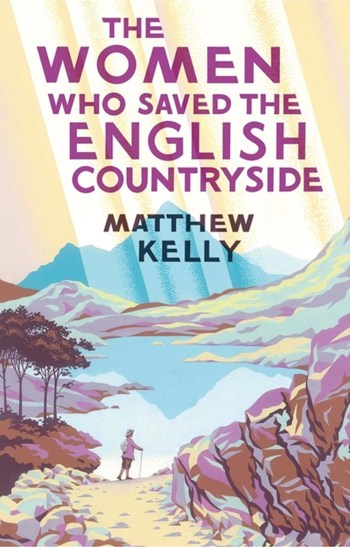 A vibrant history of English landscape preservation over the last 150 years, told through the lives of four remarkable women.
In Britain today, a mosaic of regulations protects the natural environment and guarantees public access to green spaces. But this was not always so. Over the last 150 years, activists have campaigned tirelessly for the right to roam through the countryside and the vital importance of preserving Britain’s natural beauty. Matthew Kelly traces the history of landscape preservation through the lives of four remarkable women: Octavia Hill, Beatrix Potter, Pauline Dower, and Sylvia Sayer. From the commons of London to the Lake District, Northumberland, and Dartmoor, these women protected the English landscape at a crucial period through a mixture of environmental activism, networking, and sheer determination. They grappled with the challenges that urbanization and industrial modernity posed to human well-being as well as the natural environment. By tirelessly seeking to reconcile the needs of particular places to the broader public interest they helped reimagine the purpose of the English countryside for the democratic age.
Matthew Kelly is professor of modern history at Northumbria University. He is the author of Finding Poland: From Tavistock to Hurzdowa and Back Again and Quartz and Feldspar: Dartmoor—A British Landscape in Modern Times.
c o n t e n t s
List of Illustrations
Acknowledgments
Maps
Introduction: The Four
Octavia Hill: Gathering in the Givers
Beatrix Potter: A Farm of One’s Own
Pauline Dower: ‘Inconspicuous Good’
Sylvia Sayer: Segregating Dartmoor
Epilogue: Fifty Years On
Notes
Further Reading
Index
New Book | The Invention of the English Landscape, c. 1700–1939
Peter Borsay died in 2020 at the age of 70; his last book, prepared for publication by Rosemary Sweet, has just been published by Bloomsbury:
Peter Borsay, with Rosemary Sweet, The Invention of the English Landscape, c. 1700–1939 (London: Bloomsbury Academic, 2023), 304 pages, ISBN: 978-1350031678, $115.
 Since at least the Reformation, English men and women have been engaged in visiting, exploring and portraying, in words and images, the landscape of their nation. The Invention of the English Landscape examines these journeys and investigations to explore how the natural and historic English landscape was reconfigured to become a widely enjoyed cultural and leisure resource.
Peter Borsay considers the manifold forces behind this transformation, such as the rise of consumer culture, the media, industrial and transport revolutions, the Enlightenment, Romanticism, and the Gothic revival. In doing so, he reveals the development of a powerful bond between landscape and natural identity, against the backdrop of social and political change from the early modern period to the start of the Second World War. Borsay’s interdisciplinary approach demonstrates how human understandings of the natural world shaped the geography of England, and uncovers a wealth of valuable material, from novels and poems to paintings, that expose historical understandings of the landscape. This innovative approach illuminates how the English countryside and historic buildings became cultural icons behind which the nation was rallied during war-time, and explores the emergence of a post-war heritage industry that is now a definitive part of British cultural life.
Peter Borsay was Professor of History at Aberystwyth University, a member of the advisory boards of Urban History and the Journal of Tourism History, and a committee member of the British Pre-Modern Towns Group. His books include The English Urban Renaissance (1989); The Image of Georgian Bath, 1700–2000: Towns, Heritage, and History (2000); and A History of Leisure: the British Experience since 1500 (2006). He co-edited Resorts and Ports: European Seaside Towns since 1700 (2011) and Leisure Cultures in Urban Europe, c. 1700–1870: A Transnational Perspective (2016).
Rosemary Sweet is Professor of Urban History and Director of the Centre of Urban History at the University of Leicester. She is the author of The English Town, 1680–1840 and The Writing of Urban Histories in Eighteenth-Century England.
c o n t e n t s
List of Illustrations
Foreword
Acknowledgments
1 Introduction
2 Revealing the Early Modern Landscape
3 Ideas and Representations
4 Reconfiguring the Landscape
5 New Geographies and Topographies
6 Timescapes
7 Economic and Social Change
8 The Transport Revolution and the Journey
9 Identities
10 Conclusion: The Second World War and Beyond
Select Bibliography
Index
Book Launch in Honour of Peter Borsay
From Eventbrite:
Book Launch in Honour of Peter Borsay
Online and in-person, University of Leicester, 29 September 2023, 3pm
The Centre for Urban History at the University of Leicester will mark the publication of Peter Borsay’s last book, The Invention of the English Landscape c. 1700–1939, with a symposium in honour of the late professor, who passed away in 2020. Free and open to all, the event will take place on Friday, 29th September 2023, from 15.00 until 17.00, via Teams Live and in person in the Attenborough Film Theatre. Please contact hypirfinance@le.ac.uk with any questions.
The symposium will be chaired by Professor Rosemary Sweet with the following panel of speakers:
• Penelope J. Corfield (President of the International Society of Eighteenth-Century Studies)
• Richard Coopey (Emeritus Senior Lecturer, Department of History & Welsh History, Aberystwyth University)
• Katy Layton Jones (School of History, Open University)
• Keith Snell (Emeritus Professor of English Local History, University of Leicester)
Online Talks | Digital Art History
From the series webpage:
Narrowing the Divide: A Dialogue between Art History and Digital Art History
Artl@s Conversation Series in Digital Art History, Visual Contagions, 2023–24
Organized by Béatrice Joyeux-Prunel, Catherine Dossin, and Nicola Carboni
The the Artl@s Lectures are a series of conversations that Artl@s will organize throughout the 2023–2024 academic year on the theme of Narrowing the Divide: A Dialogue between Art History and Digital Art History.
The field of Digital Art History (DAH) is currently experiencing a notable shift towards establishing its autonomy as a distinct discipline. However, its survival is challenged by the limitations of its investigations. The lack of relationships between computational effort and traditional analysis often limits the generation of novel insight. Digital art history risks becoming a mere spectacle when it relies solely on stunning visualizations without engaging in rigorous research questions. Conversely, art history limits itself from harnessing robust methodologies by disregarding computational approaches.
The digital approach increasingly demands advanced technical skills, thereby often placing art historians in a position where they lack the means and expertise to engage with it. Yet, art historians possess a keen awareness of the pressing issues within the discipline and possess the knowledge of which corpuses are relevant for addressing them. They could potentially provide their questions and corpuses to experts in digital art history. Hence, it is crucial to establish more frequent and substantive opportunities for collaboration between these two approaches. The 2023–2024 Artl@s Conversation Series aims to cultivate a convergence between the field of digital art history and the discipline of art history. The exchange of ideas and results among digital art history specialists, art historians, and the audience will foster a deeper understanding of the possibilities and implications of computational methodologies in the study of art history.
Each event will facilitate a unique encounter between two experts engaged in overlapping subject areas but employing markedly different methodologies. Within this framework, art historians will put forth inquiries and collections to experts in digital approaches, while scholars in digital art history will present the outcomes of their methodologies, along with the aspects they would readily suggest for monographic or non-digital explorations. The aim is to foster collaborations and a heightened mutual understanding of the outcomes between the realms of art history and digital art history. These gatherings provide valuable opportunities for aspiring PhD students in digital humanities and art history to discover new subjects and gain insights into the notable progress being made in both disciplines.
Organizers: Béatrice Joyeux-Prunel (UNIGE), Catherine Dossin (Purdue University), and Nicola Carboni (UNIGE)
s e s s i o n s
AI for Art History, Art History of AI
Online, Friday, 8 September 2023, 14.15–15.45 (Paris and Geneva time) / 8.15–9.30am (EST)
• Leonardo Impett, University of Cambridge
• Pascal Griener, Université de Neuchatel
Click here to join us on Zoom || Read more about the speakers.
◊ ◊ ◊ ◊ ◊
Do We Need Digital Visual Studies?
Online, Friday, 29 September 2023, 14.15–15.45 (Paris and Geneva time) / 8.15–9.30am (EST)
• Béatrice Joyeux-Prunel, Université de Geneve
• Leora Auslander, University of Chicago
Click here to join us on Zoom || Read more about the speakers.










 Enfilade
leave a comment