New Book | The Book of Marble

From Taschen:
Jan Christiaan Sepp, Marmora / The Book of Marble, edited by Geert-Jan Koot (Cologne: Taschen, 2023), 312 pages, ISBN: 978-3836594349 (English, French, and German), $125.
An exhaustive compendium of marble, Afbeelding der Marmor Soorten (A Representation of Marble Types) depicted 570 samples across 100 colour plates, accompanied by texts in five languages. Published in 1776 at the peak of the Enlightenment, it is regarded, rightly, as one of the finest illustrated scientific books of the era.
 Over the course of the 18th century, beautiful books that categorised, annotated, and illuminated the Enlightenment pursuit of learning across Europe had become increasingly popular. Knowledge was everything and everywhere, and these books provided it for those not wealthy enough to build their own personal collections of rare and exotic objects. Marmor Soorten, one such edition, took the standards of both aesthetics and categorisation to a whole new level.
Jan Christiaan Sepp and his father Christian—himself a respected collector—had already earned a reputation for luxury publications on scientific themes, starting with Christian’s own Nederlandsche Insecten (Insects of the Netherlands). But it was his son who created the visual masterpiece Marmor Soorten, revising an existing German publication from 1775 by Adam Ludwig Wirsing. The result, published in 11 installments to a print run of around 100, was among the finest examples of its kind.
Featuring new photography to depict the intricate details of the marble samples, this edition brings an unknown treasure back to relevance. The plates, each meticulously hand-coloured and arranged with painstaking precision, have an abstract-art feel that gives this volume an almost modern slant. This edition reproduces the pages from two copies of Marmor Soorten held at the State and University Library in Dresden and the Getty Research Institute in Los Angeles. Reprinting the work in full for the first time, The Book of Marble brings that rare blend of beauty and encyclopedic knowledge to a wider audience.
Geert-Jan Koot holds an MA in Art History and Archaeology from the Radboud University, Nijmegen. From 1988, he was the head of the Rijksmuseum’s Research Library and curator of library collections, as well as chair of the Working Group for Specialist Academic Libraries (Werkgroep Speciale Wetenschappelijke Bibliotheken), until his retirement in 2021. Koot now works as a consultant for book collectors and auction houses. He has also spearheaded the WorldCat Art Discovery project, a new search tool for art libraries hosting over 250 million articles.
New Book | The Wood that Built London
From Sandstone Press:
C. J. Schüler, The Wood that Built London: A Human History of the Great North Wood (Sheffield: Sandstone Press, 2021), 368 pages, ISBN: 978-1913207496 (hardcover) / ISBN: 978-1914518164 (paperback), £20.
 It is hard to imagine that the busy townscape of South London was once a great wood, stretching almost seven miles from Croydon to Deptford or that, scattered through the suburbs, from Dulwich to Norwood, a number of oak woodlands have survived since before the Norman Conquest. These woods were intensively managed for a thousand years, providing timber for construction, furniture and shipbuilding, and charcoal for London’s blacksmiths, kilns, and bakeries. Now they afford important green space, a vital habitat for small mammals, birds, and insects. Drawing on a wealth of documents, historic maps, and environmental evidence, The Wood That Built London charts the fortunes of the North Wood from its earliest times: its ecology, ownership, management, and the gradual encroachment of the metropolis.
Chris Schüler is the author of three illustrated histories of cartography: Mapping the World, Mapping the City, and Mapping the Sea and Stars and co-author of the best-selling Traveller’s Atlas. His most recent book, Writers, Lovers, Soldiers, Spies: A History of the Authors’ Club of London, 1891–2016 was published in 2016. He has also written on literature, travel, and the arts for The Independent, The Independent on Sunday, The Tablet, The Financial Times, and New Statesman.
C O N T E N T S
Foreword by Rachel Licthenstein
Introduction
Measurements, Money, and Other Matters
1 Taming the Wildwood, ca. 8000 BC–1485
2 Surveys, Ships, and Statutes, 1485–1600
3 The World Turned Upside Down, 1600–1700
4 Faith or Science? 1700–1790
5 Industry and Enclosure, 1790–1850
6 The Palace and the Railway, 1850–1910
7 The Home Front, 1910–1945
8 A Design for Living, 1945–1970
9 Save the Woods! 1970–1997
10 A New Millennium, 1997–2021
11 A Tour of the Woods Today
12 Ways through the Woods, 2021–?
Acknowledgments
A Woodland Glossary
Notes
Bibliography
Chris Schüler on the Wood that Built London
An evening lecture at the Society of Antiquaries:
Chris Schüler, The Wood That Built London
In-person and online, Society of Antiquaries of London, 12 October 2023, 5pm
Drawing on historic documents, maps and environmental evidence, The Wood That Built London charts the fortunes of the Great North Wood that once covered much of what is now South London [‘north’ relative to Croydon]. It records its botany, ecology, ownership and management, the gradual encroachment of the metropolis, and the battles fought by locals and the London Wildlife Trust to save what remained.
The lecture will discuss the documentary research into historic land ownership and management in the medieval and early modern periods that informed the book, which draws on a wide range of primary sources, some never previously cited. These include 16th-century Court of Exchequer depositions in a dispute over land ownership in the National Archives at Kew; Archbishop Morton’s 1492 survey of the Manor of Croydon and a 1678 plan of the Archbishop’s woods in Croydon Museum; Archbishop Cranmer’s 1552 survey of the Manor of Croydon in the Bodleian Library; estate maps in the British Library and London Metropolitan Archives; parish accounts; and records of woodland management in Dulwich College Archive and Lambeth Palace Library. Considered together, these scattered records combine to create a picture of the former extent of the wood, which stretched from Deptford to Croydon, its ownership by religious bodies such as Bermondsey Abbey and the Archbishopric of Canterbury, and its management by rotational coppicing, which generated income for its owners over several centuries. Tudor Acts of Parliament and the publications of 16th– and 17th-century agronomists such as Thomas Tusser and Barnaby Googe are examined to provide insight into the theory and practice of woodland management at this period.
The book also records how that income dwindled as the Industrial Revolution rendered many woodland products obsolete, leading landowners to grub up coppices, at first for farmland and then, as the railways brought the area within commuting distance of London, for housing development, to the fury of commentators such as John Ruskin and John Stuart Mill.
Presented both in-person at Burlington House and online, the event is free and open to the public. Please reserve tickets here.
Conference | Dressing the Interior
From the conference programme:
Dressing the Interior in the Early Modern Period: Textiles in Domestic Settings
Dressing the Early Modern Network Conference
Leiden University Centre for the Arts in Society (LUCAS), 23 September 2023
Organised by Jola Pellumbi, Sara van Dijk, and Alexander Dencher
Registration due by 20 September 2023
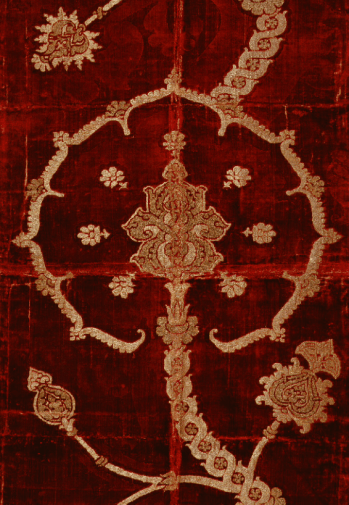
Length of velvet, 16th century, Spanish or Italian; pile on pile cut, voided, and brocaded velvet of silk and gold metallic thread with bouclé details (New York: The Metropolitan Museum of Art, 46.156.120).
Textiles, wall and furniture coverings played an important role in dressing interiors in the early modern period. From curtains to chairs, tables and beds, a variety of textiles were needed to protect, adorn, and transform rooms, homes, and palaces. They were an important part of the dwelling as they linked the interiors together and showcased the taste and material means of the owners. Different rooms served diverse purposes, from more public spaces such as waiting rooms, reception rooms, and ballrooms, to more private rooms such as the bedroom with its antechambers. In other households, rooms had multiple functions, and in many cases the distinctions between private and public spaces were more flexible. Textiles played an important role in distinguishing and modifying these spaces while giving a glimpse of the relationships that owners had with those interiors.
While extant textiles have been frequently altered to fit new purposes denoting both their durability and the costly aspects of this medium, ledgers provide further examples of repairs and replacements. On the other hand, inventories give a more accurate picture of the changes in fashion over time. Fashions played an important role in the dressing of interiors, from certain more desirable fabrics and colours being favoured over others, while also being altered according to seasons. This conference aims to generate a discussion about the use of various textiles in early modern interiors, focusing on their function, durability, colour, texture and pattern, and how they were made to fit a specific purpose and give meaning to every room.
The conference is organised by Jola Pellumbi and Sara van Dijk of Dressing the Early Modern Network and by Alexander Dencher of Leiden University and the Rijksmuseum.
Registration is available here»
p r o g r a m m e
10.00 Registration
10.30 Welcome
10:45 Session 1 | Interior and Experience
• Dangerous Liaisons Revisited: Drapery and Dress in 18th-Century French Interiors — Mei Mei Rado (Bard Graduate Center, New York)
• Tiny Textiles: Dressing the Interiors of 18th-Century English Baby Houses — Amy Craig (Cambridge University)
• 18th-Century Global Domesticity — Valeria Viola (University of Palermo)
12.15 Lunch Break
13.00 Session 2 | Objects’ Pasts and Futures
• Reduce, Reuse, Recycle ….Restore? A Case Study of Re-Using ‘Original’ Fabrics in the Collection of the Rijksmuseum — Marjolein Koek (Rijksmuseum, Amsterdam)
• Bed of White Satin with Silk Embroidery and Bobbin Made Silver Edgings — Lena Dahrén (affiliated with Uppsala University)
• Title to be confirmed — Alexander Dencher (Rijksmuseum, Amsterdam)
14.30 Coffee and Tea
15.00 Session 3 | Materials and Materiality
• Strong Weave, Soft Texture, Crisp White: The Unravelling of Fustian in Dutch Interiors in the Early 17th Century — Sara Wieman (University of Amsterdam)
• Re-Materialising Walls through Intermedial Design: Chinese Silk and Paper Wall Hangings in 18th-Century European Interiors — Erika Riccobon (Leiden University)
16.00 Keynote Lecture
• The Seemingly Original Interior — Anna Jolly (Abegg-Stiftung, Riggisberg)
16.45 Closing Remarks










 Enfilade
leave a comment