Exhibition | Claude Gillot

Claude Gillot, Scène de la comédie italienne: Une pantomime, pen and ink with red chalk wash and graphite drawing, 16 × 22 cm
(Paris: Musée du Louvre, INV 26748)
◊ ◊ ◊ ◊ ◊
300 years after his death, Gillot (1673–1722) was the subject of a spring show at The Morgan and a related symposium; a second exhibition opens next month at the Louvre:
Claude Gillot
Musée du Louvre, Paris, 9 November 2023 – 26 February 2024
Organized by Hélène Meyer and Xavier Salmon
A draughtsman and printmaker in the last years of the Grand Siècle, Claude Gillot is known for the inventiveness and originality of his works, heralding the freedom of expression and mores of the Régence period (1715–1723). With his parodies, witchcraft scenes, farces, and fairground improvisations, he is an artist known for satire, comedy, and performing arts. His countless drawings, coveted by collectors, nevertheless attest to extensive activity in a broad range of fields: illustration, theatre and opera, costume, and interior decoration. At the core of his work, a rich corpus of drawings illustrates his penchant for the comedy of the Comédie Italienne (Italian companies performing in France), with its pantomimes, acrobatics, and cross-dressing figures. A costume and set designer for the Paris Opera starting in 1712, Gillot was also a sought-after decorator, notably collaborating with Claude Audran III on private interiors and reinventing arabesque painting in the process.
Xavier Salmon, Hélène Meyer, and Jennifer Tonkovitch, Claude Gillot (1673–1722): Comédies, Fables, et Arabesques (Paris: Lienart, with the Musée du Louvre, 2023), ISBN: 978-2359064124, €32.
Online Resource | Glossary of Early Modern Popular Print Genres

◊ ◊ ◊ ◊ ◊
As recently noted on the SHARP listserv (Society for the History of Authorship, Reading, and Publishing) . . .
Jeroen Salman and Andrea van Leerdam, eds., Glossary of Early Modern Popular Print Genres (Utrecht University, 2023), link»
This glossary describes popular print genres of the early modern period (ca. 1450–1850) from a European perspective, covering terms in English, Dutch, French, German, Italian, and Spanish. It is being developed as part of the project The European Dimensions of Popular Print Culture (EDPOP), led by Dr Jeroen Salman at Utrecht University. The glossary is by no means exhaustive, but is intended to offer an overview of the concepts used in several European countries by experts in the field, as an aid to further research and to offer a state-of-the-art vocabulary for cataloging early modern popular printed materials. As a ‘work-in-progress’, it appears only online, to allow for easy updating. We invite all experts in the field to continue sending us corrections and additions.
More information is available here»
Exhibition | Dutch Art in a Global Age
Now on view at the NC Museum of Art and arriving at the Kimbell in the fall of 2024:
Dutch Art in a Global Age: Masterpieces from the Museum of Fine Arts, Boston
North Carolina Museum of Art, Raleigh, 16 September 2023 — 7 January 2024
Kimbell Art Museum, Fort Worth, 10 November 2024 — 9 February 2025

Jan van Huysum, Flowers in a Terracotta Vase, 1730, oil on panel, 80 × 61 cm (Museum of Fine Arts, Boston. Promised gift of Rose-Marie and Eijk van Otterloo, in support of the Center for Netherlandish Art, L-R 13.2019).
In the seventeenth century, Dutch merchants sailed across seas and oceans, joining trade networks that stretched from Asia to the Americas and Africa. This unprecedented movement of goods, ideas, and people gave rise to what many consider the first age of globalization and sparked an artistic boom in the Netherlands.
Dutch Art in a Global Age brings together paintings by Rembrandt, Frans Hals, Gerrit Dou, Jacob van Ruisdael, Maria Schalcken, Rachel Ruysch, and other celebrated artists from the Museum of Fine Arts, Boston’s renowned collection. These are joined by prints, maps, and stunning decorative objects in silver, porcelain, glass, and more, from the seventeenth and the first half of the eighteenth centuries. Exploring how Dutch dominance in international commerce transformed life in the Netherlands and created an extraordinary cultural flourishing, the exhibition also includes new scholarship that contextualizes seventeenth-century Dutch art within the complex histories of colonial expansion, wealth disparity, and the transatlantic slave trade during this period.
Christopher D.M. Atkins, ed., Dutch Art in a Global Age (Boston: MFA Publications, 2023), 224 pages, ISBN: 978-0878468911, £54 / $60. With text by Christopher Atkins, Pepijn Brandon, Simona Di Nepi, Stephanie Dickey, Michele Frederick, Hanneke Grootenboer, Katherine Harper, Courtney Leigh Harris, Mary Hicks, Anna Knaap, Rhona MacBeth, Katrina Newbury, Christine Storti, Gerri Strickler, Claudia Swan, Jeroen van der Vliet, and Benjamin Weiss.
Online Conversation | The Van de Veldes at the Queen’s House
In connection with the exhibition at Greenwich; from The Warburg Institute:
Curatorial Conversation | The Van de Veldes at the Queen’s House, Greenwich
Online, 17 October 2023, 5.30pm
Curators Allison Goudie and Imogen Tedbury in conversation with Bill Sherman (Warburg Institute Director) and Gregory Perry (CEO, Association for Art History)
For almost 20 years in the late 17th century the Queen’s House at Greenwich was the studio address of the marine painters Willem van de Velde the Elder (1610/11–1693) and his son, Willem the Younger (1633–1707). Although the building itself bears little trace of the Van de Veldes’ presence, in the 20th century the Queen’s House once again became a home for their work, as the dedicated art gallery of the National Maritime Museum, custodian of the world’s largest collection of works by the Van de Veldes. Spanning scores of oil and pen paintings, a tapestry, and some 1,500 drawings, the collection is unique in what it can tell us about how a 17th-century artist’s studio functioned. The physical evidence provided by this collection proved invaluable for the evocation of the Van de Velde studio that forms a centrepiece of the current exhibition, The Van de Veldes: Greenwich, Art, and the Sea, marking 350 years since the Van de Veldes moved to England from the Dutch Republic. Showcasing major conservation projects on important works in the Greenwich collection that have their origin point in the Queen’s House studio, and notwithstanding a select number very generous loans, the exhibition was also a pragmatic solution to some of the challenges facing museums as they emerged from Covid, particularly how to make an event out of a permanent collection.
Online attendance is free, with advanced booking available here»
Allison Goudie is Curator of Art (pre-1800) at Royal Museums Greenwich. Before coming to Greenwich, she was Curator of Kenwood House and previously held curatorial positions at the National Gallery and the National Trust. She completed her PhD on the subject of royal portraiture during the Revolutionary and Napoleonic wars at the University of Oxford in 2014. She is the recipient of a Getty Paper Project grant to bring to life the collection of Van de Velde drawings at Greenwich and is leading on RMG’s programme in 2023 marking 350 years since the Van de Veldes arrived in England, the centrepiece of which is the exhibition in the Queen’s House co-curated with Imogen Tedbury.
Imogen Tedbury is an art historian and curator. She has held curatorial positions at Royal Holloway, University of London, the National Gallery, London, and the Queen’s House, Royal Museums Greenwich, where she was the co-curator of The Van de Veldes: Greenwich, Art, and the Sea. Her PhD (2018) explored the reception of Sienese painting, and her research has been supported by fellowships and grants from the Getty Research Institute, the Metropolitan Museum of Art, the Paul Mellon Centre, and the Warburg Institute. She is currently undertaking research for the early Italian paintings catalogue of the Norton Simon Museum.
This event is organised by the Association for Art History in conjunction with The Warburg Institute, University of London. Curatorial Conversations invites museum directors and makers of recent exhibitions at world-leading museums and galleries to the Warburg to discuss their work. The conversations, led by academics at the Warburg Institute, discuss the issues of setting the directorial or curatorial agenda and staging meaningful encounters with objects. The series is designed to draw out discussion of the discoveries made, challenges tackled and the lessons learned in heading a collection and putting together internationally renowned exhibitions.
At Auction | Complete Autograph Set of Constitution Signatories
I’m more interested in the history of such collections than the autographs themselves, though of course the latter varies from document to document. The former includes the story of early modern sociability, seventeenth-century antiquarianism, canon formation in the eighteenth century, the rise of celebrity cultures, and connoisseurship. The Robert D. Farber University Archives and Special Collections at Brandeis University possesses a significant autograph collection spanning 350 years. –CH
From Katherine Morley’s descriptive essay for the Brandeis collection, via the library’s website:
There was a major boom in autograph collecting in both Europe and America at the turn of the 19th century; this had the most impact on modern autograph collecting. One catalyst was likely the popularity of ‘Grangerizing’, which was the insertion of autographs and other illustrative material into printed books; another was the development of the art of handwriting analysis, which sought to uncover a person’s true self as it was expressed through his or her handwriting . . .
From the RR Auction press release, via Art Daily:

Ship’s passport in French, English, and Dutch, 26 July 1795, signed by George Washington, authorizing the passage of “Peter Cockran master or commander of the schooner called the Industry of the burthen of Ninety five & 48/95 tons or thereabouts, lying at present in the port of Washington bound for Falmouth and laden with Tar, Pitch, and Beeswax.”
Boston’s RR Auction announces its October Fine Autographs and Artifacts Sale, featuring over 900 extraordinary lots. The highlight of this exceptional event is an unparalleled collection: a complete set of autographs from all 40 signers of the American Constitution, including prominent founding fathers such as George Washington, Benjamin Franklin, and Alexander Hamilton (Lot 116, low estimate of $100,000).
This remarkable gathering of signatures represents a seminal document in American history that continues to be a touchstone for discussions on governance, rights, and bureaucracy. The Constitution of the United States has been the lifeblood of the American government, shaping the nation’s foundation, and serving as a global model for democratic governance. The collection includes manuscript material from all 40 signers, encompassing a variety of formats, from letters to documents and even paper currency. A standout piece is a three-language ship’s passport signed by President George Washington. Furthermore, this collection includes an additional autograph letter signed by the Secretary to the Constitutional Convention, William Jackson, who witnessed the Constitution’s final edits. This comprehensive collection totals 40 manuscript items, making it a first-class assembly of historical significance.
The sale also features these important manuscripts by renowned figures:
• Mark Twain: An attractive vintage photographic print of ‘Samuel Langhorne Clemens’ in a handsome half-length pose, ca. 1904, signed neatly by Mark Twain. This piece sheds light on Twain’s relationship with his secretary, Isabel Lyon, and the subsequent fallout, offering unique insights into the legendary author’s life.
• Dylan Thomas: A handwritten manuscript for a note published in his Collected Poems 1934–1952, where Thomas reflects on the purpose of his poetry, emphasizing his love for humanity and praise for God.
• Henry Miller: A unique archive of four published manuscripts, each signed by Henry Miller, which delve into character studies of individuals from his personal life. These manuscripts provide a fascinating glimpse into Miller’s influential circle.
• Charles Lindbergh: A handwritten draft of a New York Times article penned by Charles Lindbergh in 1929, discussing the advances in aviation and the limitless possibilities of powered flight.
Additional auction highlights include significant letters by Sigmund Freud, Alexander Graham Bell, Oliver Cromwell, and Harry Houdini. The collection also features signatures of iconic figures like the Beatles, Geronimo, and Martin Luther King, Jr. Online bidding for the sale will conclude on 11 October 2023.
Call for Papers | Art and Architecture in the British Empire
From the Call for Papers:
On the Eve of Independence: Art and Architecture in the British Empire
The Washington Presidential Library at Mount Vernon, 31 May — 2 June 2024
Proposals due by 15 November 2023
In 1774, on the eve of the American Revolution, George Washington began a major expansion of his home, a building whose foundations dated to the 1730s. It was a project that he maintained throughout the war and that he continued after his triumphant return to Mount Vernon. Inspired by the work that began 250 years ago, and that endures today through the Mount Vernon Ladies’ Association, the George Washington Presidential Library is hosting an international and interdisciplinary symposium in the spring of 2024 that explores the art and architecture of the British Atlantic in the long-eighteenth century. The symposium is especially interested in exploring the Atlantic connections between and comparisons of British and American practices in the years preceding and surrounding the American Revolution.
The symposium organizers invite applications from scholars from any field whose work can bear new insight into the art and architecture of the British Empire, especially its North American colonies, during the colonial era and the American Revolution. Potential topics include, but are not limited to:
• The role of cultural emulation and ideas of independence in colonial North America before and after the American Revolution
• Artistic and architectural taste-making in the eighteenth-century Atlantic World
• Styles of British and American artwork, and changes to them, in the age of the American Revolution
• The training and practice of artists in the eighteenth century
• British influences on American art, and the creation of distinct American styles
• House and building design and use in the eighteenth-century Atlantic World
• Regional differences in architecture, and the environmental, social, and cultural factors that created these differences
• The practices, skills, and trades behind housebuilding in colonial America
• The role of labor and gender in art, architecture, and uses of space
• The effect of urban and rural landscapes on architecture
• The influence of Indigenous and African practices and knowledge on American art and architecture in the Atlantic World
• Influences outside of the British Empire on American art and architecture
• Analysis of current historic preservation practices at seventeenth- and eighteenth-century sites and homes and discussions of what this work has revealed and continues to reveal about the past
Presenters are asked to submit a detailed 500- to 750-word proposal for their talk along with a CV. Each presenter will be asked to deliver a thirty- to forty-minute lecture with PowerPoint encouraged. The audience is a mix of scholars, professionals, highly informed collectors and specialists, and history enthusiasts. Proposed talks should be delivered with this type of audience in mind. Selected presenters will have travel expenses covered and receive an honorarium. Mount Vernon may commission a volume after the symposium, and presenters may have an opportunity to publish in it. Conference organizers may compose panels, but they are not accepting panel proposals at this time. Proposals are due by the end of day 15 November 2023. Decisions will be made by early 2024. Please direct questions and email complete packages to SymposiumCFP@MountVernon.org.
Exhibition | Seeing the Light: Turner’s Discovery of Italy in 1819
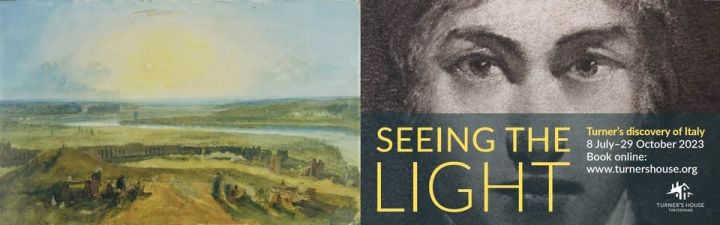
Left: J. M. W. Turner, The Roman Campagna from Monte Testaccio, Sunset, 1819, gouache, graphite, and watercolour on paper, 25 × 40 cm
(London: Tate, accepted by the nation as part of the Turner Bequest 1856, D16131).
◊ ◊ ◊ ◊ ◊
Closing this month at Turner’s House:
Seeing the Light: Turner’s Discovery of Italy in 1819
Turner’s House, Twickenham, 7 July — 29 October 2023
In the summer of 1819, the landscape artist J.M.W. Turner (1775–1851) set off on a journey to Italy that would have a profound impact on his life and work. Visitors to Turner’s House will be able to enjoy an exhibition of evocative watercolours capturing some of the painter’s first impressions of the place he was to later call the “land of all bliss,” and which provided inspiration for the rest of his career. Seeing the Light provides an exciting opportunity for the public to see some of Italy’s most well known and loved sites—Venice, Rome, Naples—through Turner’s eyes, in the unique setting of his then rural retreat in Twickenham. Visitors to this tightly-focussed exhibition will also be able to appreciate Turner’s evolving use of colour and light before and after 1819, thanks to generous loans from Tate, the Guildhall Art Gallery, and a private collection.
New Book | Exhibiting Antonio Canova
From Amsterdam UP:
Christina Ferando, Exhibiting Antonio Canova: Display and the Transformation of Sculptural Theory (Amsterdam: Amsterdam University Press, 2023), 296 pages, ISBN: 978-9463724098, €157 / $177.
 Exhibiting Antonio Canova: Display and the Transformation of Sculptural Theory argues that the display of Canova’s sculptures in the late eighteenth and early nineteenth centuries acted as a catalyst for discourse across a broad range of subjects. By enshrining his marble figures alongside plaster casts of ancient works, bathing them in candlelight, staining and waxing their surfaces, and even setting them in motion on rotating bases, Canova engaged viewers intellectually, physically, and emotionally. These displays inspired discussions on topics as diverse as originality and artistic production, the association between the sculptural surface, flesh, and anatomy, the relationship between painting and sculpture, and the role of public museums. Beholders’ discussions also shaped the legacy of important sculptural theories. They helped usher in their modern definitions and created the lenses through which we experience and interpret works of art, establishing modern attitudes not just towards sculpture, but towards cultural patrimony in general.
Christina Ferando is the Dean of Jonathan Edwards College and Lecturer in the Department of History of Art at Yale University.
c o n t e n t s
List of Illustrations
Acknowledgments
Introduction: Canova on Display
1 Imagining Sculptural Practice
2 Reevaluating Ancients and Moderns
3 Anatomizing the Female Nude
4 Challenging the Supremacy of Painting
5 Defining Modern Sculpture
Conclusion: Aftereffects
Bibliography
Index
Exhibition | Hub of the World: Art in 18th-Century Rome

Gaspar van Wittel, known as Vanvitelli, The ‘Casino’ of Cardinal Annibale Albani on the Via Aurelia, 1719, oil on canvas, 74 × 135 cm
(Private Collection, United Kingdom)
◊ ◊ ◊ ◊ ◊
From the press release (via Art Daily) for the exhibition:
Hub of the World: Art in 18th-Century Rome
Nicholas Hall Gallery, New York, 6 October — 30 November 2023
This fall, Nicholas Hall presents Hub of the World: Art in 18th-Century Rome, organized in association with the Milanese Galleria Carlo Orsi. Presented at the Upper East Side gallery in New York, the exhibition celebrates the legacy of esteemed American scholar, connoisseur, and artist Anthony M. Clark (1923–1976), who would have turned 100 this year.

Pompeo Batoni, Saint Louis Gonzaga, ca. 1744, oil on canvas, oval, in an 18th-century frame, 81 × 67 cm (Private Collection, NY).
Considered one of the most influential and admired museum professionals of his generation, Clark made a profound impact on American collecting trends in the 1950s and 1960s through his taste for art made in 18th-century Rome, especially the paintings of the Pompeo Batoni. The exhibition brings together more than 60 works by artists who lived in or traveled to Rome in the 18th century, along with a selection of Clark’s personal notebooks and a portrait photograph on loan from the National Gallery of Art in Washington, DC.
After graduating from Harvard, Clark began his career in 1955 at the Rhode Island School of Design before going on to prominent curatorial roles at the National Gallery of Art, the Metropolitan Museum of Art, and the Minneapolis Institute of Arts, of which he later became director. He also taught art history at the Institute of Fine Arts, NYU and at Williams College, Williamstown. During his tenure at Mia and The Met, Clark made significant acquisitions for the institutions and organized world-class exhibitions as a pioneering American scholar of 18th-century Rome.
The Hub of the World brings to light the fundamental role Clark played in the revival of interest among American museums in collecting work from this period. Clark deeply believed in the importance of Roman Settecento painting, drawing, and sculpture, and this passion is brilliantly reflected in his scholarship and writings. As a curator, he consistently created a historic context for art by showing sculpture and decorative arts alongside paintings and drawings at a time when it was customary to maintain a ‘hierarchy’ of the arts by studying and displaying the mediums separately.

Domenico Corvi, The Liberation of Saint Peter, 1770, oil on canvas, 63 × 49 cm (Private Collection, Paris).
Tragically Clark succumbed to a heart attack at age 53 while jogging in his favorite city, where, at the time, he was a fellow at the American Academy in Rome. Born in Philadelphia, Clark worked closely with curators at the Philadelphia Museum of Art over the course of his career; and, in 2000, the PMA—in partnership with the Museum of Fine Arts, Houston—mounted The Splendor of 18th-Century Rome, which was dedicated to his memory.
In the words of Nicholas Hall: “Anthony Clark was a larger-than-life character who changed the way we look at Old Masters. He rescued the art of 18th-century Rome from obscurity by dint of his own personal enthusiasm and brilliant scholarship. He had enormous personal charm: the son of the owner of two works in the exhibition remembers how, as a boy, he enjoyed Clark’s visits to see his parents. Clark, an avid ornithologist, later bequeathed to him a stuffed Green Woodpecker. Our exhibition is an homage to a great scholar, a tastemaker, and a dedicated museum professional.”
Hub of the World highlights the richness of the culture of 18th-century Rome with its extraordinary mixture of patronage, from popes and cardinals, to Roman aristocrats and visiting foreigners—including the German writer and poet Johann Wolfgang von Goethe, from whom the exhibition borrows its title. Goethe deemed Rome the “hub of the world,” writing that “the entire history of the world is linked up with this city.” Hall and Orsi have gathered a diverse selection of paintings, drawings, sculpture, and decorative arts that will provide a rare opportunity to experience the cosmopolitan appeal of 18th-century Rome.

Hubert Robert, Colonnade and Gardens at the Villa Medici, 1759, oil on canvas, 75 × 64 cm (Assadour O. Tavitian Trust).
Headlining the exhibition is View of the Villa Medici by Hubert Robert (1733–1808), painted in 1759 during the artist’s transformative time in Rome and on loan from the Assadour O. Tavitian Trust. A recent discovery, the exceptional work has rarely been on view to the public—previously only exhibited in the U.S. briefly at the National Gallery of Art. Other works on view include the Hemp Harvest in Caserta, executed by Jackob Philipp Hackert for the King of Naples; a portrait of the Cardinal Carlo Rezzonico by Anton Raphael Mengs that remained in the sitter’s family until the last decade; a unique view of the Villa Albani by Vanvitelli, recorded in the inventory of Cardinal Albani; a pair of oil on coppers by Angelika Kauffmann based on James Thomson’s pastoral poetry that newly resurfaced from a private Kenyan collection; a caricature painting by Joshua Reynolds, recently discovered at the estate where it has hung for over two centuries; A Vestal by Jacques-Louis David painted in Rome; a harbor scene painted on copper by Claude Joseph Vernet; Anton von Maron’s Portrait of Two English Gentlemen before the Arch of Constantine; the Rockingham Silenus, a 1st-century sculpture reworked by the celebrated Roman sculptor Bartolomeo Cavaceppi; a set of candelabras in the form of Antonius-Osirus by Luigi Valadier; and a console table designed by Antonio Asprucci, made for the Egyptian Room of the Palazzo Borghese. The exhibition pays tribute to Clark as an expert on Pompeo Batoni, as represented by a painting of Saint Louis Gonzaga and its preparatory drawing in red chalk, among several other works. Once belonging to Clark, a painting of the artist Paolo de Matteis by Pier Leone Ghezzi will also be showcased.
In conjunction with the exhibition, Nicholas Hall and Galleria Carlo Orsi will publish a fully illustrated catalogue with original essays by Italian art experts and renowned historians Edgar Peters Bowron, Alvar Gonzáles-Palacios, Melissa Beck Lemke, and J. Patrice Marandel.

Pier Leone Ghezzi, Four Samples of Classical Polychrome Marbles, 1726, watercolor on paper; from top left clockwise: ‘Diaspro Verde Fiorito, 16 × 21 cm, ‘Bianco e negro antico’, 19 × 24 cm, ‘Broccatello’, 19 × 21 cm, ‘Alabastro Orientale’, 19 × 23 cm (Private Collection, Italy). To be published by Dr. Adriano Aymonino in his upcoming book from MIT press, Paper Marbles: Pier Leone Ghezzi’s Studio di Molte Pietre (1726).
Talk and Exhibition | The Jews, the Medici, and the Ghetto of Florence
From the Medici Archive Project (MAP):
Piergabriele Mancuso and Alice S. Legé | The Jews, the Medici, and the Ghetto of Florence: History and Challenges of an Exhibition
Online, The Medici Archive Project, 10 October 2023, 5pm (EDT)

Ketubah (Marriage Contract), 1739 (Archivio di Stato di Firenze)
The exhibition The Jews, the Medici, and the Ghetto of Florence (Gli ebrei, i Medici, e il Ghetto di Firenze)—on view from 23 October 2023 until 20 January 2024 at the Palazzo Pitti—offers a comprehensive exploration of a relatively understudied aspect of the Medici and Jewish history. Delving into the intricate evolution of the Florentine Ghetto, the exhibition traces the site’s history from its establishment under the Grand Duke Cosimo I de’ Medici in 1570 to its eventual dissolution in the 19th century. Visitors will see a rich array of artifacts, including illuminated manuscripts, paintings, archival documents, photographs, maps, and sculptures. These items provide insights into the complex relationship between the Jewish community and the Grand Duchy of Tuscany.
This talk by the exhibition’s curators will focus on the creation of the exhibition, prompting important inquiries into topics such as segregation, protective measures, urban integration, and the invaluable cultural contributions made by the Jewish populace during the Florentine Renaissance.
To watch this talk, click here on Tuesday, 10 October, at 5pm (EDT).










 Enfilade
leave a comment