Exhibition | The Regency in Paris, 1715–1723
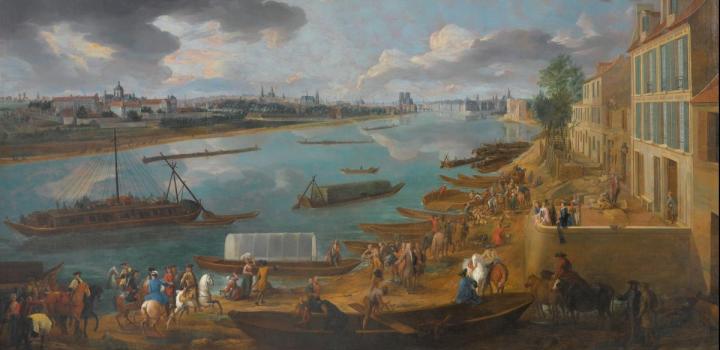
Pierre Denis Martin, View of Paris from the Quai de la Rapée toward la Salpêtrière, l’île Saint-Louis, and l’île de la Cité, 1716, oil on canvas, 170 × 315 cm (Paris: Louvre / Musee Carnavalet)
◊ ◊ ◊ ◊ ◊
Now on view at the Musée Carnavalet:
The Régence in Paris, 1715–1723: The Dawn of the Enlightenment
Musée Carnavalet, Paris, 20 October 2023 — 25 February 2024
Curated by Valérie Guillaume, with José de Los Llanos and Ulysse Jardat
The Musée Carnavalet – Histoire de Paris presents an exhibition on the Regency, a forgotten period in history, marking the return of the King and of political, economic, and cultural life to Paris.
Louis XIV died in Versailles on 1 September 1715, leaving behind a nation in debt and a five-year-old child too young to rule, Louis XV, as his heir. On 2 September, the Duke Philippe d’Orléans (1674–1723), nephew of the late King, took on the role of Regent of France. This exhibition takes place as part of the tricentennial commemoration of the Regent’s death.
In 1715, the court, the government, and all the administrations moved back to Paris, the second city in Europe, whose population then increased significantly. Thus, the city, and notably the Palais-Royal, the Regent’s residence, became the heart of all political life. A period of intense cultural effervescence ensued, giving rise to a world of philosophical, economic, and artistic innovations. Voltaire, Marivaux, Montesquieu, Law, and Watteau are some the most well-known figures of the time. With the invention of paper money and the bankruptcy of 1720, these years of economic and financial frenzy were interspersed with significant twists and turns. Under the Régence emerged a newfound freedom of criticism, which would become known as the spirit of the Enlightenment.
The exhibition’s thematic structure highlights the innovations of the period in order to illustrate the breadth of their historical significance. Over 200 works from public and private collections—paintings, sculptures, prints, items of decor, and pieces of furniture—help us explore this period of history, accounting for the mutations of society at a time when Paris was becoming the cultural capital of France in a permanent way.
Curators
• Valérie Guillaume, director of the Musée Carnavalet – Histoire de Paris
• José de Los Llanos, head curator, in charge of the Graphic Arts Department and the Maquettes Department
• Ulysse Jardat, curator, head of the Decor, Furniture, and Decorative Arts Department
La Régence à Paris (1715–1723): L’aube des Lumières (Paris: Paris-Musées, 2023), 224 pages, ISBN: 978-2759605705, €39.
Study Day | Spectacle and Representation during the Régence
From the Carnavalet:
Spectacle et représentation royale durant la Régence, 1715–1723
Orangerie du musée Carnavalet, Paris, 16 November 2023
 Dans le cadre des manifestations organisées autour de l’exposition La Régence à Paris (1715–1723): L’aube des lumières, le Centre de musique baroque de Versailles et le musée Carnavalet – Histoire de Paris proposent une journée d’études pluridisciplinaire sur les divertissements du jeune Louis XV. Cette journée réunit historiens, historiens de l’art, historiens de la danse et musicologues pour une journée d’études pluridisciplinaire autour des trois ballets dansés devant toute la cour par le jeune Louis XV aux Tuileries en 1720 et 1721 (L’Inconnu, Les Folies de Cardenio, Les Éléments), peu de temps avant sa majorité, son sacre et donc sa prise de souveraineté. S’inscrivant à la fois dans la lignée des grands divertissements royaux du Grand Siècle, mais dans des inspirations et une esthétique plus modernes, annonciatrices des Lumières, ces spectacles royaux ont participé à la construction de l’image publique du jeune souverain. Au-delà des aspects musicaux, littéraires, chorégraphiques et esthétiques, ces spectacles de cour, seront ainsi envisagés au travers de la question, transversale, de la représentation du pouvoir royal durant la Régence.
Réservation recommandée, jcharbey@cmbv.com.
m o d e r a t e u r s
Alexandre Dupilet
Petra Dotlačilová (Stockholm University, CMBV-CESR)
Thomas Leconte (CMBV-CESR)
i n t e r v e n a n t s
• José de Los Llanos (Conservateur en chef, responsable du Cabinet des Arts graphiques et du département des Maquettes, Musée Carnavalet – Histoire de Paris) et Ulysse Jardat (Conservateur du patrimoine, responsable du département des Décors, Mobilier et Arts décoratifs, Musée Carnavalet – Histoire de Paris), commissariat scientifique de l’exposition La Régence à Paris (1715–1723): L’aube des Lumières
• Laurent Lemarchand (Université de Rouen, GHRis) — Louis XV et Philippe d’Orléans : l’Union sacrée
• Vivien Richard (Musée du Louvre) — Les Tuileries : résidence du jeune Louis XV, 1715–1722
• Thomas Leconte (CMBV-CESR) — Le roi en sa capitale, 1715–1722 : l’image de la majesté à travers le cérémonial royal et le maillage urbain
• Pascale Mormiche (CY Cergy Paris Université) — Louis XV aimait-il danser ?
• Nathanaël Eskenazy (Université Paul-Valéry-Montpellier III, IRCL) — Convaincre, persuader, exhorter : repenser le discours encomiastique et la célébration de la figure royale dans les trois ballets dansés par Louis XV
• Barbara Nestola (CMBV-CESR) — Réunir pour mieux régner ? Fusion et collaboration entre troupes de cour et de ville pour la représentation des ballets dansés par Louis XV, 1720–1721
• Petra Dotlačilová (Stockholm University, CMBV-CESR) — Terpsichore durant la Régence : entre la tradition de cour et la danse théâtrale
• Mickaël Bouffard (Sorbonne Université, Théâtre Molière Sorbonne, CELLF) — Les habits des ballets de Louis XV : goût nouveau ou recyclage de vieilles idées ?
Call for Papers | From the Low Countries to Sweden, 1400–1800
From ArtHist.net:
Art on Demand: Objects, Knowledge, and Ideas from the Low Countries in Sweden, 1400–1800
RKD – Netherlands Institute for Art History, The Hague, 8 May 2024
Proposals due by 20 December 2023
The risks and challenges of migration are of compelling interest today. Over the past thirty years, research on the migration of early modern artists and on cultural exchange between the Low Countries and Sweden has advanced steadily, and addressed many themes. The Dutch and Flemish artists’ communities in Stockholm, and the careers of individual artists at the Swedish court, in the service of the Swedish nobility or Dutch industrial entrepreneurs in particular, have received fresh attention, as has the history of the collecting of Netherlandish art in Sweden.
On 8 May 2024, a symposium at the RKD – Netherlands Institute for Art History will mark the launch of the heavily annotated and illustrated digital English language version of Horst Gerson’s chapter on ‘Sweden’ from his Ausbreitung und Nachwirkung der holländischen Malerei des 17. Jahrhunderts of 1942 (The Dispersal and Legacy of Dutch 17th-Century Painting). For historians of Dutch 17th-century painting, in 1942, Gerson’s study of the integration of Dutch art in Sweden was largely uncharted territory, although there were Swedish studies in the field. The launch of the translated and annotated version of Gerson’s text marks the perfect occasion to discuss, contextualize, and rethink his original ideas in the light of present and developing knowledge.
The organizers welcome unpublished contributions on a broad range of topics relating to Dutch and Flemish artists, artisans, and art production in Sweden and its then major territories. These include: painting, drawing, graphic arts, tapestry, jewellery, sculpture and architecture, collecting and the art market, the looting of Dutch and Flemish art during the Thirty Years’ War, as well as the contribution of Dutch and Flemish migrants to many forms of material culture.
Papers will be 20 minutes long, and might address the following themes and questions:
• Fresh approaches to the careers of practitioners from the Low Countries at the Swedish court, in the service of the Swedish nobility, Dutch entrepreneurs and in urban centres (including monographic studies)
• How did those interconnected fields function as hubs of cross-cultural exchange between individuals, and of production?
• Less-studied works by Dutch and Flemish artists and artisans who were active in Sweden between 1400 and 1800
• What were the workshop practices and techniques employed by Dutch and Flemish artists and artisans in Sweden, and how did these interact with local artistic traditions and impact on technical and art literature?
• What were the social networks and professional relationships that linked and supported Netherlandish and Swedish makers, art dealers and collectors?
• What was the market for Dutch and Flemish artistic goods in Sweden, and how did it develop over time?
Please submit a preliminary title, an abstract (maximum of 300 words), and a short CV to Rieke van Leeuwen (leeuwen@rkd.nl) before 20 December 2023. Speakers will be notified by 15 January 2024. Selected presentations will be considered for publication. Please contact the organizers with any questions concerning the conference and this call for papers.
Academic Committee
Alex Alsemgeest (Rijksmuseum, Amsterdam), Quentin Buvelot (Mauritshuis, The Hague), Angela Jager (RKD, The Hague), Rieke van Leeuwen (RKD, The Hague), Martin Olin (Nationalmuseum, Stockholm), and Juliette Roding (independent, previously Leiden University)










 Enfilade
leave a comment