Exhibition | The Regency in Paris, 1715–1723
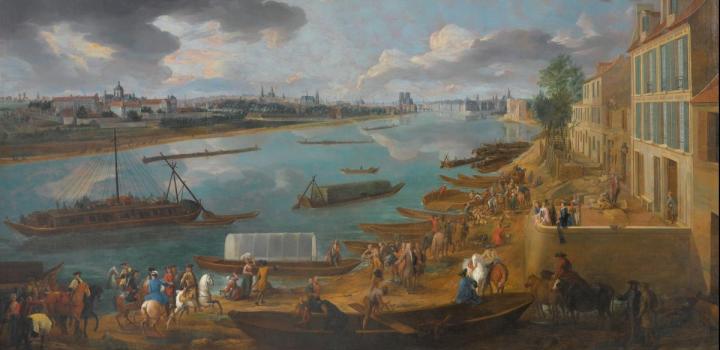
Pierre Denis Martin, View of Paris from the Quai de la Rapée toward la Salpêtrière, l’île Saint-Louis, and l’île de la Cité, 1716, oil on canvas, 170 × 315 cm (Paris: Louvre / Musee Carnavalet)
◊ ◊ ◊ ◊ ◊
Now on view at the Musée Carnavalet:
The Régence in Paris, 1715–1723: The Dawn of the Enlightenment
Musée Carnavalet, Paris, 20 October 2023 — 25 February 2024
Curated by Valérie Guillaume, with José de Los Llanos and Ulysse Jardat
The Musée Carnavalet – Histoire de Paris presents an exhibition on the Regency, a forgotten period in history, marking the return of the King and of political, economic, and cultural life to Paris.
Louis XIV died in Versailles on 1 September 1715, leaving behind a nation in debt and a five-year-old child too young to rule, Louis XV, as his heir. On 2 September, the Duke Philippe d’Orléans (1674–1723), nephew of the late King, took on the role of Regent of France. This exhibition takes place as part of the tricentennial commemoration of the Regent’s death.
In 1715, the court, the government, and all the administrations moved back to Paris, the second city in Europe, whose population then increased significantly. Thus, the city, and notably the Palais-Royal, the Regent’s residence, became the heart of all political life. A period of intense cultural effervescence ensued, giving rise to a world of philosophical, economic, and artistic innovations. Voltaire, Marivaux, Montesquieu, Law, and Watteau are some the most well-known figures of the time. With the invention of paper money and the bankruptcy of 1720, these years of economic and financial frenzy were interspersed with significant twists and turns. Under the Régence emerged a newfound freedom of criticism, which would become known as the spirit of the Enlightenment.
The exhibition’s thematic structure highlights the innovations of the period in order to illustrate the breadth of their historical significance. Over 200 works from public and private collections—paintings, sculptures, prints, items of decor, and pieces of furniture—help us explore this period of history, accounting for the mutations of society at a time when Paris was becoming the cultural capital of France in a permanent way.
Curators
• Valérie Guillaume, director of the Musée Carnavalet – Histoire de Paris
• José de Los Llanos, head curator, in charge of the Graphic Arts Department and the Maquettes Department
• Ulysse Jardat, curator, head of the Decor, Furniture, and Decorative Arts Department
La Régence à Paris (1715–1723): L’aube des Lumières (Paris: Paris-Musées, 2023), 224 pages, ISBN: 978-2759605705, €39.










 Enfilade
leave a comment