The San José in the News
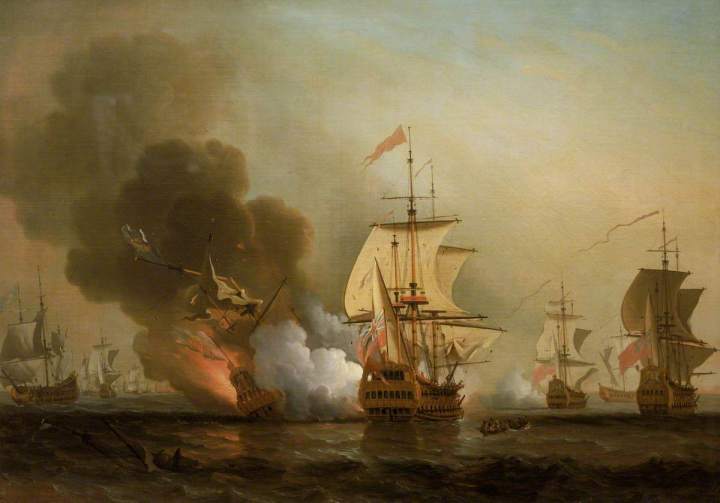
Samuel Soctt, Action off Cartagena, 28 May 1708, 1740s, oil on canvas (Greenwich: National Maritime Museum, BHC0348). Under the leadership of Commodore Wager, the Expedition (shown in the center) fires on the San José (left of center).
◊ ◊ ◊ ◊ ◊
In 1708, during the War of Spanish Succession, the San José was destroyed by a British squadron under Charles Wager (for whom a ship was named in the 1730s, that ship again made famous by David Grann’s recent best-seller). From The New York Times:
Remy Tumin and Genevieve Glatsky, “A Treasure May Be off the Coast of Colombia, but Who Can Claim It?” The New York Times (10 November 2023). The San José galleon was destroyed in 1708, sinking with goods now worth billions. Colombia’s government is planning a recovery, but not everyone wants to see the shipwreck brought to the surface.
When the San José made its final voyage from Seville, Spain, to the Americas in 1706, the Spanish galleon was considered to be one of the most complex machines ever built.
But in an instant, the armed cargo vessel went from a brilliant example of nautical architecture to what treasure hunters would come to consider the Holy Grail of shipwrecks. The San José was destroyed in an ambush by the British in 1708 in what is known as Wager’s Action, sinking off the coast of Cartagena, Colombia, with a haul of gold, jewels, and other goods that could be worth upward of $20 billion today.
Some experts say that number is extraordinarily inflated. But the myth built around the San José has prompted the Colombian government to keep its exact location a secret as a matter of national security.
Now Colombia’s president, Gustavo Petro, wants to accelerate a plan to bring the ship and its contents to the surface—and everyone wants a piece of it. It is the latest maneuver in a decades-long drama that has pitted treasure hunters, historians and the Colombian government against one another. . . .
Archaeologists and historians have condemned the effort, arguing that disturbing the ship would do more harm than good. Multiple parties, including Colombia and Spain, have laid claim to the San José and its contents. Indigenous groups and local descendants of Afro-Caribbean communities argue they are entitled to reparations because their ancestors mined the treasure.
Perhaps the largest, most enduring conflict is in the hands of an international arbiter in London. . . .
The full article is available here»










 Enfilade
leave a comment