The Burlington Magazine, November 2023
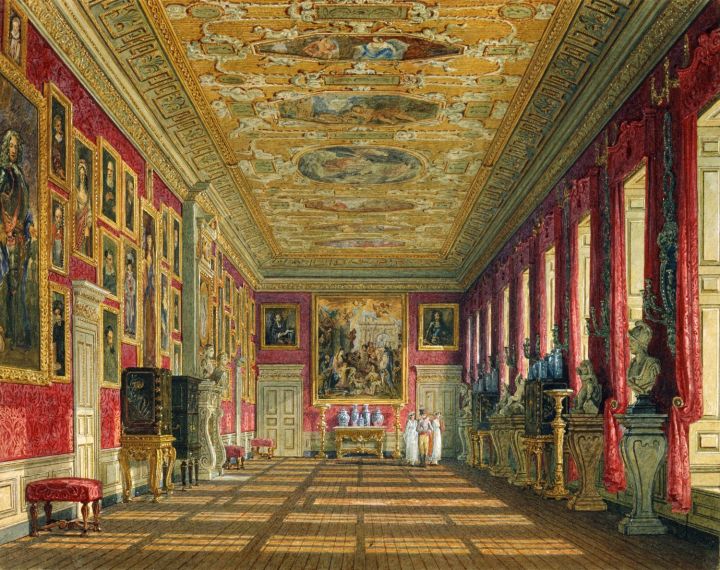
Charles Wild, Kensington Palace: The King’s Gallery, 1816, watercolour with touches of bodycolour over etched outlines, 20 × 25 cm c
(Royal Collection Trust, 922158)
◊ ◊ ◊ ◊ ◊
The eighteenth century in the November issue of The Burlington, which focuses on sculpture:
The Burlington Magazine 165 (November 2023)
e d i t o r i a l
• History of Art after Brexit, p. 1171.
It is probably fair to say that the United Kingdom’s withdrawal from the European Union in 2020 as a consequence of the referendum of 2016 was not greeted with much enthusiasm by professional art historians. The subject as it has developed over the past century is by its very nature transnational in outlook.
 a r t i c l e
• Jonathan Marsden, “George I’s Kensington Palace: The Sculptural Dimension,” pp. 1196–1205.
William Kent’s decoration of the new state rooms at Kensington Palace, London, for George I in 1722–27 has long been recognised as a pioneering exercise in neo-Palladianism. It was also an early example of the use of Classical sculpture in English interiors, a development in which Michael Rysbrack played a larger role than has formerly been recognised.
s h o r t e r n o t i c e
• Nicola Ciarlo, “Domenico Guidi in Padula: A Rediscovered Annunciation,” pp. 1206–09.
r e v i e w s
• Adriano Aymonino, “Albanimania,” pp. 1214–19.
A series of recent publications has turned the spotlight on Cardinal Alessandro Albani—described by Winckelmann as ‘the greatest patron in the world’—his villa in Rome, and collection of Classical antiquities, which have become newly accessible to scholars and the public after decades of seclusion.
• Heather Hyde Minor, Review of the exhibition catalogue, Victor Plahte Tschudi, Piranesi and the Modern Age (Nationalmuseum, Oslo / MIT Press, 2022), pp. 1239–41.
• Adam Bowett, Review of Ada De Wit, Grinling Gibbons and His Contemporaries (1650–1700): The Golden Age of Woodcarving in the Netherlands and Britain (Brepols, 2022), pp. 1247–49.
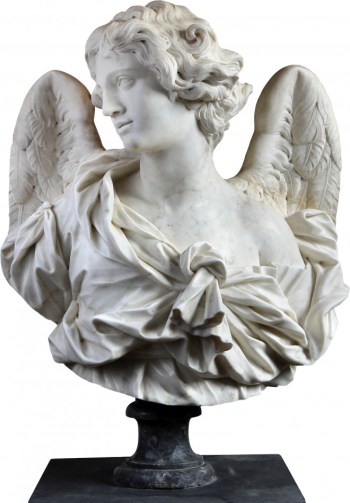
Archangel Gabriel, attributed by Nicola Ciarlo to Domenico Guidi, ca.1699–1701, marble, 94 × 81 × 39 cm, with socle (Padula: Charterhouse of S. Lorenzo).
• Marjorie Trusted, Review of Jan Zahle, Thorvaldsen: Collector of Plaster Casts from Antiquity and the Early Modern Period, 3 volumes (Thorvaldsens Museum and Aarhus University Press, 2020), pp. 1249–50.
• Natacha Coquery, Review of Iris Moon, Luxury after the Terror (Pennsylvania State University Press, 2022), pp. 1254–56.
• Joshua Mardell, Review of Jane Grenville, Pevsner’s Yorkshire, North Riding (Yale University Press, 2023), pp. 1256–57.
o b i t u a r y
• Paul Williamson, Obituary for Michael Kauffmann (1931–2023), pp. 1258–60.
Keeper of the Department of Prints & Drawings and Paintings at the Victoria and Albert Museum and subsequently Director of the Courtauld Institute of of Art, Michael Kauffmann was a scholar with a remarkable breadth of interest, as well as a widely respected and sensitive administrator and manager.
s u p p l e m e n t
• “Recent Acquisitions (2007–2023) of European Sculpture at the Victoria and Albert Museum, London,” pp. 1261–68.
Seventeen years have passed since the publication of the last supplement in this Magazine describing the recent sculpture acquisitions made by the Victoria and Albert Museum, London (V&A). The present supplement therefore highlights a selection of the most noteworthy works acquired in the intervening years.
Call for Papers | Sacred, Funerary Spaces
From ArtHist.net:
Les Espaces du Sacré, 3rd Edition: Funerary Spaces
Sainte-Marie de la Tourette Convent, Eveux (near Lyon), 12 January 2024
Proposals due by 11 December 2023
The Spaces of the Sacred offers a space for reflection and debate for anyone who understands sacred spaces as laboratories for architectural, urban and landscape research. This definition includes places of worship, funerary and memorial spaces, as well as the urban spaces and landscapes that surround them. Defining sacred spaces as a laboratory means considering both their design and their potential transformation.
The ambition is to study contexts as well as project experiences, theories as well as practices, legacies, and mutations as well as orientations and prospects—in a few words, to build knowledge and culture, to learn, experiment, and develop operational tools to understand the present and enrich contemporary practices. As a complement to the historical and social studies developed around these issues, this study day places the architectural, urban, and landscape project at the heart of its concerns.
For this third edition, the day will focus on the theme of funerary spaces. We will be looking at the shape these spaces will take in the future. Several lines of thought are envisaged:
• What place do funerary spaces have in the city? Are these places dedicated to the dead destined to remain at a distance from the living? Can they be integrated into everyday life?
• Can the boundaries of the cemetery be rethought, if not completely transformed, so that the traditional perimeter wall becomes a space of permeability with the town and the landscape?
• Is it possible to envisage funerary spaces incorporating a mix of uses and opening up to other functions?
• Is the limitation of urban expansion, imposed by the ecological and climate crisis, not an invitation to rethink the density of cemeteries and design them vertically?
• Beyond questions of density, how should environmental issues lead us to rethink funeral architecture?
• Between the monumentality of the Pharaonic tombs on the Giza plateau and the horizontal spaces concealed behind their surrounding walls, how should we view the form and aesthetics of these places?
• If there are a good number of sites and places that have been converted into funerary spaces, shouldn’t we be looking at the conversion of funerary spaces?
The Spaces of the Sacred provides an opportunity to share ongoing or completed research projects and to bring together researchers working on these issues. The event is open to students, doctoral candidates, teachers, researchers, practitioners, and anyone interested in developing interdisciplinary exchanges across institutions and borders. Les Espaces du Sacré is a study day organised in partnership between the “Architectural Solutions for the Design and Reuse of Sacred Spaces” (SACRES) chair, the “Heritage, Theory and Creation” (HTC) master’s program, the Ecole nationale supérieure d’architecture de Lyon (ENSAL), the EVS-LAURe research laboratory and the Sainte-Marie de la Tourette convent (Eveux).
The conference will be in French, but proposals may also be submitted in English. Results of the selection process will be announced by email in December 2023. Researchers wishing to contribute to this day can send their proposal, including a title, an abstract (approximately 200 words), and a short biography, to sacres@lyon.archi.fr before 11 December 2023. The study day will be organise at the Sainte-Marie de la Tourette convent (Eveux) on Friday, 12 January 2024.
Scientific Direction
• Benjamin Chavardès, Arch. Dr., titulaire de la chaire SACRES, EVS-LAURe, Ecole nationale supérieure d’architecture de Lyon
• Bastien Couturier, Arch. Dr., chaire SACRES, EVS-LAURe, Ecole nationale supérieure d’architecture de Lyon
Scientific Committee
• Benjamin Chavardès, Arch. Dr., titulaire de la chaire SACRES, EVS-LAURe, Ecole nationale supérieure d’architecture de Lyon
• Julien Correia, Arch. Dr., chaire SACRES, EVS-LAURe, Ecole nationale supérieure d’architecture de Lyon
• Bastien Couturier, Arch. Dr., chaire SACRES, EVS-LAURe, Ecole nationale supérieure d’architecture de Lyon
• Charles Desjobert, architecte du patrimoine, frère dominicain, couvent Sainte-Marie de la Tourette
• Philippe Dufieux, Pr. HDR, chaire SACRES, EVS-LAURe, Ecole nationale supérieure d’architecture de Lyon
• Ricardo Gomez Val, Arch. Dr., Universitat Internacional de Catalunya
• William Hayet, Arch., chaire SACRES, EVS-LAURe, Ecole nationale supérieure d’architecture de Montpellier
• Kevin Jacquot, Dr., MAP-Aria, Ecole nationale supérieure d’architecture de Lyon
• Aïcha Sariane, Architecte DE, chaire SACRES, Ecole nationale supérieure d’architecture de Lyon










 Enfilade
leave a comment