Call for Papers | Unfolding the Coromandel Screen
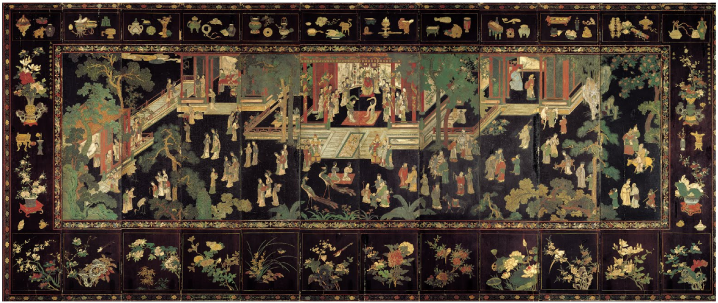
Coromandel Screen, Kangxi reign (1662–1722), Qing dynasty, carved lacquer, 258 × 52 × 3.5 cm
(Art Museum, The Chinese University of Hong Kong, 2001.0660)
◊ ◊ ◊ ◊ ◊
From the City University of Hong Kong, as posted at ArtHist.net:
Unfolding the Coromandel Screen
Online and and in-person, City University of Hong Kong, 22–25 November 2024
Organized by Wang Lianming with Mei Mei Rado
Proposals due by 20 January 2024
With the generous support of the Bei Shan Tang Foundation, the Department of Chinese and History at City University of Hong Kong will host a two-part academic event titled Unfolding the Coromandel Screen in celebration of the department’s tenth anniversary. This four-day event will bring together an international group of art historians, museum curators, conservators, collectors, and global historians to delve into various facets of the Coromandel screen and its intricate histories of interrelations with paintings, prints, decorative arts, palatial and interior designs, global maritime trade, and the fashion industry. The conference, organized by Wang Lianming (City University of Hong Kong) in collaboration with Mei Mei Rado (Bard Graduate Center, New York), will take place on-site at City University of Hong Kong and via Zoom on November 22–23. The keynote speech will be delivered by Jan Stuart, the Melvin R. Seiden Curator of Chinese Art at the Smithsonian National Museum of Asian Art, Washington D.C. Following the conference, participants will be invited to join a two-day traveling seminar from November 24 to 25, visiting lacquer and conservation workshops and museum collections in and around Guangzhou.
Context and Scope
During the second half of the seventeenth century, the production of the Coromandel screens, also known as kuancai (‘carved polychrome’), thrived along China’s southeast coast. These screens gained immense popularity domestically and in European markets, fostering connections between regional artisans, merchants, and prominent European figures such as royalty and nobility. In the last two decades of this century, the Coromandel screens emerged as one of China’s most frequently exported commodities, rivaling porcelain and challenging Japanese lacquerware exports. Their significance extends far beyond the general perception of being merely mass-produced craftwork of subpar quality. The conference will focus on two interconnected yet distinct lines of development: the screens encapsulated social cohesion, domestic networks, and transoceanic encounters while simultaneously becoming entwined in global histories that positioned them as coveted commodities, commemorative gifts, sites of maritime connectivity, and evocative artistic expressions originating from the Orient. Following this view, three key areas of investigation are at the forefront of discussions:
A) Transported Visions and Spatial Mobility unravels the role of the Coromandel screens in facilitating visual communication during the early modern world. Drawing inspiration from Aby Warburg’s concept of the ‘Image Vehicle’ (Bilderfahrzeuge, 1932), this inquiry delves into the dynamic and creative exchange of ideas, compositional elements, and ‘pictorial formulas.’
B) Inscribed Surfaces and Social Cohesion delves into the societal aspects of the Coromandel screens within domestic contexts. They were widely circulated as inscribed gifts among middle- and low-ranking, yet affluent, Qing officials stationed on the frontier. Their indexical nature provides a distinct perspective to unravel the interconnected social networks, political gatherings, interactions among officials and merchants, and intertextuality within and across regions.
C) Deconstruction and (Re)Framing: The Afterlives encompasses a wide range of transcultural practices applied to Coromandel screens after their removal from their original context. This scope analyzes and conceptualizes the procedural aspects of integrating Coromandel screens into new displays, such as European palatial interiors, marquetry furniture, and new works of art created by fragmenting, reassembling, refurbishing, and (re)appropriating lacquer panels.
Proposals may address, but are not limited to, the following topics:
• The mobility, intermingling, and dissemination of certain pictorial formulas through the Coromandel screen, such as the ‘Han Palace’ (estate celebration) or ‘Wenji Returning to Han’
• The interplay between various types of screens, porcelain, lacquerware, carpets, wallpaper, prints, furniture, and other decorative arts
• The interplay between various formats, materiality, and techniques along China’s southeast coast
• Regional divergences in terms of style, motif, lacquer and carving techniques, overall designs, etc.
• Recent discoveries in museum conservation
• The entangled histories with other screens produced in East Asia, such as the Nanban screen, the gilt biombo produced in Macao, and the painted screen in Korea
• Inscriptions, gift-giving, official-merchant interaction, political manifestos, social cohesion, and practices, etc.
• Sawing, reassembling, refurbishing, and (re-)appropriating lacquer panels in new contexts, and other framing practices
• Imitation and transmedial practices, such as leather imitation of the Coromandel screen
• The Coromandel screen’s entanglement with Japonisme painting, haute couture, and the fashion industry
• Theoretical discourses on the Coromandel screen’s valence in Orientalism, transculturalism, and global (art) history, etc.
Proposals from all disciplines are welcome. Please send an abstract of no more than 300 words, along with a brief bio, to unravelingcoromandel@googlemail.com by 20 January 2024. Presentations in English or Chinese (with pre-translated lecture notes required) should not exceed 20 minutes. The proposals accepted will be announced in early April 2024.
The Bei Shan Tang Foundation, in conjunction with the Department of Chinese and History of City University of Hong Kong, will cover the costs of lodging and travel. We also encourage speakers who can fund their own travel to participate. For further inquiries, please contact lianming.wang@cityu.edu.hk.
The organizers envision publishing selected conference papers in an edited volume.
Advisory Board
Ching May Bo, City University of Hong Kong
Burglind Jungmann, UCLA
Mei Mei Rado, Bard Graduate Center, New York
Anton Schweizer, Kyushu University
Wang Lianming, City University of Hong Kong
Xu Xiaodong, CUHK Art Museum
Call for Articles | On Borders and Boundaries
From the Call for Papers:
On Borders / Boundaries in Art and Art History | O granicach w sztuce i historii sztuki
Artium Quaestiones 35
Proposals due by 10 December 2023, with full texts due by 25 February 2024
Artium Quaestiones is an academic journal published by the Department of Art History at Adam Mickiewicz University in Poznan, Poland.
The problem of borders/boundaries in art history, both ancient and modern, recurs in various guises and meanings. A border as a dividing line—structuring political, national, or regional geography—is often an object of conflict that translates into both artistic practices and discourses that attempt to systematize and qualify art created in a given area, thus influencing artistic geography. Art is often an attempt to answer or problematize borders on the grounds of cultural, economic, or racial, differences. This is the subject of the recently opened exhibition at the National Museum in Poznań, About Sharing: Art on the (Polish-German) Border, curated by Marta Smolińska and Burcu Dogramaci, or the numerous art and exhibition projects dealing with the US-Mexican or Israeli-Palestinian borders (border art). The ongoing war in Ukraine also forces us to rethink the problem of the border and identity in art.
However, a border can also be viewed more abstractly, as a boundary, a line that delineates structures and systems of practices and discourses that seek to define identity, to classify and create hierarchy. Delimitations of this type characterized modernity (modernism) in the broad sense of this term. They were, however, eventually challenged by postmodern (poststructuralist) thought and post- and decolonial studies that favored the porosity and fluidity of previously constructed divisions, and thus of identities and their associated systems of meaning. The undecidable nature of a border (a division, boundary or a frame)—and, more broadly, of the established relationship between the hierarchically established center and the margin—was long ago discussed by Jacques Derrida in terms of parergon, and theorists such as Gilles Deleuze introduced conceptual constructs that invalidated borders/boundaries as lines of division altogether. These revaluations clearly pointed out the impossibility of sustaining thinking about borders as impermeable lines—physical and conceptual—demonstrating the necessity of thinking of them in terms of a field of difference, interpenetration, hybridization, a zone that can be both conflictual and highly productive and creative.
We encourage submissions that will address the problem of the border/boundary, with a particular focus on various attempts to theorize it, reflect on the contemporary condition of these concepts and their functioning in both contemporary artistic practices, art-historical discourse and reevaluations of the state of knowledge on the art of the past. Among other things, we will be interested in
• attempts to theorize the category of the border/boundary—both physical and conceptual—in the field of art history or visual culture studies
• problematized and theoretically framed case studies of art, including architecture, dealing with the problem of territorial, interstate, regional borders (including so called border art)
• issues of artistic geography, the establishing and/or questioning of cultural and ethnic borders/divisions through artistic and/or architectural practices
• a border/boundary as an issue of architectural practice, planning and landscape design
The deadline for submissions of abstracts (maximum of 2,500 characters) and a short academic bio is 10 December 2023. Authors of qualified abstracts will be asked to submit a full text of a maximum length of 45,000 characters (including an appendix bibliography) by 25 February 2024. All texts, with prior approval of the editorial team, will undergo a double-blind peer review. Please submit proposals via pressto. Contact an editor board at aq.redakcja@amu.edu.pl.
Exhibition | Amber: Treasures from the Baltic Sea
On view at Galerie Kugel:
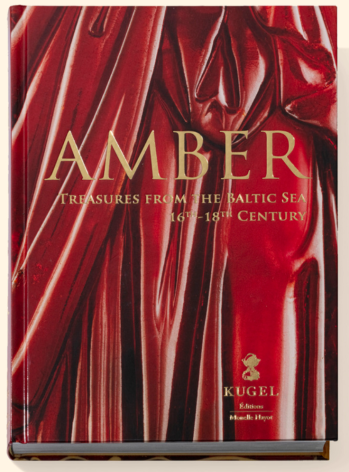
Amber: Treasures from the Baltic Sea, 16th–18th Century
Galerie Kugel, Paris, 18 October — 16 December 2023
 From Roman times to the 18th century, many recognised the inherent value of amber and hypothesised its origin, some assuming it to be whale sperm, others, solidified lynx urine. Its mystery endowed it with medicinal virtues. Amber was recommended as a powder to cure melancholy, toothache, and epilepsy, among other ailments, and as a love filter. The occasional inclusions of insects and small animals found trapped in amber have also made it a symbol of immortality. Pliny the Elder was the first to unveil its nature as the result of plant resin, but it wasn’t until 1757 that the Russian scientist Mikhail Lomonossov determined its true origin.
Amber is a fossilised resin originating, in the case of the objects exhibited, from a prehistoric forest dating back to some 30 to 40 million years, located under the Baltic Sea, between the towns of Danzig (today Gdansk in Poland) and Königsberg (today Kaliningrad in Russia), then, in East Prussia. In the 16th century, Grand Master Albert of Brandenburg-Ansbach (1490–1568) converted to Protestantism and transformed the territories of the Order of the Teutonic Knights in the Duchy of Prussia. This marked the beginning of a tremendous expansion in the trade and production of amber works of art. They became Prussia’s diplomatic gifts par excellence and were sought after to adorn the ‘Kunstkammern’ of Europe’s sovereigns and princes. It took nearly 20 years to collect the fifty pieces on display in this exhibition. Combining sculptures, caskets, tankards, and game boards, the wide variety of objects presented illustrate the fascination for amber through the 16th, 17th, and 18th centuries.
Alexis Kugel and Rahul Kulka, Amber: Treasures from the Baltic Sea, 16th to 18th Century / Ambre: Trésors de la mer Baltique du XVI au XVIIIe siècle (Saint-Remy-en-l’Eau: Éditions Monelle Hayot, 2023), 376 pages, €85. Available in French and English.
Exhibition | Drawing on Blue
Opening in January at The Getty:
Drawing on Blue
Getty Center, Los Angeles, 30 January — 28 April 2024
Curated by Edina Adam and Michelle Sullivan
Made from blue rags, blue paper has fascinated European artists from its earliest use in Renaissance Italy to Enlightenment France and beyond. Through new technical examination of drawings in the Getty’s collection, this exhibition offers fresh insight into the physical properties of blue paper and its unique contribution to artistic practice from the 15th through 18th centuries.
◊ ◊ ◊ ◊ ◊
From Getty Publications:
Edina Adam and Michelle Sullivan, eds., Drawing on Blue: European Drawings on Blue Paper, 1400s–1700s (Los Angeles: J. Paul Getty Museum, 2024), 160 pages, ISBN: 978-1606068670, $35. With contributions by Mari-Tere Álvarez, Thea Burns, Marie-Noelle Grison, Camilla Pietrabissa, and Leila Sauvage.
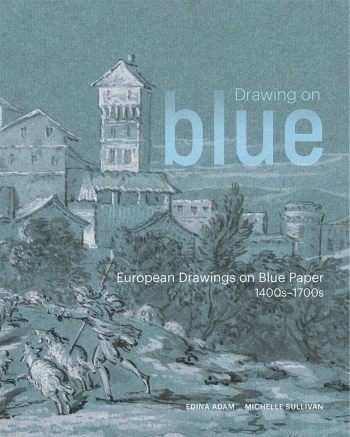 This engaging book highlights the role of blue paper in the history of drawing. The rich history of blue paper, from the late fifteenth to the mid-eighteenth centuries, illuminates themes of transcultural interchange, international trade, and global reach. Through the examination of significant works, this volume investigates considerations of supply, use, economics, and innovative creative practice. How did the materials necessary for the production of blue paper reach artistic centers? How were these materials produced and used in various regions? Why did they appeal to artists, and how did they impact artistic practice and come to be associated with regional artistic identities? How did commercial, political, and cultural relations, and the mobility of artists, enable the dispersion of these materials and related techniques? Bringing together the work of the world’s leading specialists, this striking publication is destined to become essential reading on the history, materials, and techniques of drawings executed on blue paper.
Edina Adam is assistant curator of drawings at the J. Paul Getty Museum. Michelle Sullivan is associate conservator of drawings at the J. Paul Getty Museum.
New Book | Four Centuries of Blue and White
Published by Paul Holberton and distributed by The University of Chicago Press:
Becky MacGuire, with essays by William Sargent and Angela Howard, Four Centuries of Blue and White: The Frelinghuysen Collection of Chinese and Japanese Export Porcelain (London: Ad Ilissvm, 2023), 432 pages, ISBN: 978-1915401090, £90 / $110.
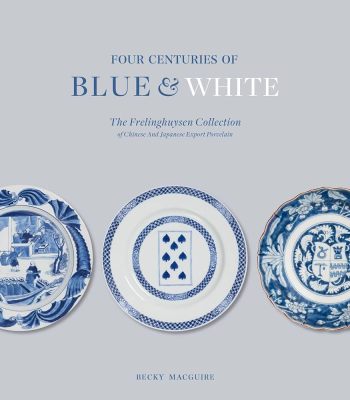 This beautifully illustrated book presents the Frelinghuysen Collection of Chinese and Japanese export porcelain. It is the first major publication to consider Chinese and Japanese blue and white together.
This extraordinary collection, assembled carefully over fifty years, features an exceptionally wide array of Asian blue and white porcelain—the most ubiquitous and influential of all ceramics. Ranging from Chinese pieces specially made for Portuguese traders in the sixteenth century to late nineteenth-century commissions for the Thai royal court, the collection also includes numerous Chinese classics from the era of the European trading companies and a notable selection of Japanese export porcelain. In its vast scope, it speaks of the diverse impulses and historical forces that propelled the trade in Asian porcelain and provides a lens to view the interaction of East and West from the early modern age to the dawn of the twentieth century. More than 300 pieces from the collection are illustrated and discussed in full and another 250 are illustrated in a compendium, all divided into thematic chapters that reflect the many ways Chinese and Japanese porcelain has been traded, collected, and used around the world.
Essays by William R. Sargent, former Curator of Asian Export Art at the Peabody Essex Museum, and noted armorial porcelain authority Angela Howard, precede the thirteen chapters, which include Faith, Identity, For the Table, To European Design, and Made in Japan. Great rarities are featured alongside small, amusing pieces and the many export porcelains made to elevate the practices of daily life.
With its strict adherence to blue and white porcelain, the collection intensifies our focus on forms, patterns, and designs, gathering together wares that are often considered only separately for study while also covering areas of little recent scholarship, such as the Thai market material. The specialized reader will find references to the latest research while the more general reader will appreciate a comprehensive overview of Asian export porcelain. There has not been a significant survey of either Chinese or Japanese blue and white since the 1990s, and they have never been considered together in a major publication.
Becky MacGuire is a graduate of the University of California at Berkeley and the Study Centre for the Fine & Decorative Arts at the Victoria & Albert Museum. She was the longtime Asian export art specialist at international auction house Christie’s.
Lecture | Iris Moon on Queen Mary’s Blue and White Ceramics
This Thursday at Yale’s History of Art Department:
Iris Moon | Blue Milk: Mary II, Porcelain, and the Queen’s Body at the Hampton Court Dairy
Yale University, 2 November 2023, 4pm
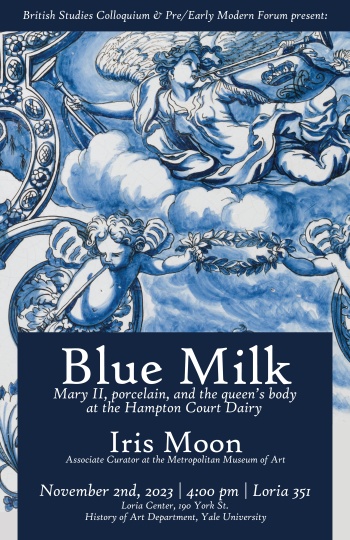 In this talk Iris Moon will explore the porcelain and delftware collection of Mary II (1662–1794) and how these artificial blue and white objects shaped the image of the queen and co-ruler of England with William III. After taking the throne in 1689, Mary II became actively involved in the extensive renovation of Hampton Court, the dilapidated Tudor residence. This included the creation of spaces designed for the queen’s pleasure, in particular the dairy in the Water Gallery, constructed out of the Tudor Watergate, a former royal retreat. Dairies in the early modern period, as the work of Meredith Martin has suggested, were not only gendered retreats of pleasure and privacy, but strategic sites of power. This presentation argues that these sites, premised upon an endless flow of milk and the promise of maternal fecundity and provisioning, also functioned as the architectural means through which female rulers worked through the anxieties of dynastic succession and the pressures to reproduce an heir. Bringing feminist theories of the body to bear upon the rare survivals from Mary II’s now destroyed dairy, such as a blue and white earthenware tile in The Metropolitan Museum of Art, Dr. Moon looks at how Mary’s extensive ceramics collection of Dutch earthenware and Asian export porcelain shaped her public persona after her sudden death in 1694. More than this, it created a surrogate, artificial body of blue and white that became mapped onto memories of the queen.
Iris Moon is an assistant curator in the European Sculpture and Decorative Arts Department at The Metropolitan Museum of Art, where she is responsible for European ceramics and glass. At The Met, she participated in the reinstallation of the British Galleries, and she is currently planning an exhibition on Chinoiserie, women, and the porcelain imaginary that will open in 2025.
Exhibition | Michail Michailov’s Dust to Dust at the Belvedere

Michail Michailov, Dust to Dust, as installed in the Carlone Hall of the Upper Belvedere in 2023.
(Photo by Johannes Stoll)
◊ ◊ ◊ ◊ ◊
From the press release (via Art Daily) for the exhibition:
Michail Michailov: Dust to Dust
Upper Belvedere, Vienna, 19 October 2023 — 14 April 2024
Curated by Stella Rollig with Johanna Hofer
As part of the Belvedere’s Carlone Contemporary series, Michail Michailov presents Dust to Dust, an 18-part trompe l’oeil drawing, previously exhibited at the Bulgarian Pavilion of the 2022 Venice Biennale. The modular work captures incidental, often overlooked vestiges of time, such as dust, hair, imprints, and stains, calling into question the value and existence of things.

Michail Michailov, Dust to Dust, detail, colored pencil on paper, 2022 (Photograph by Lisa Rastl).
Upon first glance, Dust to Dust may seem like a minimalist installation amid the baroque ambiance of the Carlone Hall. However, upon closer inspection, the display’s space-consuming surface reveals profound poetry. Michailov has meticulously crafted an 18-part series of colored pencil drawings that capture the often unnoticed and incidental vestiges of time. The work is a microcosm touching on fundamental questions of value, transience, and existence with striking simplicity. The realism of Michailov’s trompe l’oeil technique can also be observed above the installation, in the Triumph of Aurora ceiling fresco, which portrays the victory of light over darkness.
Michail Michailov states: “While science explores matter through its composition, I try to understand its meaning through art.”
General Director Stella Rollig states: “Michail Michailov is interested in providing his audience with an experience that only art can make possible. The old master technique of trompe l’oeil that he employs in the Carlone Hall seeks to amaze, amuse, and fascinate. Whether in a large-scale installation or a sheet of paper, Michailov’s work challenges the senses to set the mind in motion.”
Michail Michailov was born in 1978 in Veliko Tarnovo, Bulgaria, where he studied fine arts. Since 2002, he has lived and worked in Vienna, where he completed a degree in art history. His artistic practice moves fluidly between the fields of drawing, installation, film, and performance. The Carlone Contemporary Series showcases contemporary works in the Carlone Hall of the Upper Belvedere. From the frescoed ancient world of the deities Apollo and Diana to the present day, artists bridge the Baroque pictorial program with fresh artistic perspectives.
New Book | Decay and Afterlife
From The University of Chicago Press:
Aleksandra Prica, Decay and Afterlife: Form, Time, and the Textuality of Ruins, 1100 to 1900 (Chicago: The University of Chicago Press, 2022), 304 pages, ISBN: 978-0226811314 (hardcover), $105 / ISBN: 978-0226811598, $35. Also available as a PDF.
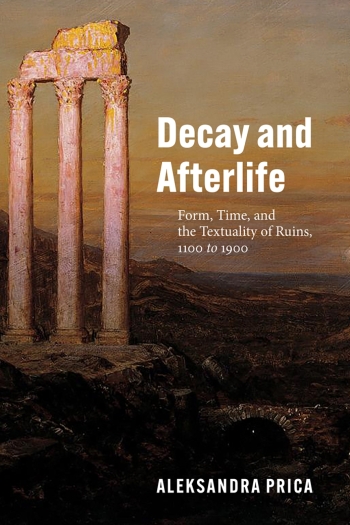 Covering 800 years of intellectual and literary history, Prica considers the textual forms of ruins.
Western ruins have long been understood as objects riddled with temporal contradictions, whether they appear in baroque poetry and drama, Romanticism’s nostalgic view of history, eighteenth-century paintings of classical subjects, or even recent photographic histories of the ruins of postindustrial Detroit. Decay and Afterlife pivots away from our immediate, visual fascination with ruins, focusing instead on the textuality of ruins in works about disintegration and survival. Combining an impressive array of literary, philosophical, and historiographical works both canonical and neglected, and encompassing Latin, Italian, French, German, and English sources, Aleksandra Prica addresses ruins as textual forms, examining them in their extraordinary geographical and temporal breadth, highlighting their variability and reflexivity, and uncovering new lines of aesthetic and intellectual affinity. Through close readings, she traverses eight hundred years of intellectual and literary history, from Seneca and Petrarch to Hegel, Goethe, and Georg Simmel. She tracks European discourses on ruins as they metamorphose over time, identifying surprising resemblances and resonances, ignored contrasts and tensions, as well as the shared apprehensions and ideas that come to light in the excavation of these discourses.
Aleksandra Prica is associate professor of German literature at the University of North Carolina at Chapel Hill.
c o n t e n t s
List of Figures
List of Abbreviations
Introduction
I | Foundations
1 Among Ruins: Martin Heidegger and Sigmund Freud
2 Afterlife: Hans Blumenberg and Walter Benjamin
II | The Propitious Moment
3 Petrarch and the View of Rome
4 Poliphilo and the Dream of Ruins
III | Living On
5 Ferdinand Gregorovius, Hildebert of Lavardin, and the Rupture of Continuity
6 Lucius Annaeus Seneca, Martin Opitz, and the Overcoming of Vanity
IV | The Battleground of Time
7 Johann Jacob Breitinger, Andreas Gryphius, and the Reconsideration of Allegory
8 Thomas Burnet, Georg Wilhelm Friedrich Hegel, and the Realignment of Discourses
V | Futures and Ruins
9 Johann Wolfgang von Goethe, Georg Simmel, and the Provisionality of Forms
Epilogue
Acknowledgments
Bibliography
Index










 Enfilade
leave a comment