Restoration of Frescoes and Stuccowork at Palazzo Pisani
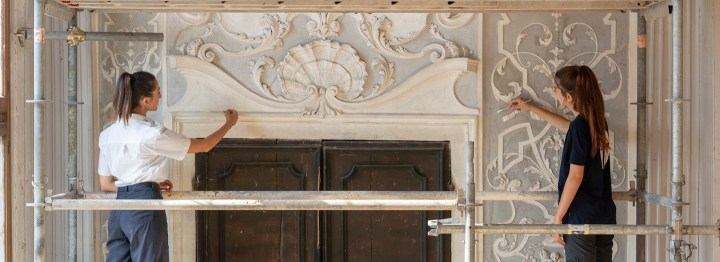
IVBC students restoring the stuccowork in the orchestra rehearsal room, summer 2023
(Venice: Palazzo Pisani; photo by Matteo De Fina)
◊ ◊ ◊ ◊ ◊
From the press release (via Art Daily) for the project (readers may know the Palazzo Pisani from the inclusion of its extraordinary rooftop for Hercule Poirot’s terrace earlier this year in A Haunting in Venice) . . .
Save Venice is proud to support the education and training of the next generation of art conservators by funding coursework and restoration fieldwork at the Istituto Veneto per i Beni Culturali’s restoration school. In 2023, this long-standing partnership fostered a new collaboration between the IVBC and Venice’s prestigious Conservatorio Benedetto Marcello in Palazzo Pisani, through a pilot initiative of conservation treatments funded by Save Venice with generous support by the Manitou Fund through Nora McNeely Hurley.
The 17th-century Palazzo Pisani, located next to Campo Santo Stefano, is the second largest palace in Venice, after Palazzo Ducale. The conservation of frescoes, stuccowork, and marble decoration in two rooms of the conservatory was undertaken in 2023 by the IVBC restoration school as a part of their post-graduate fieldwork program. The remarkable, initial results were presented to the public in December, and Save Venice is now continuing its engagement with the two institutions by funding a 2024 full-year program of stucco conservation in four rooms of the conservatory’s museum.
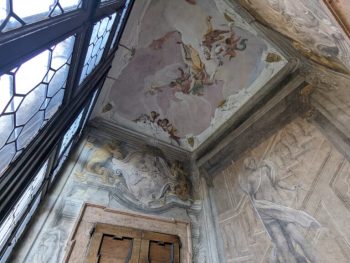
Fresco decoration in the antechamber (‘Adonis Room’), following conservation in 2023 (Venice: Palazzo Pisani; photo by Matteo De Fina).
Located on Palazzo Pisani’s 2nd floor—originally the primo piano nobile—the antechamber overlooks the interior courtyard and provides access to another, larger room. Frescoes, likely dating to the mid to late 18th century, adorn all four walls and depict illusionistic architecture with gargoyles and mythological and allegorical figures including Cupid, Venus, and Adonis. When the interior of the palazzo was heavily reworked in the 19th century, these frescoes were covered over for nearly a century before being revealed again in the mid-20th century.
The adjacent room—now used as the orchestra rehearsal room, as well as for art exhibitions—originally housed Almorò Pisani’s precious library and collection of medals and coins (sold in the 19th century). The rich stucco motifs feature mouldings with geometric designs intertwined with dynamic acanthus leaves, further enriched by coats of arms of the Catholic Church. Bas-relief portraits of John Calvin (on the north wall) and Martin Luther (on the south wall) may be attributed to the workshop of plasterers active at Palazzo Pisani in that period: Giuseppe Ferrari and Francesco Re.
Urgent intervention was needed to address the numerous cracks and fissures that were causing the delicate plaster to lift and detach from the wall beneath. The ornate decoration had been the subject of previous interventions involving the use of methods and materials that were not ideal. The stucco reliefs were whitewashed over with thick layer of lime milk and animal glues that had yellowed and distorted the elegant and refined detailing. The bas-reliefs of Calvinus and Luther were reworked using a yellow material that had discolored and was blotchy in appearance. Previous infiltrations of rainwater from the roof had left stains on the walls, and damp that passed through from the exterior masonry allowed for the formation of salt deposits. A thick layer of dirt and grime and other non-original surface residues were carefully removed, isolated areas of losses to the stucco decoration were recomposed, and the water damage and salt deposits were treated.
Exhibition | Ornament

Installation view of Ornament (Yale University Art Gallery, 2023), with a harpsichord by Andreas Ruckers (1640) from the Yale School of Music’s Morris Steinert Collection of Musical Instruments.
◊ ◊ ◊ ◊ ◊
Press release for the exhibition:
Ornament
Yale University Art Gallery, New Haven, 26 September 2023 — 18 February 2024
Organized by Freyda Spira and Laurence Kanter
Ornament marks the Yale University Art Gallery’s latest collaboration with the Yale School of Music, occasioned by the restoration of its historic building housing the Morris Steinert Collection of Musical Instruments. During the closure necessitated by the renovation project, three important and elaborately ornamented early keyboard instruments are on loan to the Gallery.

Gilles-Marie Oppenord (formerly attributed to Jean Bérain), Ornamental Panel with Father Time , ca. 1700, pen and brown ink and gray wash, sheet: 41 × 29 cm (New Haven: Yale University Art Gallery).
A 1640 harpsichord by the Antwerp-based craftsman Andreas Ruckers, with its intricately decorated soundboard and lid, exemplifies the Flemish school of harpsichord making at its height. Also featured in the installation is a smaller instrument called a spinetta, made by Francesco Poggio of Florence in 1620, with a lid painted by an accomplished atelier in the Tuscan city. On view alongside these two harpsichords is an early 19th-century Austrian pyramid piano, a stylish Neoclassical ancestor to the upright pianos that would become popular in 19th- and 20th-century homes. These three objects are accompanied by a selection of around 40 European drawings and prints from the 16th through the 18th century that demonstrate how ornament offers an arena for artistic license. The display of musical instruments and works on paper emphasizes how patterns and forms have been imitated, adapted, and translated across media by artists and craftspeople alike.
This installation is a continuation of the Gallery’s collaborations with other Yale collections, following most recently on the exhibition Crafting Worldviews: Art and Science in Europe, 1500–1800, which assembled objects and artworks from the Yale Peabody Museum, the Yale University Library, and the Yale Center for British Art (YCBA), as well as the current exhibition In a New Light, showcasing painted masterpieces from the YCBA.
Exhibition made possible by the Wolfe Family Exhibition and Publication Fund. Organized by Freyda Spira, the Robert L. Solley Curator of Prints and Drawings, and Laurence Kanter, Chief Curator and the Lionel Goldfrank III Curator of European Art.
New Book | Mozart in Italy
Published in the UK in October and coming to the American market in the spring; from Picador:
Jane Glover, Mozart in Italy: Coming of Age in the Land of Opera (London: Picador, 2023), 288 pages, ISBN: 978-1529059861, £25 / $30.
 At thirteen years old Wolfgang Amadeus Mozart was a child prodigy who had captured the hearts of northern Europe, but his father Leopold was now determined to conquer Italy. Together, they made three visits there the last when Mozart was seventeen, all vividly recounted here by acclaimed conductor Jane Glover. Father and son travelled from the theatres and concert salons of Milan to the church-filled streets of Rome to Naples, poorer and more dangerous than the prosperous north, and to Venice, the carnivalesque birthplace of public opera. All the while Mozart was absorbing Italian culture, language, style and art, and honed his craft. He met the challenge of writing Italian opera for Italian singers and audiences and provoked a variety of responses, from triumph and admiration to intrigue and hostility: in a way, these Italian years can be seen as a microcosm of his whole life. Evocative, beautifully written and with a profound understanding of eighteenth-century classical music, Mozart in Italy reveals how what he experienced during these Italian journeys changed Mozart—and his music—forever.
In Jane Glover’s long and hugely successful career as a conductor, she has been Music Director of the Glyndebourne Touring Opera, Artistic Director of The London Mozart Players, and, since 2002, is Music Director of Chicago’s Music of the Baroque. She has conducted all the major symphony and chamber orchestras in Britain, as well as many in the United States of America and across the world. She appears regularly at the BBC Proms and is a regular broadcaster, with highlights including a television series on Mozart. She is also the author of Mozart’s Women and Handel in London. She lives in London.
Call for Papers | Nature and Landscape in Schubert’s Time
From ArtHist.net:
Nature and Landscape in Schubert’s Time: An Interdisciplinary Approach
Schubert Research Center, Wien / Vienna, 23–25 October 2024
Proposals due by 14 April 2024
The relationship between nature and landscape on the one hand and the arts on the other changed during the early nineteenth century. Due to fundamental developments in the history of ideas, nature and landscape experienced manifold increases in significance and often served as a reflection of the inner state of individuals and groups. These phenomena affected not only the music of Franz Schubert (1797–1828), but also compositions of his contemporaries as well as literature, theater, and the visual arts in the Habsburg Empire.
This conference, therefore, encourages an interdisciplinary approach. We particularly invite contributions on the following topics:
• Relationships between the individual and nature, e.g. the motif of the ‘Wanderer’
• The (re)discovery of nature and landscape in the Habsburg Empire, the use and instrumentalization of nature for political purposes, and the beginning of nature-oriented tourism
• Social components of nature, e.g. urban-rural polarizations
• Topics of environmentalism in Schubert’s time
• Ecomusicological approaches
We are also open to other related topics. Applications should include a short CV and an abstract of about 300 words. These materials should be sent to schubert@oeaw.ac.at no later than 14 April 2024. The Schubert Research Center will cover travel expenses and accommodation. The conference language is English.
New Book | The Horn
From Yale UP:
Renato Meucci and Gabriele Rocchetti, The Horn (New Haven: Yale University Press, 2023), 416 pages, ISBN: 978-0300118933, $45.
 A rich and fascinating account of one of music history’s most ancient, varied, and distinctive instruments
From its origins in animal horn instruments in classical antiquity to the emergence of the modern horn in the seventeenth century, the horn appears wherever and whenever humans have made music. Its haunting, timeless presence endures in jazz and film music, as well as orchestral settings, to this day. In this welcome addition to the Yale Musical Instrument Series, Renato Meucci and Gabriele Rocchetti trace the origins of the modern horn in all its variety. From its emergence in Turin and its development of political and diplomatic functions across European courts, to the revolutionary invention of valves, the horn has presented in innumerable guises and forms. Aided by musical examples and newly discovered sources, Meucci and Rocchetti’s book offers a comprehensive account of an instrument whose history is as complex and fascinating as its music.
Renato Meucci directs the Cultural Heritage department of the celebrated Accademia Nazionale di Santa Cecilia in Rome. Gabriele Rocchetti is horn professor at the Conservatory Luca Marenzio, and a fine natural horn player.
c o n t e n t s
List of Figures
List of Musical Examples
List of Tables Abbreviations
Acknowledgments
Foreword
Part I
1 Preliminary Note on Roman Military Instruments
2 Early Horns and Calls
3 The Coiled Trompe
4 Spiral Instruments
5 Early French Hunting Fanfares
6 Hooped Models
7 Preserved Instruments
8 Von Sporck and the Trompe de Chasse
9 The Natural Hunting Horn (Jadgwaldhorn)
10 Trumpet and Horn Players
11 The Natural Horn at its Zenith (Orchesterwaldhorn)
12 Duets
13 Four Case Studies: Vivaldi, Bach, Handel, Telemann
14 Instruments’ Names in the Baroque Era
Part II
15 The Classic Era
16 New Crook Systems
17 The Classical Repertoire
18 The Heyday of the Hand Horn
19 Transitional Systems
Part III
20 Valve Horns
21 Further Valve Systems
22 Reports by Contemporaries
23 Early Music Literature
24 Valve Dissemination: A Regional Overview
25 A Few Leading Composers
26 Double Horn
27 The Horn in the Second Half of the Twentieth Century
28 The Repertoire of the Second Half of the Twentieth Century
29 The Present-Day Horn
Bibliography
Index
Appendix 1 Notation
Appendix 2 High vs. Low Horn in Haydn’s Symphonies
Appendix 3 Two Letters by Blühmel
New Book | The Recorder
From Yale UP:
David Lasocki, Robert Ehrlich, Nikolaj Tarasov, and Michala Petri, The Recorder (New Haven: Yale University Press, 2023), 392 pages, ISBN: 978-0300118704, $50.
 The fascinating story of a hugely popular instrument, detailing its rich and varied history from the Middle Ages to the present
The recorder is perhaps best known today for its educational role. Although it is frequently regarded as a stepping-stone on the path toward higher musical pursuits, this role is just one recent facet of the recorder’s fascinating history—which spans professional and amateur music-making since the Middle Ages. In this new addition to the Yale Musical Instrument Series, David Lasocki and Robert Ehrlich trace the evolution of the recorder. Emerging from a variety of flutes played by fourteenth-century soldiers, shepherds, and watchmen, the recorder swiftly became an artistic instrument for courtly and city minstrels. Featured in music by the greatest Baroque composers, including Bach and Handel, in the twentieth century it played a vital role in the Early Music Revival and achieved international popularity and notoriety in mass education. Overall, Lasocki and Ehrlich make a case for the recorder being surprisingly present, and significant, throughout Western music history.
David Lasocki, formerly head of music reference services at Indiana University Bloomington, has been a researcher of the recorder for over fifty years. Robert Ehrlich is professor of recorder at the Hochschule für Musik und Theater in Leipzig.
c o n t e n t s
List of Illustrations
Acknowledgments
Introduction — David Lasocki
1 The Era of Medieval Recorders, 1300–1500 — David Lasocki
2 The Era of Renaissance Recorders, 1501–1667 — David Lasocki
3 The Era of the Baroque Recorder, 1668–1800 — David Lasocki
4 Duct Flutes in the Nineteenth Century — Nikolaj Tarasov
5 The Recorder in the Twentieth Century — Robert Ehrlich
Epilogue — Michala Petri
Notes
Bibliography
Index
Getty Acquisitions Include Portrait of Friedrich Christian by Mengs
From the press release (4 December 2023) . . .
A rare Netherlandish masterpiece, a recently rediscovered German still life, and a magnificent state portrait bolster the Getty’s collection.
The J. Paul Getty Museum announced today the acquisition of three important paintings, enhancing its collection of European art. The works include The Holy Family (ca. 1520) by Netherlandish artist Gerard David; Bouquet of Flowers in a Two-Handed Vase (early 1560s) by German artist Ludger tom Ring the Younger; and Portrait of Friedrich Christian, Prince of Saxony (1751), by German artist Anton Raphael Mengs. The three paintings were purchased individually on the European art market and will go on display at the Getty Center this week.
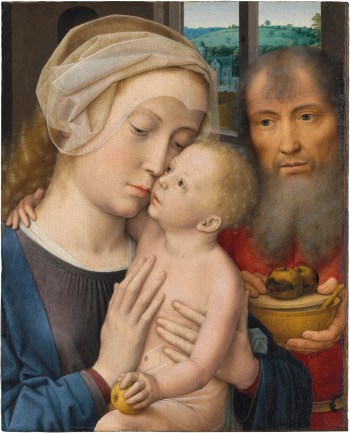
Gerard David, The Holy Family, ca. 1520, oil on panel, 16 × 13 inches (Los Angeles: Getty Museum, 2023.104).
“We rarely are able to acquire three such significant works of art at the same time,” says Timothy Potts, Maria Hummer-Tuttle and Robert Tuttle Director of the Getty Museum. “These paintings will considerably enhance our presentation of northern European paintings, adding depth and variety across the genres of religious imagery, independent still life, and grand portraiture. I have no doubt that all three pictures, representing very different aspects and periods of European art, will engage and delight our visitors.”
An extremely rare work by Gerard David, Holy Family highlights the artist’s use of rich oil colors and delicate brushwork that distinguish his extraordinarily meticulous painting technique. David placed the three figures—Mary, Jesus, and Joseph—close to the viewer, underscoring their warm, familial bond. The Virgin and Child tenderly embrace as Jesus presses his cheek against Mary’s while she holds her son tightly. Joseph holds a spoon and lidded bowl, keeping the porridge-like milk soup warm for the child. Jesus holds an unblemished apple, a symbol of his role as the ‘new Adam’; two decaying apples sitting atop the lidded bowl offer a stark allusion to the future passion of Christ.
Typical for painters of the period, David portrayed the figures in a contemporary environment: the buildings and hilly landscape visible outside the window are characteristic of 16th-century Netherlands. The superb condition of the painting preserves David’s subtle modeling of flesh and many exquisite details, such as the fine gold highlights of the Virgin’s tresses and the tiny swan floating on the pond in the background.
“With its powerful sense of immediacy, this moving and intimate depiction of the Holy Family is a major addition to our collection of Netherlandish paintings,” says Davide Gasparotto, senior curator of paintings at the Getty Museum. “Its exceptional state of preservation allows us to appreciate David’s commanding use of color and delicate brushwork.”

Ludger tom Ring the Younger, Bouquet of Flowers in a Two-Handed Vase, early 1560s, oil on oak panel, 15 × 11 inches (Los Angeles: Getty Museum, 2023.101).
Bouquet of Flowers in a Two-Handed Vase by German artist Ludger tom Ring the Younger becomes the earliest independent still life painting in Getty’s collection. It marks a pivotal moment in Renaissance art, when close artistic observation of European plants, initially expressed through drawn and watercolor studies by German masters Martin Schongauer and Albrecht Dürer around 1500, became worthy subjects of panel painting.
The painting imparts a monumentality despite its relatively modest scale. On a simple shelf or table set against a dark background, the artist depicted a luxurious two-handled vase made of milky Venetian glass decorated with gold and blue enamel. The vibrant bouquet features over 15 species of plants native to northern Europe, including roses, gillyflowers, pot marigolds, pink daisies, violets, and rosemary.
“A pioneer in the history of European still life, Ludger tom Ring was the author of only a handful of panels with bouquet of flowers: this is the first bouquet painting by Ring acquired by a museum in the United States,” says Gasparotto. “With its brilliant palette, exuberant textures, and characterful vase, this work greatly expands our collection of German Renaissance art.”
A magnificent state portrait, created by Anton Raphael Mengs when he was on the cusp of international fame, captures the energy and optimism of a youthful prince. Prince Friedrich Christian commissioned the portrait in 1751, soon after the artist was appointed principal painter to the Saxon court in Dresden, Germany. The painting portrays Christian in three-quarter length, clad in tournament armor under billowing layers of richly colored drapery, sashes, and medals. The prince adopts a self-assured attitude, with one knee bent, his right hand gripping a baton, and his left arm resting upon his helmet. His soft, good-natured features are sharpened by the quick intelligence apparent in his bright, delicate eyes.

Anton Raphael Mengs, Portrait of Friedrich Christian, Prince of Saxony, 1751, oil on canvas, 61 × 43 inches (Getty Museum, 2023.100).
Mengs created a splendidly engaging portrait that asserts the prince’s dynastic legitimacy while concealing the sitter’s disability—likely cerebral palsy—which would have prevented him from assuming the easy, confident stance shown in his portrait. After the prince’s untimely death in 1763, the painting remained with the royal family in an almost unbroken chain of inheritance until its sale in 2022.
“With its burst of color and over-the-top grandeur, this painting is a magnificent addition to our extraordinary collection of early modern portraiture,” says Gasparotto. “The portrait will offer visitors a chance to consider the purpose and potential of the state portrait, the highest form of political image-making in early modern Europe.”
This new painting joins three other works by Mengs in the Getty collection: Portrait of William Burton Conyngham (a pastel); Asclepius (recto) and Study of a Male Youth Bearing Some Leaves (verso) (a drawing); and Portrait of José Nicolás de Azara, Marquis of Nibbiano (a painting).
New Book | Tischbein the Elder (1722–1789)
An exhibition from 2022 that I missed, though the catalogue is still available from Michael Imhof:
Tischbein: Meisterwerke des Hofmalers, Porträts und Landschaften von Johann Heinrich Tischbein d. Ä. (1722–1789) (Petersberg : Michael Imhof Verlag, 2022), 160 pages, ISBN: 978-3731912675, €35.
 Ausstellung im Schloss Fasanerie in Eichenzell/Fulda: 11. Juni bis 9. Oktober 2022
Am 3. Oktober 2022 jährt sich der Geburtstag Johann Heinrich Tischbeins des Älteren (1722–1789) zum 300. Mal. Den runden Geburtstag des bedeutendsten Vertreters der berühmten hessischen Malerdynastie Tischbein nimmt die Kulturstiftung des Hauses Hessen zum Anlass, dem landgräflich-hessischen Hofmaler im Museum Schloss Fasanerie bei Fulda eine monografische Ausstellung zu widmen. Ein Schwerpunkt der Ausstellung stellt die Rolle Tischbeins als Hofmaler dreier hessischer Landgrafen in Kassel dar. Im Jahr 1753 wurde Johann Heinrich d. Ä. von Landgraf Wilhelm VIII. von Hessen-Kassel zum Hofmaler ernannt und blieb es auch während der gesamten Regierungszeit Friedrichs II. (1760–1785). Obwohl Tischbein bei Regierungsantritt Wilhelms IX. bereits krank war, blieb er auch unter ihm Hofmaler, und der Landgraf richtete auf Schloss Wilhelmshöhe eine ihm posthum gewidmete Gemäldegalerie ein. Aufträge erhielt der Maler jedoch nicht allein von Mitgliedern des Kasseler Hofs, er schuf auch zahlreiche Porträts für Fürst Karl August von Waldeck und Pyrmont und stattete dessen Residenz in Bad Arolsen mit Gemälden aus. Darüber hinaus porträtierte Tischbein seine eigene Familie und war auch bei bürgerlichen Auftraggebern jenseits von Hof und Residenz gefragt. Neben Porträts zeigt der Katalog Landschaftsgemälde von Johann Heinrich Tischbein d. Ä. Darunter befinden sich wichtige Ansichten des Schlosses auf dem Weißenstein (dem Vorgängerbau von Schloss Wilhelmshöhe in Kassel) und der das Schloss umgebenden Parkanlagen des 18. Jahrhunderts.
i n h a l t
Zum Geleit Donatus Landgraf von Hessen
1 Johann Heinrich Tischbein d. Ä.: Selbstbildnisse als Inszenierungdes sich wandelnden Künstlertums — Justus Lange
Katalog
2 Die Porträts Landgraf Friedrichs II. von Hessen-Kassel — Andreas Dobler
Katalog
3 Landgräfin Philippine von Hessen-Kassel (1745–1800) im Porträt — Malena Rotter
Katalog
4 Denker und Dichterinnen: Johann Heinrich Tischbeins d. Ä. Porträtmalerei jenseits von Hof und Residenz — Andrea Linnebach
Katalog
5 Landschaftsgemälde von Johann Heinrich Tischbein d. Ä.— Markus Miller
Katalog
Literaturverzeichnis
Exhibition | Unnamed Figures: Black Presence and Absence
 Rufus Hathaway, A View of Mr. Joshua Winsor’s House &c., Duxbury, Massachusetts, ca. 1793–95, oil on canvas (New York: American Folk Art Museum, gift of Ralph Esmerian, 2013.1.19). From the museum’s Instagram account, “This iconic folk painting has typically been interpreted as its eighteenth-century patron, Joshua Winsor, would have expected: as a chronicle of his wealth and property as a merchant and shipbuilder in Duxbury, Massachusetts. Usually unremarked upon is the figure of a Black woman in the lower left-hand corner of the scene. With her back to the viewer, the woman is faceless, evoking the limited details known about early African American lives. Census records provide small clues. Was she the one free person of color recorded in the Winsor household in 1790, a few years before this painting was made? Likely attending to many aspects of the Winsors’ domestic lives, this enigmatic figure was one of the many unnamed Black residents of New England whose underrecognized labor paved the way for their employers’ or enslavers’ prosperity.”
◊ ◊ ◊ ◊ ◊
Karen Rosenberg’s review of the exhibition recently appeared in The New York Times (21 December 2023) . . . .
Unnamed Figures: Black Presence and Absence in the Early American North
American Folk Art Museum, New York, 15 November 2023 — 24 March 2024
Flynt Center of Early New England Life, Deerfield, Massachusetts, 1 May — 4 August 2024
Curated by Emelie Gevalt, RL Watson, and Sadé Ayorinde
Unnamed Figures: Black Presence and Absence in the Early American North is on view at the American Folk Art Museum until 24 March 2024. As a corrective to histories that define slavery and anti-Black racism as a largely Southern issue, this exhibition offers a new window onto Black representation in a region that is often overlooked in narratives of early African American history.
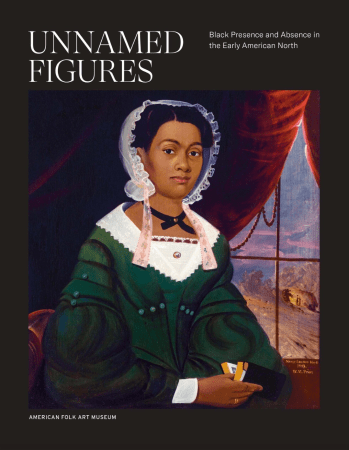 Through 125 remarkable works including paintings, needlework, and photographs, this exhibition invites visitors to focus on figures who appear in—or are omitted from—early American images and will challenge conventional narratives that have minimized early Black histories in the North, revealing the complexities and contradictions of the region’s history between the late 1600s and early 1800s. A 300-page scholarly book with contributions from Gwendolyn DuBois Shaw, Jennifer Van Horn, and several other authors, is available for purchase.
The exhibition is co-curated by Emelie Gevalt, Curatorial Chair for Collections and Curator of Folk Art, AFAM; RL Watson, Assistant Professor of English and African American Studies, Lake Forest College; and Sadé Ayorinde, Terra Foundation Predoctoral Fellow in American Art at the Smithsonian American Art Museum. A free digital guide on Bloomberg Connects is available here.
Please be advised that this exhibition contains complex, challenging, and racist imagery.
Unnamed Figures: Black Presence and Absence in the Early American North (New York: American Folk Art Museum, 2023), 300 pages, $75.
Catalogue contributors are scholars and researchers with expertise in American art history, material culture, African American history and literature, and other related topics. The book includes a foreword by Gwendolyn DuBois Shaw and Jason Busch. Contributors include the exhibition’s curators as well as Virginia Anderson, Kelli Racine Barnes, Michael Bramwell, Christy Clark-Pujara, Anne Strachan Cross, Jill Vaum Rothschild, Jonathan Michael Square, Lea Stephenson, Jennifer Van Horn, and Gordon Wilkins.
r e l a t e d p r o g r a m m i n g
7 December 2023
Virtual Insights: Reasserting Black Presence in the Early American North
11 January 2024
BlackMass Responds to Unnamed Figures: Tour with Yusuf Hassan and Kwamé Sorrell
14 February 2024
Notes on Style: A Discussion with BlackMass on Portraiture and Personhood
23 February and 28 March 2024
‘The Picture Is Still Out There’: Reframing Black Presence in the Collections of Early American Art and Material Culture | 2024 Elizabeth and Irwin Warren Folk Art Symposium
18 March 2024
Autobiographical Landscapes: Gary Tyler in Conversation with Allison Glenn
◊ ◊ ◊ ◊ ◊
Note (added 4 January 2024) — The posting was updated to include Historic Deerfield as a venue.
Online Symposium | Reframing Black Presence
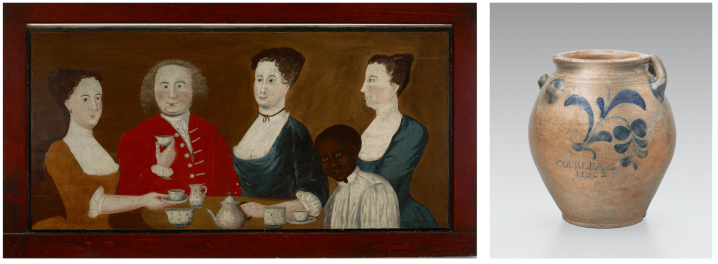
Left: unidentified painter, John Potter and Family, Matunuck, Rhode Island, ca. 1740, oil on wood, 31 × 64 inches (Newport Historical Society). Right: Thomas W. Commeraw, Two-Gallon Jar, New York City, ca. 1793–1819, salt-glazed stoneware with cobalt decoration, 9 inches high (Private Collection).
◊ ◊ ◊ ◊ ◊
From the American Folk Art Museum in New York:
‘The Picture Is Still Out There’: Reframing Black Presence in the Collections of Early American Art and Material Culture
Elizabeth and Irwin Warren Folk Art Symposium
Online, 23 February 2024 and 8 March 2024
“ … Even if I die, the picture of what I did, or knew, or saw, is still out there,” says one of Toni Morrison’s characters in her masterpiece Beloved. Reflecting on this process of Black ‘re-memory’, the symposium ‘The Picture Is Still Out There’: Reframing Black Presence in the Collections of Early American Art and Material Culture presents curatorial practices and scholarship that affirm African American presence in early American art and material culture. This two-day online symposium is organized in connection with the exhibition Unnamed Figures: Black Presence and Absence in the Early American North, on view at the American Folk Art Museum, from 15 November 2023 until 24 March 2024. Drawing inspiration from the research behind this exhibition, the symposium serves as a platform for a broader consideration of museum practices in relation to folk art, early American history, and issues of anti-Black racism.
Art scholars, museum curators, and public historians—including exhibition co-curators Emelie Gevalt, RL Watson and Sadé Ayorinde as well as Janine Boldt, Alexandra Chan, Anne Strachan Cross, Gwendolyn DuBois Shaw, Michael Hartman, Elizabeth S. Humphrey, Tiffany Momon, Marc Howard Ross, Jennifer Van Horn and Jill Vaum Rothschild—are invited to gather, share, and discuss their efforts in celebrating and reframing the early contributions of African American individuals to the field of art. Talks will consider early material culture from global and historically marginalized perspectives, acknowledging gaps in history, knowledge, and care. This virtual symposium will also present new methods of preserving, acquiring, and exhibiting that address colonialist and racist ideologies while rethinking accountability, transparency, and language choices in interpretation. This will be a unique opportunity to approach the colonial past and its continuities in museums and public institutions.
Learn more about our speakers by clicking here. A detailed schedule with speaker abstracts will be released in January. For questions, please email publicprograms@folkartmuseum.org.
f r i d a y , 2 3 f e b r u a r y
11.00 Introductory Conversation
• Jennifer Van Horn, Associate Professor of Art History and History, University of Delaware
• Gwendolyn DuBois Shaw, Class of 1940 Bicentennial Term, Associate Professor of History of Art, University of Pennsylvania
1.30 Session 1
Moderator: Anne Strachan Cross, Assistant Teaching Professor of American Art, Pennsylvania State University
• Elizabeth S. Humphrey, former Curatorial Assistant and Manager of Student Programs, Bowdoin College Museum of Art; PhD Candidate at the University of Delaware
• Michael Hartman, Jonathan Little Cohen Associate Curator of American Art Hood Museum of Art, Dartmouth College
• Janine Yorimoto Boldt, Associate Curator of American Art at The Chazen Museum of Art
Register here»
f r i d a y , 8 m a r c h
11.00 Session 2
Moderator: Jill Vaum Rothschild, Luce Foundation Curatorial Fellow, Smithsonian American Art Museum
• Alexandra Chan, archaeologist, member of the academic advisory board of the Royall House and Slave Quarters, a National Historic Landmark and museum in Medford, Massachusetts, and author of Slavery in the Age of Reason: Archaeology at a New England Farm (2015)
• Marc Howard Ross, William Rand Kenan, Jr., Emeritus Professor of Political Science at Bryn Mawr College, and author of Slavery in the North: Forgetting History and Recovering Memory (2018), which begins with a study of the President’s House/Slavery Memorial at Independence National Historical Park in Philadelphia
• Tiffany Momon, Assistant Professor of History and Mellon Fellow at Sewanee, University of the South, founder and co-Director of Black Craftsmanship Digital Archive
1.30 Closing Conversation
• Emelie Gevalt, Curatorial Chair for Collections and Curator of Folk Art, AFAM
• RL Watson, Assistant Professor of English and African American Studies, Lake Forest College
• Sadé Ayorinde, Terra Foundation Predoctoral Fellow in American Art at the Smithsonian American Art Museum
Register here»










 Enfilade
leave a comment