Call for Papers | Collecting, Growing, and Exploring
From ArtHist.net:
Collecting, Growing, and Exploring in Early Modernity
EPHE Sorbonne, Paris 11 June 2024
Organized by Maddalena Bellavitis and Catherine Powell-Warren
Proposals due by 15 January 2024
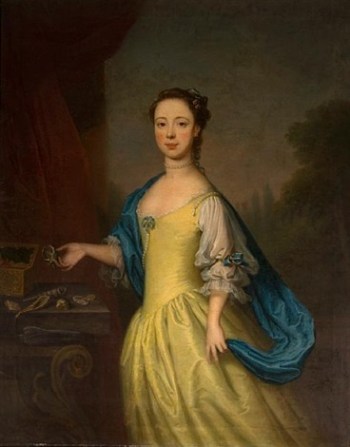
Thomas Bardwell, Portrait of a Girl in a Yellow Dress Holding a Shell, 1756, oil on canvas, 126 × 101 cm (sold at Bonhams, 2 December 2010).
The last few decades have produced a number of studies devoted to the relationship between collecting and science, highlighting the relationship between a growing interest in botany and the fascination with the collection of naturalia, especially from the mid-sixteenth century onwards. These objects of natural origins aroused the admiration of enthusiasts and scientists alike. This passion for collecting reached various corners of society: the academic garden at Leiden University included an ambulacrum that housed dried plant specimens, fossils, and taxidermized animals (Egmond 2010); artists kept collections of rarities not only for use in the studio, but also to satisfy their personal curiosity (Rijks 2022); and Petronella de la Court’s shell collection was represented in her prized dollhouse, and mentioned several times in Georg Eberhard Rumphius’ seminal text D’Amboinsche Rariteitkamer (Powell-Warren 2023). Indeed, the interest in collecting even spawned its own genre of still life painting. The interest in such wonders of nature and the desire to possess them often went beyond the ‘simple’ collecting of specimens, dried samples, or shells obtained through exchanges and purchases. In fact, they could often go so far as to push those who possessed gardens or parks to engage in botanical experiments that led to attempts to grow tropical flowers and fruits even if it was in unfavourable climates and hostile terrain, and even to promote scientific expeditions to study and collect specimens in distant and exotic lands.
More recent scholarship has addressed several issues regarding collecting practices, the intersection between collecting and science, and even the participation of women in collecting. Among other ground-breaking works, the following spring to mind: Possessing Nature (Findlen 1994); Visible Empire: Colonial Botany and Visual Culture in the Hispanic Enlightenment (Bleichmar 2012); Objects in Motion in the Early Modern World (Bleichmar and Martin, eds.) 2015); Conchophilia (Bass et al. 2021); Rarities of these Lands (Swan 2021); and Women and the Art and Science of Collecting (Leis and Wells, eds.) 2021).
What remains un- or underexplored, however, is the extent to which—if at all—collecting and scientific experimentation and exploration were related in the early modern period. Thus, this workshop aims to focus attention on the collections of naturalia, on the one hand, and on the attempts to grow exotic plants in Europe and the adventurous journeys that the search for tropical plants and animals they encouraged, on the other. The organizers of this workshop, Maddalena Bellavitis and Catherine Powell-Warren, invite interdisciplinary contributions addressing the topic from the perspective of each discipline, from art history to material culture, from botany to gastronomy, from travel literature to cartography. Proposals that feature a female figure as protagonist are particularly encouraged, as the importance of the female contribution to this topic, although demonstrated, remains under-researched and under-published. To be considered for participation, please provide a single PDF document containing (in English) a short bio and a one-page proposal for a 20-minute presentation of original, unpublished research. Applications may be sent to maddalena.bellavitis@gmail.com by 15 January 2024. Participants will be notified at the beginning of February.
Conference | Scientific Objects in the Museum
From ArtHist.net:
Les objets scientifiques au musée: Comment étudier et exposer l’histoire des sciences? XVIe–XIXe siècle
Musée du Louvre, Centre Dominique-Vivant Denon, Paris, 11–13 December 2023
Rencontre organisée dans le cadre du projet «Réflexions ciblées autour de la muséologie entre la France et l’Amérique du Nord d’hier à nos jours: collections, politiques culturelles et innovations muséographiques», soutenu par l’accord France-Canada pour la coopération et les échanges dans le domaine des musées (Ministère de la Culture, France / Ministère de l’enseignement supérieur et de la recherche, France / Ministère du patrimoine canadien, Canada).
l u n d i , 1 1 d e c e m b r e 2 0 2 3
Journée du 11 décembre ouverte au public, Centre Dominique-Vivant Denon; inscription obligatoire à centre-vivant-denon@louvre.fr. Les inscrits sont priés de se présenter munis de leur carte d’identité.
9.00 Mot de bienvenue par Françoise Mardrus (Directrice, direction des Études muséales et de l’Appui à la recherche, musée du Louvre) et Vincent Droguet (Conservateur général du patrimoine, sous-directeur des collections, Service des Musées de France), à confirmer
9.10 Présentation du déroulement des trois journées par Françoise Dalex (direction des Études muséales et de l’Appui à la recherche, musée du Louvre)
9.30 Objets d’art et de science: Points de vue de la recherche
Présidence de séance: Philippe Cordez
• Susanne Thürigen (Curator for Scientific Instruments, History of Medicine and Pharmacy, Arms and Armour, Germanisches Nationalmuseum, Nuremberg), The Behaim Globe: History and Future of a Political Instrument
• Federica Gigante (Research Associate, Faculty of Asian and Middle Eastern Studies / Oxford Centre for the History of Science, Medicine, and Technology, University of Oxford), Du cabinet de curiosités au musée d’aujourd’hui: L’histoire remarquable d’un astrolabe longtemps méconnu
• Sven Dupré (Professor of History of Art, Science and Technology / Director, Research Institute for History and Art History, Utrecht University), Glass, Conservation, and the Art of Scientific Instrument Making
• Marco Storni (Postdoctoral researcher, EOS project RENEW18, Université Libre de Bruxelles), Vers une histoire alternative de la mesure du temps: Les sabliers, XVe–XVIIIe siècle
• Omar Nasim (Professor of History of Science, University of Regensburg), Furniture History of Science: Merging Material and Visual Cultures
12.30 Pause déjeuner
14.00 Visite et présentation de la salle des objets scientifiques au musée du Louvre
15.00 Quelques collections et expositions d’objets scientifiques en Europe
Présidence de séance: Françoise Dalex
• Marta Lourenço (National Museum of Natural History and Science, MUHNAC, Portuguese Infrastructure of Scientific Collections, University of Lisbon), An Overview of the Recent Past in the Preservation and Access of Scientific Heritage: Where Are We Now?
• Rebekah Higgitt (Principal Curator of Science, National Museums, Scotland, Edinburgh), Collections and Displays of Historic Scientific Instruments in United Kingdom Museums
• Giorgio Strano (Head of Collections, Museo Galileo, Florence), Displaying the Medici and Lorena Collections of Historic Scientific Instruments at the Museo Galileo in Florence
• Dominique Bernard (maître de conférences (honoraire) en physique, Université de Rennes 1, membre de l’association Rennes en Sciences), Les instruments scientifiques et l’enseignement: Quelques exemples de l’université de Rennes
17.30 Vanessa Ferey et Jean-François Gauvin: Commentaire général et résumé de la journée
m a r d i , 1 2 d e c e m b r e 2 0 2 3
Visites-ateliers, pour les intervenants
Musée des Arts et Métiers
10.00 Présentation de la collection Lavoisier par Marco Beretta (Professor, Department of Philosophy and Communication Studies, History of Science and Technology, Université de Bologne)
Muséum national d’Histoire Naturelle
14.00 Visite de la salle des collections de chimie avec Christine Maulay-Bailly (ingénieur d’études CNRS en analyse chimique, Responsable technique de la Chimiothèque/Extractothèque, Unité Molécules de Communication et Adaptation des Microorganismes, Museum national d’Histoire naturelle) et Brice Monnely (secrétaire Gestionnaire, Unité Molécules de Communication et Adaptation des Micro-organismes, Museum national d’Histoire naturelle)
15.00 Visite de la zoothèque avec Pierre-Yves Gagnier (délégué à l’innovation numérique, Muséum national d’Histoire naturelle)
m e r c r e d i , 1 3 d e c e m b r e 2 0 2 3
Visites-ateliers, pour les intervenants
Musée de la Marine, réserves de Dugny
10.00 Présentation des réserves, de la documentation, d’objets non exposés par Louise Contant (Cheffe du département des Collections), Eric Rieth (responsable de la recherche scientifique au musée national de la Marine, directeur de recherche émérite au CNRS, membre de l’Académie de Marine, spécialiste d’archéologie nautique médiévale et moderne des espaces maritimes et fluviaux), Marianne Tricoire (conservatrice du patrimoine en charge des objets scientifiques et techniques), et Léa Surrel (chargée de documentation)
Musée de la Marine, Paris, palais de Chaillot
15.00 Visite du musée par Louise Contant (Cheffe du département des Collections) et Marianne Tricoire (conservatrice du patrimoine en charge des objets scientifiques et techniques)
Online Talk | Julie Park, Lady Scott’s Landscape in a Dark Room

Paul Sandby, Roslin Castle, Midlothian, ca. 1780, gouache on medium laid paper, mounted on board, sheet: 46 × 68 cm
(New Haven: Yale Center for British Art, Paul Mellon Collection, B1975.4.1877)
◊ ◊ ◊ ◊ ◊
This afternoon from 12.30 to 1.00, from the Yale Center for British Art:
Julie Park | Lady Scott’s Landscape in a Dark Room
Online, Tuesday, 5 December 2023, 12.30pm
Julie Park will discuss the role of the camera obscura used by Lady Frances Scott as depicted in Paul Sandby’s landscape painting Roslin Castle, Midlothian (ca. 1780) and the dynamics of interiority and looking that it mediates. Park chose a detail from this painting for the cover of her recent monograph My Dark Room, which explores the camera obscura as a paradigm for the designs and experiences of interiority in eighteenth-century England’s spaces of the built environment. Please register here»
Julie Park is Paterno Family Librarian for Literature and professor of English at Pennsylvania State University. She is the author of My Dark Room (2023) and The Self and It (2009).










 Enfilade
leave a comment