New Book | The Borders of Chinese Architecture
From Harvard UP:
Nancy Shatzman Steinhardt, The Borders of Chinese Architecture (Cambridge: Harvard University Press, 2022), 448 pages, ISBN: 978-0674241015, $57.
 An internationally acclaimed expert explains why Chinese-style architecture has remained so consistent for two thousand years, no matter where it is built.
For the last two millennia, an overwhelming number of Chinese buildings have been elevated on platforms, supported by pillars, and covered by ceramic-tile roofs. Less obvious features, like the brackets connecting the pillars to roof frames, also have been remarkably constant. What makes the shared features more significant, however, is that they are present in Buddhist, Daoist, Confucian, and Islamic milieus; residential, funerary, and garden structures; in Japan, Korea, Mongolia, and elsewhere. How did Chinese-style architecture maintain such standardization for so long, even beyond China’s borders?
Nancy Shatzman Steinhardt examines the essential features of Chinese architecture and its global transmission and translation from the predynastic age to the eighteenth century. Across myriad political, social, and cultural contexts within China and throughout East Asia, certain design and construction principles endured. Builders never abandoned perishable wood in favor of more permanent building materials, even though Chinese engineers knew how to make brick and stone structures in the last millennium BCE. Chinese architecture the world over is also distinctive in that it was invariably accomplished by anonymous craftsmen. And Chinese buildings held consistently to the plan of the four-sided enclosure, which both afforded privacy and differentiated sacred interior space from an exterior understood as the sphere of profane activity. Finally, Chinese-style buildings have always and everywhere been organized along straight lines. Taking note of these and other fascinating uniformities, The Borders of Chinese Architecture offers an accessible and authoritative overview of a tradition studiously preserved across time and space.
Nancy Shatzman Steinhardt is Professor of East Asian Art and Curator of Chinese Art at the University of Pennsylvania and the author of Chinese Architecture: A History (2019). Her work has been supported by the Guggenheim Foundation, Getty Foundation, National Endowment for the Humanities, and the American Philosophical Society.
c o n t e n t s
Preface
Introduction: The Borders Problem
1 Chinese Architecture before China
2 Han
3 Architecture before Reunification
4 Seeing the Sixth Century as the Seventh and Eighth
5 Tang Internationalism
6 Defining Chinse Architecture and Borders during Liao
7 Western Xia, Song, Japn, Jin
8 A Revisionist History of Yuan Architecture
9 Ming
10 The Long Eighteenth Century
Afterword
New Report | Survey of Asian Ceramics, National Trust for Scotland
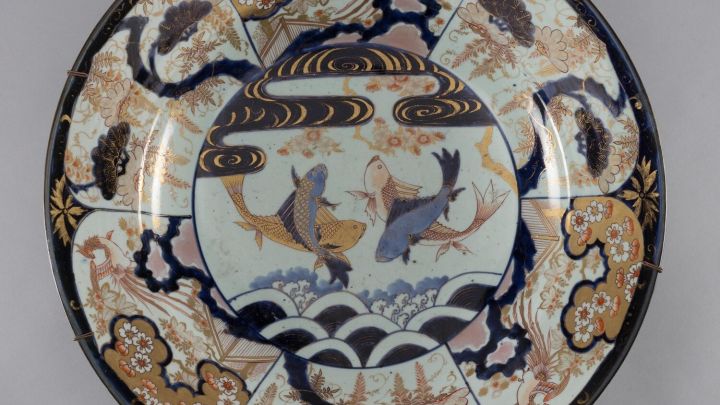
Large dish, porcelain, painted in underglaze blue, iron-red, and gold, Imari-type palette, made in Arita kilns, Japan, Edo period, c.1700–20
(National Trust for Scotland)
◊ ◊ ◊ ◊ ◊
The report was released early this year; Patricia Ferguson provides an introduction here. The full report is available (for free) as a PDF file here.
Patricia Ferguson, Survey of Asian Ceramics in the Collection of the National Trust for Scotland (National Trust for Scotland, 2023), 162 pages.
Between 2017 and 2019 the National Trust for Scotland delivered Project Reveal, a major collections project inventorying a collection of over 140,000 objects, distributed across 50 properties throughout Scotland. Encompassing major object groupings in the areas of fine and decorative art, household furniture and domestic life, these collections chart the experiences of people living in Scotland through 500 years of Scottish history, as well as demonstrating Scotland’s past relationships with the rest of the world.
This survey of Asian ceramics is a natural successor to Project Reveal. It delves deeper into the history and significance of a collection of circa 1,700 ceramic items. Undertaken by the independent researcher Patricia F. Ferguson this report sets out the survey findings, drawing together disparate existing research on the subject and contributing new collection research and knowledge. Focusing on key collections at nine different National Trust for Scotland properties, the report positions the collections within the broader context of historic ceramic production and collecting, with attention to influences such as: fashion and the role of royalty; production in and trade with China and Japan; and the growth of and changes in demand.
Patricia Ferguson is a ceramic specialist with an MA from the School of Oriental and African Studies (SOAS), London. She has worked in London at the British Museum and Victoria & Albert Museum, and as Honorary Adviser on Ceramics to the National Trust (England, Wales, and Northern Ireland). She published Ceramics: 400 Years of British Collecting in 100 Masterpieces in 2016.










 Enfilade
leave a comment