New Book | Symbols and Forms in Jewish Art
From IRSA, the Institute for Art Historical Research (founded in Venice in 1979 as the Istituto per le Ricerche di Storia dell’Arte, the institute was relocated to Florence and then to Vienna, before arriving in its current home in Cracow). Orders can be placed via email, irsa@irsa.com.pl.
Rachel Wischnitzer-Bernstein, Symbols and Forms in Jewish Art, translated by Renata Stein (Cracow: IRSA, 2022), 212 pages, ISBN: 978-8389831354. With an essay on Wischnitzer’s life and work by Shalom Sabar.
 This is an English translation of a classic study on the iconography of Jewish art by Rachel Wischnitzer-Bernstein (1885–1989), originally published in Berlin in 1935 as Symbole und Gestalten der jüdischen Kunst. The outbreak of the Second World War prevented the book from spreading, and its uncirculated print-run was almost entirely destroyed by the Nazis. The few surviving copies of the book that circulated among specialists, gained this highly innovative work on Jewish iconography a position of a classic study. The present English edition makes the legendary book by Rachel Wischnitzer-Bernstein available to wider audiences of international readers for the first time.
“Against all odds, two years after the Nazi party and Hitler rose to power, Symbole und Gestalten der jüdischen Kunst appeared in Berlin in the mid-1930s. Presenting the visual art of the Jewish people as a sophisticated humanistic achievement, this handsome, beautifully produced volume illustrates the deep meanings and the powerful symbols of the Jewish people over the ages. Moreover, the book’s thesis and the materials gathered in it are underlined by an implied aspiration: to strengthen Jewish identity and make the Jews of the time conscious and proud of their rich heritage. The author of this courageous book…, Rachel Wischnitzer (1885–1989), a modest woman, small in size, …contributed more than any other scholar of the first half of the twentieth century to the establishment and development of a new field of academic study—the history of Jewish art.” —From Shalom Sabar’s biographical essay
Rachel Wischnitzer (1885–1989) during her long life produced 344 publications, including books, scholarly articles, reviews of books, and exhibitions, as well as encyclopedia items. Together with her husband Mark, she edited the literary and artistic periodicals Rimon and Milgroim. The doyenne of historians of Jewish art, she was a pioneer in the field when she published in 1913 her first article on the ancient synagogue in Lutsk. Her wide interests drove her to study and publish about Hebrew illuminated manuscripts, synagogue architecture, Jewish and general iconography. Her major contribution to Jewish iconography was a courageous attempt to find a single theme to which all the paintings in the third century Synagogue at Dura Europos would adhere.
c o n t e n t s
Foreword by Józef Grabski
Introduction
1 Divine Revelation
2 Kingdom
3 Doctrine
4 Priesthood
5 Judaism
6 Festivals and Customs
7 Messianic Hope
8 Time and the Universe
Shalom Sabar — Rachel Wischnitzer: Life and Work
Conference | Women in Architecture before 1800

From the conference website:
WoArch 2024: Women as Builders, Designers, and Critics of the Built Environment before 1800
Online and in-person, Palazzo Taverna, Rome, 25–27 January 2024
Organized by Shelley Roff, Consuelo Lollobrigida, and Francesca Riccardo
We are pleased to announce the first edition of the conference series WoArch (Women in Architecture) as an international symposium entitled Women as Builders, Designers, and Critics of the Built Environment before 1800, which will take place in Rome, 25–27 January 2024. Organized by the University of Arkansas Rome Center in collaboration with the School of Architecture + Planning at the University of Texas at San Antonio, this symposium is also supported by the Women in Architecture Affiliate Group of the Society of Architectural Historians. The event will be hosted in person at the Rome Center in Palazzo Taverna, Rome, and will be live-streamed on the Rome Center YouTube channels.
For almost 30 years, the literature investigating women and the built environment before the modern era has focused on women’s patronage of architecture. This symposium is designed to open a discussion about what is missing from this conversation and yet can be found in the historical record: the roles that women of various social classes played in shaping architecture, landscapes, and cities in diverse parts of the world and the cultural and political implications of their activities. In part, the symposium calls for a re-interpretation of patronizing activities by women; and, from another point of view, it directs the spotlight toward women engaging in socio-political urban reform, creating networks of design influence, managing and participating in construction, and serving as the designer of the built environment across a broad geographic scope before modern industrialization.
For program details and speakers’ abstracts, please visit our webpage. For other queries, please write to Shelley Roff, shelley.roff@utsa.edu.
2 5 j a n u a r y | w o m e n a s b u i l d e r s a n d d e s i g n e r s
9.00 Introduction by Shelley E. Roff, Consuelo Lollobrigida, and Francesca Riccardo
9.20 Session 1: A Passion for Design
Moderator: Francesca Riccardo
• Alba Carballeira (Private Foundation, Spain), Building Knowledge: Princesse des Ursins’ Gesamtkunstwerk for Philip the V
• Rebecca Shields (Virginia Commonwealth University), Frances Stewart, the Duchess of Lennox and Richmond, and Richmond House
• Consuelo Lollobrigida (University of Arkansas Rome Center), The Influence of Borromini in Bricci’s Architectural Apprenticeship and Background
• Laura Hindelang (University of Bern), Female Architectural Agency Pre-1900: Conceptualizing Cross-Cultural Perspectives
• Izabela Kopania (Institute of Art, Polish Academy of Sciences), Dutch-British Style for Cottage Architecture: Magdalena Morska’s Aesthetic Vision of Zarzecze Village
12.30 Archive Oratorio dei Filippini
14.20 Lunch
16.00 Session 2: Women Building the City
Moderator: María Elena Díez Jorge
• Mariana de Moura (Universidade Federal de Minas Gerais, Brazil), Women and Construction Know-How: Critical Fabulations from Self-Produced Sites
• Barry Stiefel (College of Charleston), To Carry Forty Pounds of Clay: Enslaved Black Women and Children Building Trades Workers in Early America
• Elizabeth Biggs (Trinity College Dublin) and Kirsty Wright (Historic Royal Palaces), Women Shaping the Palace of Westminster, ca. 1290–1700
• Nicoletta Marconi (Università degli Studi di Roma Tor Vergata), Unsuspected Presences: Women Workers on 16th–18th Century Roman Building Sites
• Gül Kale (Carleton University, Canada), Women as Shapers of Spatial Practices in Ottoman Istanbul
2 6 j a n u a r y | c o n n e c t i n g s p h e r e s o f i n f l u e n c e
9.00 Session 3: Critical Agents of Transformation
Moderator: Alba Carballeira
• Julie Beckers (University of Leuven), Rebuilding for Observance: Architectural Changes to Santa Maria di Monteluce in Perugia post Reform, ca. 1448–1485
• Sol Pérez Martinez (ETH Zürich), Nuns Reporting the City: Convents, Urban Life, and Female Experiences of 1700s Chile
• Elena Rieger (ETH Zürich), Urban Living: Emilie von Berlepsch and the Late 18th-Century City
• Christina Contandriopoulos and Étienne Morasse-Choquette (Université du Québec à Montréal), “Woman Writing on the Art and Architecture in 18th-Century Paris
• Anne Hultzsch (ETH Zürich), Conversations at the Tea Table: Eliza Haywood and the Sites of Criticism
11.50 San Giovanni dei Fiorentini, Galleria Spada, Palazzo Falconieri
13.45 Lunch
15.30 Session 4: The Politics of Gender in Building
Moderator: Consuelo Lollobrigida
• María Elena Díez Jorge (Universidad de Granada), The Prestige of Women through Architecture in 16th-Century Spain
• Ceren Göğüş (İstanbul Kültür University), Self-Representation of Ottoman Women through Public Projects
• Jaroslaw Pietrzak (University of the National Education Commission, Krakow), Polish Abbesses as Restorers of Churches and Monasteries in the 18th Century in the Light of Monastery Chronicles
• Konrad Niemira, (Museum of Literature / Polish Academy of Sciences, Warsaw)
• Sigrid de Jong (ETH Zürich), Women as Agents of Change: Female Interventions in Parisian Architecture
18.10 Keynote Address
• Anuradha Chatterjee (Dean of the School of Design and Innovation, RV University, India), Remembering (and Forgetting) Ahilya Bai Holkar’s Architectural Legacy
2 7 j a n u a r y | m a t r o n a g e i n a n e w l i g h t
9.30 Roundtable
Moderator: Shelley Roff
• Shelley Roff (University of Texas at San Antonio), Introduction: Matronage in a New Light
• Margaret Woodhull (University of Colorado, Denver), Women and Public Buildings around the Ancient Mediterranean: Some Thoughts on What and Why They Built
• Jyoti Pandey Sharma (School of Planning and Architecture, Delhi), Invisible Patrons and Stewardship of the Faith: The Begami Masjids (Mosques built by Mughal Ladies) of the Mughal Badshahi Shahar (Imperial City) Shahjanahabad
• Alper Metin (Università di Bologna ), Women Shaping the Ottoman Capital, from Saliha to Nakşıdil Sultan, 1730–1817
• Hannah Mawdsley and Eleanor Harding (National Trust, UK), Unpicking the Evidence of Elizabeth Murray’s Role in the Expansion of Ham House
• Mercedes Simal López (Universidad de Jaén), Elizabeth Farnese, Builder of the Majesty of Philip V
• Priscilla Sonnier (University College Dublin), ‘Noble Minded Sister’: Grizelda Steevens and Dublin’s Steevens’ Hospital, 1717–1733
• Danielle Willkens (Georgia Institute of Technology), Paper Patrons: Women of the Transatlantic Design Network
10.50 Discussion
11.30 Closing Remarks
Conference | York and the Georgian City
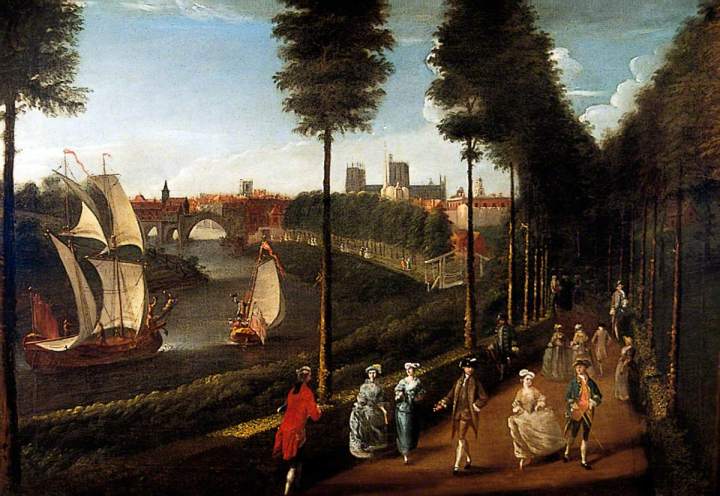
Nathan Drake, The New Terrace Walk, York, ca. 1756, oil on canvas, 76 × 107 cm
(York Art Gallery)
◊ ◊ ◊ ◊ ◊
From the York Georgian Society:
York and the Georgian City: Past, Present, and Future
King’s Manor, York, 18 May 2024
Joint conference presented by the York Georgian Society and the Centre for Eighteenth-Century Studies, University of York
The aim of this conference is to re-evaluate the notion of York as a Georgian city, which was one of the founding premises of the York Georgian Society in 1939. It will examine to what extent York can be described as a ‘Georgian’ city, and whether that label is relevant or meaningful in the present day. Why not a medieval, or a Victorian city? Is ‘Georgian’ merely a paradigm for good taste?
Keynote Presentations
• Rosemary Sweet (University of Leicester), When Did York Become Georgian?
• Madeleine Pelling (historian, writer, and broadcaster), Writing on the Wall: Graffiti, Rebellion and the Making of 18th-Century Britain
Other talks will include Constance Halstead on Anne Lister, Rachel Feldberg on Jane Ewbank, Matt Jenkins on whether York is an archetypical Georgian city, and John Mee on Manchester College, York. The full programme will be posted nearer the event.
Standard ticket prices (which include morning coffee, a light lunch, afternoon tea, and a reception) are £25; with discounted rates available to students (£5) and YGS members and University of York Staff (£15). Tickets can be booked here.
Exhibition | British Vision, 1700–1900, Selected Drawings and Prints

Joseph Farington, Dumbarton Rock from the South, 1788, pen and gray ink and watercolor; sheet: 38 × 68 cm
(New York: The Metropolitan Museum of Art, Purchase, Raymond Lifchez Living Trust Gift, 2014.148)
◊ ◊ ◊ ◊ ◊
Now on view at The Met:
British Vision, 1700–1900: Selections from the Department of Drawings and Prints
The Metropolitan Museum of Art, New York, 7 December 2023 — 5 March 2024
This rotation from the Department of Drawings and Prints celebrates recent additions to the collection by British artists who worked across two centuries, from 1700 to 1900. Landscape is a focus, with the genre becoming closely allied to the growing popularity of watercolor during this period. Around 1760, artists like Paul and Thomas Sandby, Francis Towne, and Thomas Jones began to explore the medium’s expressive potential. In the nineteenth century, dedicated watercolor societies were established and held regular exhibitions to promote their members’ work. Increasingly developed and poetically resonant compositions sought to challenge the preeminence of oil painting.
In this display, watercolors made rapidly out of doors by John Constable and Peter De Wint may be compared to finished compositions by John Brett, Samuel Palmer, and Alfred William Hunt. Travel’s ability to spur creativity is demonstrated by works that respond to sites in Britain, France, Italy, Caucasia, and North Africa. Nature studies, conversely, affirm how foreign flora became increasingly available at home. Finally, the sustained importance of the figure is represented by early chalk and pastel renderings by Joseph Wright of Derby and Allan Ramsay, vibrantly colored later portraits by David Wilkie and John Frederick Lewis, and representations of Black models by Lewis, William Henry Hunt, and Simeon Solomon.
Images of the works are available here»










 Enfilade
leave a comment