Call for Papers | Environmental Impacts of Catholic Missions, Atlantic
From ArtHist.net:
The Environmental Impacts of Early Modern Catholic Missions in the Atlantic Space
Université Paris 1 Panthéon-Sorbonne, 9 March 2024
Université du Québec à Montréal, 18 March 2024
Proposals due by 31 December 2023
These series of workshops aim to explore the role of the Catholic Church, through its missionary undertaken, in the global environmental upheavals and discoveries of the early modern period. Venturing wide and far beyond the familiar European sphere, early modern missionaries frequently used the rhetoric of Theatrum Mundi to reflect on their encounters with previously unknown cultures. What has escaped scholars’ attention, however, is how these rapidly evolving dramas of evangelization in turn shaped the seemingly timeless backstage setting of Nature. As the missionaries voyaged away and established new religious communities, they were not only faced with social and cultural challenges raised by the vastly different linguistic, political, and philosophical traditions, but they also had to adapt to unfamiliar geographical, climate, and material conditions as they sought to construct churches or realize liturgical rituals, not to mention the extensive agricultural and medical activities they had to pick up for personal survival in often severe natural conditions.
We would like to ask and try to answer questions such as:
• How did the missionaries adapt to local conditions of climate, sunlight, and building technologies when constructing churches?
• How did the missionaries accommodate rituals and its theological implications (such as the presence of wine and bread in the Mass) in reaction to local natural resources?
• How did early modern missionaries develop survival precautions over time to adapt to the dangers of these new natural environments?
• To what extent were the early modern global missionary activities impacted by major environmental crisis of this period, such as the epidemics or the Little Ice Age?
• How did the missionaries’ encounters with new geographical spaces and conditions stimulate knowledge creation and circulation, such as in the areas of cartography, botany, zoology, and medicine?
These are a few of the many possible new questions we hope to explore in this workshop. One overarching method we want to propose is to think about early modern Catholicism in the plural term, as theorized by Simon Ditchfield. Studies on post-Tridentine missions tended to emphasize the central authoritative role of Rome, focusing especially on the role of the missionary as leader in the creating of new religiosity, new economical exchanges, or new societies. The new attention paid to missionaries’ interactions with local natural conditions will complexified our understanding of Rome as one of the few truly global institutions of the early modern period acting not only as a religious and evangelist force but also in the colonialist expansions.
These two workshops will be consecrated to the missions in the Atlantic space. It will be followed by a second series of workshop in 2025 to look over the Pacific space and will be concluded by an edited volume. Please send an title, a short abstract (300 words) and a one-page CV to harvey.isabel@uqam.ca, Alysee.Le-Druillenec@univ-paris1.fr, and wenjies@princeton.edu, before 31 December 2023.
Organizers
Isabel Harvey (Université du Québec à Montréal), Alysée Le Druillenec (University of Paris 1 Pantheon-Sorbonne), and Wenjie Su (Princeton University)
Call for Papers | Romanticism’s Colonial Legacies
From ArtHist.net:
Romanticism’s Colonial Legacies in and beyond Europe: Critical Perspectives on Art and Visual Culture
Frankfurt am Main, 10–12 October 2024
Proposals due by 29 February 2024
The study of Romanticism has been markedly imbued with a sense of heroism, an epic aura, and a novelistic ethos, ultimately culminating in a pronounced ‘romanticisation’ of that era. However, this standpoint proves insufficient to elucidate the evolution of Romanticism and its impact beyond Europe. While some studies have critically engaged with the nationalist aspects of some variants of European Romanticism, matters pertaining to race, class, expansionism, and colonialism seemed not to belong to the Romantics’ sensitivity, becoming ‘the monsters hidden in the attic’ of Romanticism studies.
Scholarship has so far neglected, for example, the role played by the Romantic generation as agents of power actively engaged in the surveying, chronicling, mapping and imaginative rendering of distant territories that either already were or were about to be colonised. Similarly, practices such as the classification and depiction of flora, fauna, and humans carried out at and beyond the boundaries of Europe in the name of Enlightenment ideals are widely praised, despite the involvement of Romantic sciences in an extensive global inventory project that, for the most part, sought the imposition of a singular and dominant conception of knowledge as part of the Western agenda of modernity.
In light of these observations, the conference seeks to expand the critical examination of late 18th- and 19th-century art and visual culture, including intermedial perspectives. We aim to challenge canonical narratives by delving into the intricate connections with wider socio-political dimensions. These encompass racialism, class, gender, evolution, Imperialism, and colonial power. We warmly invite presentations that address facets and transformations of Romantic art and, more widely, late 18th- and 19th-centuries visual cultures in the Americas, the Caribbean, Africa, Asia, and Oceania, as well as Europe and its peripheries viewed through the lenses of intersectionality, (eco-)feminism, Marxism, postcolonial theories, Indigenous epistemologies, and critical race studies.
Possible areas of focus and themes include
• Romanticism and race
• Arts and Romantic sciences
• Concepts of ‘Nature’ and ‘Landscape’
• Romantic ecology
• The Sublime and the (tropical) Picturesque
• Botanical and zoological illustrations
• Maps and cartographies
• Gender and sexuality
• Nationalism(s) and colonialism(s)
• Indigeneity and Europeanness
• Class and social relationships
The language of the conference is English. Please email abstracts (max. 300 words), a short biography (150 words) and a selected list of publications to Dr Miguel Gaete (miguel.gaete@york.ac.uk) by 29th February 2024. Total or partial travel expenses can be covered if needed.
Keynote Speaker
Professor Luciana Martins (Birkbeck University London)
Organisers
Prof. Dr. Mechthild Fend
Dr. Miguel Gaete
Prof. Dr. Frederike Middelhoff
Call for Papers | Historical Botanical Gardens
From ArtHist.net and the conference website:
2nd International Congress of Historical Botanical Gardens
Wien, 29–31 July 2024
Proposals due by 15 January 2024
 The Austrian Federal Gardens in cooperation with the Botanical Garden of the University of Vienna, the Natural History Museum Vienna, and the International Association of Botanic Gardens (IABG) look forward to an interesting continuation of the 1st International Congress of Historical Botanical Gardens held in Lisbon in 2021. The initial impulse to communicate the issues and importance of botanical gardens to a broader public, highlighting their history as well as their importance and building a common network will be continued in 2024. For more than 450 years, plants have been collected, cultivated, studied, and exhibited in Vienna. This long and continuous tradition makes Vienna one of the most important locations for current and historic plant research and conservation.
This second event will expand the focus to include conservation and preservation of plants and gardens. How can we protect historical botanical gardens and their heritage from the major threats of our time, such as lack of resources, climate change, war, and conflicts of all kinds? What can we learn from the turbulents in the past? We invite papers related to the fields of Botanical Gardens, Historical Gardens, Plant Collections, and related disciplines. Submissions from students, associations, and independent researchers are encouraged. Presentation formats include 5-minute pitch presentations and 20-minute talks, as well as posters.
Examples for potential presentations:
Session 1 | The Transition of Historical Botanical Collections
• Survival of botanical collections in times of war or crisis
• Transition of princely botanical collections into the ownership of modern republics
• Transition of colonial collections into the ownership of independent states
• Endangerment of historical botanical collections during military conflicts
• Historical botanical collections and climate crisis
• Preliminary protective measures
Session 2 | Horticulture: Challenges in Daily Horticulture Practice
• Pest control and measures
• Prevention: biological cultivation and biological treatments
• Changes in cultivation because of climate change
• Cultivation and conservation of single plants of particular high value
• Protection of the collection
• Handling and protection of plants for and during exhibitions
Session 3 | Science: Sharing of Knowledge
• Importance of traditional horticultural crafts in historical botanical gardens
• Methods to conserve and transmit (horticultural) knowledge
• Which knowledge is transmitted
• Transition of traditional knowledge and traditional techniques to modernism
• Networking: international and transdisciplinary relationships
Session 4 | Historical Botanical Gardens
• Portraits of historical botanical gardens (existing and lost)
Please send your abstract (maximum of 250 words, excluding title and affiliation) as a Word file with an indication of the topic as well as the preferred presentation format to ichbg2024@bundesgaerten.at before 15 January 2024. You will be informed about acceptance and format of the presentation by 25 March 2024. For further information, please see the conference website, and don’t hesitate to contact the organizing committee at ichbg2024@bundesgaerten.at.
New Book | Hidden Patrons: Women and Architectural Patronage
From Bloomsbury:
Amy Boyington, Hidden Patrons: Women and Architectural Patronage in Georgian Britain (London: Bloomsbury Visual Arts, 2023), 328 pages, ISBN: 978-1350358614 (hardcover), £65 / ISBN: 978-1350358607 (paperback), / £20.
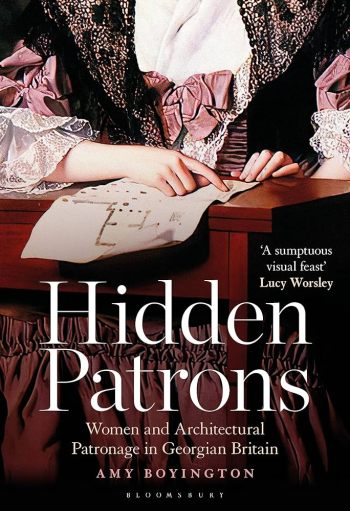 An enduring myth of Georgian architecture is that it was purely the pursuit of male architects and their wealthy male patrons. History states that it was men who owned grand estates and houses, who commissioned famous architects, and who embarked upon elaborate architectural schemes. Hidden Patrons dismantles this myth—revealing instead that women were at the heart of the architectural patronage of the day, exerting far more influence and agency than has previously been recognised. Architectural drawing and design, discourse, and patronage were interests shared by many women in the eighteenth century. Far from being the preserve of elite men, architecture was a passion shared by both sexes, intellectually and practically, as long as they possessed sufficient wealth and autonomy. In an accessible, readable account, Hidden Patrons uncovers the role of women as important patrons and designers of architecture and interiors in eighteenth-century Britain and Ireland. Exploring country houses, Georgian townhouses, villas, estates, and gardens, it analyses female patronage from across the architectural spectrum and examines the work of a range of pioneering women from grand duchesses to businesswomen to lowly courtesans. Re-examining well-known Georgian masterpieces alongside lesser-known architectural gems, Hidden Patrons unearths unseen archival material to provide a fascinating new view of the role of women in the architecture of the Georgian era.
Amy Boyington is a social and architectural historian, with a PhD from the University of Cambridge. She serves as a trustee of the Georgian Group and is a popular Instagram and TikTok historian.
c o n t e n t s
List of Illustrations
Acknowledgements
Note on Text
List of Abbreviations
Introduction
1 The Country House
2 The Town House
3 The Villa
4 The Wider Estate, Garden Design, and Ornamental Buildings
Conclusions
Bibliography
Index










 Enfilade
leave a comment