The Huntington Acquires a Portrait by Goya
From the press release (20 November 2023) . . . .
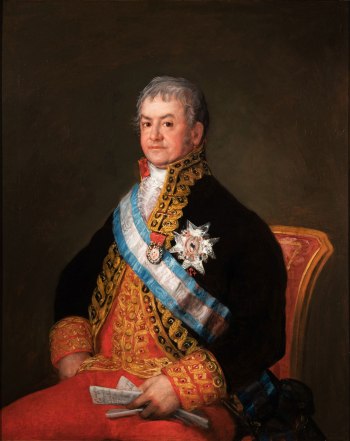
Francisco José de Goya y Lucientes, Portrait of José Antonio Caballero, Second Marqués de Caballero, Secretary of Grace and Justice, 1807, oil on canvas, frame: 135 × 114 × 9 cm (The Huntington Library, Art Museum, and Botanical Gardens, Gift of The Ahmanson Foundation).
The Huntington Library, Art Museum, and Botanical Gardens announced today that it has acquired a historic portrait by Spanish master Francisco José de Goya y Lucientes (1746–1828). Portrait of José Antonio Caballero, Second Marqués de Caballero, Secretary of Grace and Justice was painted in 1807, a time when Goya was renowned for his portraits of the Spanish nobility and just before the Napoleonic invasion of Spain profoundly altered the nature of his later work. While The Huntington holds a number of Goya’s etchings and aquatints, Portrait of José Antonio Caballero is the first Spanish oil painting to join The Huntington’s art collection and will complement its extensive holdings of Library materials on Spanish imperial history. The painting—which will go on view in the Huntington Art Gallery on 29 November 2023—is The Huntington’s third masterpiece acquired through a gift from The Ahmanson Foundation.
“Once again, The Ahmanson Foundation has proven to be an invaluable strategic partner, helping us reach our goals of broadening our collections with significant works and inviting new, interdisciplinary connections,” Huntington President Karen Lawrence said. “We couldn’t be more grateful to them for making possible the acquisition of such a superb and historically significant masterpiece.”
Considered one of the last Old Masters and one of the first and most influential great modern painters, Goya was celebrated during his lifetime for his ability to capture his subjects’ innermost personalities as well as their grandeur and political power—albeit with what has been perceived as an occasional layer of satire. He is also acclaimed for his virtuosic painterly style; flickering, impressionistic brushwork; and, in his later years, revolutionary subject matter.
Trained in Madrid and inspired by travels in Rome, Goya became a Spanish court painter in 1786, and he soon became known for such royal and aristocratic portraits as Portrait of José Antonio Caballero. But after the 1808 French invasion of Spain that began the Napoleonic Wars, Goya turned his artistic attention to portraying the horrors of war in paintings and prints.
“Portrait of José Antonio Caballero is historically fascinating and a prime example of Goya’s genius as a portraitist,” said Christina Nielsen, the Hannah and Russel Kully Director of the Art Museum at The Huntington. “Along with the exquisite French portrait by Élisabeth Louise Vigée Le Brun acquired with The Ahmanson Foundation last year, it will add an important international perspective to our outstanding collection of 17th- and early 18th-century British portraits.”
The Ahmanson Foundation funded The Huntington’s acquisition of Portrait of Joseph Hyacinthe François-de-Paule de Rigaud, comte de Vaudreuil (ca. 1784) by Vigée Le Brun (1755–1842), the most important female artist of 18th-century France, in 2022, and the monumental Portage Falls on the Genesee (ca. 1839) by Anglo American painter Thomas Cole (1801–1848) in 2021.
The sitter in the Goya painting, José Antonio Caballero (1754–1821), was from the minor nobility in Spain. He studied law and went on to a successful career in the royal court, holding four secretary positions. His accomplishments included convincing King Charles IV of Spain to conduct a vaccination campaign against smallpox that extended to the Spanish territories in North and South America and Asia. Goya painted the portrait when Caballero was the secretary of state and had just inherited the title of Marquis de Caballero from his uncle.
In the portrait, Caballero is depicted in a highly decorated ministerial uniform and seated in a red armchair. His black coat and bright red waistcoat are extensively embroidered with gold decoration. He looks directly at the viewer, conveying a sense of stature and power, with his right hand at his waist and his left hand holding papers. A powder-blue-and-white sash is draped across his chest, pinned with the Order of the Grand Cross of Charles III. The bright white insignia of a knight of the Order of Santiago is pinned to his coat.
The portrait will be installed in the Huntington Art Gallery, the former residence of founders Henry E. and Arabella Huntington, in a paneled room that was once Henry Huntington’s private office.
Spain’s Museum of Romanticism to Receive a Pieta by Goya
As noted at Art History News, from Spain’s Ministerio de Cultura:
Spain’s Ministry of Culture [has announced] that they have acquired an early Pieta by Francisco Goya. . . The painting is believed to have been inspired by the artist’s travels in Italy. The work was acquired for €1.5m and will head to the National Museum of Romanticism in Madrid.
◊ ◊ ◊ ◊ ◊

Francisco de Goya y Lucientes, Pietà, 1772–74, 84 × 58 cm (Madrid: Museo Nacional del Romanticismo).
El Ministerio de Cultura ha adquirido La Piedad, una obra fechada en la etapa temprana del pintor aragonés Francisco de Goya (1746–1828), por valor de 1,5 millones de euros. La obra se destinará a la colección permanente del Museo Nacional del Romanticismo, museo de titularidad estatal y gestión del Ministerio.
El cuadro, inédito hasta época reciente, permite conocer mejor la pintura religiosa del artífice. Mide 83,5 × 58 centímetros y conserva su tela y bastidor originales. La obra se ha fechado entre 1772 y 1774, por lo que es un testimonio relevante sobre las fuentes de inspiración que el aragonés recogió de su viaje a Italia, donde pudo conocer La Piedad de Miguel Ángel y otros modelos de Carracci, Maratti y Giaquinto. Tras su regreso a Zaragoza en 1771, Goya pudo expresar su evolución en sus trabajos en la Basílica del Pilar y en la Cartuja Aula Dei, con un estilo comparable con el de La Piedad adquirida por el Ministerio.
En la última década, el lienzo ha sido objeto de distintas solicitudes para su exportación, si bien estas han sido denegadas al tratarse de una obra de gran rareza, representativa del periodo temprano de la producción de su autor y por constituir uno de los pocos ejemplos de su obra religiosa, ayudando así a definir la figura del artista en su contexto.
Con La Piedad, el Museo Nacional del Romanticismo refuerza la presencia del “romántico quizá más glorioso y original,” en palabras del historiador del arte Manuel Bartolomé Cossío (1857–1935). Hasta ahora, la institución sólo contaba con una pieza de Goya, San Gregorio Magno, Papa, una obra monumental que pertenece al museo desde su fundación y que da buena prueba de la importancia que la producción del aragonés tuvo en el periodo romántico. Actualmente, el San Gregorio Magno, Papa preside el Oratorio, un espacio propio de las viviendas acomodadas que se empleaba para la devoción privada y donde se oficiaban los actos religiosos de carácter íntimo, como bodas, bautizos o velatorios. Precisamente, la temática y el tamaño de La Piedad sugieren que fue un encargo de algún eclesiástico o comitente de la burguesía zaragozana para cumplir una función devocional privada o doméstica.










 Enfilade
leave a comment