Restoration of Frescoes and Stuccowork at Palazzo Pisani
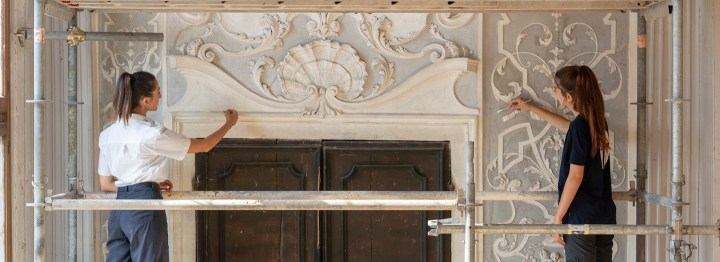
IVBC students restoring the stuccowork in the orchestra rehearsal room, summer 2023
(Venice: Palazzo Pisani; photo by Matteo De Fina)
◊ ◊ ◊ ◊ ◊
From the press release (via Art Daily) for the project (readers may know the Palazzo Pisani from the inclusion of its extraordinary rooftop for Hercule Poirot’s terrace earlier this year in A Haunting in Venice) . . .
Save Venice is proud to support the education and training of the next generation of art conservators by funding coursework and restoration fieldwork at the Istituto Veneto per i Beni Culturali’s restoration school. In 2023, this long-standing partnership fostered a new collaboration between the IVBC and Venice’s prestigious Conservatorio Benedetto Marcello in Palazzo Pisani, through a pilot initiative of conservation treatments funded by Save Venice with generous support by the Manitou Fund through Nora McNeely Hurley.
The 17th-century Palazzo Pisani, located next to Campo Santo Stefano, is the second largest palace in Venice, after Palazzo Ducale. The conservation of frescoes, stuccowork, and marble decoration in two rooms of the conservatory was undertaken in 2023 by the IVBC restoration school as a part of their post-graduate fieldwork program. The remarkable, initial results were presented to the public in December, and Save Venice is now continuing its engagement with the two institutions by funding a 2024 full-year program of stucco conservation in four rooms of the conservatory’s museum.
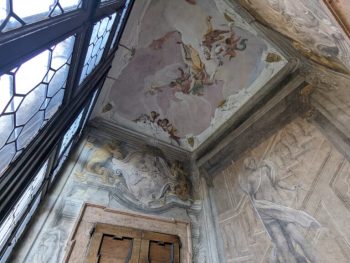
Fresco decoration in the antechamber (‘Adonis Room’), following conservation in 2023 (Venice: Palazzo Pisani; photo by Matteo De Fina).
Located on Palazzo Pisani’s 2nd floor—originally the primo piano nobile—the antechamber overlooks the interior courtyard and provides access to another, larger room. Frescoes, likely dating to the mid to late 18th century, adorn all four walls and depict illusionistic architecture with gargoyles and mythological and allegorical figures including Cupid, Venus, and Adonis. When the interior of the palazzo was heavily reworked in the 19th century, these frescoes were covered over for nearly a century before being revealed again in the mid-20th century.
The adjacent room—now used as the orchestra rehearsal room, as well as for art exhibitions—originally housed Almorò Pisani’s precious library and collection of medals and coins (sold in the 19th century). The rich stucco motifs feature mouldings with geometric designs intertwined with dynamic acanthus leaves, further enriched by coats of arms of the Catholic Church. Bas-relief portraits of John Calvin (on the north wall) and Martin Luther (on the south wall) may be attributed to the workshop of plasterers active at Palazzo Pisani in that period: Giuseppe Ferrari and Francesco Re.
Urgent intervention was needed to address the numerous cracks and fissures that were causing the delicate plaster to lift and detach from the wall beneath. The ornate decoration had been the subject of previous interventions involving the use of methods and materials that were not ideal. The stucco reliefs were whitewashed over with thick layer of lime milk and animal glues that had yellowed and distorted the elegant and refined detailing. The bas-reliefs of Calvinus and Luther were reworked using a yellow material that had discolored and was blotchy in appearance. Previous infiltrations of rainwater from the roof had left stains on the walls, and damp that passed through from the exterior masonry allowed for the formation of salt deposits. A thick layer of dirt and grime and other non-original surface residues were carefully removed, isolated areas of losses to the stucco decoration were recomposed, and the water damage and salt deposits were treated.










 Enfilade
leave a comment