Vivliofika, Volume 11 (2023)
This year’s issue of Vivliofika has just been released; in addition to the articles and book reviews noted below, the issue includes sections for obituaries and debates (both in Russian).
Vivliofika: E-Journal of Russian Eighteenth-Century Studies 11 (2023)
Vivliofika (Вивлiоѳика) is the flagship online publication of the Eighteenth Century Russian Empire Studies Association (ECRESA), an affiliate group of the Association for Slavic, Eurasian, and East European Studies (ASEEES). Volume 11 of the journal includes a special forum on “Russo-European Artistic Encounters in the Eighteenth Century,” guest edited by Margaret Samu, which highlights recent research on the Russian art world and its engagement with Western Europe in the eighteenth century. It arose from an online program in September of 2021 hosted by the Historians of Eighteenth-Century Art and Architecture (HECAA).
f o r u m : r u s s o – e u r o p e a n a r t i s t i c e n c o u n t e r s

Ivan Argunov, Portrait of Anna Nikolaevna Kalmykova, 1767, oil on canvas, 62 × 50 cm (Moscow: Kuskovo Estate Museum).
• Margaret Samu, “Introduction: Russo-European Encounters in the Eighteenth Century,” pp. 1–4.
The introduction summarizes the special forum and explains the effect that Russia’s full-scale invasion of Ukraine has had on art historical research. It argues for the importance of both trans-national and post-colonial approaches to the study of eighteenth-century Imperial Russian art.
• Margaret Samu, “Andrei Matveev: Painting Allegory from Antwerp to Russia,” pp. 5–36.
Margaret Samu explores Russia’s adoption of allegorical language in art, as well as the practice of sending art students to Europe in the Petrine era, through a close examination of Andrei Matveev’s Allegory of Painting (1725).
• Anna Korndorf, “The ‘Sketes’ of Cheerful Elizabeth: Mid-Eighteenth-Century Russian Hermitages” (in Russian), pp. 37–60.
Anna Korndorf’s article looks at hermitages as intimate, informal spaces for elite sociability. Her study helps us to rediscover the hermitages of Elizabeth Petrovna (r. 1741–62) by emphasizing their personal significance to the empress and their connections to similar structures in Europe.
• Zalina Tetermazova, “Self-Portrait Prints and Portraits of Printmakers: On the Social Status and Self-Image of Printmakers in Russia in the Second Half of the Eighteenth Century” (in Russian), pp. 61–81.
Zalina Tetermazova’s work uses self-portraits by printmakers as a lens through which to investigate their social status, as well as the role of engraving in the academic hierarchy of arts during the second half of the eighteenth century.
• Alexandra Helprin, “Ivan Argunov’s Portrait of Anna Kalmykova,” pp. 82–101.
Alexandra Helprin focuses on Ivan Argunov’s portrait of Anna Nikolaevna Kalmykova (1767) to explore the relative positions of the enserfed artist and Kalmyk child in the Sheremetev family. She analyzes the ways in which European conventions of portraiture took on new meanings under Russia’s particular conditions of serfdom and colonization.
• Emily Roy, “St. Petersburg through Venetian Eyes: An Episode in Late Eighteenth-Century Book Illustration,” pp. 102–24.
Emily Roy’s article explores Venetian perceptions of Peter I’s founding of Saint Petersburg by studying an etching published by Antonio Zatta in 1797 as part of a six-volume biography of Catherine II.
a d d i t i o n a l a r t i c l e s
• Erica Camisa Morale, “In Search of Nature and Consciousness in Andrei Bialobotskii’s Pentateugum: Classical Echoes and Modern Impulses,” pp. 125–41.
• W. Forrest Holden, “Making Sense of the Empire’s Others: Mikhail Chulkov’s Dictionary of Russian Superstitions and the European Enlightenment,” pp. 142–62.
• Rodolphe Baudin, “Translation as Politics: Translating Nikolai Karamzin’s Letters of a Russian Traveler in Nineteenth-Century France,” pp. 163–84.
r e v i e w s
• Barbara Skinner, Review of Zenon Kohut, Volodymyr Sklokin, and Frank Sysyn, with Larysa Bilous, eds., Eighteenth-Century Ukraine: New Perspectives on Social, Cultural, and Intellectual History (Montreal and Kingston: McGill-Queens University Press / Edmonton and Toronto: Canadian Institute of Ukrainian Studies Press, 2023), pp. 271–75.
• Kelsey Rubin-Detlev, Review of Vera Proskurina, The Imperial Script of Catherine the Great: Governing with the Literary Pen (Boston: Academic Studies Press, 2023), pp. 276–80.
• Rodolphe Baudin, Review of S. V. Pol’skoi and V. S. Rzheutskii, eds., Laboratoriia poniatii: Perevod i iazyki politiki v Rossii XVIII veka (Moscow: Novoe literaturnoe obozrenie, 2022), pp. 281–83.
• Sara Dickinson, Review of Nikolai Karamzin, Lettres d’un voyageur russe, introduction, translation, notes, and commentary by Rodolphe Baudin (Paris: Institut d’Études Slaves, 2022), pp. 284–86.
• Brian Davies, Review of A.G. Gus’kov, K. A. Kochegarov, S. M. Shamin, Russko-turetskaia voina 1686–1700 godov (Moscow: Russkoe slovo, 2022), pp. 287–89.
New Book | Portraiture in Old Poland
From IRSA, the Institute for Art Historical Research (founded in Venice in 1979 as the Istituto per le Ricerche di Storia dell’Arte, the institute was relocated to Florence and then to Vienna, before arriving in its current home in Cracow). Orders can be placed via email, irsa@irsa.com.pl.
Jan Ostrowski, Portraiture in Old Poland, translated by Nicholas Hodge and Sabina Potaczek-Jasionowicz (Cracow: IRSA, 2023), 508 pages.
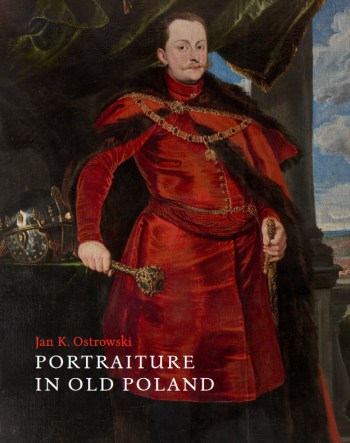 Written by one of Poland’s foremost art historians, this landmark book—the first English-language study to tackle its subject in depth—is an essential text for readers keen to look beyond the Western European art centres that have dominated art history since the discipline’s inception.
The Polish-Lithuanian Commonwealth—in spite of its flaws—was once the largest state in Europe, and it produced a distinctive culture that was often at odds with those of the absolutist monarchies of the day. The author casts his net wide, considering forms of portraiture that were widespread across the continent as well as indigenous specialities such as coffin portraits and tomb banners. He likewise demonstrates how the 18th-century Partitions of Poland affected portraiture and national identity. This book serves both as an incisive exploration of the subject and as a thought-provoking—and at times witty—resource on how to approach art in general, with the author spotlighting several pitfalls that can mislead the researcher. Finally, he shows how context and rational deduction can help solve iconographic puzzles. The English translation was made possible by a grant from the Lanckoroński Foundation.
Jan K. Ostrowski (b. 1947) grew up surrounded by family portraits at home, which sparked a fascination that stayed with him for life. He studied at Cracow’s Jagiellonian University and the University of Nancy. Later, he was a visiting scholar in Florence, Munich, and at the Institute for Advanced Study, Princeton. He taught the history of art at the Jagiellonian University from 1973 to 2018, becoming a full professor in 1992. In 1989 he was appointed director of Wawel Royal Castle in Cracow and he held this post for three decades. Since 2018, he has been president of the Polish Academy of Arts and Sciences. He conceived and directed a programme of inventorying historic sites in the Lviv region (western Ukraine; 23 vols, 1993–2015). He has extensively researched and published on late Baroque sculpture in Lviv (Johann Georg Pinsel), Polish Romantic painting (Piotr Michałowski), and Baroque painting in Flanders and Italy (Anthony van Dyck, Sinibaldo Scorza). He has been decorated both at home and abroad, including with the Order of Polonia Restituta and France’s Legion of Honour.
c o n t e n t s
Preface to the English Edition
Preface to the Polish Edition
1 Introduction
2 Paths to the Early Modern Independent Portrait
3 A Short History of Portraiture in Old Poland
4 The Portrait in Society: Function and Reception
5 Attire, Attributes, and Furnishings in Portraits: What Objects Tell Us about the Sitter and Their Time
Conclusion
Glossary
Abbreviations
Bibliography
Index of Names
List of Figures
The Huntington Acquires a Portrait by Goya
From the press release (20 November 2023) . . . .
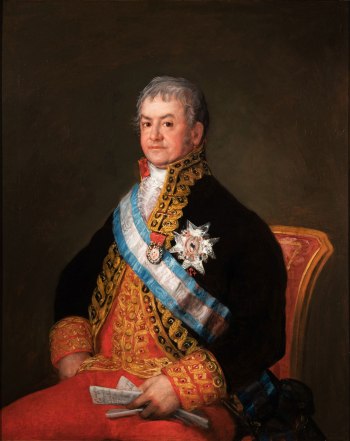
Francisco José de Goya y Lucientes, Portrait of José Antonio Caballero, Second Marqués de Caballero, Secretary of Grace and Justice, 1807, oil on canvas, frame: 135 × 114 × 9 cm (The Huntington Library, Art Museum, and Botanical Gardens, Gift of The Ahmanson Foundation).
The Huntington Library, Art Museum, and Botanical Gardens announced today that it has acquired a historic portrait by Spanish master Francisco José de Goya y Lucientes (1746–1828). Portrait of José Antonio Caballero, Second Marqués de Caballero, Secretary of Grace and Justice was painted in 1807, a time when Goya was renowned for his portraits of the Spanish nobility and just before the Napoleonic invasion of Spain profoundly altered the nature of his later work. While The Huntington holds a number of Goya’s etchings and aquatints, Portrait of José Antonio Caballero is the first Spanish oil painting to join The Huntington’s art collection and will complement its extensive holdings of Library materials on Spanish imperial history. The painting—which will go on view in the Huntington Art Gallery on 29 November 2023—is The Huntington’s third masterpiece acquired through a gift from The Ahmanson Foundation.
“Once again, The Ahmanson Foundation has proven to be an invaluable strategic partner, helping us reach our goals of broadening our collections with significant works and inviting new, interdisciplinary connections,” Huntington President Karen Lawrence said. “We couldn’t be more grateful to them for making possible the acquisition of such a superb and historically significant masterpiece.”
Considered one of the last Old Masters and one of the first and most influential great modern painters, Goya was celebrated during his lifetime for his ability to capture his subjects’ innermost personalities as well as their grandeur and political power—albeit with what has been perceived as an occasional layer of satire. He is also acclaimed for his virtuosic painterly style; flickering, impressionistic brushwork; and, in his later years, revolutionary subject matter.
Trained in Madrid and inspired by travels in Rome, Goya became a Spanish court painter in 1786, and he soon became known for such royal and aristocratic portraits as Portrait of José Antonio Caballero. But after the 1808 French invasion of Spain that began the Napoleonic Wars, Goya turned his artistic attention to portraying the horrors of war in paintings and prints.
“Portrait of José Antonio Caballero is historically fascinating and a prime example of Goya’s genius as a portraitist,” said Christina Nielsen, the Hannah and Russel Kully Director of the Art Museum at The Huntington. “Along with the exquisite French portrait by Élisabeth Louise Vigée Le Brun acquired with The Ahmanson Foundation last year, it will add an important international perspective to our outstanding collection of 17th- and early 18th-century British portraits.”
The Ahmanson Foundation funded The Huntington’s acquisition of Portrait of Joseph Hyacinthe François-de-Paule de Rigaud, comte de Vaudreuil (ca. 1784) by Vigée Le Brun (1755–1842), the most important female artist of 18th-century France, in 2022, and the monumental Portage Falls on the Genesee (ca. 1839) by Anglo American painter Thomas Cole (1801–1848) in 2021.
The sitter in the Goya painting, José Antonio Caballero (1754–1821), was from the minor nobility in Spain. He studied law and went on to a successful career in the royal court, holding four secretary positions. His accomplishments included convincing King Charles IV of Spain to conduct a vaccination campaign against smallpox that extended to the Spanish territories in North and South America and Asia. Goya painted the portrait when Caballero was the secretary of state and had just inherited the title of Marquis de Caballero from his uncle.
In the portrait, Caballero is depicted in a highly decorated ministerial uniform and seated in a red armchair. His black coat and bright red waistcoat are extensively embroidered with gold decoration. He looks directly at the viewer, conveying a sense of stature and power, with his right hand at his waist and his left hand holding papers. A powder-blue-and-white sash is draped across his chest, pinned with the Order of the Grand Cross of Charles III. The bright white insignia of a knight of the Order of Santiago is pinned to his coat.
The portrait will be installed in the Huntington Art Gallery, the former residence of founders Henry E. and Arabella Huntington, in a paneled room that was once Henry Huntington’s private office.
Spain’s Museum of Romanticism to Receive a Pieta by Goya
As noted at Art History News, from Spain’s Ministerio de Cultura:
Spain’s Ministry of Culture [has announced] that they have acquired an early Pieta by Francisco Goya. . . The painting is believed to have been inspired by the artist’s travels in Italy. The work was acquired for €1.5m and will head to the National Museum of Romanticism in Madrid.
◊ ◊ ◊ ◊ ◊

Francisco de Goya y Lucientes, Pietà, 1772–74, 84 × 58 cm (Madrid: Museo Nacional del Romanticismo).
El Ministerio de Cultura ha adquirido La Piedad, una obra fechada en la etapa temprana del pintor aragonés Francisco de Goya (1746–1828), por valor de 1,5 millones de euros. La obra se destinará a la colección permanente del Museo Nacional del Romanticismo, museo de titularidad estatal y gestión del Ministerio.
El cuadro, inédito hasta época reciente, permite conocer mejor la pintura religiosa del artífice. Mide 83,5 × 58 centímetros y conserva su tela y bastidor originales. La obra se ha fechado entre 1772 y 1774, por lo que es un testimonio relevante sobre las fuentes de inspiración que el aragonés recogió de su viaje a Italia, donde pudo conocer La Piedad de Miguel Ángel y otros modelos de Carracci, Maratti y Giaquinto. Tras su regreso a Zaragoza en 1771, Goya pudo expresar su evolución en sus trabajos en la Basílica del Pilar y en la Cartuja Aula Dei, con un estilo comparable con el de La Piedad adquirida por el Ministerio.
En la última década, el lienzo ha sido objeto de distintas solicitudes para su exportación, si bien estas han sido denegadas al tratarse de una obra de gran rareza, representativa del periodo temprano de la producción de su autor y por constituir uno de los pocos ejemplos de su obra religiosa, ayudando así a definir la figura del artista en su contexto.
Con La Piedad, el Museo Nacional del Romanticismo refuerza la presencia del “romántico quizá más glorioso y original,” en palabras del historiador del arte Manuel Bartolomé Cossío (1857–1935). Hasta ahora, la institución sólo contaba con una pieza de Goya, San Gregorio Magno, Papa, una obra monumental que pertenece al museo desde su fundación y que da buena prueba de la importancia que la producción del aragonés tuvo en el periodo romántico. Actualmente, el San Gregorio Magno, Papa preside el Oratorio, un espacio propio de las viviendas acomodadas que se empleaba para la devoción privada y donde se oficiaban los actos religiosos de carácter íntimo, como bodas, bautizos o velatorios. Precisamente, la temática y el tamaño de La Piedad sugieren que fue un encargo de algún eclesiástico o comitente de la burguesía zaragozana para cumplir una función devocional privada o doméstica.
New Book | Portrait Miniatures
From Michael Imhof:
Bernd Pappe and Juliane Schmieglitz-Otten, eds., Portrait Miniatures: Artists, Functions, Techniques, and Collections (Petersberg: Michael Imhof Verlag, 2023), 272 pages, ISBN: 978-3731913399, €40.
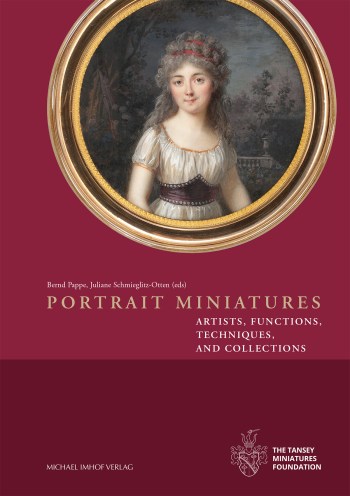 The specialist conferences on miniature portraits, organized for the past ten years by the Tansey Miniatures Foundation, have enabled an in-depth examination of this particularly intimate genre of portrait painting. In this third volume of conference proceedings, twenty-one internationally renowned experts from ten countries explore the miniature portrait from different perspectives, highlighting the private use of miniatures and contrasting it with their function in a more public context. Several authors provide new insights into important but hitherto little-known private and museum collections; others introduce specific artists. For the first time, this volume also addresses in significant depth specific technical aspects of creating and preserving portrait miniatures.
The contents can be viewed here»
Exhibition | Good Impressions: Portraits across Three Centuries
From the press release for the exhibition:
Good Impressions: Portraits across Three Centuries from Reynolda and Wake Forest
Reynolda House Museum of American Art, Winston-Salem, 20 October 2023 — 27 October 2024
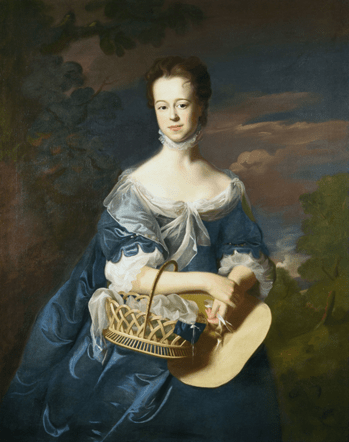
John Singleton Copley, Portrait of Elizabeth Gorham Rogers (wife of Daniel Rogers), 1762, oil on linen, 50 × 40 inches (Winston-Salem: Wake Forest University, Hanes Collection, Gift of Philip and Charlotte Hanes, HC1991.1.1). More information is available here.
Portraits are often taken at face value—as accurate representations of a person’s appearance, sometimes removed by decades or centuries. But portraits are often the products of delicate negotiations between artist and subject. Sometimes they flatter, exaggerating the sitter’s beauty or rich attire. Sometimes they capture the subject engaged in his or her occupation, whether pausing during study or painting in his or her studio. Sometimes they celebrate an auspicious occasion, such as a recent engagement or the imminent birth of a child. This exhibition features three centuries of portraits of men and women, Black and White, solitary and companionate, classic and modern.
“The museum and university are both strengthened by collaborations like this small yet glorious presentation of portraits,” said Allison Perkins, executive director, Reynolda House and Wake Forest University associate provost for Reynolda House & Reynolda Gardens. “More importantly, Wake Forest’s students and Winston-Salem’s community have the privilege of seeing extraordinary works in conversation on our walls.”
Good Impressions was mounted to mark the recent conservation treatment of John Singleton Copley’s 1762 Portrait of Elizabeth Gorham Rogers (Mrs. Daniel Rogers) in the collection of Wake Forest University and Reynolda House’s recent acquisition of the 1973 photograph Changing Times by Kwame Brathwaite (1938–2023).

Kwame Brathwaite, Changing Times, 1973, archival pigment print, 30 × 30 inches (Winston-Salem: Reynolda House Museum of American Art, Museum purchase, 2022.3.2).
Reynolda is set on 170 acres in Winston-Salem, North Carolina and comprises Reynolda House Museum of American Art, Reynolda Gardens and Reynolda Village Shops and Restaurants. The Museum presents a renowned art collection in a historic and incomparable setting: the original 1917 interiors of Katharine and R. J. Reynolds’s 34,000-square-foot home. Its collection is a chronology of American art and featured exhibitions are offered in the Museum’s Babcock Wing Gallery and historic house bedrooms. The Gardens serve as a 134-acre outdoor horticultural oasis open to the public year-round, complete with colorful formal gardens, nature trails and a greenhouse. In the Village, the estate’s historic buildings are now home to a vibrant mix of boutiques, restaurants, shops and services.
Conference | 76th Annual Williamsburg Antiques Forum
From Colonial Williamsburg:
76th Annual Antiques Forum: Domestic Affairs
Online and in-person, Colonial Williamsburg, 23–27 February 2024
Registration due by 1 February 2024 (virtual registration by 10 February)
 From London to Nova Scotia, New England to Virginia and the Carolinas, the Mid Atlantic to the Gulf South: all make an appearance at Colonial Williamsburg’s 76th Annual Antiques Forum: Domestic Affairs. Join us as we explore fashions, furnishings, and the familial while traveling through time and space and delving into houses and histories. We will journey through public and private collections, revealing new research, revitalized spaces, and the fascinating stories that are told by objects, architecture, and interiors.
On opening day of this year’s Antiques Forum, we are joined by Tim Whittaker, former Director of The Spitalfields Trust, who introduces the visionaries and eccentrics who saved the Georgian architectural legacy of East London. Robert Leath, Executive Director of Edenton Historical Commission, then dives into four centuries of North Carolina History as he examines the story of Hayes Plantation. Chief Curator Adam Erby reveals recent discoveries from Mount Vernon, and architectural paint conservator Maeve Woolley Delph peels back the layers on the interior paint restoration of Wilton House Museum. Trevor Brandt from Americana Insights and Colonial Williamsburg’s Associate Curator of Paintings, Drawings, and Sculpture, Kate Teiken Rogers round out our visit to houses and objects as they take a deeper look at spiritual labyrinths in Pennsylvania German fraktur and portraiture of early Williamsburg residents, respectively.
On Sunday, Cynthia Cooper from the McCord Stewart Museum reveals the unlikely travels of an 18th-century dress from Virginia to Quebec City. We then travel to Mississippi as Jefferson Mansell, Historian with the Natchez National Historical Park, looks at the rise of the of the Natchez suburban estate. In the afternoon, attendees are invited to venture to the Art Museums of Colonial Williamsburg for an update on recent acquisitions in the foundation’s collection, with mini-lectures by Colonial Williamsburg’s Curator of Furniture Tara Chicirda; Senior Curator of Mechanical Arts, Metals, and Numismatics Erik Goldstein; and Curator of Costumes and Textiles Neal Hurst. Following afternoon refreshments, lectures resume in the Virginia Room of the Lodge with the Carolyn and Michael McNamara Young Scholars Series, sponsored by The Decorative Arts Trust and featuring emerging scholars Ahmauri Williams-Alford (Telfair Museum), Henry Beard (Old Salem), and Cecelia Eure (Winterthur). The Annual Forum Shields Tavern Barbecue, sponsored by Jeffrey S. Evans & Associates, concludes the day.
We explore indoors and out, above ground and below on Monday with independent scholar Errol Manners addressing “Ceramics and the Garden: Display, Delight, and Consumption,” and Drayton Hall’s Director of Archaeology Luke Pecoraro investigating Drayton Hall’s designed landscape. Colonial Williamsburg’s Director of Archaeology Jack Gary and Associate Curator of Ceramics and Glass, Angelika Kuettner then join our guest speakers on stage to discuss garden ceramics, archaeology, and historic preservation. In the afternoon attendees are invited to an open house at Custis Square to see the ongoing garden archaeology project and join Colonial Williamsburg’s Nation Builder Kurt Smith for a fascinating look at “Thomas Jefferson and English Gardens,” inspired by the visits of both men spanning different centuries. The Margaret Beck Pritchard Associate Curator of Maps and Prints, Katie McKinney, will end the day with a look at Robert Furber, his prints, and their influence on garden and floral arrangement design in the 18th century and today.
Our final day of lectures ventures to New England and the Mid-Atlantic with Historic Deerfield’s Amanda Lange looking at ceramics for the American home. Montgomery County Pennsylvania’s Daniel Hiester House is the subject of this year’s Collectors Talk, given by scholar and owner Lisa Minardi, while Matthew Skic, Curator of Exhibitions, Museum of the American Revolution, takes a look at the material world of the Forten Family of Philadelphia. Brenton Grom, Director of Connecticut’s Webb-Deane-Stevens Museum discusses how the spectacle of house museums can bring us together, and architectural historian Willie Graham gives our closing keynote highlighting remarkable discoveries during the restoration of Cloverfields, one of Tidewater Maryland’s grandest houses. A night to remember follows with live entertainment for the closing dinner.
Images from the Forum Flyer: Top Left: Detailed shot of a three-piece Court Suit, Warsaw, Poland, 1787–95, silk, linen, wool, iron, silver, gold, garnets, wood, paper (Transfer from The Valentine Museum, Richmond, VA, 2023-21,1-3). Bottom Left: Portrait of Helen M. Eddy, Joseph Whiting Stock, Springfield, Massachusetts, 1845, oil on canvas (Bequest of Abby M. O’Neill, 2018.100.3). Top Middle: Three-piece Court Suit, Warsaw, 1787–95, silk, linen, wool, iron, silver, gold, garnets, wood, paper (Transfer from The Valentine Museum, Richmond, VA, 2023-21,1-3). Bottom Middle: Hong Bowl, Jingdezhen, China, ca. 1787–88, hard-paste porcelain (Museum Purchase, The Joseph H. and June S. Hennage Fund, 2023-4). Top Right: Portrait of Major General Alexander Finley Whitaker possibly by John Bradley, New York, ca. 1835, oil on mattress ticking (Museum Purchase, Hank and Dixie Wolf in honor of Margaret Beck Pritchard and Laura Pass Barry, 2023.100.1). Bottom Right: Armchair, London, 1763–67, mahogany (Museum Purchase, 1959-351,3).
Conference | Working Wood in the 18th Century: By the Book

From Colonial Williamsburg:
Working Wood in the 18th Century: By the Book
Online and in-person, Colonial Williamsburg, 25–28 January 2024
Registration due by 1 January 2024
Printed words and images: How did 18th-century craftspeople turn them into actions and objects? How did craftspeople fill in the blanks left by what was unwritten or unillustrated? And how can the ink they left on paper inform our understanding of a past in which most craft knowledge was shared orally? Join tradespeople and scholars from Colonial Williamsburg and esteemed guest presenters as they explore woodworking by the book.
All lectures will take place in the Hennage Auditorium, at the Art Museums of Colonial Williamsburg. In-person capacity is limited and those on the waitlist will be notified via email should space become available. Virtual capacity is unlimited.
Christopher Schwarz—woodworker, author, and publisher of Lost Art Press—will open the conference with a keynote on the long historical arc of woodworking books. Later, he’ll demonstrate the low workbench illustrated by M. Hulot in L’Art du Tourneur Mécanicien (1775) to explore how the design has persisted among chairmakers up to the present. Chairmaking of a different flavor will be the focus of demonstrations by master cabinetmaker and educator Dan Faia, who will explore the structure and ornament of a high-style neoclassical chair design published by George and Alice Hepplewhite in The Cabinet-maker and Upholsterer’s Guide (1789). Colonial Williamsburg cabinetmakers Bill Pavlak and John Peeler will explore how 18th-century craftspeople could use Thomas Chippendale’s elaborate published patterns as a springboard for designing and building chairs in the ’plain and neat’ manner favored by colonial Virginia’s fashion-conscious consumers.
In the realm of architectural woodworking, Colonial Williamsburg’s joiners Brian Weldy and Peter Hudson will employ a variety of 18th-century pattern books to design and build a door, its frame, and the decorative woodwork that surrounds it. In a panel moderated by supervisor-journeyman Matt Sanbury, apprentice carpenters Harold Caldwell, Mary Lawrence Herbert, and McKinley Groves will crack open Joseph Moxon’s late 17th-century work Mechanick’s Exercises to put his lessons in carpentry to the test. Does Moxon’s writing accurately reflect the practices of carpenters?
Decorative techniques are discussed at length in period writings, though usually in an incomplete manner. Conservators Chris Swan and Sarah Towers will introduce their recent exploration into traditional silvering techniques for carved picture frames. Harpsichord makers Edward Wright and Melanie Belongia will explore decorative veneering methods that are useful for furniture and musical instruments alike. In both cases, presenters will show how the written word combined with hours of experimentation at the bench led to successful results.
In addition to bringing the techniques and designs from books to life, we’ll also explore books themselves from a variety of perspectives. Whitney L.B. Miller, author of Henry Boyd’s Freedom Bed, will share how she was inspired to turn her research on Henry Boyd—a free Black furniture maker, inventor, and abolitionist who was born into enslavement—into a book for today’s children. Colonial Williamsburg’s curator of furniture Tara Chicirda will introduce the role that pattern books and price books played in the cabinetmaker’s trade. To learn about what went into making detailed printed illustrations, master engraver Lynn Zelesnikar will demonstrate her craft while reproducing a plate from Chippendale. She and Bill Pavlak will also compare notes on how to turn the same ornamental pattern into a two-dimensional engraving or a three-dimensional wood carving. Any collection of books needs shelves, and decorative arts historian Thomas Savage will deliver our banquet keynote on the acclaimed Holmes-Edwards library bookcase, a beautifully crafted home for books with a compelling story of its own.
Decorative Arts Trust Announces Failey Grant Recipients for 2024
From the press release:

Page from the African Union Society book of records, recording a land transaction between Arthur Flagg and Cupid Brown for a house and lot on Thames Street (NHS Vol. 1674B, Page 190).
The Decorative Arts Trust is pleased to announce that the 2024 Dean F. Failey Grant recipients are the Andrew Jackson Foundation in Nashville, TN; the Brandywine Conservancy & Museum of Art in Chadds Ford, PA; Fallingwater in Mill Run, PA; Museo de las Americas in Denver, CO; the Newport Historical Society in Newport, RI; and the Tomaquag Museum in Exeter, RI.
The Failey Grant program provides support for noteworthy research, exhibition, and conservation projects through the Dean F. Failey Fund, named in honor of the Trust’s late Governor. Each of these projects also incorporates contributions from an emerging scholar. Failey Grant applications are due October 31 annually.
The Andrew Jackson Foundation will conserve and exhibit Sarah Yorke Jackson’s 1820–30 Spanish guitar attributed to Cabasse-Visnaire L’ainé that is currently on display in the Hermitage Mansion. The project will be led by Collections Manager Jennifer Schmidt and Collections Aide Haley Weltzien.
The Brandywine Conservancy & Museum of Art will publish the catalogue for The Crafted World of Wharton Esherick exhibition. Wharton Esherick Museum (WEM) Director of Curatorial Affairs Emily Zilber will be the catalogue’s primary author, with essays by WEM Director of Interpretation and Research Holly Gore, Philadelphia-based design and culture writer Sarah Archer, and Philadelphia Museum of Art Assistant Curator in the Department of European Decorative Arts Colin Fanning.
Fallingwater will restore 24 oversized blueprints of shop drawings for Frank Lloyd Wright’s built-ins and furniture as well as 28 blueprints of the guest house. Paper conservator Jayne Girold Holt will work with Hannah Cioccho, Fallingwater’s newly appointed Collections Manager and Archivist.
Museo de las Americas plans to launch a digital resource focusing on a collection of Latin American textiles, which includes containers, clothing, and blankets. Curator of Collections Laura Beacom will work with a paid intern to photograph, digitize, and upload content to Bloomberg Connects and Google Arts and Culture.
The Newport Historical Society will develop A Name, a Voice, a Life: The Black Newporters of the 17th–19th Centuries, an exhibition about how the lives of Africans and African Americans have been interpreted from the written record. The exhibition will be led by Collaborating Curator Zoe Hume and Project Director Kaela Bleho.
The Tomaquag Museum will conserve an 1840s Narragansett birchbark canoe, which was crafted by the great uncle of Ferris Dove, the Narragansett Chief Roaring Bull. Conservator Linda Nieuwenhuizen will perform a condition assessment, and Tomaquag Museum Archival Assistant and Narragansett Nation citizen Kathryn Cullen-Fry will document the history and community memories of the canoe, which will serve as a centerpiece of Tomaquag’s new visible storage facility.
Doctoral Scholarship | Representations of Black People in European Art
From ArtHist.net, where the posting includes the German description:
Doctoral Scholarship | The Representation of Black People in European Art and Material Culture Using the Example of the Tucher Family Coat of Arms
Argelander Professorship for Critical Museum and Heritage Studies, University of Bonn, and Tucher Kulturstiftung
Applications due by 31 January 2023
Since 1345, the central motif of the Tucher family coat of arms has been the head of a Person of Colour in profile. While in the early modern period the depiction was interpreted as a portrait of St Maurice and a symbol of Christian defence and virtue, depictions from the colonial period tend to suggest stereotypical, racialising ideas of Black people. As part of the doctoral scholarship The Representation of Black People in European Art and Material Culture Using the Example of the Tucher Family Coat of Arms (Die Darstellung von Schwarzen Menschen in europäischer Kunst und materieller Kultur am Beispiel des Tucher Familienwappens), some of the diverse questions raised by the family coat of arms will be explored. What can the changing depiction of Black people / BIPoC / people of the global majority in the coat of arms over the centuries tell us about the perception of people from Africa and the African diaspora in Europe? How did the presence of Black people in Europe shape the representations? What role did upheavals in the history of ideas and political economy—such as the Enlightenment in Europe, the transatlantic trade in enslaved people, and the colonisation of non-European territories—play in the different forms of representation? What purposes did the identification of a white patrician family with a Black person serve in these different eras? And to what extent did the changing materiality of European art and craftsmanship influence the forms of depiction of the family coat of arms? The doctoral candidate selected is invited to set their own research priorities according to their expertise (epochs, materialities) and to contribute comparative examples to the research. A critical examination of the tipping points of self-perception and external attribution expressed by the changing family coat of arms is desired. Reference to approaches from Postcolonial and Critical Whiteness Studies is also expressly encouraged.
Tasks
• Independent research on the topic The Representation of Black People in European Art and Material Culture Using the Example of the Tucher Family Coat of Arms
• Annual research reports
• Conclusion of a supervisory relationship at the University of Bonn at the start of the fellowship
Applicant Profile
• Completed Master’s degree in social and cultural anthropology, history, art history, cultural studies, museum studies, material culture studies, postcolonial studies, or related subjects
• Experience with historical German scripts
• Experience with historical material culture
1700€ / month doctoral scholarship; 1500€ / year travel and material costs
To apply, please send a cover letter, a description of the proposed research project (1–2 pages), a writing sample, and a CV in one PDF file to Nana Tsiklauri, ntsiklau@uni-bonn.de. The scholarship should be started as soon as possible. The deadline for applications is 31 January 2024. For details, please refer to the official call for applications at this link. If you have any questions, please contact Jun.-Prof. Dr. Julia Binter, julia.binter@uni-bonn.de.










 Enfilade
leave a comment