Sculpture Journal, November 2023
The latest issue of the Sculpture Journal is dedicated to the long eighteenth and nineteenth centuries:
Sculpture Journal 32.4 (November 2023)
 • Samantha Lukic-Scott and Charlotte Davis, “Valuing Sculpture: Art, Craft, and Industry, 1660–1860,” pp. 409–16.
Responding to the many useful and intriguing discussions that arose over the two days of the Valuing Sculpture: Art, Craft and Industry, 1660–1860 conference held in July 2021, this special issue explores new directions for scholarly research. This introduction considers the usefulness of the classifications of art, craft, and industry, and in doing so presents this collection’s methodology of expanding dialogues by reaching across medial, dimensional, geographical, and categorical boundaries.
• M. G. Sullivan, “Valuing Sculpture in the Long Eighteenth Century: Materials and Technology,” pp. 417–32.
In 1712 the sale catalogue of John Nost’s studio defined the value of sculpture as lying in the intrinsic value of materials, the performance of the artist, and the costs and complexity of sculptural production. This article looks at how these values of materials and making shifted over the course of the following 150 years through specific examples of materials—lead and granite—that gained and then lost value; and how production processes that streamlined sculptural production, notably James Tulloch’s marble works, were first celebrated and then seen as anathema to sculptural value. The article argues for the malleability of sculptural value systems in the long eighteenth century, and the need to understand sculptural value in materials and production in relation to economic and technological history.
• Caroline Stanford, “‘Peculiarly Fit for Statues’: The Contribution of Coade’s Fired Artificial Stone to Sculpture in the Eighteenth Century,” pp. 433–50.
This article considers the enduring ‘value’ of Coade stone as artefact. Using insights from Alois Riegl’s The Modern Cult of Monuments, it examines the contribution of fired artificial stone as a key enabler of the eighteenth-century passion for sculpture in Britain, as replicated sculptural forms entered interiors, gardens, and architecture. This durable stoneware first crossed into statuary in the 1720s. From 1769, Eleanor Coade (1733–1821) became its figurehead, successfully positioning Coade stone as superior to natural stone. Formulation and production were collaborative processes dependent upon specialist, often overlooked fabricating skills. This article considers factors that led to the success of Coade stone, as well as its composition and production. It concludes with a brief case study of the Coade stone caryatids that Sir John Soane took as a personal motif.
• Rebecca Wade, “The Young Naturalist by Henry Weekes: Intermediality, Industry, and International Exhibitions,” pp. 451–68.
The Young Naturalist by Henry Weekes (1807–77) was first presented in plaster at the Royal Academy of Arts in 1854. Beginning as an object located firmly in the domain of the fine arts through its modes of production and sites of display, the sculpture encountered industry through a series of international exhibitions in Paris, London and Manchester during the 1850s and 1860s. Not only was the work in proximity to industrial objects, processes and collectors, it was fundamentally transformed by them, resulting in a collaboration between Weekes and the Birmingham-based manufacturer Elkington & Co. This article charts the changing status of sculpture and labour in the second half of the nineteenth century, with its increasing visibility and availability to new markets through both emerging and established technologies of reproduction.
• Liberty Paterson, ” ‘Wider than the Realm of England’: The Hosack Family Heritage, Atlantic Slavery, and Casting Mary, Queen of Scots for the Nation,” pp. 469–92.
In 1871 the Scottish-born magistrate John Hosack (1809–87) was described as ‘the chivalrous and most recent defender’ of Mary, Queen of Scots. After writing a popular historical account of her life, he had presented a plaster cast bust of her Westminster effigy to London’s National Portrait Gallery, which it then used to create an electrotype sculpture with the help of Elkington & Co. This article interrogates the ‘value’ of this sculpture as a cultural heritage object by retracing its history. It places Hosack’s desire to replicate and commemorate Scottish heritage alongside his family ties to Jamaica, including the parallel life of his half-brother William and the wealth John derived from his father’s sugar profits, which relied on African enslavement. It argues the importance of understanding how such legacies enabled individuals to participate in cultural philanthropy in the Victorian period, which simultaneously distanced them from their Atlantic pasts. It also considers how, in its transformation into an electrotype, Hosack’s cast became part of a wider effort by museums and galleries to replicate national heritage using manufacturing methods indebted to the industrial economy intertwined with the British Empire. Sculpture offered a powerful medium through which to fortify national history, but its commemorative capacity can, and should, be unpicked to better understand British legacies of enslavement and colonialism.
• Justine Gain, “Valuing Ornament: Jean-Baptiste Plantar (1790–1879) between Art, Craft, and Industry,” pp. 493–511.
In the nineteenth century, as European countries reacted to industrialization, art, and burgeoning industries intertwined in a myriad of new ways. From this union, several major changes occurred in building construction, decorative arts, and sculpture. The career and oeuvre of Jean-Baptiste Plantar, French ornamentalist and sculptor des Bâtiments du Roi, illustrate the new relationships forged between traditional architectural patterns and industrial artistic production. Despite holding a central role in their establishment, Plantar has been largely unheeded both by his contemporaries and later writers. This article reasserts Plantar’s significance in the creation of a visual—essentially Parisian—landscape in the first half of the nineteenth century.
• Patricia Monteiro, “The Art of Stucco in Southern Portugal: Morphologies, Value Judgements, and the Prejudice of Conservation,” pp. 513–29.
The Portuguese artistic production of stucco is part of a long tradition of decorative techniques that form part of a shared visual and cultural legacy in southern Europe. However, little is understood of local idiosyncrasies within this legacy. By focusing on stucco artworks in the peripheral area of Alentejo, away from the cultural capitals of Europe, this article explores the emergence of an original and distinct formal and functional interplay over the course of several centuries. This article re-evaluates the morphologies of Alentejo’s stucco sculptures and assesses the degree to which such morphologies express common artistic practices and constitute a distinct art form. Finally, the article identifies the deleterious ramifications that have arisen from such considerations not being taken account of during the conservation of these works.
• David Mark Mitchell, “Fabricating Enchantment: Antoine Benoist’s Wax Courtiers in Louis XIV’s Paris,” pp. 531–44.
Antoine Benoist’s Cercle royal was an exhibition of life-size wax figures on display in Louis XIV’s Paris. In the absence of extant objects from the exhibition itself, this article focuses on the corpus of sources that attest to its reception. It concentrates on the Cercle royal’s initial recognition, beginning in the 1660s, when the exhibition centred on French royalty’s courtly entourage. Alternately celebrated as vivid miracles or derided as deceitful trivialities, Benoist’s wax figures provide an informatively problematic case for considering questions of sculptural craft and the decorum of its display in this era. In tracing the discord of wax portraiture’s reception, this article demonstrates that vexed questions of artisanal stature were embedded within aesthetic debates about illusionistic verisimilitude.
• Jennifer Dudley, Review of the exhibition If Not Now, When? Generations of Women in Sculpture in Britain, 1960–2022 (Hepworth Wakefield, 2023), pp. 545–48.
Call for Papers | Environmental Impacts of Catholic Missions, Atlantic
From ArtHist.net:
The Environmental Impacts of Early Modern Catholic Missions in the Atlantic Space
Université Paris 1 Panthéon-Sorbonne, 9 March 2024
Université du Québec à Montréal, 18 March 2024
Proposals due by 31 December 2023
These series of workshops aim to explore the role of the Catholic Church, through its missionary undertaken, in the global environmental upheavals and discoveries of the early modern period. Venturing wide and far beyond the familiar European sphere, early modern missionaries frequently used the rhetoric of Theatrum Mundi to reflect on their encounters with previously unknown cultures. What has escaped scholars’ attention, however, is how these rapidly evolving dramas of evangelization in turn shaped the seemingly timeless backstage setting of Nature. As the missionaries voyaged away and established new religious communities, they were not only faced with social and cultural challenges raised by the vastly different linguistic, political, and philosophical traditions, but they also had to adapt to unfamiliar geographical, climate, and material conditions as they sought to construct churches or realize liturgical rituals, not to mention the extensive agricultural and medical activities they had to pick up for personal survival in often severe natural conditions.
We would like to ask and try to answer questions such as:
• How did the missionaries adapt to local conditions of climate, sunlight, and building technologies when constructing churches?
• How did the missionaries accommodate rituals and its theological implications (such as the presence of wine and bread in the Mass) in reaction to local natural resources?
• How did early modern missionaries develop survival precautions over time to adapt to the dangers of these new natural environments?
• To what extent were the early modern global missionary activities impacted by major environmental crisis of this period, such as the epidemics or the Little Ice Age?
• How did the missionaries’ encounters with new geographical spaces and conditions stimulate knowledge creation and circulation, such as in the areas of cartography, botany, zoology, and medicine?
These are a few of the many possible new questions we hope to explore in this workshop. One overarching method we want to propose is to think about early modern Catholicism in the plural term, as theorized by Simon Ditchfield. Studies on post-Tridentine missions tended to emphasize the central authoritative role of Rome, focusing especially on the role of the missionary as leader in the creating of new religiosity, new economical exchanges, or new societies. The new attention paid to missionaries’ interactions with local natural conditions will complexified our understanding of Rome as one of the few truly global institutions of the early modern period acting not only as a religious and evangelist force but also in the colonialist expansions.
These two workshops will be consecrated to the missions in the Atlantic space. It will be followed by a second series of workshop in 2025 to look over the Pacific space and will be concluded by an edited volume. Please send an title, a short abstract (300 words) and a one-page CV to harvey.isabel@uqam.ca, Alysee.Le-Druillenec@univ-paris1.fr, and wenjies@princeton.edu, before 31 December 2023.
Organizers
Isabel Harvey (Université du Québec à Montréal), Alysée Le Druillenec (University of Paris 1 Pantheon-Sorbonne), and Wenjie Su (Princeton University)
Call for Papers | Romanticism’s Colonial Legacies
From ArtHist.net:
Romanticism’s Colonial Legacies in and beyond Europe: Critical Perspectives on Art and Visual Culture
Frankfurt am Main, 10–12 October 2024
Proposals due by 29 February 2024
The study of Romanticism has been markedly imbued with a sense of heroism, an epic aura, and a novelistic ethos, ultimately culminating in a pronounced ‘romanticisation’ of that era. However, this standpoint proves insufficient to elucidate the evolution of Romanticism and its impact beyond Europe. While some studies have critically engaged with the nationalist aspects of some variants of European Romanticism, matters pertaining to race, class, expansionism, and colonialism seemed not to belong to the Romantics’ sensitivity, becoming ‘the monsters hidden in the attic’ of Romanticism studies.
Scholarship has so far neglected, for example, the role played by the Romantic generation as agents of power actively engaged in the surveying, chronicling, mapping and imaginative rendering of distant territories that either already were or were about to be colonised. Similarly, practices such as the classification and depiction of flora, fauna, and humans carried out at and beyond the boundaries of Europe in the name of Enlightenment ideals are widely praised, despite the involvement of Romantic sciences in an extensive global inventory project that, for the most part, sought the imposition of a singular and dominant conception of knowledge as part of the Western agenda of modernity.
In light of these observations, the conference seeks to expand the critical examination of late 18th- and 19th-century art and visual culture, including intermedial perspectives. We aim to challenge canonical narratives by delving into the intricate connections with wider socio-political dimensions. These encompass racialism, class, gender, evolution, Imperialism, and colonial power. We warmly invite presentations that address facets and transformations of Romantic art and, more widely, late 18th- and 19th-centuries visual cultures in the Americas, the Caribbean, Africa, Asia, and Oceania, as well as Europe and its peripheries viewed through the lenses of intersectionality, (eco-)feminism, Marxism, postcolonial theories, Indigenous epistemologies, and critical race studies.
Possible areas of focus and themes include
• Romanticism and race
• Arts and Romantic sciences
• Concepts of ‘Nature’ and ‘Landscape’
• Romantic ecology
• The Sublime and the (tropical) Picturesque
• Botanical and zoological illustrations
• Maps and cartographies
• Gender and sexuality
• Nationalism(s) and colonialism(s)
• Indigeneity and Europeanness
• Class and social relationships
The language of the conference is English. Please email abstracts (max. 300 words), a short biography (150 words) and a selected list of publications to Dr Miguel Gaete (miguel.gaete@york.ac.uk) by 29th February 2024. Total or partial travel expenses can be covered if needed.
Keynote Speaker
Professor Luciana Martins (Birkbeck University London)
Organisers
Prof. Dr. Mechthild Fend
Dr. Miguel Gaete
Prof. Dr. Frederike Middelhoff
Call for Papers | Historical Botanical Gardens
From ArtHist.net and the conference website:
2nd International Congress of Historical Botanical Gardens
Wien, 29–31 July 2024
Proposals due by 15 January 2024
 The Austrian Federal Gardens in cooperation with the Botanical Garden of the University of Vienna, the Natural History Museum Vienna, and the International Association of Botanic Gardens (IABG) look forward to an interesting continuation of the 1st International Congress of Historical Botanical Gardens held in Lisbon in 2021. The initial impulse to communicate the issues and importance of botanical gardens to a broader public, highlighting their history as well as their importance and building a common network will be continued in 2024. For more than 450 years, plants have been collected, cultivated, studied, and exhibited in Vienna. This long and continuous tradition makes Vienna one of the most important locations for current and historic plant research and conservation.
This second event will expand the focus to include conservation and preservation of plants and gardens. How can we protect historical botanical gardens and their heritage from the major threats of our time, such as lack of resources, climate change, war, and conflicts of all kinds? What can we learn from the turbulents in the past? We invite papers related to the fields of Botanical Gardens, Historical Gardens, Plant Collections, and related disciplines. Submissions from students, associations, and independent researchers are encouraged. Presentation formats include 5-minute pitch presentations and 20-minute talks, as well as posters.
Examples for potential presentations:
Session 1 | The Transition of Historical Botanical Collections
• Survival of botanical collections in times of war or crisis
• Transition of princely botanical collections into the ownership of modern republics
• Transition of colonial collections into the ownership of independent states
• Endangerment of historical botanical collections during military conflicts
• Historical botanical collections and climate crisis
• Preliminary protective measures
Session 2 | Horticulture: Challenges in Daily Horticulture Practice
• Pest control and measures
• Prevention: biological cultivation and biological treatments
• Changes in cultivation because of climate change
• Cultivation and conservation of single plants of particular high value
• Protection of the collection
• Handling and protection of plants for and during exhibitions
Session 3 | Science: Sharing of Knowledge
• Importance of traditional horticultural crafts in historical botanical gardens
• Methods to conserve and transmit (horticultural) knowledge
• Which knowledge is transmitted
• Transition of traditional knowledge and traditional techniques to modernism
• Networking: international and transdisciplinary relationships
Session 4 | Historical Botanical Gardens
• Portraits of historical botanical gardens (existing and lost)
Please send your abstract (maximum of 250 words, excluding title and affiliation) as a Word file with an indication of the topic as well as the preferred presentation format to ichbg2024@bundesgaerten.at before 15 January 2024. You will be informed about acceptance and format of the presentation by 25 March 2024. For further information, please see the conference website, and don’t hesitate to contact the organizing committee at ichbg2024@bundesgaerten.at.
New Book | Hidden Patrons: Women and Architectural Patronage
From Bloomsbury:
Amy Boyington, Hidden Patrons: Women and Architectural Patronage in Georgian Britain (London: Bloomsbury Visual Arts, 2023), 328 pages, ISBN: 978-1350358614 (hardcover), £65 / ISBN: 978-1350358607 (paperback), / £20.
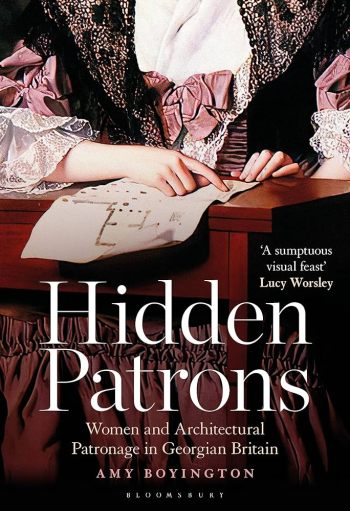 An enduring myth of Georgian architecture is that it was purely the pursuit of male architects and their wealthy male patrons. History states that it was men who owned grand estates and houses, who commissioned famous architects, and who embarked upon elaborate architectural schemes. Hidden Patrons dismantles this myth—revealing instead that women were at the heart of the architectural patronage of the day, exerting far more influence and agency than has previously been recognised. Architectural drawing and design, discourse, and patronage were interests shared by many women in the eighteenth century. Far from being the preserve of elite men, architecture was a passion shared by both sexes, intellectually and practically, as long as they possessed sufficient wealth and autonomy. In an accessible, readable account, Hidden Patrons uncovers the role of women as important patrons and designers of architecture and interiors in eighteenth-century Britain and Ireland. Exploring country houses, Georgian townhouses, villas, estates, and gardens, it analyses female patronage from across the architectural spectrum and examines the work of a range of pioneering women from grand duchesses to businesswomen to lowly courtesans. Re-examining well-known Georgian masterpieces alongside lesser-known architectural gems, Hidden Patrons unearths unseen archival material to provide a fascinating new view of the role of women in the architecture of the Georgian era.
Amy Boyington is a social and architectural historian, with a PhD from the University of Cambridge. She serves as a trustee of the Georgian Group and is a popular Instagram and TikTok historian.
c o n t e n t s
List of Illustrations
Acknowledgements
Note on Text
List of Abbreviations
Introduction
1 The Country House
2 The Town House
3 The Villa
4 The Wider Estate, Garden Design, and Ornamental Buildings
Conclusions
Bibliography
Index
New Book | Symbols and Forms in Jewish Art
From IRSA, the Institute for Art Historical Research (founded in Venice in 1979 as the Istituto per le Ricerche di Storia dell’Arte, the institute was relocated to Florence and then to Vienna, before arriving in its current home in Cracow). Orders can be placed via email, irsa@irsa.com.pl.
Rachel Wischnitzer-Bernstein, Symbols and Forms in Jewish Art, translated by Renata Stein (Cracow: IRSA, 2022), 212 pages, ISBN: 978-8389831354. With an essay on Wischnitzer’s life and work by Shalom Sabar.
 This is an English translation of a classic study on the iconography of Jewish art by Rachel Wischnitzer-Bernstein (1885–1989), originally published in Berlin in 1935 as Symbole und Gestalten der jüdischen Kunst. The outbreak of the Second World War prevented the book from spreading, and its uncirculated print-run was almost entirely destroyed by the Nazis. The few surviving copies of the book that circulated among specialists, gained this highly innovative work on Jewish iconography a position of a classic study. The present English edition makes the legendary book by Rachel Wischnitzer-Bernstein available to wider audiences of international readers for the first time.
“Against all odds, two years after the Nazi party and Hitler rose to power, Symbole und Gestalten der jüdischen Kunst appeared in Berlin in the mid-1930s. Presenting the visual art of the Jewish people as a sophisticated humanistic achievement, this handsome, beautifully produced volume illustrates the deep meanings and the powerful symbols of the Jewish people over the ages. Moreover, the book’s thesis and the materials gathered in it are underlined by an implied aspiration: to strengthen Jewish identity and make the Jews of the time conscious and proud of their rich heritage. The author of this courageous book…, Rachel Wischnitzer (1885–1989), a modest woman, small in size, …contributed more than any other scholar of the first half of the twentieth century to the establishment and development of a new field of academic study—the history of Jewish art.” —From Shalom Sabar’s biographical essay
Rachel Wischnitzer (1885–1989) during her long life produced 344 publications, including books, scholarly articles, reviews of books, and exhibitions, as well as encyclopedia items. Together with her husband Mark, she edited the literary and artistic periodicals Rimon and Milgroim. The doyenne of historians of Jewish art, she was a pioneer in the field when she published in 1913 her first article on the ancient synagogue in Lutsk. Her wide interests drove her to study and publish about Hebrew illuminated manuscripts, synagogue architecture, Jewish and general iconography. Her major contribution to Jewish iconography was a courageous attempt to find a single theme to which all the paintings in the third century Synagogue at Dura Europos would adhere.
c o n t e n t s
Foreword by Józef Grabski
Introduction
1 Divine Revelation
2 Kingdom
3 Doctrine
4 Priesthood
5 Judaism
6 Festivals and Customs
7 Messianic Hope
8 Time and the Universe
Shalom Sabar — Rachel Wischnitzer: Life and Work
Conference | Women in Architecture before 1800

From the conference website:
WoArch 2024: Women as Builders, Designers, and Critics of the Built Environment before 1800
Online and in-person, Palazzo Taverna, Rome, 25–27 January 2024
Organized by Shelley Roff, Consuelo Lollobrigida, and Francesca Riccardo
We are pleased to announce the first edition of the conference series WoArch (Women in Architecture) as an international symposium entitled Women as Builders, Designers, and Critics of the Built Environment before 1800, which will take place in Rome, 25–27 January 2024. Organized by the University of Arkansas Rome Center in collaboration with the School of Architecture + Planning at the University of Texas at San Antonio, this symposium is also supported by the Women in Architecture Affiliate Group of the Society of Architectural Historians. The event will be hosted in person at the Rome Center in Palazzo Taverna, Rome, and will be live-streamed on the Rome Center YouTube channels.
For almost 30 years, the literature investigating women and the built environment before the modern era has focused on women’s patronage of architecture. This symposium is designed to open a discussion about what is missing from this conversation and yet can be found in the historical record: the roles that women of various social classes played in shaping architecture, landscapes, and cities in diverse parts of the world and the cultural and political implications of their activities. In part, the symposium calls for a re-interpretation of patronizing activities by women; and, from another point of view, it directs the spotlight toward women engaging in socio-political urban reform, creating networks of design influence, managing and participating in construction, and serving as the designer of the built environment across a broad geographic scope before modern industrialization.
For program details and speakers’ abstracts, please visit our webpage. For other queries, please write to Shelley Roff, shelley.roff@utsa.edu.
2 5 j a n u a r y | w o m e n a s b u i l d e r s a n d d e s i g n e r s
9.00 Introduction by Shelley E. Roff, Consuelo Lollobrigida, and Francesca Riccardo
9.20 Session 1: A Passion for Design
Moderator: Francesca Riccardo
• Alba Carballeira (Private Foundation, Spain), Building Knowledge: Princesse des Ursins’ Gesamtkunstwerk for Philip the V
• Rebecca Shields (Virginia Commonwealth University), Frances Stewart, the Duchess of Lennox and Richmond, and Richmond House
• Consuelo Lollobrigida (University of Arkansas Rome Center), The Influence of Borromini in Bricci’s Architectural Apprenticeship and Background
• Laura Hindelang (University of Bern), Female Architectural Agency Pre-1900: Conceptualizing Cross-Cultural Perspectives
• Izabela Kopania (Institute of Art, Polish Academy of Sciences), Dutch-British Style for Cottage Architecture: Magdalena Morska’s Aesthetic Vision of Zarzecze Village
12.30 Archive Oratorio dei Filippini
14.20 Lunch
16.00 Session 2: Women Building the City
Moderator: María Elena Díez Jorge
• Mariana de Moura (Universidade Federal de Minas Gerais, Brazil), Women and Construction Know-How: Critical Fabulations from Self-Produced Sites
• Barry Stiefel (College of Charleston), To Carry Forty Pounds of Clay: Enslaved Black Women and Children Building Trades Workers in Early America
• Elizabeth Biggs (Trinity College Dublin) and Kirsty Wright (Historic Royal Palaces), Women Shaping the Palace of Westminster, ca. 1290–1700
• Nicoletta Marconi (Università degli Studi di Roma Tor Vergata), Unsuspected Presences: Women Workers on 16th–18th Century Roman Building Sites
• Gül Kale (Carleton University, Canada), Women as Shapers of Spatial Practices in Ottoman Istanbul
2 6 j a n u a r y | c o n n e c t i n g s p h e r e s o f i n f l u e n c e
9.00 Session 3: Critical Agents of Transformation
Moderator: Alba Carballeira
• Julie Beckers (University of Leuven), Rebuilding for Observance: Architectural Changes to Santa Maria di Monteluce in Perugia post Reform, ca. 1448–1485
• Sol Pérez Martinez (ETH Zürich), Nuns Reporting the City: Convents, Urban Life, and Female Experiences of 1700s Chile
• Elena Rieger (ETH Zürich), Urban Living: Emilie von Berlepsch and the Late 18th-Century City
• Christina Contandriopoulos and Étienne Morasse-Choquette (Université du Québec à Montréal), “Woman Writing on the Art and Architecture in 18th-Century Paris
• Anne Hultzsch (ETH Zürich), Conversations at the Tea Table: Eliza Haywood and the Sites of Criticism
11.50 San Giovanni dei Fiorentini, Galleria Spada, Palazzo Falconieri
13.45 Lunch
15.30 Session 4: The Politics of Gender in Building
Moderator: Consuelo Lollobrigida
• María Elena Díez Jorge (Universidad de Granada), The Prestige of Women through Architecture in 16th-Century Spain
• Ceren Göğüş (İstanbul Kültür University), Self-Representation of Ottoman Women through Public Projects
• Jaroslaw Pietrzak (University of the National Education Commission, Krakow), Polish Abbesses as Restorers of Churches and Monasteries in the 18th Century in the Light of Monastery Chronicles
• Konrad Niemira, (Museum of Literature / Polish Academy of Sciences, Warsaw)
• Sigrid de Jong (ETH Zürich), Women as Agents of Change: Female Interventions in Parisian Architecture
18.10 Keynote Address
• Anuradha Chatterjee (Dean of the School of Design and Innovation, RV University, India), Remembering (and Forgetting) Ahilya Bai Holkar’s Architectural Legacy
2 7 j a n u a r y | m a t r o n a g e i n a n e w l i g h t
9.30 Roundtable
Moderator: Shelley Roff
• Shelley Roff (University of Texas at San Antonio), Introduction: Matronage in a New Light
• Margaret Woodhull (University of Colorado, Denver), Women and Public Buildings around the Ancient Mediterranean: Some Thoughts on What and Why They Built
• Jyoti Pandey Sharma (School of Planning and Architecture, Delhi), Invisible Patrons and Stewardship of the Faith: The Begami Masjids (Mosques built by Mughal Ladies) of the Mughal Badshahi Shahar (Imperial City) Shahjanahabad
• Alper Metin (Università di Bologna ), Women Shaping the Ottoman Capital, from Saliha to Nakşıdil Sultan, 1730–1817
• Hannah Mawdsley and Eleanor Harding (National Trust, UK), Unpicking the Evidence of Elizabeth Murray’s Role in the Expansion of Ham House
• Mercedes Simal López (Universidad de Jaén), Elizabeth Farnese, Builder of the Majesty of Philip V
• Priscilla Sonnier (University College Dublin), ‘Noble Minded Sister’: Grizelda Steevens and Dublin’s Steevens’ Hospital, 1717–1733
• Danielle Willkens (Georgia Institute of Technology), Paper Patrons: Women of the Transatlantic Design Network
10.50 Discussion
11.30 Closing Remarks
Conference | York and the Georgian City
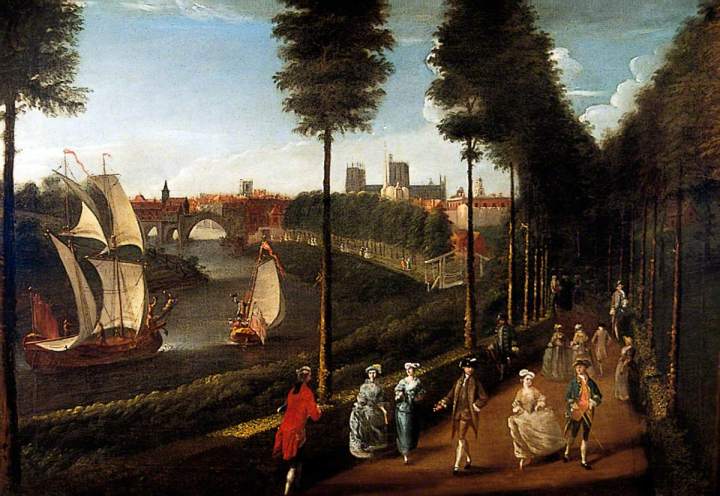
Nathan Drake, The New Terrace Walk, York, ca. 1756, oil on canvas, 76 × 107 cm
(York Art Gallery)
◊ ◊ ◊ ◊ ◊
From the York Georgian Society:
York and the Georgian City: Past, Present, and Future
King’s Manor, York, 18 May 2024
Joint conference presented by the York Georgian Society and the Centre for Eighteenth-Century Studies, University of York
The aim of this conference is to re-evaluate the notion of York as a Georgian city, which was one of the founding premises of the York Georgian Society in 1939. It will examine to what extent York can be described as a ‘Georgian’ city, and whether that label is relevant or meaningful in the present day. Why not a medieval, or a Victorian city? Is ‘Georgian’ merely a paradigm for good taste?
Keynote Presentations
• Rosemary Sweet (University of Leicester), When Did York Become Georgian?
• Madeleine Pelling (historian, writer, and broadcaster), Writing on the Wall: Graffiti, Rebellion and the Making of 18th-Century Britain
Other talks will include Constance Halstead on Anne Lister, Rachel Feldberg on Jane Ewbank, Matt Jenkins on whether York is an archetypical Georgian city, and John Mee on Manchester College, York. The full programme will be posted nearer the event.
Standard ticket prices (which include morning coffee, a light lunch, afternoon tea, and a reception) are £25; with discounted rates available to students (£5) and YGS members and University of York Staff (£15). Tickets can be booked here.
Exhibition | British Vision, 1700–1900, Selected Drawings and Prints

Joseph Farington, Dumbarton Rock from the South, 1788, pen and gray ink and watercolor; sheet: 38 × 68 cm
(New York: The Metropolitan Museum of Art, Purchase, Raymond Lifchez Living Trust Gift, 2014.148)
◊ ◊ ◊ ◊ ◊
Now on view at The Met:
British Vision, 1700–1900: Selections from the Department of Drawings and Prints
The Metropolitan Museum of Art, New York, 7 December 2023 — 5 March 2024
This rotation from the Department of Drawings and Prints celebrates recent additions to the collection by British artists who worked across two centuries, from 1700 to 1900. Landscape is a focus, with the genre becoming closely allied to the growing popularity of watercolor during this period. Around 1760, artists like Paul and Thomas Sandby, Francis Towne, and Thomas Jones began to explore the medium’s expressive potential. In the nineteenth century, dedicated watercolor societies were established and held regular exhibitions to promote their members’ work. Increasingly developed and poetically resonant compositions sought to challenge the preeminence of oil painting.
In this display, watercolors made rapidly out of doors by John Constable and Peter De Wint may be compared to finished compositions by John Brett, Samuel Palmer, and Alfred William Hunt. Travel’s ability to spur creativity is demonstrated by works that respond to sites in Britain, France, Italy, Caucasia, and North Africa. Nature studies, conversely, affirm how foreign flora became increasingly available at home. Finally, the sustained importance of the figure is represented by early chalk and pastel renderings by Joseph Wright of Derby and Allan Ramsay, vibrantly colored later portraits by David Wilkie and John Frederick Lewis, and representations of Black models by Lewis, William Henry Hunt, and Simeon Solomon.
Images of the works are available here»
Exhibition | James Gillray: Characters in Caricature
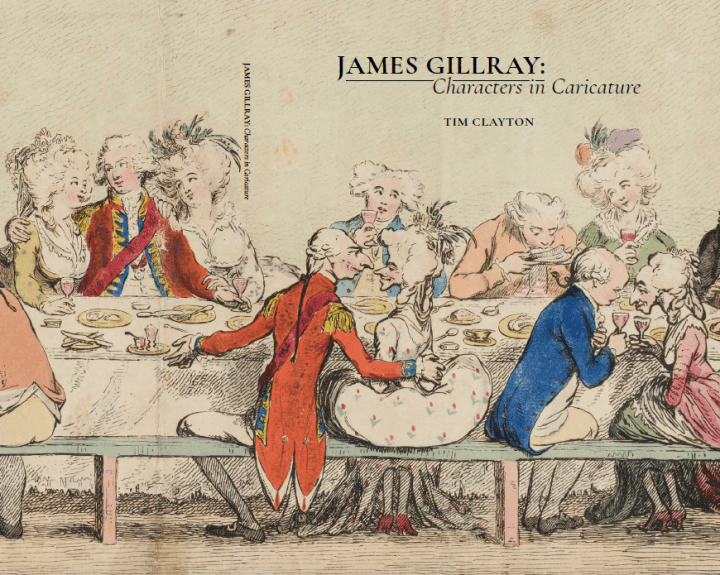
Now on view at Gainsborough’s House (which was just announced as the winner of The Georgian Group’s 2023 award for the ‘Restoration of a Georgian Building in an Urban Context’). . .
James Gillray: Characters in Caricature
Gainsborough’s House, Sudbury, 11 November 2023 — 10 March 2024
Curated by Tim Clayton
James Gillray (1756–1815) was Georgian Britain’s funniest, most inventive, and most celebrated graphic satirist. His work transcends his own time and has continued to influence his successors of the modern age, from David Low to Martin Rowson. Tim Clayton, author of 2022’s definitive biography of James Gillray, brings the master satirist to life in an astonishing, colourful, and at times salacious exhibition, James Gillray: Characters in Caricature. This lively and daring exhibition examines how Gillray exposed the most notorious scandals of his time by focusing on the artist’s principal characters—household names to which he returned to again and again, from Emma Hamilton to the Emperor Napoleon.
Tim Clayton, James Gillray: Characters in Caricature (Sudbury: Gainsborough’s House Society, 2023), ISBN: 978-0946511693, £20.










 Enfilade
leave a comment