Print Quarterly, December 2023

J. J. Grandville, after Francisco de Goya, And So Was His Grandfather (‘Hasta su abuelo’), 1834, graphite, over stylus indentations, 79 × 119 mm
(Nancy: Musée des Beaux-Arts)
◊ ◊ ◊ ◊ ◊
The long eighteenth century in the latest issue of Print Quarterly:
Print Quarterly 40.4 (December 2023)
a r t i c l e s
• Thea Goldring, “Beyond Siberia: Drawings by Le Prince for the Histoire Générale des Voyages,” pp. 391–406.
This article examines two signed and dated drawings by Jean-Baptiste Le Prince (1734–1781) that were acquired by the Metropolitan Museum of Art in 2012 and identifies their origins and purpose, proving Le Prince’s hitherto unknown participation in the Histoire Générale des Voyages project. The author discusses their relationship with the commissioned illustrations to Voyage en Sibérie by Jean Chappe d’Auteroche (1728–1769), as well as Le Prince’s contribution to other illustrated books. Throughout the paper, there is a detailed analysis of his common practice to appropriate and modify visual information from earlier sources, reworking them for illustrated travel texts.

Jean-Baptiste Le Prince, Inuit Manner of Dress, 1769, pen and black ink, brush and grey wash, over black chalk, with additions in graphite, 170 × 120 mm (New York: The Metropolitan Museum of Art).
• Paula Fayos-Pérez, “La Fontaine, Goya, Grandville: A Study of Visual and Literary Sources,” pp. 406–419.
This article considers how J.J. Grandville (1803–1847) was deeply influenced by Francisco de Goya y Lucientes (1746–1828), particularly how the plates from the Caprichos inspired the former’s illustrations to Jean de la Fontaine’s Fables and other illustrated books. Incidentally, Goya had also previously derived his sources for the Caprichos and Desastres de la Guerra from earlier illustrations to La Fontaine’s 17th-century text. In doing so, the interconnection of literary and visual sources in both artists is revealed, highlighting their shared concern for public education and masked political undertones.
n o t e s a n d r e v i e w s
• Tim Clayton, Review of David Alexander, A Biographical Dictionary of British and Irish Engravers, 1714–1820 (Paul Mellon Centre for Studies in British Art and Yale University Press, 2021), pp. 442–43.
This review is just as much a praise of David Alexander’s research methods and resourcefulness as it is to the book’s groundbreaking contributions in this field. Clayton highlights the book’s revelations concerning invisible women engravers, who often worked alongside and carried on the business after their husbands had died. In keeping with Alexander’s wide area of focus, the book also includes native and foreign engravers in branches of the trade outside of fine art, leading to a far more expansive and representational dictionary than previous ones.
• Alexandra C. Axtmann, Review of Dominique Lerch, Kristina Mitalaité, Claire Rousseau and Isabelle Seruzier, eds., Les Images de Dévotion en Europe XVIe–XXIe Siècle. Une précieuse histoire (Bibliothèque Beauchesne, 2021), pp. 477–79.
This review summarises a copious book based on papers presented at a two-day conference in Paris in 2019 organized by the Dominican library of Le Saulchoir together with the Académie des Inscriptions et Belles-Lettres. The content offers a European-wide perspective on small printed devotional prints that are often considered ‘kitsch’, enabling them to be studied with a variety of approaches concerning their creation, function, and reception up to the present day.
Call for Papers | In Motion: La Serenissima, Abruzzo, and the Adriatic
From ArtHist.net, which include the Call for Papers in Italian:
Art, Culture, and Politics in Motion: La Serenissima, Abruzzo, and the Adriatic Regions of the Kingdom of Naples, 16th–18th Centuries
Arte, cultura e politica in movimento: La Serenissima, l’Abruzzo e le regioni adriatiche del Regno di Napoli, XVI–XVIII secolo
Università degli Studi di Teramo, 10–11 April 2024
Organized by Martina Leone and Chiara Di Carlo
Proposals due by 4 February 2024
This call for studies stems from the ongoing research of two art historians and PhD students at the University of Teramo. Given the wide historiographical gaps on the subject, they propose to the scientific community, particularly to young researchers, two study days dedicated to the cultural and artistic circulation and the political and economic relations between the Republic of Venice, Abruzzo, and the Adriatic regions of the Kingdom of Naples (16th–18th centuries). There will be special but not exclusive attention to the movement of people, goods, works of art, ideas, collections, and documents, including in relation to the other side of the Adriatic Sea.
The 20th-century historiography has partly neglected the correspondence between Abruzzo and the territories of the Serenissima, instead focusing on the flourishing and proven connections between the Florentine-Aquilan and Roman-Aquilan figurative culture. Since the early 15th century, however, numerous testimonies have been known that confirm the migrations of Venetian artists to the territories of central Italy. In Abruzzo, the work of Jacobello da Fiore in Teramo, the sculpture of Girolamo Pittoni from Vicenza, and valuable 18th-century works by the Venetian artist Vincenzo Damini, prompt us to reconsider the entire situation. To enrich even more the debate are the reverse routes. We are witnessing not only migrations from North to Central Italy, but also displacements from the territories of Abruzzo to those of the Serenissima, as proven by the case of the 17th-century painter of Campli, Giovanni Battista Boncori.
With a chronological arc extended from the 16th to the 18th century, scholars from various fields (art history, modern history, economic history, gender history, book history, etc.) are invited to present unpublished and original contributions that shed light on the scope of Venetian figurative culture in Abruzzo and vice versa; on the exchange of documents and books within the two contexts; on the circulation of people, objects, materials and ideas, such as, the presence of local craftsmen active in both geographical areas. Like the maritime routes, carpenters, goldsmiths, woodworkers, potters, and collectors, represent an excellent starting point of investigation to highlight, once again, the correspondence between economic and social phenomena with artistic practice.
The submission of each contribution must include an abstract of no more than 300 words and a short curriculum vitae et studiorum of the applicant. The proposal must be sent to mleone@unite.it and cdicarlo@unite.it no later than Sunday, 4 February 2024. Scientific contributions will be published after peer review. The organising committee will provide the speakers with food for the entire duration of the conference and special agreements at accommodation facilities of the city of Teramo. The round trip transfer Rome-Teramo is funded for speakers coming from territories outside of Italy.
Possible but not exclusive lines of studies:
• Artistic influences between the Republic of Venice, Abruzzo, and the Adriatic regions of the Kingdom of Naples
• Circulation of people, ideas, and knowledge, also in relation to the Balkan side
• Carpenters, goldsmiths, woodworkers, and potters: the minor arts and the processing of local materials
• Circulation of drawings, engravings, and models
• Circulation of books and texts and the role of printing works
• Transmission of information (political, economic, etc.): correspondence, inventories, and dispatches
• Political and religious propaganda between the Holy See, the Republic of Venice, and the Kingdom of Naples
• The formation of collections of naturalia and mirabilia
• The movement of the economy: trade and commercial routes along the Adriatic
• Circulation of cults and religious men
Scientific Committee
Prof. Massimo Carlo Giannini (University of Teramo – Complutense University of Madrid)
Prof. Luca Siracusano (University of Teramo)
Prof.ssa Francesca Fausta Gallo (University of Teramo)
Prof. Giorgio Fossaluzza (University of Verona)
Prof. Adriano Ghisetti Giavarina (University ‘G. d’Annunzio’ of Chieti-Pescara)
Prof. Michele Maccherini (University of L’Aquila)
Prof. Egidio Ivetic (University of Padua)
New Book | The Art of the Chinese Picture-Scroll
Published by Reaktion and also distributed by The University of Chicago Press:
Shane McCausland, The Art of the Chinese Picture-Scroll (London: Reaktion Books, 2023), 299 pages, ISBN: 978-1789147964, £35 / $50.
 The Chinese picture-scroll, a long painting or calligraphic work held within a horizontal scrolling mount, has been China’s pre-eminent aesthetic format for the last two millennia. This first extended history of the picture-scroll explores its extraordinary longevity, and its adaptability to social, political, and technological change. The book describes what the picture-scroll demands of a viewer, how China’s artists grappled with its cultural power, and how collectors and connoisseurs have left their marks on scrolls for later generations to judge. The return to mass appeal of scrolling—a media technology that seemed long outdated yet persists in our digital age—provides urgent and fascinating context to this book.
Shane McCausland is Percival David Professor of the History of Art at SOAS University of London. His many books include The Mongol Century: Visual Cultures of Yuan China, 1271–1368 (Reaktion Books, 2014), and he has curated numerous exhibitions in Europe, North America, and China.
c o n t e n t s
Introduction
1 On Origins and Uses over the First Millennium
2 Inscribing the Artist and the Collector: The Picture-Scroll in the Song–Liao–Jin Period
3 Handscrolls in Mongol Palaces
4 Musing on Shadows: Reading the Ming Picture-Scroll
5 Qing: Reading the ‘Baroque’ Handscroll
6 Modernist Uses of the Chinese Picture-Scroll
7 The Medium of Silent Poetry in the Late Modern World
References
Further Reading
Acknowledgements
List of Illustrations
Index
New Book | East Asian Aesthetics and the Space of Painting
Isabelle Tillerot’s Orient et ornement: l’espace à l’oeuvre ou le lieu de la peinture was published in 2018; an English edition will soon be available from The Getty:
Isabelle Tillerot, East Asian Aesthetics and the Space of Painting in Eighteenth-Century Europe, translated by Chris Miller (Los Angeles: Getty Research Institute, 2024), 272 pages, ISBN: 978-1606067970 (paperback), $70.
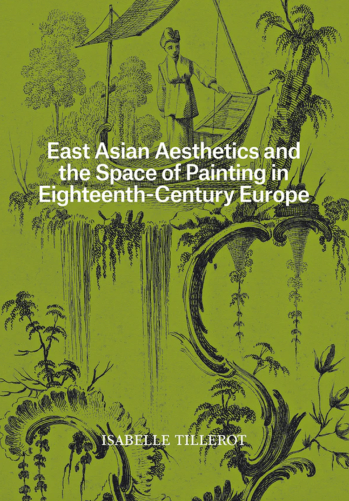 This volume offers the first critical account of how European imports of East Asian textiles, porcelain, and lacquers, along with newly published descriptions of the Chinese garden, inspired a revolution in the role of painting in early modern Europe. With particular focus on French interiors, Isabelle Tillerot reveals how a European enthusiasm for East Asian culture and a demand for novelty transformed the dynamic between painting and decor. Models of space, landscape, and horizon, as shown in Chinese and Japanese objects and their ornamentation, disrupted prevailing design concepts in Europe. With paintings no longer functioning as pictorial windows, they began to be viewed as discrete images displayed on a wall—and with that, their status changed from decorative device to autonomous work of art. This study presents a detailed history of this transformation, revealing how an aesthetic free from the constraints of symmetry and geometrized order upended paradigms of display, enabling European painting to come into its own.
Isabelle Tillerot is an independent scholar of eighteenth-century French art.
Exhibition | The Palace of Versailles and the Forbidden City
From the press release (6 March 2023), from the Château de Versailles:
The Palace of Versailles and the Forbidden City: French-Chinese Relations in the 18th Century
Palace Museum, Forbidden City, Beijing, 1 April — 30 June 2024
Hong Kong Palace Museum, 18 December 2024 — 4 May 2025

Fontaine à parfum, porcelaine à glaçure céladon craquelé et céramique brune, Jingdezhen, début de l’époque Qianlong (1736–1795), monture en bronze doré, Paris, vers 1743 (Château de Versailles).
Initially scheduled for 2020 and postponed due to the pandemic, the exhibition entitled The Palace of Versailles and the Forbidden City: French-Chinese Relations in the 18th Century will run from 1 April 2024 at the Forbidden City’s Palace Museum. On 6 April 2023, Palace of Versailles Chair Catherine Pégard and Xudong Wang, Chair of the Forbidden City’s Palace Museum, met at the Great Hall of the People in Beijing to reiterate their enthusiasm in seeing this joint project through to completion before Presidents Xi and Macron.
The Palace of Versailles is honoured to be working with the Forbidden City’s Palace Museum in Beijing in organising this exhibition surrounding the relationship between France and China in the 18th century and due to run from 1 April to 30 June 2024. The exhibition is a more in-depth version of the one that was rolled out at the Palace of Versailles in 2014 to mark fifty years of diplomatic relations between the two countries, initially sparked by General de Gaulle on 27 January 1964.
Louis XIV put in place in the context of his relations with Emperor Kangxi, which took the form of initiatives such as French Jesuits dispatched to China in 1685 to serve at the Chinese court as mathematicians to the King. This process paved the way for the two nations to begin forging a relationship built on mutual trust and admiration, one that remains unfamiliar to many, and lasted until the 18th century. This special diplomatic relationship and mutual respect helped usher in French appreciation for modern China and Chinese artistry.
In France, the court’s love affair with China and Chinese art shines through in a variety of different ways, and four key phenomena: importing Chinese artworks and pieces; altering certain imported artworks, notably by adding gilt-bronze frames to porcelain pieces and using lacquered panels on French furniture; imitating Chinese products, such as the frenzied quest to track down the secret to making kaolin porcelain; and Chinese art’s marked influence on French art, particularly in the field of decorative arts. The exhibition will illustrate how Chinese art served as a bottomless source of inspiration for French artists and intellectuals, in everything from painting, art objects, and interior design to architecture, landscape design, literature, music and the sciences.
Meanwhile, in the Chinese court, many French Jesuits also followed after the arrival of the ‘Mathematicians of the king’ sent by Louis XIV in China, some of whom served the court for a long time. With them as the intermediary, French culture had an important influence on many fields such as science, art, architecture, medicine, mapping and so on in the Qing court. Therefore, juxtaposed with French Exhibits in the Exhibition are also clocks, scientific instruments, prints, porcelain, bronzes, books, and other objects from the Palace Museum collection, directly reflecting the achievements of exchanges and cultural exchanges between the two sides.
The exhibition in Beijing will bring together a selection of pieces taken from the Palace of Versailles and Palace Museum collections, designed to serve as broader examples of the veritable fascination for Chinese art that took root at the court of Versailles and among French enthusiasts. It showcases the efforts and achievements made by China and France to achieve mutual understanding and cultural exchanges in the 18th century, and vividly restores the splendid cultural and artistic exchanges between the two countries for more than a century.
Exhibition commissioned by Marie-Laure de Rochebrune, Curator at the Palace of Versailles, and Guo Fuxiang, Curator at the Palace Museum.
◊ ◊ ◊ ◊ ◊
Note (added 18 December 2024) — The posting was updated to include the Hong Kong venue.
New Book | The Borders of Chinese Architecture
From Harvard UP:
Nancy Shatzman Steinhardt, The Borders of Chinese Architecture (Cambridge: Harvard University Press, 2022), 448 pages, ISBN: 978-0674241015, $57.
 An internationally acclaimed expert explains why Chinese-style architecture has remained so consistent for two thousand years, no matter where it is built.
For the last two millennia, an overwhelming number of Chinese buildings have been elevated on platforms, supported by pillars, and covered by ceramic-tile roofs. Less obvious features, like the brackets connecting the pillars to roof frames, also have been remarkably constant. What makes the shared features more significant, however, is that they are present in Buddhist, Daoist, Confucian, and Islamic milieus; residential, funerary, and garden structures; in Japan, Korea, Mongolia, and elsewhere. How did Chinese-style architecture maintain such standardization for so long, even beyond China’s borders?
Nancy Shatzman Steinhardt examines the essential features of Chinese architecture and its global transmission and translation from the predynastic age to the eighteenth century. Across myriad political, social, and cultural contexts within China and throughout East Asia, certain design and construction principles endured. Builders never abandoned perishable wood in favor of more permanent building materials, even though Chinese engineers knew how to make brick and stone structures in the last millennium BCE. Chinese architecture the world over is also distinctive in that it was invariably accomplished by anonymous craftsmen. And Chinese buildings held consistently to the plan of the four-sided enclosure, which both afforded privacy and differentiated sacred interior space from an exterior understood as the sphere of profane activity. Finally, Chinese-style buildings have always and everywhere been organized along straight lines. Taking note of these and other fascinating uniformities, The Borders of Chinese Architecture offers an accessible and authoritative overview of a tradition studiously preserved across time and space.
Nancy Shatzman Steinhardt is Professor of East Asian Art and Curator of Chinese Art at the University of Pennsylvania and the author of Chinese Architecture: A History (2019). Her work has been supported by the Guggenheim Foundation, Getty Foundation, National Endowment for the Humanities, and the American Philosophical Society.
c o n t e n t s
Preface
Introduction: The Borders Problem
1 Chinese Architecture before China
2 Han
3 Architecture before Reunification
4 Seeing the Sixth Century as the Seventh and Eighth
5 Tang Internationalism
6 Defining Chinse Architecture and Borders during Liao
7 Western Xia, Song, Japn, Jin
8 A Revisionist History of Yuan Architecture
9 Ming
10 The Long Eighteenth Century
Afterword
New Report | Survey of Asian Ceramics, National Trust for Scotland
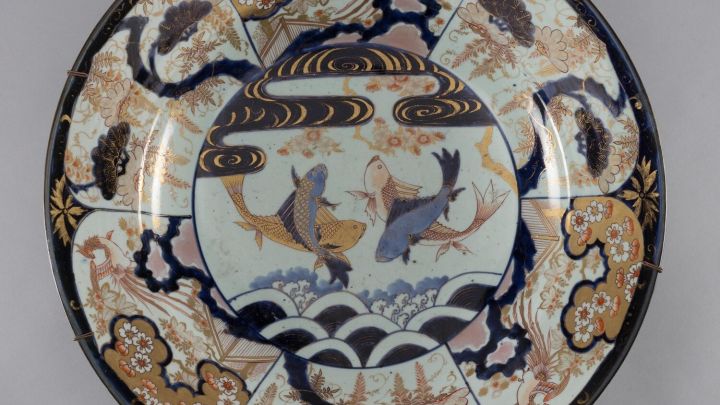
Large dish, porcelain, painted in underglaze blue, iron-red, and gold, Imari-type palette, made in Arita kilns, Japan, Edo period, c.1700–20
(National Trust for Scotland)
◊ ◊ ◊ ◊ ◊
The report was released early this year; Patricia Ferguson provides an introduction here. The full report is available (for free) as a PDF file here.
Patricia Ferguson, Survey of Asian Ceramics in the Collection of the National Trust for Scotland (National Trust for Scotland, 2023), 162 pages.
Between 2017 and 2019 the National Trust for Scotland delivered Project Reveal, a major collections project inventorying a collection of over 140,000 objects, distributed across 50 properties throughout Scotland. Encompassing major object groupings in the areas of fine and decorative art, household furniture and domestic life, these collections chart the experiences of people living in Scotland through 500 years of Scottish history, as well as demonstrating Scotland’s past relationships with the rest of the world.
This survey of Asian ceramics is a natural successor to Project Reveal. It delves deeper into the history and significance of a collection of circa 1,700 ceramic items. Undertaken by the independent researcher Patricia F. Ferguson this report sets out the survey findings, drawing together disparate existing research on the subject and contributing new collection research and knowledge. Focusing on key collections at nine different National Trust for Scotland properties, the report positions the collections within the broader context of historic ceramic production and collecting, with attention to influences such as: fashion and the role of royalty; production in and trade with China and Japan; and the growth of and changes in demand.
Patricia Ferguson is a ceramic specialist with an MA from the School of Oriental and African Studies (SOAS), London. She has worked in London at the British Museum and Victoria & Albert Museum, and as Honorary Adviser on Ceramics to the National Trust (England, Wales, and Northern Ireland). She published Ceramics: 400 Years of British Collecting in 100 Masterpieces in 2016.
Conference | Exploring the Histories of Chinese Collections in Europe

Gotha Research Centre (Das Forschungszentrum Gotha ), Universität Erfurt, Thuringia (large grey building on the left).
◊ ◊ ◊ ◊ ◊
From ArtHist.net:
From Cabinets to Museums: Exploring the Histories of Chinese Collections in Europe
Gotha Research Centre, University of Erfurt, 10–11 January 2024
Organized by Emily Teo
An international workshop at the Gotha Research Centre of the University of Erfurt, in cooperation with Stiftung Schloss Friedenstein Gotha
Chinese objects were acquired by European collectors for a variety of reasons: ranging from the aesthetic decoration of their residences, to using objects as a source of knowledge about foreign cultures. This workshop brings together historians and museum professionals to discuss the complex histories of Chinese collections in European contexts. Central to the workshop is the East Asian collection in Gotha. Around 1800, Duke August of Saxe-Gotha-Altenburg (1772–1822) founded the Chinese Cabinet, a rich and diverse collection of East Asian objects in Gotha’s Friedenstein Palace. Themes that will be explored include the global circulation of artwork, China-Mode in 18th-century Europe, and the practices of collecting and displaying Chinese objects in European collections. The goal of the workshop is to historicize these collections and to explore their interconnections, leading to new directions for research on East Asian collections in Europe. Registration and contact: Emily.teo@uni-erfurt.de

Shoes from the East Asian collection in Gotha, founded by Augustus, Duke of Saxe-Gotha-Altenburg as the Chinese Cabinet around 1800 (Schloss Friedenstein, inv. no. ETH14S).
w e d n e s d a y , 1 0 j a n u a r y
11.00 Tour of the Ducal Museum*
• Agnes Strehlau (Stiftung Schloss Friedenstein Gotha)
14.00 Greeting
• Martin Mulsow (Gotha Research Centre, University of Erfurt)
• Tobias Pfeifer-Helke (Stiftung Schloss Friedenstein Gotha)
14.15 Introduction
• Emily Teo (Gotha Research Centre)
14.30 Session 1 | Historical Collections
• Jean Theodore Royer (1737–1807) and His Chinese Collection: Thoughts on His Objectives and Collecting Strategies — Jan van Campen (Rijksmuseum, Amsterdam)
• Noblesse Oblige — Francois Coulon (Musée des Beaux-Arts, Rennes)
15.40 Coffee break
Object Workshop
16.15 Viewing East Asian Artefacts*
• Kerstin Volker-Saad and Agnes Strehlau (Stiftung Schloss Friedenstein Gotha)
18.00 Evening Lecture
• Traces of Guangzhou: Craftsmanship, Material (Dis)Connections and Chinesische Kabinette — Anna Grasskamp (University of Oslo)
19.00 Workshop dinner, for invited participants
t h u r s d a y , 1 1 j a n u a r y
9.30 Object Workshop
• Viewing Chinese Export Albums* — Ulrike Eydinger (Stiftung Schloss Friedenstein Gotha)
11.00 Coffee break
11.15 Session 2 | Transcultural Objects
• Gemstone Potted Landscapes: A Case Study for Exploring the 18th- and 19th-Century China-Europe Transcultural Materiality and Craftsmanship — Wen-ting Wu (National Taiwan University)
• From ’18 Stuck grose Vasen’ to ‘national wertvolles Kulturgut’: Chinese Monumental Vases and the History of Chinese Art History at the Dresden Porcelain Collection — Feng Schöneweiß (Kunsthistorisches Institut in Florenz – Max-Planck-Institut)
12.25 Lunch break
13.15 Session 3 | Chinese Architecture for European Princes
• Chinese Architecture at the Friedenstein Palace: Henri-Léonard Bertin, Herzog August von Saxe-Gotha-Altenburg and the Influence of the Drawings from l’Essai sur l’architecture chinoise (1773) — Kee Il Choi Jr (University of Zürich)
• Just for Decoration or Made for Pedagogical Purposes? Murals with Scenes from the Life of Confucius in Oranienbaum Commissioned by Duke Franz of Anhalt-Dessau (1740–1817) — Dorothee Schaab-Hanke (University of Bamberg)
• Think Big: Augustus the Strong and His Collections of Asiatica — Cordula Bischoff (Independent Researcher)
15.00 Final remarks
* Workshop presentations and the evening lecture at the Gotha Research Centre are open to the public with registration. Due to space constraints, the museum tour and object workshops are open only to workshop speakers. Object workshops will be held at the Perthes Forum, a 10-minute walk from the Gotha Research Centre.
Exhibition | Shoes: Inside Out

Eighteenth-century women’s shoes (Hampshire Cultural Trust’s Collection).
◊ ◊ ◊ ◊ ◊
Now on view at The Arc:
Shoes: Inside Out
Willis Museum and Sainsbury Gallery, Basingstoke, Spring 2023
The Arc, Winchester, 24 November 2023 — 6 March 2024
From the functional and practical to the fashionable and extravagant, shoes have played an intriguing role in our social history and modern lives. They can tell us about a person’s work, leisure choices, status, and aspirations—but the story is not always straightforward. Conformity to gender stereotypes is blurred, power statements conceal repression, and the utilitarian merges with the frippery. Shoes: Inside Out is an exhibition featuring footwear from our past, as far back as 11 AD, to the present. Through the themes of work, protect, play, empower, transform, identify, and aspire, 70 pairs of shoes from Hampshire Cultural Trust’s Collection explore how shoes have shaped—and have been shaped by—society. From Georgian high society shoes to 1970s platforms and current high-end designer heels to everyday boots there is a shoe to fit all interests. Alongside the footwear, a display of high-definition x-rays of some of the shoes allow us to glimpse the story within, uncovering developments in the shoes’ construction and revealing an ethereal reminiscence of a life lived.
New Book | Pockets: An Intimate History
We now have two books on pockets (Carlson’s joins that of Barbara Burman and Ariane Fennetaux, published by Yale UP in 2019). From Hachette Book Group:
Hannah Carlson, Pockets: An Intimate History of How We Keep Things Close (Algonquin Books, 2023), 320 pages, ISBN: 978-1643751542, $35.
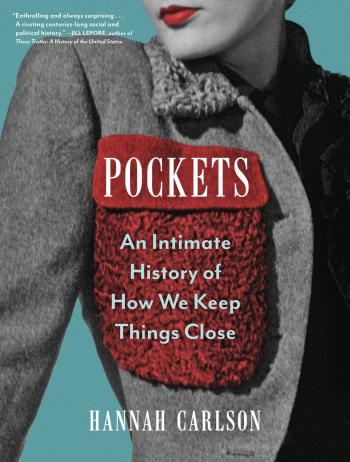 Who gets pockets, and why? It’s a subject that stirs up plenty of passion: Why do men’s clothes have so many pockets and women’s so few? And why are the pockets on women’s clothes often too small to fit phones, if they even open at all? In her captivating book, Hannah Carlson, a lecturer in dress history at the Rhode Island School of Design, reveals the issues of gender politics, security, sexuality, power, and privilege tucked inside our pockets.
Throughout the medieval era in Europe, the purse was an almost universal dress feature. But when tailors stitched the first pockets into men’s trousers five hundred years ago, it ignited controversy and introduced a range of social issues that we continue to wrestle with today, from concealed pistols to gender inequality. See: #GiveMePocketsOrGiveMeDeath.
Filled with incredible images, this microhistory of the humble pocket uncovers what pockets tell us about ourselves: How is it that putting your hands in your pockets can be seen as a sign of laziness, arrogance, confidence, or perversion? Walt Whitman’s author photograph, hand in pocket, for Leaves of Grass seemed like an affront to middle-class respectability. When W.E.B. Du Bois posed for a portrait, his pocketed hands signaled defiant coolness.
And what else might be hiding in the history of our pockets? (There’s a reason that the contents of Abraham Lincoln’s pockets are the most popular exhibit at the Library of Congress.) Thinking about the future, Carlson asks whether we will still want pockets when our clothes contain ‘smart’ textiles that incorporate our IDs and credit cards. Pockets is for the legions of people obsessed with pockets and their absence, and for anyone interested in how our clothes influence the way we navigate the world.
Hannah Carlson teaches dress history and material culture at the Rhode Island School of Design. After training as a conservator of costume and textiles at the Fashion Institute of Technology, she received a PhD in material culture from Boston University. She has contributed articles to Commonplace: The Journal of Early American Life; Dress; and MacGuffin: The Life of Things.










 Enfilade
leave a comment