Exhibition | The Fabric of Democracy

La fête de la Fédération textile, 1790
(Musee de la Toile de Jouy)
◊ ◊ ◊ ◊ ◊
Now on view at the Fashion and Textile Museum:
The Fabric of Democracy: Propaganda Textiles from the French Revolution to Brexit
Fashion and Textile Museum, London, 29 September 2023 – 3 March 2024
Curated by design historian Amber Butchart, this exhibition explores printed propaganda textiles over more than two centuries. Discover how fabric designers and manufacturers have responded to political upheaval from the French Revolution through to Brexit.
The mechanisation of textile industries from the mid-18th century led to the development of printing techniques that could create more detailed imagery on cloth, quicker than ever before. These increasingly affordable processes ‘democratised’ textile decoration, allowing governments, regimes, and corporations to harness the power of print to communicate, from wartime slogans to revolutionary ideals.
While propaganda is usually associated with public art and monumental sculpture, this exhibition explores how fabrics have been used as a political medium both in the home and on the body, through furnishing and fashion. Find out how textiles were used as a tool of the state across the political spectrum, from communism to fascism. Discover how a fraternal crisis in the monarchy played out on cloth, and how democracies promote national identity through textile design. On display will be textiles from countries including Britain, America, Italy, Germany, and Austria—ranging from French toile de Jouy to Japanese robes from the Asia-Pacific war, to Cultural Revolution-era Chinese fabrics rarely exhibited in the UK.
Amber Butchart is a curator, writer, and broadcaster who specialises in the cultural and political history of textiles and dress. She is a former Research Fellow at the University of the Arts London and is a regular public lecturer across the UK’s leading arts institutions. She researches and presents documentaries for television and radio, including the six-part series A Stitch in Time for BBC Four that fused biography, art, and the history of fashion to explore the lives of historical figures through the clothes they wore, and she is the history consultant and regular on-screen historian for BBC One’s Great British Sewing Bee. Amber is an external adviser for the National Crime Agency as a Forensic Garment Analyst, working on cases that require investigation of clothing and textiles. She has published five books on the history and culture of clothes, including The Fashion of Film, Nautical Chic, and a history of British fashion illustration for the British Library.
Exhibition | Boy’s Dress, 1760–1930
Now on view at the Fashion and Textile Museum:
Oh Boy! Boy’s Dress, 1760–1930
Fashion and Textile Museum, London, 29 September 2023 – 3 March 2024
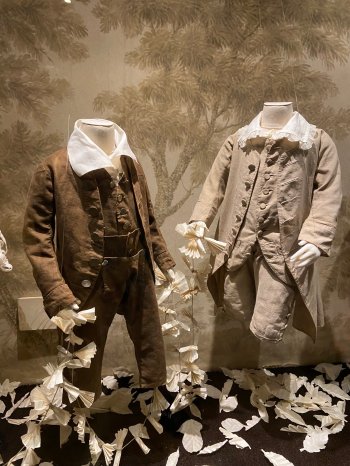 The Fashion and Textile Museum is excited to present Oh Boy!, an exploration into historical boy’s dress. Curated by leading fashion historian Amy de la Haye, alongside renowned expert collector Alasdair Peebles, the exhibition presents an unrivalled collection of an often-undervalued area of fashion history, spread over two acts.
29 September — 16 December 2023
Act One: Breeched, No More Dresses explores the ceremony of entry into the masculine world, taking place after six years of age, as boys abandoned dresses in favour of breeches. Focusing on the period from 1760 to 1810, Act One presents a dimity gown and coat, a robust three-piece fustian breeches suit, and a block-printed skeleton suit, alongside other fascinating pieces.
21 December 2023 — 3 March 2024
Act Two: Ship Shape delves into the vogue for nautical wear dating from 1860 to 1930. Starting with a miniature suit that an admiral had made for his young son and including linen and wool serge suits, loosely inspired by naval dress, accompanied by accessories. The space will be imaginatively adorned, showcasing Alasdair’s skills as a decorative period interior painter and exploring the topic of collecting as narrative.
Amy de la Haye is Professor of Dress History & Curatorship, and joint director of the Centre for Fashion Curation at London College of Fashion (LCF). Recent and current projects include Gluck: Art & Identity at Brighton Museum (2017), Ravishing: The Rose in Fashion at MFIT (2021), Wild & Cultivated: Fashioning the Rose at London’s Garden Museum (2022), Making Mischief: Folk Costume in Britain at Compton Verney (2023), and Making More Mischief… at LCF Stratford (2024). She has published extensively and writes for SHOWstudio. Formerly she served as curator of 20th-century dress at the Victoria and Albert Museum with exhibitions including the radical Streetstyle: from sidewalk to catwalk (1994).
Alasdair Peebles works as a freelance decorative painter, specialising in hand-painted wallpapers and the restoration of painted finishes in Historic houses. For the last thirty years, he has built a private collection focused exclusively on boy’s and youth’s clothes from 1750 to 1950. He is currently co-authoring a book on men’s and boys’ dress for Bloomsbury. He has lectured widely, regularly lends clothing to museums for exhibitions and works with costume designers on period film projects including Little Women and Mary Poppins.
Colloquium | Le stuc dans les grands décors en Europe
From ArtHist.net and the conference programme:
Le stuc dans les grands décors en France et en Europe, de la Renaissance à 1850
Online and in-person, Versailles, Paris, and Fontainebleau, 11–13 December 2023
L’objectif de ces journées est de faire le point sur les recherches en cours, les avancées dans les domaines de la restauration et de l’analyse scientifique, les découvertes effectuées à l’occasion de récents chantiers de restauration et définir des objets de recherches pluridisciplinaires. L’usage du stuc dans l’Antiquité et au Moyen Âge a suscité l’intérêt des historiens de l’art et des scientifiques du patrimoine français. Par contre, hormis dans la sphère provençale et languedocienne, où le milieu universitaire est particulièrement actif sur le sujet des décors, le stuc demeure un champ d’étude encore trop peu exploré en France pour la période de la Renaissance au XIXe siècle.
 Pourtant, le vaste sujet du stuc connaît en Europe un certain engouement, comme en témoignent le Centro Studi per la Storia dello Stucco in Età Moderna e Contemporanea, les publications du Rijksdienst voor Cultureel Erfgoed des Pays-Bas, les colloques organisés par la Low Countries Sculpture Society et par l’université de Pardubice, en République Tchèque. La galerie Mazarin à la Bibliothèque nationale de France, la chambre de la duchesse d’Étampes, la galerie François Ier et la Porte Dorée à Fontainebleau, la galerie d’Apollon et l’appartement d’été d’Anne d’Autriche au Louvre ou encore la galerie des Glaces et le salon de Diane à Versailles sont autant de campagnes de restaurations récentes ou en cours qui concernent en partie le stuc. Elles sont l’opportunité de mettre en lumière la question du stuc dans les grands décors français en stuc, de la Renaissance au XIXe siècle.
Les trois journées d’études et de visites sont le premier évènement organisé par un nouveau groupe de recherche sur le décor en stuc dans les grandes demeures en France et en Europe de la Renaissance à 1850. L’objectif de ces journées est de faire le point sur les recherches en cours, les avancées dans les domaines de la restauration et de l’analyse scientifique, les découvertes effectuées à l’occasion de récents chantiers de restauration et définir des objets de recherches pluridisciplinaires. Langues: français et anglais.
Le colloque est retransmis en direct sur YouTube, où vous pourrez continuer à le visionner après l’événement. Il suffit de cliquer sur les liens ci-dessous.
Le lien de la chaîne YouTube: https://www.youtube.com/@GroupeStucs
1 e journée, Versailles: https://youtube.com/live/wrNoOIji2CM
2e journée, C2RMF: https://youtube.com/live/ijBg390diu0
3e journée, Fontainebleau: https://youtube.com/live/RYip3hmp164
Collaboration entre le château de Versailles, le château de Fontainebleau, le Centre de Recherche et de Restauration des Musées de France, le Laboratoire de Recherche des Monuments Historiques, le musée du Louvre, le château de Compiègne et l’association Low Countries Sculpture asbl
À l’heure actuelle, le groupe rassemble plusieurs institutions muséales, patrimoniales et scientifiques : le musée national des châteaux de Versailles et de Trianon, le musée national du château de Fontainebleau, le musée national du château de Compiègne, le musée du Louvre, la bibliothèque nationale de France, le château de Vaux-le-Vicomte, le Centre de Recherche et de Restauration des Musées de France, le Laboratoire de Recherche des Monuments Historiques, le château de Vaux-le-Vicomte et l’association Low Countries Sculpture. Le groupe espère réunir une communauté d’historiens de l’art (conservateurs et universitaires), de restaurateurs, de scientifiques du patrimoine et d’artisans s’intéressant à ce sujet qui puisse à terme élaborer des programmes de recherches cohérents et devenir une référence pour les prochains chantiers de restauration concernant des décors de stuc.
Comite d’Organisation
Lionel Arsac (château de Versailles)
Oriane Beaufils (château de Fontainebleau)
Anne Bouquillon (C2RMF)
Ann Bourges (C2RMF)
Valérie Carpentier-Vanhaverbeke (musée du Louvre)
Stéphanie Deschamps-Tan (musée du Louvre)
Jean Ducasse-Lapeyrusse (LRMH)
Étienne Guibert (château de Compiègne)
Léon Lock (The Low Countries Sculpture Society)
l u n d i , 1 1 d e c e m b r e 2 0 2 3
Château de Versailles, auditorium, cour d’Honneur, entrée sur la gauche du Pavillon Dufour (A)
9.50 Laurent Salome (directeur, château de Versailles), Mots de bienvenue
10.00 Lionel Arsac (conservateur du patrimoine, château de Versailles), Introduction
10.20 Session 1 | Le Stuc: état de la recherche, définitions
Présidence: Geneviève Bresc-Bautier (directrice honoraire du département des Sculptures, musée du Louvre)
• Serena Quagliaroli (université de Turin), and Giulia Spoltore (Università della Svizzera italiana), A Centre for the Study of Stucco
• Giacinta Jean (SUPSI, Mendrisio), Giovanni Nicoli (SUPSI, Mendrisio), and Jana Zapletová (Palacký University, Olomouc), Form and Material of Stucco Decoration: Developing Research Projects for a Better Understanding, Conservation, and Dissemination
• Sarah Munoz (université de Lausanne), Usages et techniques du stuc en France aux XVIe et XVIIe siècles: considérations, savoir-faire et secrets d’atelier
• Cyril de Ricou (Atelier de Ricou, Paris) et Armelle Le Gendre (Atelier de Ricou, Paris), Regards croisés sur les stucs de Michel Anguier dans les appartements d’été d’Anne d’Autriche: l’apport des sources écrites et de l’analyse des matériaux
12.15 Pause déjeuner
13.45 Session 2 | Sculpteurs, stucateurs et gipiers
Présidence: Pascal Julien (université Toulouse Jean-Jaurès)
• Lionel Arsac (conservateur du patrimoine, château de Versailles), Le stuc dans les Grands Appartements de Versailles
• Magali Theron (université d’Aix-Marseille), Maîtres sculpteurs et/ou gipiers? Les auteurs des décors en gypserie à Marseille et Aix au XVIIe et début du XVIIIe siècle
15.20 Session 3 | Concevoire: modèles et transmissions
Présidence: Christine Casey (Trinity College Dublin)
• Alicia Adamczak-Gosset (Institut catholique de Paris), Le stuc en regard de la peinture: valeur iconographique et matérielle dans les décors de Jacques Sarazin et de Simon Vouet
• Léon Lock (The Low Countries Sculpture Society, Bruxelles/Mons), Le stuc dans les anciens Pays-Bas de 1650 à 1780: Réflexions sur la traduction de modèles gravés en hauts reliefs
• Giuseppe Dardanello (université de Turin), Stucco in Piedmont from the Late 17th to the mid-18th Century: Designers and Producers
• Barbara Rinn-Kupka (historienne de l’art indépendante, Cologne), French outside France: French Decoration Models in Central and Northern German Stuccowork from the 16th to the mid-18th Century
m a r d i , 1 2 d e c e m b r e 2 0 2 3
Centre de Recherche et de Restauration des Musées de France (C2RMF), auditorium, Palais du Louvre, porte des Lions, escalier de l’Horloge
8.30 Accueil
9.00 Jean-Michel Loyer-Hascoët (directeur, C2RMF), Mots de bienvenue
9.10 Anne Bouquillon (C2RMF) et Ann Bourges (C2RMF), Introduction
9.35 Session 4 | Échanges et diffusion (I)
Présidence: Muriel Barbier (directrice du patrimoine et des collections, château de Fontainebleau)
• Oriane Beaufils (conservatrice du patrimoine, château de Fontainebleau) et Émilie Checroun (conservatrice-restauratrice, Paris), Les stucs du château de Fontainebleau: modèles, méthodes et matérialité
• Grégoire Extermann (SUPSI, Mendrisio) et Alberto Felici (SUPSI, Mendrisio), Une décoration en stuc inédite à la Villa Imperiale de Pesaro: entre Italie, empire et monarchies
11.05 Session 5 | Échanges et diffusion (II)
Présidence: Oriane Beaufils (conservatrice du patrimoine, château de Fontainebleau)
• Serena Quagliaroli (université de Turin) and Giulia Spoltore (Università della Svizzera italiana), Some Italian-French Case Studies in mid-16th-Century Rome
• Mickaël Zito (musée des beaux-arts et d’archéologie de Besançon), Des Lacs à la Toscane, sur les traces des stucateurs Portogalli
12.05 Pause déjeuner
13.00 Session 6 | Grands décors: étude de cas de restauration (I)
Présidence: Jean Ducasse-Lapeyrusse (LRMH)
• Luca Baroni (Université Ca’Foscari, Venise – directeur, lieux culturels de la région des Marches du Nord), Stucco as Political Power: The Rediscovery and Restoration of the Decorative Cycle by Federico Brandani in the Ducal Palace of Montebello, ca. 1530–63
• Jan Verbeke (conservateur-restaurateur indépendant, Gand), The Plasterer Ian Christiaen Hansche in the Refectory of Park Abbey in Heverlee: The Meticulous Conservation and Restoration of the Monumental 1679 Stucco Ceiling
• Michael Gratton (atelier Tollis, Paris), Les décors de gypseries du Grand Salon du château de Vaux-le-Vicomte, étude des techniques de mise en œuvre et restauration
15.00 Session 7 | Grands décors: étude de cas de restauration (II)
Présidence: Fabrice Goubard (LPPI, CY Cergy Paris Université)
• Corrado De Giuli Morghen (Agence d’architecture Fabrica Traceorum, Marseille), Pierrick Rodriguez (conservateur des Monuments Historiques, DRAC PACA), et Margot Morisse (conservatrice-restauratrice du patrimoine), Le maître-autel et le retable du sculpteur Christophe Veyrier de l’église Notre-Dame de Nazareth à Trets (13), un témoignage précieux du baroque provençal
• Camille Jacquot (responsable du pôle patrimoine, château de Lunéville) et Annabelle Sansalone (conservatrice-restauratrice du patrimoine, Paris), Présentation des décors en plâtre dans l’antichambre de la Reine au château de Lunéville: contexte historique et mise en œuvre de l’ouvrage
• Wijnand Freling (architecte du patrimoine, Rocaille b.v., La Haye), Preserving a Monumental 18th-Century Stucco Ceiling in the Staircase of the Senate at the Binnenhof, the Centre of Government of the Netherlands in The Hague
17.00 Discussion sur le stuc: matérialité et caractérisation des matériaux
• Fabrice Goubard (LPPI, CY Cergy Paris Université)
• Anne Bouquillon (C2RMF)
• Ann Bourgès (C2RMF)
• Jean Ducasse-Lapeyrusse (LRMH)
18.00 Visite de la Galerie Dorée de la Banque de France
Arnaud Manas (chef du service historique, Banque de France)
Max. 35 personnes, sur inscription
m e r c r e d i , 1 3 d e c e m b r e 2 0 2 3
Château de Fontainebleau, salle des Colonnes
11.20 Accueil café
11.45 Oriane Beaufils (conservatrice du patrimoine, château de Fontainebleau), Introduction
12.00 Session 8 | Matériaux particuliers, reproductibilité
Présidence: Guilhem Scherf (département des Sculptures, musée du Louvre)
• François Gilles (université Paris I Panthéon-Sorbonne/Musée des arts décoratifs, Paris), Usage(s) du plâtre chez les sculpteurs en ornement parisiens au XVIIIe siècle
• Étienne Guibert (conservateur du patrimoine, château de Compiègne), Le stuc, un matériau économique et pratique dans les décors néoclassiques de Compiègne
13.00 Pause déjeuner
14.15 Session 9 | Quand le stuc est omniprésent
Présidence: Eckart Marchand (The Warburg Institute, université de Londres)
• Alexia Lebeurre (université de Bordeaux), La grande manière retrouvée: le stuc-marbre dans les demeures parisiennes de la seconde moitié du XVIII e siècle
• Hugues Morisse (Lympia Architecture, Paris), Agir en diplomate. Quand le stuc s’exporte à l’étranger. Le cas de la légation de France à Belgrade dans l’entre-deux-guerres
• Johann Kräftner (architecte du patrimoine, ancien directeur, collections princières du Liechtenstein, Vienne/Vaduz), The Restoration of the Stucco in the Two Liechtenstein Palaces in Vienna
15.45 Conclusions et perspectives
• Valérie Carpentier-Vanhaverbeke (conservatrice du patrimoine, musée du Louvre)
• Stéphanie Deschamps-Tan (conservatrice en chef du patrimoine, musée du Louvre)
16.10 Réception de clôture
Call for Papers | Collecting, Growing, and Exploring
From ArtHist.net:
Collecting, Growing, and Exploring in Early Modernity
EPHE Sorbonne, Paris 11 June 2024
Organized by Maddalena Bellavitis and Catherine Powell-Warren
Proposals due by 15 January 2024
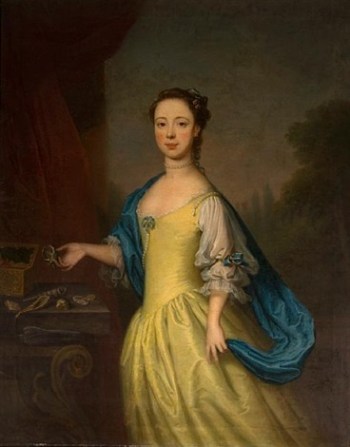
Thomas Bardwell, Portrait of a Girl in a Yellow Dress Holding a Shell, 1756, oil on canvas, 126 × 101 cm (sold at Bonhams, 2 December 2010).
The last few decades have produced a number of studies devoted to the relationship between collecting and science, highlighting the relationship between a growing interest in botany and the fascination with the collection of naturalia, especially from the mid-sixteenth century onwards. These objects of natural origins aroused the admiration of enthusiasts and scientists alike. This passion for collecting reached various corners of society: the academic garden at Leiden University included an ambulacrum that housed dried plant specimens, fossils, and taxidermized animals (Egmond 2010); artists kept collections of rarities not only for use in the studio, but also to satisfy their personal curiosity (Rijks 2022); and Petronella de la Court’s shell collection was represented in her prized dollhouse, and mentioned several times in Georg Eberhard Rumphius’ seminal text D’Amboinsche Rariteitkamer (Powell-Warren 2023). Indeed, the interest in collecting even spawned its own genre of still life painting. The interest in such wonders of nature and the desire to possess them often went beyond the ‘simple’ collecting of specimens, dried samples, or shells obtained through exchanges and purchases. In fact, they could often go so far as to push those who possessed gardens or parks to engage in botanical experiments that led to attempts to grow tropical flowers and fruits even if it was in unfavourable climates and hostile terrain, and even to promote scientific expeditions to study and collect specimens in distant and exotic lands.
More recent scholarship has addressed several issues regarding collecting practices, the intersection between collecting and science, and even the participation of women in collecting. Among other ground-breaking works, the following spring to mind: Possessing Nature (Findlen 1994); Visible Empire: Colonial Botany and Visual Culture in the Hispanic Enlightenment (Bleichmar 2012); Objects in Motion in the Early Modern World (Bleichmar and Martin, eds.) 2015); Conchophilia (Bass et al. 2021); Rarities of these Lands (Swan 2021); and Women and the Art and Science of Collecting (Leis and Wells, eds.) 2021).
What remains un- or underexplored, however, is the extent to which—if at all—collecting and scientific experimentation and exploration were related in the early modern period. Thus, this workshop aims to focus attention on the collections of naturalia, on the one hand, and on the attempts to grow exotic plants in Europe and the adventurous journeys that the search for tropical plants and animals they encouraged, on the other. The organizers of this workshop, Maddalena Bellavitis and Catherine Powell-Warren, invite interdisciplinary contributions addressing the topic from the perspective of each discipline, from art history to material culture, from botany to gastronomy, from travel literature to cartography. Proposals that feature a female figure as protagonist are particularly encouraged, as the importance of the female contribution to this topic, although demonstrated, remains under-researched and under-published. To be considered for participation, please provide a single PDF document containing (in English) a short bio and a one-page proposal for a 20-minute presentation of original, unpublished research. Applications may be sent to maddalena.bellavitis@gmail.com by 15 January 2024. Participants will be notified at the beginning of February.
Conference | Scientific Objects in the Museum
From ArtHist.net:
Les objets scientifiques au musée: Comment étudier et exposer l’histoire des sciences? XVIe–XIXe siècle
Musée du Louvre, Centre Dominique-Vivant Denon, Paris, 11–13 December 2023
Rencontre organisée dans le cadre du projet «Réflexions ciblées autour de la muséologie entre la France et l’Amérique du Nord d’hier à nos jours: collections, politiques culturelles et innovations muséographiques», soutenu par l’accord France-Canada pour la coopération et les échanges dans le domaine des musées (Ministère de la Culture, France / Ministère de l’enseignement supérieur et de la recherche, France / Ministère du patrimoine canadien, Canada).
l u n d i , 1 1 d e c e m b r e 2 0 2 3
Journée du 11 décembre ouverte au public, Centre Dominique-Vivant Denon; inscription obligatoire à centre-vivant-denon@louvre.fr. Les inscrits sont priés de se présenter munis de leur carte d’identité.
9.00 Mot de bienvenue par Françoise Mardrus (Directrice, direction des Études muséales et de l’Appui à la recherche, musée du Louvre) et Vincent Droguet (Conservateur général du patrimoine, sous-directeur des collections, Service des Musées de France), à confirmer
9.10 Présentation du déroulement des trois journées par Françoise Dalex (direction des Études muséales et de l’Appui à la recherche, musée du Louvre)
9.30 Objets d’art et de science: Points de vue de la recherche
Présidence de séance: Philippe Cordez
• Susanne Thürigen (Curator for Scientific Instruments, History of Medicine and Pharmacy, Arms and Armour, Germanisches Nationalmuseum, Nuremberg), The Behaim Globe: History and Future of a Political Instrument
• Federica Gigante (Research Associate, Faculty of Asian and Middle Eastern Studies / Oxford Centre for the History of Science, Medicine, and Technology, University of Oxford), Du cabinet de curiosités au musée d’aujourd’hui: L’histoire remarquable d’un astrolabe longtemps méconnu
• Sven Dupré (Professor of History of Art, Science and Technology / Director, Research Institute for History and Art History, Utrecht University), Glass, Conservation, and the Art of Scientific Instrument Making
• Marco Storni (Postdoctoral researcher, EOS project RENEW18, Université Libre de Bruxelles), Vers une histoire alternative de la mesure du temps: Les sabliers, XVe–XVIIIe siècle
• Omar Nasim (Professor of History of Science, University of Regensburg), Furniture History of Science: Merging Material and Visual Cultures
12.30 Pause déjeuner
14.00 Visite et présentation de la salle des objets scientifiques au musée du Louvre
15.00 Quelques collections et expositions d’objets scientifiques en Europe
Présidence de séance: Françoise Dalex
• Marta Lourenço (National Museum of Natural History and Science, MUHNAC, Portuguese Infrastructure of Scientific Collections, University of Lisbon), An Overview of the Recent Past in the Preservation and Access of Scientific Heritage: Where Are We Now?
• Rebekah Higgitt (Principal Curator of Science, National Museums, Scotland, Edinburgh), Collections and Displays of Historic Scientific Instruments in United Kingdom Museums
• Giorgio Strano (Head of Collections, Museo Galileo, Florence), Displaying the Medici and Lorena Collections of Historic Scientific Instruments at the Museo Galileo in Florence
• Dominique Bernard (maître de conférences (honoraire) en physique, Université de Rennes 1, membre de l’association Rennes en Sciences), Les instruments scientifiques et l’enseignement: Quelques exemples de l’université de Rennes
17.30 Vanessa Ferey et Jean-François Gauvin: Commentaire général et résumé de la journée
m a r d i , 1 2 d e c e m b r e 2 0 2 3
Visites-ateliers, pour les intervenants
Musée des Arts et Métiers
10.00 Présentation de la collection Lavoisier par Marco Beretta (Professor, Department of Philosophy and Communication Studies, History of Science and Technology, Université de Bologne)
Muséum national d’Histoire Naturelle
14.00 Visite de la salle des collections de chimie avec Christine Maulay-Bailly (ingénieur d’études CNRS en analyse chimique, Responsable technique de la Chimiothèque/Extractothèque, Unité Molécules de Communication et Adaptation des Microorganismes, Museum national d’Histoire naturelle) et Brice Monnely (secrétaire Gestionnaire, Unité Molécules de Communication et Adaptation des Micro-organismes, Museum national d’Histoire naturelle)
15.00 Visite de la zoothèque avec Pierre-Yves Gagnier (délégué à l’innovation numérique, Muséum national d’Histoire naturelle)
m e r c r e d i , 1 3 d e c e m b r e 2 0 2 3
Visites-ateliers, pour les intervenants
Musée de la Marine, réserves de Dugny
10.00 Présentation des réserves, de la documentation, d’objets non exposés par Louise Contant (Cheffe du département des Collections), Eric Rieth (responsable de la recherche scientifique au musée national de la Marine, directeur de recherche émérite au CNRS, membre de l’Académie de Marine, spécialiste d’archéologie nautique médiévale et moderne des espaces maritimes et fluviaux), Marianne Tricoire (conservatrice du patrimoine en charge des objets scientifiques et techniques), et Léa Surrel (chargée de documentation)
Musée de la Marine, Paris, palais de Chaillot
15.00 Visite du musée par Louise Contant (Cheffe du département des Collections) et Marianne Tricoire (conservatrice du patrimoine en charge des objets scientifiques et techniques)
Online Talk | Julie Park, Lady Scott’s Landscape in a Dark Room

Paul Sandby, Roslin Castle, Midlothian, ca. 1780, gouache on medium laid paper, mounted on board, sheet: 46 × 68 cm
(New Haven: Yale Center for British Art, Paul Mellon Collection, B1975.4.1877)
◊ ◊ ◊ ◊ ◊
This afternoon from 12.30 to 1.00, from the Yale Center for British Art:
Julie Park | Lady Scott’s Landscape in a Dark Room
Online, Tuesday, 5 December 2023, 12.30pm
Julie Park will discuss the role of the camera obscura used by Lady Frances Scott as depicted in Paul Sandby’s landscape painting Roslin Castle, Midlothian (ca. 1780) and the dynamics of interiority and looking that it mediates. Park chose a detail from this painting for the cover of her recent monograph My Dark Room, which explores the camera obscura as a paradigm for the designs and experiences of interiority in eighteenth-century England’s spaces of the built environment. Please register here»
Julie Park is Paterno Family Librarian for Literature and professor of English at Pennsylvania State University. She is the author of My Dark Room (2023) and The Self and It (2009).
Exhibition | Pleasing Truths: Power and Portraits in the American Home
Closing this month at the DAR Museum, with a curatorial talk scheduled for the 12th.
Pleasing Truths: Power and Portraits in the American Home
Daughters of the American Revolution Museum, Washington, DC, 17 March — 31 December 2023
Curated by William Strollo

Unidentified French artist, Portrait of Elisabeth Has Haley, ca. 1810, oil on canvas, 32 × 38 inches (Washington, DC: DAR Museum, Gift of Sarah Hawkes Thornton, 75.189.2).
In 1754, artist Lawrence Kilburn advertised that “all Gentlemen and Ladies inclined to favour him in having their pictures drawn, that he don’t doubt of pleasing them in taking a true Likeness.” Kilburn’s advertisement, loaded with meaning, is one of many examples of advertisements placed by artists in the 18th and 19th centuries to garner portrait commissions. This ad reveals a lot about his, and other artists, potential clients, and their desires for being represented on canvas. In looking closer at portraits, subjects, artists, and the context in which they were produced, a deeper understanding of society is revealed—a society that valued power, personal leisure, and prescribed gender roles. This exhibition takes a deeper dive into the context and symbolism of early portraits to better understand the transmission of ideas and their impact on people over time.
William Strollo, Pleasing Truths: Power and Portraits in the American Home (Washington, DC: Daughters of the American Revolution Museum, 2023), 135 pages, $35.
◊ ◊ ◊ ◊ ◊
As noted at Events in the Field, the calendar maintained by The Decorative Arts Trust:
Curator’s Talk: William Strollo on Pleasing Truths
Online and in-person, DAR Museum, Washington, DC, 12 December 2023, noon
The exhibition Pleasing Truths: Power and Portraits in the American Home features over 50 portraits from the DAR Museum’s collection, dating from the 17th to the 19th centuries. In this talk, William Strollo, Curator of Exhibitions, will discuss the use of portraits to convey power and prestige and to reinforce traditional gender roles in the early American home. This free event will take place in-person and will also be streamed online; pre-registration is requested.
Decorative Arts Trust Grant to Support Study of Frames at AGO
From the press release (1 December 2023). . .
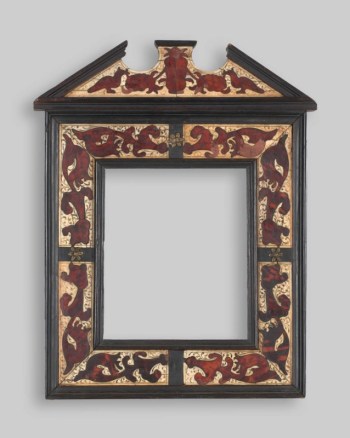
Italian Tabernacle Frame, 1600s, tortoiseshell, bone or ivory, and wood. (Toronto: AGO, gift from a private collector, 94/994).
The Decorative Arts Trust is pleased to announce that the Art Gallery of Ontario (AGO) in Toronto, Canada, will serve as our 2024–26 Curatorial Internship Grant partner. The Decorative Arts Trust underwrites curatorial internships for recent Masters or PhD graduates in collaboration with museums and historical societies. These internships allow host organizations to hire a deserving professional who will learn about the responsibilities and duties common to the curatorial field while working alongside a talented mentor.
This intern will focus on a type of material culture that links the decorative and fine arts: frames. The AGO is home to one of the largest collections of historic frames in the world, currently amounting to well over 1,200 examples. The collection is expansive in terms of both chronology and geography, ranging from the late 1400s to the early 1990s, and with fine frames from France, England, Germany, the Netherlands, Italy, Spain, the Americas, and Asia. The AGO’s goals are twofold: to study the history of frame making to preserve knowledge at a moment when most experts in the field are currently retiring; and to pair paintings and frames to show artwork within a surround that was made in the same region and time period.
Under the mentorship of Caroline Shields, Curator, European Art, and Adam Harris Levine, Associate Curator, European Art, the intern will research and catalogue the AGO’s holdings and assist in making the collection available to the public online. They will work to pair paintings with frames that are chronologically and geographically suited, and they will facilitate the loan of frames to peer museums. The intern’s term will begin in May 2024, when the AGO hosts an international conference, Many Lives: Picture Frames in Context, featuring keynote speakers Hubert Baija, Senior Frames Conservator, and Lynn Roberts, Frame Historian. As part of their tenure at the AGO, the intern will help prepare the conference papers for a digital publication.
A formal call for applications for the internship will be posted early in 2024. Current and recent graduate students who are interested in this opening are encouraged to visit AGO’s website at ago.ca for updates.
Concord Museum Awarded Funding Prize by Decorative Arts Trust

Visitors viewing powder horns on display in the April 19, 1775 gallery at the Concord Museum, the recipient of the 2023 Decorative Arts Trust Prize for Excellence and Innovation, which includes an award of $100,000.
◊ ◊ ◊ ◊ ◊
Press release (16 November 2023) from The Decorative Arts Trust:
The Decorative Arts Trust is thrilled to announce that the 2023 Prize for Excellence and Innovation was awarded to the Concord Museum in Concord, Massachusetts, for their exhibitions and publication commemorating the 250th anniversary of the American Revolution in 2025–26.
The Concord Museum’s initiative will feature a series of three special exhibitions showcasing the stories of individuals, families, and communities during the American Revolution. Focused on the theme of “Whose Revolution,” the special exhibitions will explore themes of liberty, community, and memory, tracing the continued legacy of the Revolution today. The Museum will also create a companion digital exhibition to extend the geographical reach of the exhibitions beyond Concord and promote further education and engagement. Additionally, the Museum will release the first major publication of its American Revolution collection, from flints and powder horns carried by militia soldiers to textiles, furniture, and ceramics that were valued and preserved for their role in witnessing a revolution.
The Concord Museum began in the 1850s as the private collection of local resident Cummings Davis, who gathered and preserved the relics of his friends and neighbors as a record of local history. The collection grew throughout the 19th century and was incorporated as the Concord Antiquarian Society in 1886, moving to a new building in 1930 and later becoming known as the Concord Museum. The Museum now houses a significant collection of over 45,000 objects, with particular strengths in the decorative arts from the 18th and 19th centuries, the American Revolution, transcendentalism, and other areas relating to Concord and New England history. The Museum recently completed a major building expansion and renovation of its permanent galleries, including new spaces for collections, education, and public programs.
The Decorative Arts Trust Prize for Excellence and Innovation, founded in 2020, funds outstanding projects that advance the public’s appreciation of decorative art, fine art, architecture, or landscape. The Prize is awarded to a nonprofit organization in the United States or abroad for a scholarly endeavor, such as museum exhibitions, print and digital publications, and online databases. Past recipients include Cooper Hewitt, Smithsonian Design Museum; the Black Craftspeople Digital Archive; and Craft in America.
Exhibition | Interwoven: Women’s Lives Written in Thread

Now on view at the Concord Museum:
Interwoven: Women’s Lives Written in Thread
Concord Museum, 29 September 2023 — 25 February 2024
Our current special exhibition, Interwoven: Women’s Lives Written in Thread, highlights needlework produced by young women in New England and specifically the extraordinary collection of samplers at the Concord Museum. Featuring 30 samplers sewn in the early 1700s to mid-1800s, Interwoven explores how young women created records of their own lives and experiences, written in thread.

Detail of Sampler by Phebe Bliss, 1749 (Concord, MA: Concord Museum, gift of Mrs. Richard D. Boyer, T18).
The exhibition explores the history of needlework and embroidery, its importance as an art form, and its significance to women in the 18th and 19th centuries. Intended to showcase young women’s accomplishments, the samplers also communicate details of their lives and education, their communities, and their families. The exhibition provides a unique view into their private lives. For most of these young women, their samplers are the only objects that survive from their lives. Many of the samplers have never been displayed before.
Learn about the education of privileged young women in the early republic and understand how wealth and enslaved labor enabled them to pursue decorative arts. Explore the materials used in constructing samplers, such as linens, dyes and silk, and how and where these materials were produced. View samplers that demonstrate how women recorded family history and the loss of loved ones through needlework. Understand how they incorporated the importance of community and a strong sense of place in their samplers. The gallery includes areas for hands-on and interactive activities. Exhibition programs connect the history of samplers to contemporary work through visiting artists, demonstrations, workshops, and more.










 Enfilade
leave a comment