Symposium | Portraiture in 18th-Century Europe
From the DFK:
Portraiture in 18th-Century Europe: Artwork—Social Practice—Circulation
Le portrait au XVIIIe siècle en Europe: Œuvre d’art—pratique sociale—objet de transfert
Deutsches Forum für Kunstgeschichte, Paris, 11–12 March 2024
Organized by Markus Castor, Martin Schieder, and Marlen Schneider

Alexandre Roslin, Self-Portrait with the Artist’s Wife Marie-Suzanne Giroust Painting a Portrait of Henrik Wilhelm Peill, detail, 1767, oil on canvas, 131 × 99 cm (Stockholm, Nationalmuseum, NM 7141).
Whether a manifestation of political power, expression of intimate feelings, an embellishing masquerade, or a faithful likeness, the art of portraiture in the Age of Enlightenment was marked by exceptional diversity throughout Europe. Between the apogee of absolutism and the political, social, and intellectual upheavals of the revolutionary era, it became a mirror of a society in full mutation. The differentiation of taste, changes in the art market, and the gradual establishment of public exhibitions were decisive factors contributing to the variety of effigies. Finally, the criticism of portraiture that flourished at the same time as this artistic genre, wrongly considered as ‘minor’, testified to the growing tension between its social functions and its claim to be a work of art in its own right.
The aim of the symposium is to study portraiture from a multifaceted perspective, tracing its social, theoretical, artistic, and material conditions. Focusing on its development during the Enlightenment in the French context, we also wish to open the discussions up to a European perspective. What concepts and themes shaped the debates surrounding portraits? How did the usages and functions of portraits evolve, and what were the consequences for the production and materiality of these objects? By what means and networks did portrait modes circulate in the various European artistic centers? We intend to shed light on these different aspects in their interdependence, in order to better understand the complex success story of portraiture in the 18th century.
Concept and Organization
Markus A. Castor (DFK Paris), Martin Schieder (Universität Leipzig), and Marlen Schneider (Université Grenoble Alpes/LARHRA)
◊ ◊ ◊ ◊ ◊
m o n d a y , 1 1 m a r c h 2 0 2 4
Speakers are assigned 45-minute slots; specific times, along with breaks, are available here»
14.30 Opening remarks by Peter Geimer (Director of the DFK Paris) and introduction by Markus Castor, Martin Schieder, and Marlen Schneider
15.00 I | Social Practices
Moderation: Martin Schieder
• Elise Urbain Ruano (Musée royal de Mariemont), Portraits transgressifs et modes négligées
• Gerrit Walczak (Zentralinstitut für Kunstgeschichte, München), Silk, Lace, and Deception: The Rococo Dummy Board Princesses of Georg David Matthieu
• Lara Pitteloud (Université de Neuchâtel), S’entourer de portraits « regardés comme uniques » : le cas parisien du Comte de Baudouin
• Philippe Bordes (Université Lumière Lyon 2 / LARHRA), Le piège de la célébrité sous la Révolution: les portraits de députés par Adélaïde Labille-Guiard et Jean Louis Laneuville
18.30 Conférence du soir
• Melissa Hyde (University of Florida), Gifted: Women, Portraiture, and the Art of Friendship
Drinks reception
t u e s d a y , 1 2 m a r c h 2 0 2 4
9.30 II | Circulations and Transfer
Moderation: Markus Castor
• Hannah Williams (Queen Mary University of London), Linked Lives: Portraits as Traces of Colonial Networks in Paris’s 18th-Century Art World
• Ulrike Kern (Goethe-Universität, Frankfurt am Main), License to Portrait: Annexation of a Genre in Early 18th-Century British Art Theory
• Marlen Schneider (Université Grenoble Alpes / LARHRA), Portraits à la française? Appropriations et détournements du portrait déguisé entre Paris et Berlin
• Agata Dworzak (Jagiellonian University, Cracovie), Representation and Creation: The Tradition of Portraiture of Church Hierarchs in Central and Eastern Europe in the Second Half of the 18th Century: A Case Study of the Polish-Lithuanian Commonwealth
12.45 Lunch break
14.00 III | Theories and Techniques
Moderation: Marlen Schneider
• Marianne Koos (Universität Wien), Resemblance as a Passing Quality: Liotard, La Tour, and the Question of le faire in 18th-Century Portraiture
• Juliette Souperbie (Université Toulouse II Jean Jaurès), L’artiste à l’œuvre: Une mise en abyme du portrait au XVIIIe siècle
• Andreas Plackinger (Albert-Ludwigs-Universität Freiburg), Zwischen Konventionsbruch, Kunsttheorie und Sociabilité: Plastische Bildhauerselbstporträts im Frankreich des späten Ancien Régime
• Jan Mende (Stadtmuseum Berlin), Die Porträtbüste geht in Serie: Neue Technologien und preiswerte Werkstoffe um 1790
• Amy Freund (Southern Methodist University), Who/What is a Self? Animal Portraiture in 18th-Century France
18.15 Conclusion and perspectives
Exhibition | Petr Brandl: The Story of a Bohemian

Installation view of the exhibition Petr Brandl: The Story of a Bohemian, Waldstein Riding School, Prague (2023).
◊ ◊ ◊ ◊ ◊
Now on view at Národní galerie Praha (as noted at Art History News) . . .
Petr Brandl: The Story of a Bohemian / Příběh bohéma
Waldstein Riding School, National Gallery Prague, 19 October 2023 — 11 February 2024
Curated by Andrea Steckerová
After over fifty years, this exhibition presents the work of the most important Baroque artist in Bohemia, Petr Brandl (1668–1735). On display are his monumental altarpieces—specially restored for the occasion—as well as his portraits and genre paintings of very interesting subject matter. Visitors will also see newly discovered works by Brandl for the very first time. The exhibition is organized around two parallel narratives: the painter’s works and his life.
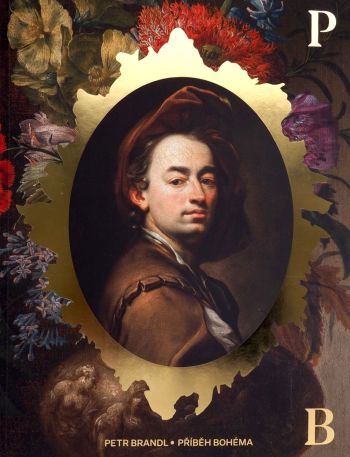 We have numerous archival documents of Brandl’s life of bohemian revolt, which is remarkable even today, offering interesting contexts for the problems of our time. Brandl was, for instance, a lifelong debtor due to his penchant for the luxury lifestyle of nobility, which he was keen to enjoy himself. It also led him to court battles with his wife Helena over alimony. In addition, Brandl was regularly in trouble with his commissioners, as he often failed to comply with the terms of his contracts. The painter’s unbound life has inspired a contemporary theatre play Three Women and a Hunter in Love, which will be staged together with the exhibition (Geisslers Hofcomoedianten).
None of this, however, changes the fact that Brandl was the highest-paid artist of his time, probably because of his very distinctive and original style of painting, in which we can trace certain parallels with Rembrandt. X-rays and macro-photographs of Brandl’s works complement the exhibition to give visitors a glimpse into the inner workings of his painting.
Andrea Steckerová, Petr Brandl: Příběh Bohéma (Prague: Národní galerie Praha, 2023), 288 pages, ISBN: 978-8070358221, 1050 Czech Koruna / $46.
At Sotheby’s | The Collection of Joseph Baillio
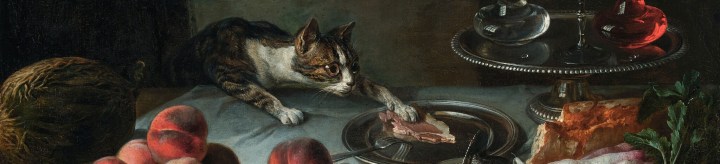
Alexandre-François Desportes, Still Life of the Remnants of a Meal with a Lunging Cat, detail, ca. 1720s, oil on canvas, unframed: 74 × 92 cm (Lot 26, estimate: $200,000–300,000).
◊ ◊ ◊ ◊ ◊
This Wednesday at Sotheby’s (with viewing still available Monday and Tuesday) . . .
A Scholar Collects
Sotheby’s, New York, 31 January 2024, 10am, (Sale N11437)
Sotheby’s is honored to present A Scholar Collects, a sale [of 41 lots] comprised of paintings, drawings, and sculpture from the collection of the preeminent scholar Joseph Baillio. A visionary art historian who specializes in the art of eighteenth-century France, Baillio is most well-known for his expertise in the pioneering woman artist Élisabeth Louise Vigée Le Brun. His landmark exhibitions on her life and career—first in 1982 in Fort Worth and then in 2016 in New York, Paris, and Montreal—were triumphant in catapulting her to the forefront of scholarship and furthered her indelible mark on the history of art.
◊ ◊ ◊ ◊ ◊
 From Neil Jeffares’s accompanying essay on Baillio:
Neil Jeffares, “Joseph Baillio: An Appreciation.”
For most of us the name Joseph Baillio is synonymous with Mme Vigée Le Brun, the artist to whom he has devoted so much of his career and whose reputation now stands at a peak unimaginable before the famous exhibition he organized in the Kimbell Art Museum in 1982. You will of course have a clearer recollection of the vast and astonishing monographic show Joseph presented in the Grand Palais in Paris in 2015 (before moving to New York and Toronto). And we all await the magnum opus, the catalogue raisonné (already signaled in the 1982 catalogue), as the apotheosis of this labor.
But there is so much more to Joseph than just one artist—or even the circle of talent that grew around her . . .
As much as reevaluating and contextualizing familiar masterpieces, Joseph’s work has been the painstaking combination of archival and visual clues to give back the identity of pictures that have been hidden or lost. And he has done that countless times . . .
The full essay is available here»
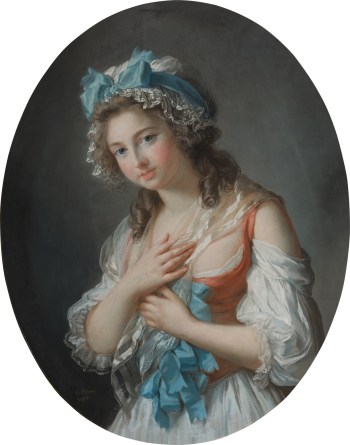
Élisabeth Louise Vigée Le Brun, Portrait of the Duchesse de Guiche, née Louise Françoise Gabrielle Aglaé de Polignac, 1784, pastel on two joined sheets of paper laid on canvas, 80 × 64 cm (Lot 19, estimate: $500,000–700,000).
Call for Papers | Cultural History of the Hunt
From ArtHist.net, which includes the German version:
7th Workshop of the Cultural History of the Hunt Research Network
Online (via Zoom), 3 May 2024
Proposals due by 28 February 2024
The Cultural History of the Hunt research network (Netzwerk Jagdgeschichten) was founded in the summer of 2021 to promote academic exchange on the history of hunting. By viewing the topic of hunting from a transdisciplinary perspective, we aim to critically examine the role of hunting in the constitution, transformation, and perpetuation of the culture/nature-divide and related binary hierarchies. This international network brings together researchers at different career stages and consciously understands itself as open to a variety of research approaches regardless of their methodological, regional, and temporal framework, as well as their points of view concerning animal ethics.
The 7th meeting is thematically open. The workshop is intended to encourage an exchange regarding all questions from the field of cultural-historical research on hunting. Please send your proposals for a 20- to 30-minute contribution (maximum 200 words) and a short CV to Laura Beck (laura.beck@germanistik.uni-hannover.de) and Maurice Saß (maurice.sass@alanus.edu) before 28 February 2024.
New Book | Louis-François Chatard
From Éditions Faton:
Sébastien Boudry, Louis-François Chatard et les peintres doreurs du Garde-Meuble de la Couronne sous Louis XVI (Dijon: Éditions Faton, 2023), 208 pages, ISBN: 978-2878443318, €36.
 Les peintres et doreurs du Garde-Meuble de la Couronne ont participé à la création des plus beaux sièges du XVIIIe siècle. Leur production illustre la diversité et l’excellence des métiers d’art qui ont fait la réputation de Paris à la fin du XVIIIe siècle. Leur travail apporte finition et éclat au décor des bois après le travail du menuisier et du sculpteur qu’ils mettent en valeur.
Sous Louis XVI, Louis-François Chatard en devient le principal fournisseur. Peintre et doreur, il est également parfumeur. Ses confrères peintres et doreurs comme Julliac ou la famille Chaise tiennent également boutique à Paris en tant que marchands et restaurateurs de tableaux. Cet ouvrage nous fait découvrir cette profession et ce savoir-faire, ceux qui l’exercèrent avec excellence, tout en illustrant les mutations des corporations et de l’artisanat à Paris à la veille de la Révolution.
Historien de l’Art spécialisé en mobilier et objets d’art, Sébastien Boudry obtient un DEA (Master) à l’Université de Paris IV – Sorbonne en 2001. Chargé d’études au Centre des Monuments nationaux depuis 2003, il est en charge de la conservation-restauration des collections de plusieurs monuments depuis 2010. A ce titre il a participé aux projets de restauration et de présentation des collections de l’Hôtel de Sully à Paris (2012), du château de Champs-sur-Marne (2012–13), de la villa Cavrois à Croix (2014–15), du château de Voltaire à Ferney (2017–18), de l’Hôtel de la Marine à Paris (2018–2021), et du château de Bussy-Rabutin (2021–22).
Dresden’s Royal East Asian Porcelain Catalogue Now Available
A decade in development, the online catalogue for Dresden’s Royal East Asian Porcelain collection was recently launched by Staatliche Kunstsammlungen Dresden:
The Dresden Porcelain Project
Researching the Royal East Asian Collection and the Japanese Palace Inventories
From 2014 to 2024, the Porzellansammlung, Staatliche Kunstsammlungen Dresden, has been the subject of a collaboration between an international team of specialists on an extensive research project aimed at cataloguing the collection of East Asian porcelain owned by Augustus the Strong (1670–1733). Of the initially more than 29,000 Chinese and Japanese ceramic objects, about 8200 are still extant in the Porzellansammlung today. The Japanese Palace Inventories were transcribed, translated and analysed as part of the research into the objects’ provenance.
The project’s findings are available here on the digital platform. The Royal Dresden Porcelain Collection is a publication of the Porzellansammlung. It showcases the objects and emphasises the historical context of the collection.
Team
Cora Würmell, Project Leader
Christiaan J. A. Jörg, Academic Supervisor
Karolin Randhahn, Research Associate
Ruth Sonja Simonis, Research Associate
Advisory Board
John Ayers
Helen Espir
Jessica Harrison-Hall
Peter Lam
Hiroko Nishida
Kōji Ōhashi
Rosemary Scott
Authors
Caroline Allen, Masaaki Arakawa, Eline van den Berg, Denise A. Campbell, Jan van Campen, Teresa Canepa, Menno Fitski, Ron Fuchs II, Tomoko Fujiwara, Ernst Geppert, Christiaan J. A. Jörg, Rose Kerr, Regina Krahl, Anette Loesch, Hiroko Nishida, Kōji Ōhashi, Linda Pomper, Karolin Randhahn, Maura Rinaldi, Miki Sakuraba, William R. Sargent, Ruth Sonja Simonis, Filip Suchomel, Daniel Suebsman, Yue Sun, Heike Ulbricht, Ching-Ling Wang, Liang-Chung Wang, Wen-Ting Wu, Cora Würmell, Pei-Chin Yu
More information and additional credits can be found here»
Call for Papers | Commerce and Circulation of Decorative Arts, 1792–1914
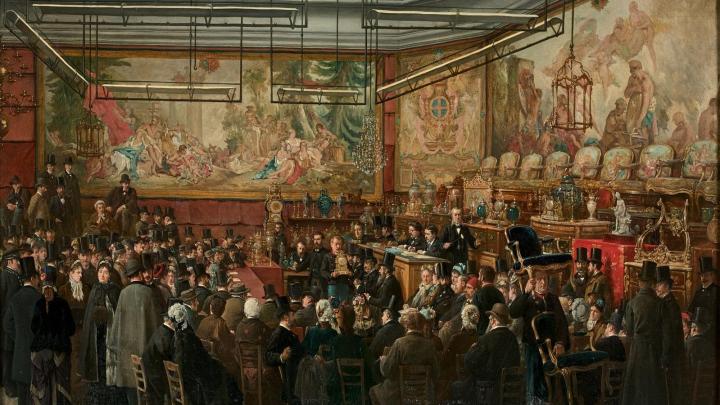
Benjamin Eugène Fichel, À l’hôtel Drouot, 1876 , exhibited at the Salon in 1877, oil on canvas, 61 × 90 cm. [The painting sold for €80,000 at a sale held in Paris by Beaussant Lefèvre on 22 June 2017, as reported by the Antiques Trade Gazette. –CH]
◊ ◊ ◊ ◊ ◊
From the Call for Papers, which includes the French Appel à communications:
The Commerce and Circulation of Decorative Arts, 1792–1914:
Auctions, Dealers, Collectors, and Museums
Le commerce et la circulation des objets d’art, 1792–1914:
Ventes aux enchères, marchands/es, collectionneurs/ses et musées
Lyon, 25–27 September 2024
Proposals due by 17 March 2024
This international three-day colloquium, to be held in Lyon, France, from 25 to 27 September 2024, will investigate the role played by auctions, dealers, collectors, and museums in the circulation of the decorative arts from 1792 until 1914. Beginning with the ‘ventes des biens des émigrés’ in Revolutionary France and ending with the onset of World War I, these were years of seismic political and socio-economic change that revolutionised the art market.
It was during the nineteenth century that the decorative arts, originally described as ‘curiosities’ and then ‘antiques’, became the subject of intellectual curiosity. The period under review saw the emergence of a more scholarly approach and publications, the development of the antiques trade and of museum collections devoted to the decorative arts, facilitated by the expansion of global trading networks, extended by colonisation and encouraged by international travel and world fairs. London and Paris led the growth of this market, but economic downturn in Britain and France resulted in the mass export of art to the Americas from the 1880s. At the same time, a new cosmopolitan elite stimulated purchase across Europe, competing with museums for prize objects.
These developments were first charted by Gerald Reitlinger in The Economics of Taste: The Rise and Fall of the Objets d’art Market since 1750 (1963) and then by Clive Wainwright in The Romantic Interior (1989). Art market historiography has increased exponentially over recent years with scholarship on dealers (Lynn Catterson, Paola Cordera, Charlotte Vignon, Mark Westgarth), collectors and museums (Julius Bryant, Ting Chang, Suzanne Higgott, Sophie Le-Tarnec, Pauline Prévost-Marcilhacy), collecting culture (Elizabeth Emery, Tom Stammers, Adriana Turpin), and markets and networks of trade (Anne Helmreich, Léa Saint-Raymond), among others as well as a dedicated Journal for Art Market Studies. This has been augmented by the Getty Provenance Index, Bloomsbury Art Market, the Archives Directory for the History of Collecting in America, the creation of specific publishers’ series (from Brill and Bloomsbury), the digitisation of auction catalogues, and two programmes initiated by INHA (one on Connoisseurs, Collectors and Dealers of Asian Art in France, 1700–1939, and the other on Sales of Antiquities in Nineteenth-Century France).
To date, however, scholarship has largely centred on the fine arts. This conference will focus on the commerce and global circulation of the decorative arts in order to open new perspectives and approaches that will provide a more comprehensive understanding of the art market. ‘Decorative arts’ are taken to include: furniture, metalwork, clocks, silverware, ceramics and glass, enamels, small sculpture, hardstones, ivories, jewellery, textiles, tapestries, and boiseries, from Ming dynasty porcelain, Mamluk glass, and Augsburg Kunstkammer objects to Boulle furniture, and Thomire bronzes, not to mention the contemporary Arts and Crafts and Art Nouveau movements.
We hope to encourage interdisciplinary dialogue among participants specialising in art history, material culture and economic history. We welcome presentations using new methodologies or technologies for interpreting dealer/ collector/museum records and auction results as well as well as more traditional case studies. Topics for consideration will investigate the inter-relationships between the decorative arts market, connoisseurship, taste, and collecting practice. They may include, but are not limited to the following:
• The repercussions of political and socio-economic change on the circulation of objects
• Auctions and their impact on networks of local and international exchange
• Collectors’ preferences and methods of acquisition (auctions, dealers, agents, and advisors)
• The role of dealers, agents, curators and advisors, their influence on taste and collecting practice
• Networks of trade between Europe, the Americas, Asia, the Middle East, and further afield
• Collaboration and competition within and between networks across borders
• The influence of the circulation of antiques on workshop practice and craftsmanship in the decorative arts
• The involvement of museums in the art market, their role at auctions, and the relations between dealers and curators, trade expertise, and scholarly research
• The impact of public exhibitions on the art market and the trade in decorative arts
• Connoisseurship and expertise across borders: the interrelationship between the discourse of decorative art history and the market (including the use of photography, sale catalogues, museum catalogues, and scholarly publications and journals)
• Cultural transfers through collecting practice
• The visualisation and staging of the collecting space/ interior
• The use of digital tools to analyse the circulation of the decorative arts
We encourage submissions from both early career researchers (PhD candidates) and established scholars, involved in the study of trade, art markets, collections, as well as museums and provenance research. This will be an ‘in-person’ event. It is hoped to cover accommodation for speakers for the duration of the conference. The symposium will be bi-lingual (English is preferred). Please submit abstracts for 20-minute papers (of no more than 350 words), together with a brief biography as an email attachment to camille.mestdagh@univ-lyon2.fr and diana_davis@hotmail.co.uk no later than 17 March 2024. Applicants selected by the scientific committee will be notified by 22 April 2024. Further updates will be posted on the event webpage. We hope to publish a volume of essays stemming from revised conference papers.
Organising Committee
Natacha Coquery (Professeure, Université Lumière Lyon 2, LARHRA), Camille Mestdagh (Post-doctoral researcher, Université Lumière Lyon 2, LARHRA), Igor Moullier (Maître de conférences, ENS Lyon, LARHRA), Rossella Froissart (Directrice d’études, Ecole Pratique des Hautes Études-PSL, SAPRAT), Diana Davis (Independent researcher, PhD, University of Buckingham, UK)
Scientific Committee
Arnaud Bertinet (Maître de Conférences, Paris 1 Panthéon Sorbonne), Jérémie Cerman (Professeur, Université d’Artois, Arras), Paola Cordera (Associate Professor, Politecnico di Milano), Elizabeth Emery (Professor, Montclair State University, New Jersey), Sandra van Ginhoven (Head, Getty Provenance Index, Getty Research Institute, Los Angeles), Anne Helmreich (Director, Archives of American Art, Smithsonian Institution, Washington), Caroline McCaffrey-Howarth (Lecturer, University of Edinburgh), Johannes Nathan (co-founder of the Centre of Art Market Studies, Technische Universität, Berlin), Anne Perrin-Khelissa (Maître de conferences HDR, Université Toulouse-Jean Jaurès), Florencia Rodríguez Giavarini (Doctoral fellow, UNSAM-CONICET, Buenos Aires), Adriana Turpin (Head of Research, IESA, Paris)
This colloquium forms part of a wider project on the market for decorative arts: OBJECTive – ANR/ Lyon 2 Université / LARHRA : OBJECTive – ANR Objects through the Art Market: A Global Perspective – LARHRA.
Lecture | Pascale Ballesteros on Painters Historicizing 18th-C Fashion
This spring at BGC:
Pascale Gorguet Ballesteros, Eighteenth-Century Fashion and the Decisive Museological Action of French Historicizing Painters
A Françoise and Georges Selz Lecture on Eighteenth- and Nineteenth-Century French Decorative Arts and Culture
Bard Graduate Center, New York, 3 April 2024
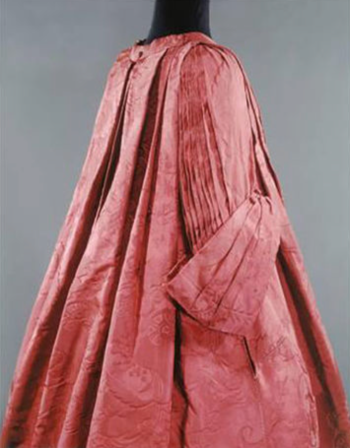
Dress detail from the collection of the Musée de la Mode de la Ville de Paris, formerly known as Musée Galliera.
On January 10, 1907, the Société de l’Histoire du Costume was founded in Paris to create a ‘Musée du Costume’. Sixteen of the founders were painters, and most of them were artists that historicized the eighteenth century. In this lecture, curator and scholar Pascale Gorguet Ballesteros considers the influence of artists such as Maurice Leloir (1853–1940), Gustave Jean Jacquet (1846–1909), and François Flameng (1856–1923) in the formation of the eighteenth-century fashion collection of the Palais Galliera and the construction of its image.
Responsible for the nineteenth-century collections at Palais Galliera, Musée de la Mode de la Ville de Paris, Pascale Gorguet Ballesteros has curated several exhibitions including Fastes de cours et cérémonies royales in 2009 at the castle of Versailles and L’art de paraître au 18e siècle at Nantes and Dijon Fine Arts Museums in 2021 and 2022. She teaches fashion history and fashion materials at Sorbonne Université. Her next exhibition will deal with women, travels, art, and fashion in the Enlightenment.
Registration is available here»
Call for Papers | Dress and Painting: Clothing and Textiles in Art
From the Call for Papers:
Dress and Painting: Clothing and Textiles in Art
The Association of Dress Historians International Conference
National Portrait Gallery, London, 7–8 October 2024
Proposals due by 28 April 2024
The Association of Dress Historians are delighted to introduce our two-day autumn conference for 2024 on the theme of Dress and Painting: Clothing and Textiles in Art. The conference aims to bring together scholars, professionals, and practitioners to explore and examine the wide range of interconnections between dress, textiles, and painting across any culture or region of the world, from before classical antiquity to the present day.
Confirmed Keynote Speakers
– Aileen Ribeiro, Professor Emeritus of the Courtauld Institute of Art
– Timothy McCall, Associate Professor of Art History at Villanova University
– Anna Reynolds, Deputy Surveyor of The King’s Pictures at Royal Collection Trust
Papers are invited that investigate, but are not limited to, any of the following prompts:
• The value (and limitations) of painted sources for historians of dress including portraits, genre scenes, illuminated manuscripts, frescoes, and miniatures
• The reality (or otherwise) of clothing portrayed in paintings through comparison with extant garments, documentary sources, etc
• The practices of dressing up (e.g. fancy dress, professional robes) or dressing down (e.g. déshabillé) for portraits
• The symbolism of dress in paintings
• The role of clothing in interpretations of meaning or narrative
• Individual artists and their different approaches to depicting dress
• Artists’ involvement in decisions about what sitters should wear for portraits
• Artists’ personal attitudes to fashion and the selection of clothing worn in self-portraits
• Techniques used by artists to represent textiles and three-dimensional garments in paint
• The draped figure in painting, depictions of the clothed and unclothed body
• The role of the specialist drapery painter in artists’ studios
• Overlapping spheres of production in the raw materials for paintings and textiles e.g. pigments and dyes, linen canvas, animal hair
• Paintings as fashion illustration, and their role in the fashion design process
• Textile designs inspired by paintings
• Painters who were also fashion/textile designers
• Museum practices of exhibiting paintings alongside items of dress
We welcome submissions for 15- to 20-minute research presentations. To submit a proposal, please send an abstract of no more than 200 words alongside a biography of no more than 50 words and an optional illustrative image* with caption to be included in an online programme to dressandpainting@dresshistorians.org by 00:00 BST on 28 April 2024. The conference is guest chaired by Anna Reynolds (Royal Collection Trust) and co-convened by Kirsten Burrall (Deputy Chair of ADH).
* Please send images as separate tiff or jpeg attachments and include the relevant caption beneath your abstract. Image captions are not included in abstract word count.
New Book | The Domino and the 18th-C London Masquerade
Part of the Elements in Eighteenth-Century Connections series from Cambridge UP:
Meghan Kobza, The Domino and the Eighteenth-Century London Masquerade: A Social Biography of a Costume (New York: Cambridge University Press, 2024), 75 pages, ISBN: 978-1009468244 (hardcover), $65 / ISBN: 978-1009045551 (paperback), $22. Also available digitally through Cambridge UP.
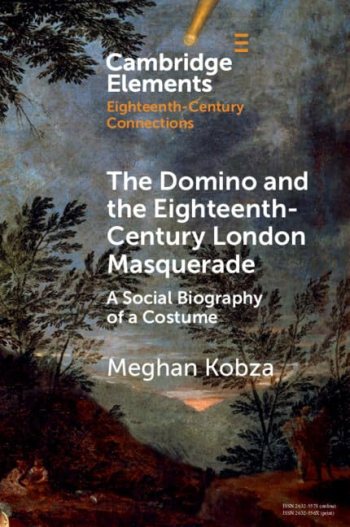 This Element presents new cultural, social, and economic perspectives on the eighteenth-century London masquerade through an in-depth analysis of the classic domino costume. Constructing the object biography of the domino through material, visual, and written sources, Meghan Kobza brings together various experiences of the masquerade and expand the existing geographical, chronological, and socio-economic scope of the entertainment beyond the masquerade event itself. The book examines the domino’s physical and figurative movements from the masquerade warehouse, through eighteenth-century fashionable society, and into print and visual culture, drawing upon masquerade warehouse records, newspapers, manuscripts, prints, and physical objects to establish a comprehensive understanding of the domino and how it reflected contemporary experiences of the real and imagined masquerade. Analysing the domino through interdisciplinary methodologies illustrates the impact material and visual sources can have on reshaping existing scholarship.
Meghan Kobza is currently a Leverhulme Early Career Fellow at Newcastle University, where she completed her PhD in 2020. As a social historian, she is particularly interested in the history of eighteenth-century leisure culture in the British Empire and transatlantic world.
c o n t e n t s
Introduction
1 The Masquerade and the Domino
2 Three Dominos
3 The Domino as a Commodity
4 Everywhere and Nowhere
Conclusion
References










 Enfilade
leave a comment