New Book | A Delicate Matter
From The Pennsylvania State UP:
Oliver Wunsch, A Delicate Matter: Art, Fragility, and Consumption in Eighteenth-Century France (University Park: Penn State University Press, 2024), 192 pages, ISBN: 978-0271095288, $100.
 Eighteenth-century France witnessed an unprecedented proliferation of materially unstable art, from oil paintings that cracked within years of their creation to enormous pastel portraits vulnerable to the slightest touch or vibration. In A Delicate Matter, Oliver Wunsch traces these artistic practices to the economic and social conditions that enabled them: an ascendant class of art collectors who embraced fragile objects as a means of showcasing their disposable wealth. While studies of Rococo art have traditionally focused on style and subject matter, this book reveals how the physical construction of paintings and sculptures was central to the period’s reconceptualization of art. Drawing on sources ranging from eighteenth-century artists’ writings to twenty-first-century laboratory analyses, Wunsch demonstrates how the technical practices of eighteenth-century painters and sculptors provoked a broad transformation in the relationship between art, time, and money. Delicacy, which began the eighteenth century as a commodified extension of courtly sociability, was by century’s end reimagined as the irreducible essence of art’s autonomous value. Innovative and original, A Delicate Matter is an important intervention in the growing body of scholarship on durability and conservation in eighteenth-century French art. It challenges the art historical tendency to see decay as little more than an impediment to research, instead showing how physical instability played a critical role in establishing art’s meaning and purpose.
Oliver Wunsch is Assistant Professor of Art History at Boston College.
Exhibition | Pastels, between Line and Color
Now on view at the Cognacq-Jay:
Pastels, entre ligne et couleur
Musée Cognacq-Jay, Paris, 12 October 2023 — 11 February 2024
Curated by Pascal Faracci and Sixtine de Saint-Léger
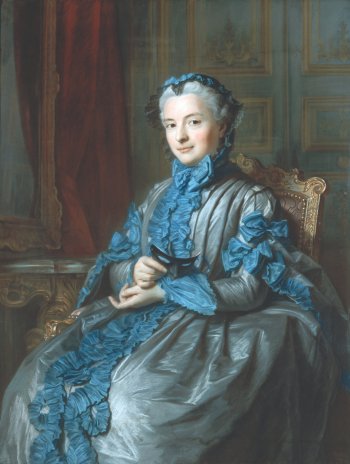
Maurice Quentin de La Tour, Portrait de Madame la présidente de Rieux, en habit de bal, tenant un masque, 1742 (Musée Cognacq-Jay).
Siècle d’or du pastel, le XVIIIe voit s’épanouir la virtuosité de dessinateurs tels que Maurice-Quentin de La Tour, le « prince des pastellistes », et son rival talentueux Jean-Baptiste Perronneau. Ils sont à l’honneur dans la collection Cognacq-Jay, avec des portraits qui comptent parmi leurs chefs-d’œuvre, comme celui de Madame la présidente de Rieux, en habit de bal, tenant un masque, aux dimensions monumentales. À ces œuvres françaises s’ajoutent celles de trois pastellistes anglais : Hugh Douglas Hamilton, John Russel et Daniel Gardner, témoins des échanges artistiques entre les deux pays autant que du goût singulier d’Ernest Cognacq pour l’école britannique.
La facture moelleuse, l’éclatante fraîcheur des coloris et l’expressivité des modèles de ces portraits témoignent du talent des artistes à manier le pastel, cette poudre de couleur aux nuances et aux dégradés variant à l’infini. À la fois ligne et couleur, le pastel offre une rapidité d’écriture, une transcription sensible de l’émotion et une intensité qui reste intacte au fil du temps.
Aux côtés des œuvres de la collection Cognacq-Jay, une sélection de pastels d’artistes du XVIIIe, tels que François Boucher ou Élisabeth Vigée Le Brun issus d’autres institutions de Paris Musées, complète ce panorama.
L’accrochage exceptionnel de ces œuvres fragiles, accompagné d’une médiation spécifique, permettra d’éclairer le goût pour le portrait intime, caractéristique du siècle des Lumières, et sera également l’occasion de dévoiler les dernières acquisitions du musée en arts graphiques.










 Enfilade
leave a comment