New Book | Palaces of Reason
From The Pennsylvania State UP:
Robin Thomas, Palaces of Reason: The Royal Residences of Bourbon Naples (University Park: Penn State University Press, 2024), 212 pages, ISBN: 978-0271095219, $110.
 Palaces of Reason traces the fascinating history of three royal residences built outside of Naples in the eighteenth century at Capodimonte, Portici, and Caserta. Commissioned by King Charles of Bourbon and Queen Maria Amalia of Saxony, who reigned over the Kingdom of the Two Sicilies, these buildings were far more than residences for the monarchs. They were designed to help reshape the economic and cultural fortunes of the realm.
The palaces at Capodimonte, Portici, and Caserta are among the most complex architectural commissions of the eighteenth century. Considering the architecture and decoration of these complexes within their political, cultural, and economic contexts, Robin L. Thomas argues that Enlightenment ideas spurred their construction and influenced their decoration. These modes of thinking saw the palaces as more than just centers of royal pleasure or muscular assertions of the crown’s power. Indeed, writers and royal ministers viewed them as active agents in improving the cultural, political, social, and economic health of the kingdom. By casting the palaces within this narrative, Thomas counters the assumption that they were imitations of Versailles and the swan songs of absolutism, while expanding our understanding of the eighteenth-century European palace more broadly.
Robin L. Thomas is Professor of Art History and Architecture at Penn State University. He is the author of Architecture and Statecraft: Charles of Bourbon’s Naples, 1734–1759, also published by Penn State University Press.
New Book | Volcanic
From Yale UP:
John Brewer, Volcanic: Vesuvius in the Age of Revolutions (New Haven: Yale University Press, 2023), 544 pages, ISBN: 978-0300272666, £30 / $40.
 A vibrant, diverse history of Vesuvius and the Bay of Naples in the age of Romanticism
Vesuvius is best known for its disastrous eruption of 79CE. But only after 1738, in the age of Enlightenment, did the excavations of Herculaneum and Pompeii reveal its full extent. In an era of groundbreaking scientific endeavour and violent revolution, Vesuvius became a focal point of strong emotions and political aspirations, an object of geological enquiry, and a powerful symbol of the Romantic obsession with nature. John Brewer charts the changing seismic and social dynamics of the mountain, and the meanings attached by travellers to their sublime confrontation with nature. The pyrotechnics of revolution and global warfare made volcanic activity the perfect political metaphor, fuelling revolutionary enthusiasm and conservative trepidation. From Swiss mercenaries to English entrepreneurs, French geologists to local Neapolitan guides, German painters to Scottish doctors, Vesuvius bubbled and seethed not just with lava, but with people whose passions, interests, and aims were as disparate as their origins.
John Brewer is emeritus professor of humanities and social sciences at the California Institute of Technology and a faculty associate of the Harvard University History Department. His books include Pleasures of the Imagination, which won the Wolfson History Prize and was shortlisted for the National Book Awards.
A New Chapter for the Berger Prize
From The Walpole Society:
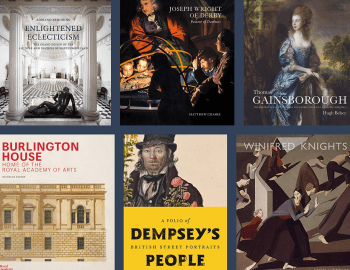 The Walpole Society is delighted to announce an agreement with the Berger Collection Educational Trust (BCET) to run the leading book prize for British art history, the Berger Prize. The Berger Prize celebrates brilliant writing and scholarship about the arts and architecture of the United Kingdom. The Walpole Society, which promotes the study of Britain’s art history, will deliver the Berger Prize from 2024, working alongside the BCET and Denver Art Museum, home of the Berger Collection of British art. The Walpole Society was appointed following the retirement of Robin Simon, co-founder and organiser of the prize since 2001. Chair of BCET trustees, Katherine MB Berger, and Dr Jonny Yarker, incoming chair of judges, paid tribute to Robin Simon at the 2023 Prize ceremony.
Several initiatives starting in 2024 will build on the Prize’s two decades of support for British art history, further broadening its reach:
• A new website to showcase the prize.
• The prize’s eligibility and rules, with a renewed commitment to governance and transparency, will be updated. Nominations for the 2024 prize close on 28 March.
• The incumbent prizewinner will deliver a lecture at the Denver Art Museum, home of the Berger Collection. The 2024 lecture by Tim Clayton is on 7 May.
• A summer event in London will announce the long list. In 2024 this will be on 28 June, when Tim Clayton will talk about his 2023 Berger Prizewinning book, James Gillray: A Revolution in Satire.
• New from 2024, each shortlisted book will receive a prize of £500. The 2024 shortlist will be announced at a virtual event on 15 September.
• The first prize of £5000 is the largest sum offered by any art history book prize. The winner of the 2024 Berger Prize will be presented on 15 November, at a ceremony at London’s Reform Club.
• A new podcast from The Walpole Society, launching in the latter part of 2024, will showcase brilliant writing and scholarship about the arts and architecture of the United Kingdom, with a focus on Berger Prize shortlisted authors.
• Walpole Society trustee, Dr Jonny Yarker, succeeds Robin Simon as chair of judges. Joining the panel in 2024 are Clare Hornsby, Chairwoman of The Walpole Society, and Angelica Daneo, Chief Curator at the Denver Art Museum. Click here for information about the 2024 prize jury.
Katherine MB Berger, Chairman of the Berger Collection Educational Trust (BCET), commented: “We are all so excited and we look forward to future vibrant initiatives—and to working together with The Walpole Society on our shared aim for promoting excellence in British art history.”
Clare Hornsby, Chairwoman of The Walpole Society, said: “We’re honoured to have been chosen by the Berger Collection Educational Trust to run the Berger Prize. The Prize feels like a natural fit for The Walpole Society, whose goals are so closely aligned with it and with the BCET. We intend the Prize in this new era to reach an even wider audience—in the UK, US, and internationally, whilst honouring its twenty year heritage established by Robin Simon and Katherine Berger.”
Incoming chair of Berger Prize judges, Dr Jonny Yarker, said: “British art history is extraordinary for its richness, range and creativity. I look forward to the Berger Prize both recognising the brilliance and dedication of researchers, whose books are often the summation of a life’s research, and also for the Prize to offer an annual snapshot of the field of studies in all its diversity and depth.”










 Enfilade
leave a comment