New Book | Mariana de Neoburgo
The English description of the book from CEEH:
Gloria Martínez Leiva, with a foreword by Javier Jordán de Urríes, Mariana de Neoburgo, última reina de los Austrias: Vida y legado artístico (Madrid: Centro de Estudios Europa Hispánica, 2022), 432 pages, ISBN: 978-8418760082, €50.
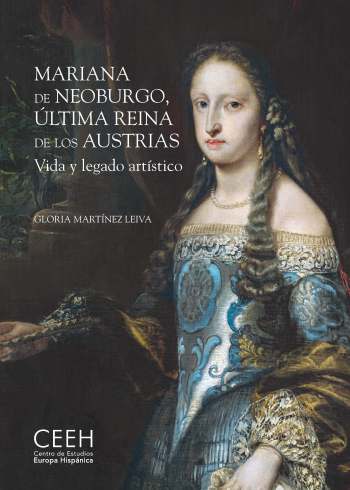 Maria Anna of Neuburg (1667−1740), the second wife of Charles II (Carlos II), was queen consort of Spain for ten years and queen dowager for another forty. However, she is a little-known figure to whom historians have barely paid attention. This study takes a look at her life, her image and her artistic patronage, which was not unaffected by the heightened political tension that characterised European history around 1700 and resulted in a change of dynasty in Spain.
Against this turbulent international backdrop, the survey of the queen’s life explores in depth important aspects of court art such as the decoration of her apartments in the royal palaces and sites in which she lived, drawing on documents held in Spanish and foreign archives. It also examines the residences she occupied as a widow in Toledo and Guadalajara, as well as her homes and palaces in Bayonne during her thirty-two-year exile. The approximately one hundred known portraits of her help both unravel her personality and trace the artistic, stylistic and conceptual evolution of the genre over more than half a century, showing how her image—first as queen consort and subsequently as queen dowager—was shaped and publicly projected.
A comprehensive overview of the works of art she commissioned—especially from Luca Giordano—or owned, the portrait gallery she assembled, the paintings she sent to her brother the elector palatine, her richly stocked library and her exceptional founding of the chapel of Loreto in Chiusa (Italy) sheds new light on the patronage of Maria Anna, who is finally studied in her full dimension as the last Habsburg queen.
Gloria Martínez Leiva, who received a PhD in art history for her thesis on Maria Anna of Neuburg, has focused her research on the Spanish royal collections, on which she has published many articles. She is co-author of Quadros y otras cosas que tiene Su Magestad Felipe IV en este Alcázar de Madrid. Año de 1636 (2007) and El inventario del Alcázar de Madrid de 1666. Felipe IV y su colección artística (2015). She has pursued a career in cultural institutions such as Patrimonio Nacional and the Fundación Universitaria Española. She is director of the platform InvestigArt.
Call for Papers | Panel on Ships at ASPHS 2024 in Lisbon
The Association for Spanish and Portuguese Historical Studies annual conference will be held in Lisbon, 8–12 July 2024.
Ships and Their Contents: Shipbuilding, Shipwrecks, and Global Circulation in the Iberian World, 1600–1800
Chaired by Sabina de Cavi and Luis Gordo Peláez
Proposals due by 21 January 2024
In a recent talk organized by the Getty Research Institute, Mirko Sardelić (Senior Research Associate of the Croatian Academy of Sciences and Arts / The University of Western Australia) theorized about Renaissance ships as mobile cross-cultural systems. In response to the increasing academic interest in maritime history, ars navigandi, and maritime archaeology, this panel aims at discussing the materiality of ships and their role as cultural and artistic media in a transoceanic context. It focuses on the global trade in the Iberian World that was dominated by the two main urban centers and port cities of Seville and Lisbon and often interacted and clashed with English and Dutch interests. We welcome contributions on topics such as: the materiality and daily life on the early modern ship; economic partnerships for shipbuilding; shipwrecks, their representation and remains; the iconography of transatlantic cargo ships and the global trade (cartography); cargoes of art and precious goods; smuggling, docks and customs across the globe; marines and the maritime society in the broadest sense (gente di mare). Please submit a 300-word proposal, 5 keywords and a one-page CV before 21 January 2024 to Sabina de Cavi (scavi@fcsh.unl.pt) and Luis Gordo Peláez (luisgordopelaez@csufresno.edu).










 Enfilade
leave a comment