New Book | Mariana de Neoburgo
The English description of the book from CEEH:
Gloria Martínez Leiva, with a foreword by Javier Jordán de Urríes, Mariana de Neoburgo, última reina de los Austrias: Vida y legado artístico (Madrid: Centro de Estudios Europa Hispánica, 2022), 432 pages, ISBN: 978-8418760082, €50.
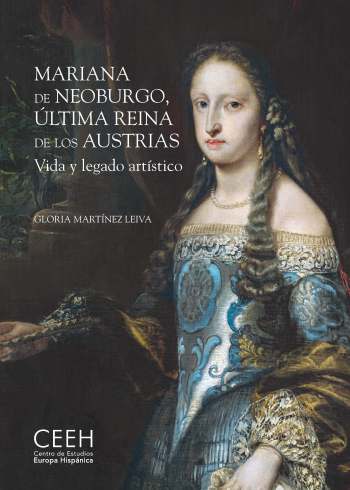 Maria Anna of Neuburg (1667−1740), the second wife of Charles II (Carlos II), was queen consort of Spain for ten years and queen dowager for another forty. However, she is a little-known figure to whom historians have barely paid attention. This study takes a look at her life, her image and her artistic patronage, which was not unaffected by the heightened political tension that characterised European history around 1700 and resulted in a change of dynasty in Spain.
Against this turbulent international backdrop, the survey of the queen’s life explores in depth important aspects of court art such as the decoration of her apartments in the royal palaces and sites in which she lived, drawing on documents held in Spanish and foreign archives. It also examines the residences she occupied as a widow in Toledo and Guadalajara, as well as her homes and palaces in Bayonne during her thirty-two-year exile. The approximately one hundred known portraits of her help both unravel her personality and trace the artistic, stylistic and conceptual evolution of the genre over more than half a century, showing how her image—first as queen consort and subsequently as queen dowager—was shaped and publicly projected.
A comprehensive overview of the works of art she commissioned—especially from Luca Giordano—or owned, the portrait gallery she assembled, the paintings she sent to her brother the elector palatine, her richly stocked library and her exceptional founding of the chapel of Loreto in Chiusa (Italy) sheds new light on the patronage of Maria Anna, who is finally studied in her full dimension as the last Habsburg queen.
Gloria Martínez Leiva, who received a PhD in art history for her thesis on Maria Anna of Neuburg, has focused her research on the Spanish royal collections, on which she has published many articles. She is co-author of Quadros y otras cosas que tiene Su Magestad Felipe IV en este Alcázar de Madrid. Año de 1636 (2007) and El inventario del Alcázar de Madrid de 1666. Felipe IV y su colección artística (2015). She has pursued a career in cultural institutions such as Patrimonio Nacional and the Fundación Universitaria Española. She is director of the platform InvestigArt.
Call for Papers | Panel on Ships at ASPHS 2024 in Lisbon
The Association for Spanish and Portuguese Historical Studies annual conference will be held in Lisbon, 8–12 July 2024.
Ships and Their Contents: Shipbuilding, Shipwrecks, and Global Circulation in the Iberian World, 1600–1800
Chaired by Sabina de Cavi and Luis Gordo Peláez
Proposals due by 21 January 2024
In a recent talk organized by the Getty Research Institute, Mirko Sardelić (Senior Research Associate of the Croatian Academy of Sciences and Arts / The University of Western Australia) theorized about Renaissance ships as mobile cross-cultural systems. In response to the increasing academic interest in maritime history, ars navigandi, and maritime archaeology, this panel aims at discussing the materiality of ships and their role as cultural and artistic media in a transoceanic context. It focuses on the global trade in the Iberian World that was dominated by the two main urban centers and port cities of Seville and Lisbon and often interacted and clashed with English and Dutch interests. We welcome contributions on topics such as: the materiality and daily life on the early modern ship; economic partnerships for shipbuilding; shipwrecks, their representation and remains; the iconography of transatlantic cargo ships and the global trade (cartography); cargoes of art and precious goods; smuggling, docks and customs across the globe; marines and the maritime society in the broadest sense (gente di mare). Please submit a 300-word proposal, 5 keywords and a one-page CV before 21 January 2024 to Sabina de Cavi (scavi@fcsh.unl.pt) and Luis Gordo Peláez (luisgordopelaez@csufresno.edu).
New Book | Praying to Portraits
Largely a 17th-century story, but also entirely relevant to the 18th century with good 18th-century examples—and to my thinking, a really smart, helpful book for thinking about portraits of any sort (and incredibly well-written). –CH
From The Pennsylvania State UP:
Adam Jasienski, Praying to Portraits: Audience, Identity, and the Inquisition in the Early Modern Hispanic World (University Park: Penn State University Press, 2023), 232 pages, ISBN: 978-0271093444, $120.
 In Praying to Portraits, art historian Adam Jasienski examines the history, meaning, and cultural significance of a crucial image type in the early modern Hispanic world: the sacred portrait.
Across early modern Spain and Latin America, people prayed to portraits. They prayed to ‘true’ effigies of saints, to simple portraits that were repainted as devotional objects, and even to images of living sitters depicted as holy figures. Jasienski places these difficult-to-classify image types within their historical context. He shows that rather than being harbingers of secular modernity and autonomous selfhood, portraits were privileged sites for mediating an individual’s relationship to the divine. Using Inquisition records, hagiographies, art-theoretical treatises, poems, and plays, Jasienski convincingly demonstrates that portraiture was at the very center of broader debates about the status of images in Spain and its colonies.
Highly original and persuasive, Praying to Portraits profoundly revises our understanding of early modern portraiture. It will intrigue art historians across geographical boundaries, and it will also find an audience among scholars of architecture, history, and religion in the early modern Hispanic world.
Adam Jasienski is Associate Professor of Art History in the Meadows School of the Arts at Southern Methodist University in Dallas.
c o n t e n t s
List of Illustrations
Acknowledgements
List of Abbreviations
Introduction: Portraits and Sacred Images in Early Modernity
1 Sacrificing the Self
2 True Portraits, Lying Portraits
3 Repainting Portraits
4 Portraits as Sacred Images
Conclusion: The Life Histories of Sacred Portraits and the History of Sacred Portraiture
Notes
Bibliography
Index
Exhibition | Part of the Furniture: The Library of John Bedford
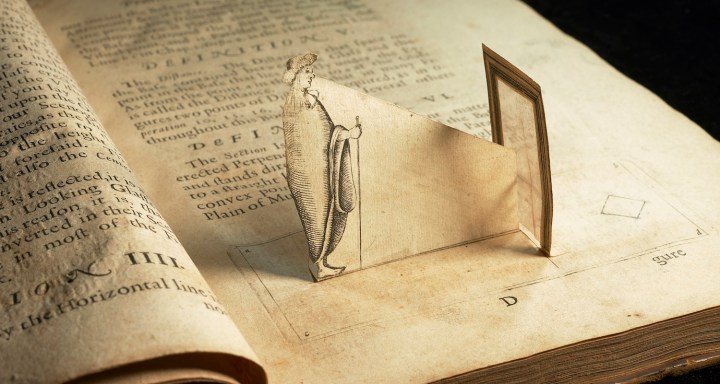
Joseph Moxon, Practical Perspective; or Perspective Made Easie (London, 1670)
(University of Leeds)
◊ ◊ ◊ ◊ ◊
Now on view at the University of Leeds, with additional information at the Antique Collecting Magazine. Also, see this posting at Antique Dealers Blog by one of the show’s curators, Mark Westgarth.
Part of the Furniture: The Library of John Bedford
Brotherton Gallery, University of Leeds, 9 January — 21 December 2024
Curated by Mark Westgarth, Rachel Eckersley, and Rhiannon Lawrence-Francis
Rare and beautiful books chart the evolution of furniture design over the centuries and the journey from drawing board, to workshop, to home
Selected from the world-leading library of antiques dealer John Bedford (1941–2019), ornate patterns by a renaissance pioneer, designs by Chippendale, Sheraton, Pugin, and Morris, elaborate trade cards, colourful catalogues, drawings, and manuals show how ideas and trends took shape, gained influence, and were eventually revived as fashions came full circle.
Upholsterer and furniture dealer Daniel Thorn might be less of a household name, but his personal sketchbook of designs for drapery, curtains, and furniture is a lively working record of the looks of the late-18th and early-19th centuries. Other highlights include the only complete coloured copy of The Ladies Amusement, an 18th-century book of decorative designs made to cut out and paste. Henry Lawford’s gloriously garish 1855 fold-out sofa catalogue sweeps away clichés of dismal Victoriana in a colour-lithographed riot of puce, lavender, and pea-green.
The exhibition also celebrates Bedford’s life, his vast knowledge, and his generous legacy to the University of Leeds, which enabled the extension and refurbishment of The Brotherton Research Centre and the establishment of The John Bedford Fellowship, in addition to the donation of his dazzling library.
Part of the Furniture: The Library of John Bedford is curated by Mark Westgarth, Associate Professor of Art History and Museum Studies and Director of the Centre for the Study of the Art & Antiques Market; Rachel Eckersley, Rare Book Specialist; and Rhiannon Lawrence-Francis, Special Collections Curator.
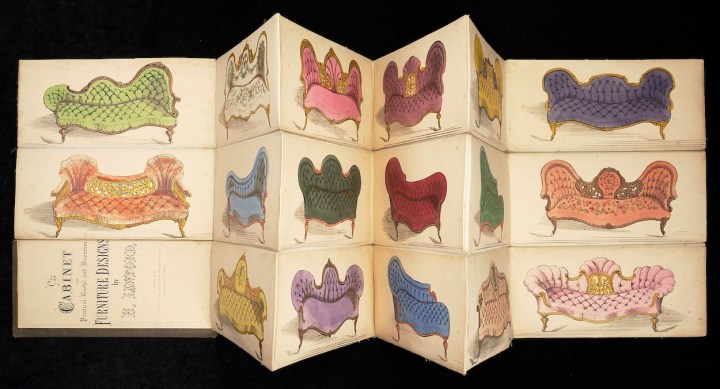
Henry Lawford, The Cabinet of Practical, Useful, and Decorative Furniture Designs (J. S. Virtue & Co., 1855)
(University of Leeds)
Call for Papers | HECAA Emerging Scholars Showcase
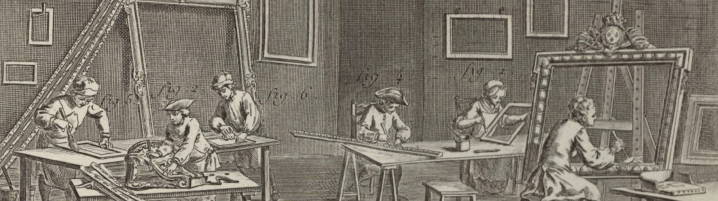
Workshop for Gilding on Wood (Doreur sur bois), detail, Encyclopédie ou Dictionnaire raisonné des sciences, des arts et des métiers, edited by Denis Diderot and Jean le Rond d’Alembert, volume 20, plate IV (Paris, 1765 / ARTFL Encyclopédie Project, University of Chicago).
◊ ◊ ◊ ◊ ◊
HECAA Emerging Scholars Showcase
Online, 5 March 2024
Proposals due by 26 January 2024
We at HECAA are thrilled to invite emerging scholars studying the art, architecture, and visual culture of the long eighteenth century around the globe to participate in our 2024 virtual showcase. A beloved HECAA tradition, the showcase is intended as a platform for emerging scholars to connect with the wider HECAA community and get feedback on their research.
Scholars will each be given 3–5 minutes to present their work, followed by an open question and answer session. This year’s Emerging Scholars Showcase will be held on Tuesday, March 5 (time TBD based on participants’ time zones). As in previous years, an additional showcase may be added if there is sufficient interest; so, we encourage you to apply even if you are unable to present on Tuesday, March 5.
To apply, please fill out this form by Friday, January 26 at midnight (EST). Emerging scholars may be current graduate students (MAs or PhDs) and early career researchers who have received their PhDs in the past five years. We ask that presenters apply no more than once every three years to allow for as many individuals as possible to participate. Also note that you do not have to be a member of HECAA to apply to participate in the Emerging Scholars Showcase, so feel free to circulate widely in your networks. Please, direct all questions, suggestions (and love) to hecaa.emergingscholarsrep@gmail.com.
Warmly,
Demetra Vogiatzaki
HECAA Board Member At-Large, Emerging Scholars Representative
Journal18 | Pendant Essays on Paint Boxes
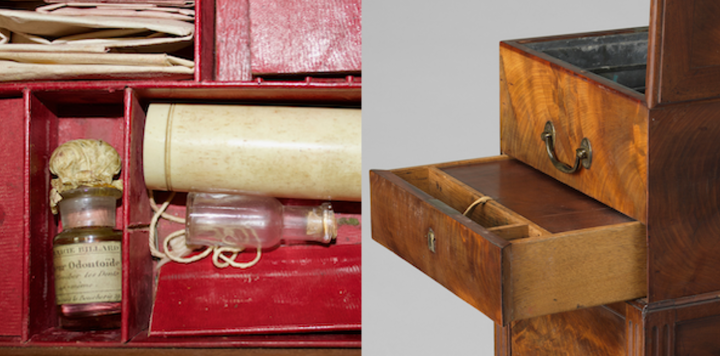
Left: Partial view of the contents of Charlotte Martner’s paint box (Private collection; author’s photograph). Right: Caspar Schneider, Paint box on stand, ca. 1789, mahogany on oak structure, 75 cm high (New York: The Metropolitan Museum of Art).
◊ ◊ ◊ ◊ ◊
Recent pieces from J18′s Notes & Queries:
Conceived as pendants, these two essays by David Pullins and Damiët Schneeweisz unpack two paint boxes that belonged to Marie Victoire Lemoine (1754–1820) and Charlotte Daniel Martner (1781–1839), bringing out how these boxes tie the material history of painting to gender, colonialism, and enslavement.
◊ ◊ ◊ ◊ ◊
David Pullins, “Contained Assertions: Marie Victoire Lemoine’s Paint Box,” Journal18 (December 2023).
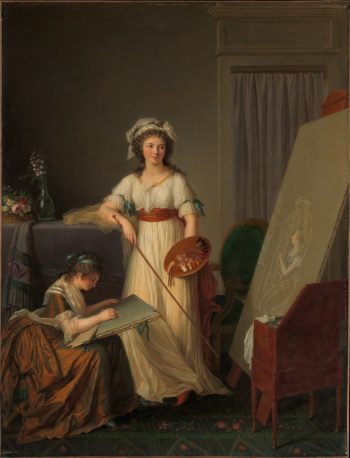
Marie Victoire Lemoine, The Interior of a Woman Painter’s Atelier, 1789, oil on canvas, 116.5 × 88.9 cm (New York: The Metropolitan Museum of Art).
Holding a loaded palette, brushes and maulstick, a standing woman represents the art of painting, while a second woman seated on a low stool embodies the foundational art of drawing (Fig. 1).[1] Their practices converge in the canvas underway on an easel, depicting a priestess presenting a young woman to a statue of Athena, goddess-protectress of the arts, in which chalk outlines have begun to be fleshed out in color. But the allegory has been dressed in contemporary terms, pointedly situating Marie Victoire Lemoine’s The Interior of a Woman Painter’s Atelier in the year it was executed, 1789, and boldly taking on the language of genre painting that was used more often to critique than to promote women artists. Michel Garnier’s A Young Woman Painter from the same year offers a counter-image (Fig. 2). A painter sets her canvases aside (literally turned to the wall, her easel reflected distantly in the mirror), while she is distracted by love (signaled by the dove, flowers, and book propped on an insubstantial table easel). In contrast to Lemoine’s somber, antique mise-en-abyme, Garnier chooses an unfinished “Greuze girl” as his gloss. . . .
The full essay is available here»
David Pullins is Associate Curator in the Department of European Paintings at The Metropolitan Museum of Art.
◊ ◊ ◊ ◊ ◊
Damiët Schneeweisz, “Laboring Likeness: Charlotte Daniel Martner’s Paint Box in Martinique (1803–1821),” Journal18 (December 2023).
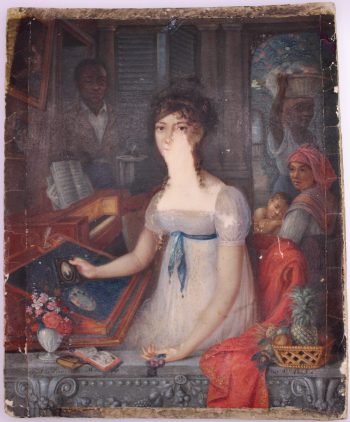
Charlotte Martner, Self-Portrait with Four People, 1805, watercolor on ivory and cardboard, 14.5 × 11.5 cm (Private collection).
In Charlotte Daniel Martner’s self-portrait miniature (1805), the classical tendencies of French eighteenth-century portraiture collide with a distinctive burgeoning Antillean visual culture of the early nineteenth century (Fig. 1).[1] The miniature is a contrast in colors: the artist’s luminous pale white skin and Empire dress, emanating from the portrait’s ivory ground like moonlight, set against the darker skin tones of the man, women, and child that surround her, each dressed in dulled shades of red, orange, blue, and beige. The precise status of the four Black individuals within this household is unclear, and they are yet to be identified, but their placement, each suspended in an act of domestic labor, suggests that perhaps they depict those then enslaved in Martner’s home. At the center of the portrait is a brisk loss, as if someone has pressed their thumb to the watercolor and swept away Martner’s features, leaving only a set of auburn eyes, the contours of a nose, dark-brown eyebrows, and loose curls pinned back with a bejeweled comb. . .
The full essay is available here»
Damiët Schneeweisz is a PhD Candidate at The Courtauld Institute of Art currently on Doctoral Placement at the Victoria & Albert Museum in London.
Journal18, Fall 2023 — Cold
The latest issue of J18:
Journal18, Issue #16 (Fall 2023) — Cold
Issue edited by Michael Yonan
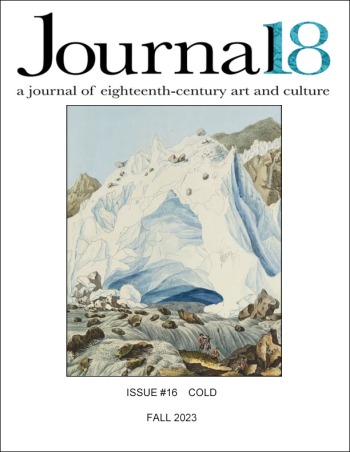 Feeling cold is increasingly a privilege in our warming world. Regions of the world known for temperate, moderate climates are becoming accustomed to erratic weather. Cooler areas of the globe are warming, and warmer areas becoming too hot to occupy. Accompanying these climatological transformations are humanity’s attempts to control temperature, led by the invention of technologies (most prominently air conditioning) which help us live comfortably, but which come with substantial human, economic, and environmental costs. By creating pleasant temperatures in which to live and work, we exacerbate the problem that makes human intervention into the climate more urgent.
The cause of these changes is the consumption of fossil fuels, which transformed human life profoundly in the pursuit of modernity. The origin of this transformation falls squarely within the long eighteenth century. The established scientific terminus post quem for measuring human effects on global temperatures is the year 1800. Moreover, the 1700s were the final century of the Little Ice Age, a climatological phenomenon characterized by lower global mean temperatures. With these conditions in mind, might temperature play a greater role in our discussion of eighteenth-century art? For this issue of Journal18, I have invited scholars to address this possibility. My goal is to encourage reflection on how eighteenth-century art might engage the scholarly literatures on historical climatology and the history of the senses. Do the conditions of eighteenth-century life, as filtered through artistic production, help us understand why the world became warmer? Can we find in the eighteenth century’s ideas about temperature the roots of our current beliefs, and perhaps locate in art ways of rethinking or undoing the assumptions that have brought us to this place?
The essays offered here address these concerns from multiple perspectives, engage varied works of art, and do so in diverse regions of the globe. Jennifer Van Horn examines an eighteenth-century plate warmer, made circa 1790, owned by George Washington and used in his residences, to reveal its place within a racially determined temperature-scape. She achieves this by analyzing not only how it mediated temperatures for its socially prominent owners, but also how it reveals the experiences of the enslaved individuals who tended it during dinners. She thereby locates the warmer’s effect on bodies, its thermoception, within the “complex entanglements of cold, race, unfreedom, and materiality” of early America to produce a “racialized thermal order.”
Sylvia Houghteling’s essay takes us to a different region of the globe, South Asia, and to a different problem, namely creating cool temperatures for inhabitants of a hot climate. Houghteling shows that South Asian societies produced sophisticated systems of cooling long before colonial occupation, but these early techniques often relied on creating the psychological effect of cold by stimulating other senses, notably smell and sight. She thereby produces a synesthetic framework for temperature modification, one in which the senses interconnect. This approach offers insight into how to produce art history that is sensually engaged, not just in an erotic dimension, but in the ability to imagine complex sensual entanglements through the past’s material remains.
Alper Metin leads us to the Ottoman Empire, where he investigates the history of a warming device appreciated across the world: the fireplace. Eighteenth-century Ottoman patrons adapted fireplace designs from Western models, and in so doing responded to substantial socioeconomic and cultural changes in Ottoman society. These included the desire for increased comfort in domestic interiors and the need to display wealth and sophistication through a fireplace’s decoration. Metin reflects on the Ottoman Turkish terminology for fireplaces, revealing both gendered and socio-ethnic dimensions to its language, and on morphological changes to fireplace design. Fireplaces emerge as more than just warming devices, but rather as creations that express changing conditions and mentalities in a society rethinking its international place.
Our shorter notices take up these themes in further directions. Kaitlin Grimes shows how the Kingdom of Denmark-Norway incorporated narwhal ivory into conceptions of royal power that both supported and materialized its colonial project in the Arctic Atlantic. Etienne Wismer demonstrates that melting glaciers in Switzerland (much in the news today) fascinated Europeans in the years around 1800, spurring scientific investigations, inspiring interior decoration, and generating new health regimens. Both Grimes and Wismer explore the relationship between what Wismer calls a “biotope” and the human beings who inhabited it. I would add that art mediates the relationship between humanity and biotope, and that temperature is a central force constituting their interconnection.
Issue Editor
Michael Yonan, University of California, Davis
a r t i c l e s
• Jennifer Van Horn — Racialized Thermoception: An Eighteenth-Century Plate Warmer
• Sylvia Houghteling — Beyond Ice: Cooling through Cloth, Scent, and Hue in Eighteenth-Century South Asia
• Alper Metin — Domesticating and Displaying Fire: The Technical and Aesthetic Evolution of Ottoman Fireplaces
s h o r t e r p i e c e s
• Kaitlin Grimes — Narwhal Ivory as the Arctic Colonial Speciality of the Kingdom of Denmark-Norway
• Etienne Wismer — Making Sense of Ice? Engaging Meltwater in the Long Eighteenth Century in Switzerland and France
All articles are available here»
Call for Articles | Spring 2025 Issue of J18: Africa, Beyond Borders
From the Call for Papers:
Journal18, Issue #19 (Spring 2025) — Africa: Beyond Borders
Issue edited by Prita Meier, Hermann von Hesse, and Finbarr Barry Flood
Proposals due by 1 April 2024; finished articles will be due by 1 September 2024
Since the dawn of decolonization in 1950s and 1960s Africa, Africanist scholars have emphasized Africa’s connections to the rest of the world before the period of European colonialism. While such views have gained widespread currency among Africanists and some Africanist-adjacent scholars and journals, Africa, apart from the continent’s Mediterranean coast, is hardly discussed beyond these circles. Even when medieval and early modern (art)history and material culture studies claim to be global, Africa often remains on the periphery of the discussion of long-distance trade, artistic innovations, and material cultural exchange.
This special issue of Journal18 invites contributions that examine the confluence of the global, interregional, and local in shaping African arts, material culture, and sartorial practices. It seeks to shift standard accounts of globalization by decentering European empire-building and the colonial archive. The long eighteenth century saw the expansion of African polities and local networks of exchange flourished. Internal trade and migration were just as important as oceanic movements. Traders, merchants, and migrants constantly moved between different societies, actively facilitating the intermingling of diverse cultural forms across great distances. Artisans, both free and enslaved, were also highly mobile during this period. Archipelagic Africa, especially its port cities and mercantile polities, played a significant role in shaping the commodity networks of the entire world.
Among the questions that this issue seeks to address are: Can the discussions of African trade objects help us historicize intra-and inter-continental trade and cultural exchanges? How did African royals, travelers, enslaved, and free individuals engage with the foreign and the faraway? What can African artifacts tell us about religious, aesthetic, and cultural transformations in Africa and its internal or transregional diasporas before the colonial period? What can historic African art collecting tell us about African identities and transcultural negotiations? How did Africa inspire global artistic imaginations during this dynamic period?
We welcome proposals for contributions on related topics, including African architectural forms and notions of space; the visualization of race in pre-colonial Africa; cultures of making and their regional and transregional connections; the reception and reimagining associated with transregional or transcultural reception; African writing and graphic systems; the material cultures of enslaved/free Africans and their experiences of migration and diaspora; and the politics of eighteenth-century heritage conservation.
To submit a proposal, send an abstract (250 words) and brief biography to the following addresses: editor@journal18.org and spm9@nyu.edu, vonhesse@illinois.edu, fbf1@nyu.edu. Articles should not exceed 6000 words (including footnotes) and will be due by 1 September 2024. For further details on submission and Journal18 house style, see Information for Authors.
Issue Editors
Prita Meier, New York University
Hermann von Hesse, University of Illinois Urbana-Champaign
Finbarr Barry Flood, New York University
Exhibition | Gods, Heroes, and Traitors
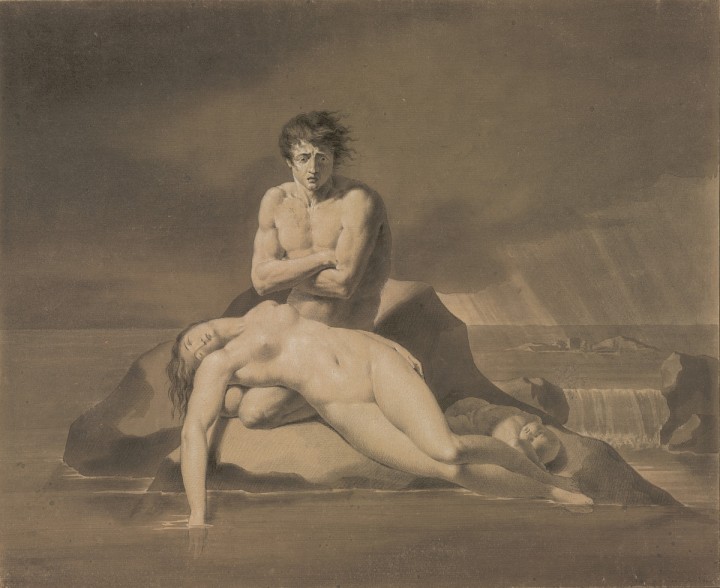
Robert von Langer, The Human Race Threatened by the Element of Water (Das Menschengeschlecht vom Element des Wassers bedroht), 1804
(Vienna: Albertina)
◊ ◊ ◊ ◊ ◊
The show was on view at the Albertina last summer; the catalogue (in German) is still available from Hatje Cantz Verlag:
Gods, Heroes, and Traitors: The History Image around 1800
Albertina, Vienna, 2 June — 27 August 2023
Borne up by sentiment, historical painting was considered the most elevated genre of art well into the early nineteenth century. Staking a claim to morality as Schiller saw it—in the sense of having the ability to affect the spirit and intellect didactically—the drawings condense significant moments of religious, mythological material. Human emotions and deeds were turned into an artistic image of history, in the truest sense of the word.
 With the pictures assembled here, the Albertina unites outstanding works of art that mark the origins of what is today the most important collection of prints worldwide. Its founder, Prince Albert Casimir of Saxony, Duke of Teschen, was a collector with his finger on the pulse of the times. He was especially interested in drawings, studies, sketches, and large-format works on paper, acquiring the artworks directly, and often personally, from the studios of artists such as Jacques-Louis David, Anton Raphael Mengs, Antonio Canova, Angelika Kauffmann, Heinrich Friedrich Füger, and Johann Heinrich Füssli, or from the big Academy exhibitions of his era.
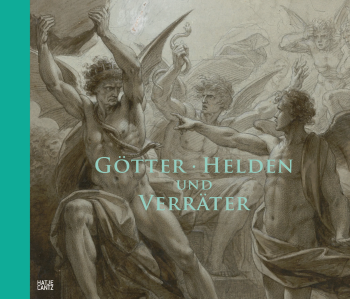
Christof Metzger and Julia Zaunbauer, eds., with a foreword by Klaus Albrecht Schröder, Götter, Helden und Verräter: Das Historienbild um 1800 (Berlin: Hatje Cantz Verlag, 2023), 216 pages, ISBN: 978-3775754521, $62.
New Book | Étienne Barthélemy Garnier
From Éditions Faton:
Christophe Huchet de Quénetain and Moana Weil-Curiel, Étienne Barthélemy Garnier (1765–1849): De l’Académie royale à l’Institut de France (Dijon: Éditions Faton, 2023), 544 pages, ISBN: 978-2878443462, €74.
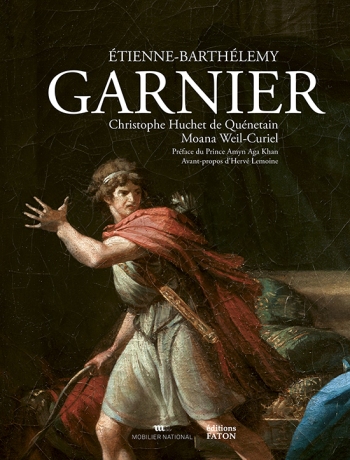 Étienne-Barthélemy Garnier, dont on connaît parfois la monumentale Consternation de Priam, ou certains très beaux dessins, est trop souvent considéré comme un élève de David. Dans une période complexe sur les plans politique et artistique, il saura tracer un chemin qui va le mener des Prix de l’Académie royale aux cimaises du Salon, des décors officiels aux plus hautes fonctions de l’Institut, dont il deviendra le doyen, sans cesser de plaire à une clientèle privée. Dans ce livre, le lecteur comme l’amateur vont découvrir un bel artiste qui perpétue dans la première moitié du XIXe siècle les préceptes reçus de ses maîtres (Durameau, Doyen et Vien), tous pleinement inscrits dans le XVIIIe siècle. Sa volonté de privilégier, quelle que soit la technique, la lisibilité de ses compositions face au lyrisme ou à l’emphase de certains confrères et la précocité (son Hippolyte quittant Phèdre, son portrait de Napoléon dans son cabinet de travail), sinon l’originalité (sa Charité romaine féminisée…), de certains sujets font assurément partie de ses qualités et nous font regretter que ses projets pour la tapisserie destinés à la manufacture des Gobelins n’aient pu être menés à bien.
Christophe Huchet de Quénetain est historien d’art et antiquaire. Docteur en histoire de l’art de l’université de Paris-IV Sorbonne, auditeur de The Royal Collection Studies et de l’Institut des hautes études de défense nationale, ancien élève de l’École pratique des hautes études, de l’École du Louvre et de l’École Boulle-Greta, il est qualifié aux fonctions de maître de conférences des universités. Il s’intéresse aux arts décoratifs et aux collectionneurs des XVIIe, XVIIIeet XIXe siècles.
Docteur en histoire de l’art de l’École pratique des hautes études, les principaux domaines de recherche de Moana Weil-Curiel sont la peinture et le décor en France et en Italie du XVIIe au XVIIIe siècle, ainsi que l’histoire du goût.










 Enfilade
leave a comment